Master Sergeant Dale Kowalski had broken Soviet codes. In 1967, that meant he was among the best signals intelligence analysts the US military had ever produced—a mind that could find pattern in chaos, meaning in noise. He had never failed to extract intelligence from a transmission. Not once. But now, sitting in a monitoring station outside Da Nang, Vietnam, staring at a transcript of an unencrypted radio transmission from an allied unit just 3 km away, he could not tell you what a single sentence meant. Not one.
He read it again. Mouthed the words. Tried different groupings. Checked for known code terminology. Nothing. He called in two colleagues. They looked at each other, then at him. One whispered that it might be an agricultural reference. The other wasn’t sure it was even English. It was English. It was Australian English. And that distinction—that gap between those two things—would turn out to be one of the most extraordinary, most unintentional military communications advantages in the history of modern warfare.
The question sits at the center of this story, a question no one thought to ask until it was too late: What happens when a language evolves not to communicate clearly, but to exclude? Not theoretically, but in the real world—when an entire military force speaks a dialect so dense, so fast-moving, so saturated with cultural reference that trained linguists with sophisticated tools simply cannot follow it? What happens when the most powerful intelligence apparatus in the world throws its full weight at a communications problem and comes away empty-handed, not once, not twice, but across three separate wars and three separate decades?
This is that story. And it begins not with a general or a policy, but with the way Australians have always talked to each other—in a way that nobody else has ever fully understood.
To understand what defeated Kowalski that night—and Holt before him in 1942, and every American signals analyst who came after—you need to grasp something fundamental about the Australian relationship with language. Most English speakers use language as a delivery mechanism: you have a thought, encode it in words, transmit it, and the other person decodes it. Communication achieved. Australians do something different. They use language as a membership test. The words are not just carrying information; they are asking a question: Do you belong? If you understand, you belong. If you don’t, you don’t—and the language will not help you, because it was never designed to include you. It was designed, through generations of organic cultural pressure, to identify who is inside and make it impossible for anyone outside to pretend they are in.
This is not a conscious policy. No Australian sat down and decided this. It emerged the way everything powerful emerges: through use, through time, through the accumulated weight of a culture that valued mateship over formality, irreverence over clarity, and belonging over comprehension. The result was a linguistic system so effective at excluding outsiders that it defeated three military intelligence services across three wars—without anyone on the Australian side ever noticing they were doing anything unusual.
The first time the American military encountered the wall was in 1942. A joint allied signals monitoring station in the South Pacific was intercepting radio traffic from multiple allied units—standard procedure. The Australian traffic came through unencrypted, which should have made it the easiest material to process. It was the hardest. A US Navy communications officer filed a formal report describing Australian radio transmissions as “incomprehensible to trained American signals personnel despite being transmitted in the clear.” In the clear. No encryption, no cipher, no deliberate security measure of any kind—just Australians talking.
The report cited a specific transmission from an infantry unit coordinating a patrol. The Australian radio operator had said something that, when transcribed, contained recognizable English words arranged in a sequence that produced, to the American analysts, absolutely no recoverable meaning. The words were there. They could write them down. They could spell them correctly. What they could not do was derive from them any information about what the Australian soldiers were actually doing, where they were going, or what they needed.
The report was flagged. Meetings were held. A supervisor read the transcript, removed his glasses, cleaned them, put them back on, read it again, and said something that would be repeated in various forms by American military personnel across multiple decades: “Get me someone who speaks Australian.” He meant it completely seriously.
What followed was the first official attempt to crack what nobody had yet recognized was an uncrackable problem. Major Charles Whitfield of Allied Signals Command authorized the creation of a formal glossary—an Australian English codebook. He assigned four intelligence analysts to the project. These were serious people, trained professionals who had spent their careers finding meaning inside deliberately obscured communications. They sat down with Australian soldiers. They recorded conversations. They cross-referenced terminology. They built definitions and tested them against new transmissions. They worked for 11 weeks. The glossary was 40 pages long, alphabetized, thorough—the product of genuine analytical effort applied with genuine seriousness to a genuine operational problem.
It was outdated within 3 weeks of completion. Not because the analysts had done poor work, but because the language had moved. New terms had appeared. Old terms had shifted meaning. A phrase that had meant one thing in January meant something adjacent but different in April, and something else entirely by June. And the Australians had not held a meeting about this. They had not circulated a memo. It had simply happened the way language always happens when it is alive: without permission, without documentation, and without any regard whatsoever for the people trying to record it.
And then the Australians found the glossary. This is the moment the story tips from operational frustration into something that would define the entire dynamic between American intelligence services and Australian communications for the next 30 years. The Australians found the glossary, read it, found it to be the funniest thing they had encountered in the war so far, and immediately began using it against its creators. New terms appeared overnight specifically because the Australians knew the Americans had a document, and they wanted to make the document wrong. Old terms from the glossary were deployed with inverted meanings over open radio—deliberately, cheerfully, with enormous entertainment value. The glossary became not just outdated, but actively misleading, a trap for anyone who relied on it. And the trap had been set not by enemy intelligence, but by Allied soldiers who thought the entire situation was, and this is a word that will appear repeatedly in accounts from this period, hilarious.
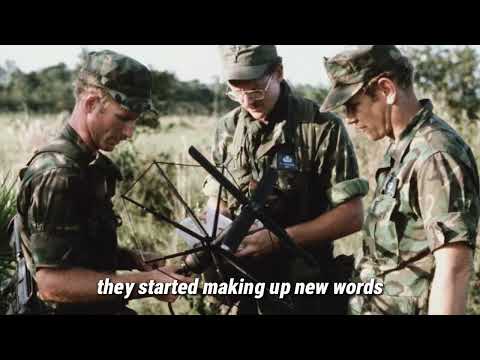
Staff Sergeant William Brennan, an American liaison officer attached to the Australian 9th Division, described the experience with the kind of precision that only genuine bafflement produces. “They gave us this booklet,” he said, “about 40 pages, alphabetized, very thorough. And the Australians thought it was the funniest thing they had ever seen. They started making up new words specifically because they knew we had the glossary. It became a game.” A game. The Americans were trying to solve an intelligence problem. The Australians were playing a game, and the Australians were winning.
You have to understand something about what Australian slang actually is before you can understand why no glossary, no analytical team, no amount of institutional effort was ever going to solve this problem. It is not slang in the sense that most people understand slang. American slang is informal vocabulary grafted onto standard grammar. You know the rules of the sentence, and then you swap out a formal word for an informal one. Australian slang is not that. It is a parallel system. It has its own construction logic, its own rules of meaning generation, its own mechanisms for creating new terms and retiring old ones. And those mechanisms are multiple and layered in ways that make each one individually disorienting, and all of them together genuinely impenetrable.
The first mechanism is rhyming slang, inherited from Cockney London but mutated so far beyond its origin that the original connection is invisible to anyone who does not already know it. The system works by replacing a word with a phrase that rhymes with it, and then dropping the rhyming part, leaving only the word that tells you nothing. A telephone becomes a dog and bone, then simply a dog. A look becomes a Captain Cook, then a captain. A road becomes a frog and toad, then a frog. An Australian telling someone to get on the dog and let the captain check the frog is asking them to use the telephone to tell someone to look at the road. To an outside ear, it is a sentence about an animal, a military officer, and an amphibian. Complete nonsense unless you have the key. And the key was not written anywhere because every Australian already had it.
The second mechanism is compression. Australians shorten everything with a compulsive enthusiasm that goes beyond preference into something closer to cultural identity. Afternoon becomes arvo. Breakfast becomes brekky. Service station becomes servo. Ambulance becomes ambo. Journalist becomes journo. This would be manageable if it stopped there, but it does not. The compression extends to phrases, to entire concepts, to multi-word military terminology that gets reduced to sounds that bear no obvious relationship to the original words. Reconnaissance becomes recce, pronounced recky, which American signals personnel in the Pacific consistently transcribed as a proper name and spent considerable effort trying to identify which soldier named Ricky was being referenced in Australian operational communications.
Sergeant Peter Mallowy of the 7th Division told a story about an American officer sitting in on a full operational briefing. Forty minutes, maps, objectives, the complete operational picture. Afterward, the officer approached Mallowy and reported that he had understood approximately 12% of what had been said. Twelve percent. Mallowy noted with evident satisfaction that the American was not unintelligent. He had a degree from Princeton. He simply could not follow the way Australians talked when they were talking to each other.
The third mechanism is cultural reference, and it is the one that most completely defeats anyone who has not grown up inside the culture because you cannot look it up. Australian slang draws from cricket, from horse racing, from the specific texture of rural and working-class life in a country that most of the people trying to decode its communications had never visited and had no framework for understanding. A soldier on a sticky wicket is in trouble. Someone batting on a flat deck has an easy assignment. A unit that has come a gutser has failed. A plan that is rough as guts is poorly conceived. A commanding officer who is all hat and no cattle is incompetent. These are not random phrases. They follow internal logic. They make complete sense if you grew up in Australia. They are invisible symbols, meaningless noise if you did not.
Captain Howard Jensen, an American intelligence officer who spent six months embedded with Australian forces in New Guinea, described the experience of encountering the racing terminology with the specific despair of a man who has tried very hard and got nowhere. “They would say something was rough odds,” he said, “or a bloke was past the post, or they needed to scratch an operation. I grew up in Connecticut. I had never been to a horse race in my life. It was like they were speaking from inside a world I could not see.” A world he could not see. That is the phrase that matters. The knowledge was not just absent from his vocabulary. It was absent from his experience, and you cannot be taught experience. You can only have it.
The fourth mechanism is the one that caused the most documented operational confusion, and it is the one that is hardest to explain to anyone who has not encountered it firsthand. It is deliberate inversion. Australians routinely, reflexively, completely naturally say the opposite of what they mean. A large man is called Tiny. A man with no hair is called Curly. A plan of reckless danger is described as a bit of a picnic. A terrifying mission is called nothing to write home about. A catastrophically bad outcome is described as not ideal. This sounds like sarcasm. It is not sarcasm in the way Americans understand sarcasm. American sarcasm is signaled. The tone shifts. The eyebrows move. There is a tell. Australian inversion has no tell. The delivery is flat. The tone is unchanged. The face does not move. You either know that the meaning is inverted because you grew up understanding that the meaning is always potentially inverted, or you take it at face value, and you are wrong. And you may not know you are wrong until the consequences of your misunderstanding have already played out.
This happened multiple times in documented incidents across multiple theaters. An Australian liaison officer describing a patrol route as quiet as a church mouse was understood by his American counterpart as confirmation that the route was safe. The Australian had meant the exact opposite. He had meant the route was so dangerous that the phrase he reached for was the most extreme indicator of safety he had. Deployed with complete sincerity as a warning that anybody Australian would have understood instantly. The patrol was redirected only because a second Australian officer intervened, translated, and then had to stand there and answer the question of why his colleague had said there was nothing to worry about when there was everything to worry about. “Because there is everything to worry about,” the second officer said. The American stared at him. “That does not make sense.” “It does,” the officer said, “if you are Australian.”
The fifth mechanism is speed. This is the one that makes all the others worse. Australians speak extraordinarily fast—not quickly, extraordinarily fast. Words do not end before the next one begins. Consonants are negotiable. Vowels take forms that are specific to regions, to neighborhoods, to the particular acoustic history of someone who grew up in a particular suburb of a particular city, and absorbed the sounds of that place into the base layer of their speech. “Good day. How are you going?” becomes something that registers to an unacculturated ear as a single syllable event. “What is the situation at the forward observation post?” becomes a four-word sound delivered in under two seconds. On paper, a trained analyst could potentially work through the vocabulary if given enough time. On radio, in real time, without the ability to ask for a repeat—because asking an Australian soldier to repeat himself was understood by all parties as an admission that you did not belong—the speed alone was ruinous.
Lieutenant Holt, the signals officer who first documented the problem in 1942, eventually produced a 67-page classified report titled Linguistic Challenges in Allied Radio Traffic: The Australian Problem. Its central recommendation was something no signals intelligence officer had ever written about an Allied force before. “Do not attempt to decode Australian voice communications using standard analytical methods,” Holt wrote. “The language system is self-modifying and culturally encrypted beyond the capacity of conventional signals intelligence to penetrate. Recommend assigning native Australian speakers to all joint monitoring stations.” Culturally encrypted. He used the term as a formal analytical classification, not as a metaphor. He was saying that the encryption was not in any machine. It was in the culture, and the culture could not be broken by an algorithm.
The Japanese came to the same conclusion independently, and their conclusion was in some ways more remarkable because they had invested more heavily in solving the problem. Imperial Japanese signals intelligence in the Pacific theater had analysts who had studied at American universities. They could read American newspapers. They could follow American military communications with reasonable accuracy. They had learned English as a strategic asset and deployed that asset with considerable effectiveness against Allied communications throughout the war. Australian radio traffic defeated them so completely that a captured intelligence report from 1943 categorized Allied communications by nation and rated them separately. American traffic: difficult but penetrable. British traffic: formal and predictable. Australian traffic: impossible. The word used in the original Japanese and confirmed by multiple historians in translation is impossible. Not difficult. Not resource-intensive. Not requiring additional analytical time. Impossible. The report recommended focusing resources elsewhere. The most sophisticated signals intelligence operation in the Pacific theater formally decided that understanding the way Australians talked was not worth the effort because the effort could not succeed.
A lieutenant commander named Tita led the Japanese team assigned to Australian communications for 18 months. His team produced over 3,000 pages of analysis. They identified approximately 600 individual slang terms and managed to correctly define roughly half of them. It did not matter, and Tita knew it did not matter, and his final assessment says so with a directness that reads, across the gap of 80 years, as the statement of a genuinely exhausted man. “The Australian language problem is not one of intelligence or resources,” Tita wrote. “It is one of time. The language moves faster than analysis can follow. By the time we understand what a term means, it means something else. We are always behind. We will always be behind. This is not a solvable problem.”
The war ended. The advantage did not end with it. When Australian forces deployed to Korea in 1950 alongside American units, American signals teams encountered the same wall. The slang had evolved. The World War II glossary was not outdated—it was a document describing a language that no longer existed in the form it had been captured. New terms had replaced old ones. Meanings had shifted. The currency of the vocabulary had changed entirely while preserving the underlying system, which was the same system it had always been. A living, evolving thing that moved faster than any attempt to document it and derived its security precisely from that movement. Nobody planned this. Nobody maintained it. It maintained itself because that is what living languages do.
And then came Vietnam. Vietnam is where the story becomes something that transcends military history and becomes something closer to a lesson in the limits of intelligence as a tool. The Australian task force that arrived in Phuoc Tuy province in 1966 brought with them a slang that had spent 20 years absorbing the influences of post-war Australian life—rock music, television, immigration, the specific culture of national service conscription—all layered on top of a base vocabulary that was already impenetrable to outside analysis. The old terms were still there underneath. On top of them was a new generation of language that was denser, faster, more regionally specific, and more culturally encoded than anything the Americans had encountered in the Pacific.
Corporal James Tierney, an American signals analyst stationed at Long Binh, described it in terms that suggest he was not entirely joking when he used them. “At least with the World War II Australians, you could sometimes pick out individual words,” he said. “The Vietnam-era Australians—I was not even sure they were using words. It was more like sounds. Sounds that happened to carry meaning if you were from the right postcode in Melbourne.” The right postcode in Melbourne. That level of specificity was real. Australian slang was not a single uniform system. It varied by state, by city, by suburb, by the particular social world of a unit’s composition. A soldier from Western Sydney used different vocabulary from a soldier from rural Queensland. A conscript from Melbourne spoke differently from a regular from Darwin. And yet they all understood each other because the system was flexible enough to accommodate internal regional variation while remaining completely opaque to anyone outside it. The variation was not a weakness. It was a feature. It meant that even if you cracked one subset of the language, you had cracked only one subset, and the next unit you monitored might use a completely different vocabulary to say the same things.
The Viet Cong and the North Vietnamese Army monitored Allied radio traffic constantly. They had English-speaking analysts. They intercepted American communications regularly and extracted genuine operational intelligence from them. American units operated under strict communications protocols specifically because the enemy was listening, and because the enemy was effective at exploiting what they heard. The Australians used none of these protocols. They transmitted in the clear. They used real names. They described real positions. They discussed actual objectives with the kind of casual directness that would have been an operational security catastrophe if anyone listening had been able to understand them. It was not a catastrophe. A captured North Vietnamese signals intelligence document from 1968 contains a passage about Australian communications that echoes the Japanese assessment from 25 years earlier with a fidelity that suggests the problem was not cultural or temporal, but structural—permanent and irreducible. The NVA analyst described Australian radio traffic as using an unknown dialect that does not correspond to any English language training materials. “Attempts at translation have produced contradictory results. Resources are better allocated to monitoring American frequencies.” Unknown dialect. Twenty-five years apart, two different enemies, two different continents, the same conclusion.
Sergeant Malcolm Fraser, a platoon radio operator in Phuoc Tuy, described the experience from the Australian side with the relaxed confidence of a man who had known for years that nobody outside his unit was following his transmissions and had stopped thinking about it. “We knew the VC were listening,” he said. “We did not care. What were they going to do with it? We would say something like, ‘Tell Digger the Mozers are cactus and we need a few durries before we head bush.’ The VC could transcribe every syllable and still not know we needed mosquito nets and cigarettes before going on patrol.” He paused. “Actually, I reckon our own headquarters did not always know what we meant either, but they had the good sense not to ask.”
The Americans tried again. They always tried again. In 1969, the US Military Assistance Command Vietnam commissioned what it called the Australian Vernacular Project. This time they brought in academic linguists, not intelligence analysts—people who had spent careers studying how language actually works, how dialects form and evolve, how meaning is generated inside communities of speakers. They embedded these linguists with Australian units. They recorded hundreds of hours of radio traffic. They conducted structured interviews. They mapped regional variations. They traced etymologies. They built what they believed was the most comprehensive database of Australian military speech ever assembled. The project ran for 14 months. The final report was over 400 pages. Its conclusion was unambiguous and devastating, in a way that only true conclusions ever are. The Australian military vernacular, the report stated, constitutes a dynamic sociolect that resists systematization. Its core vocabulary shifts at a rate that exceeds the capacity of any static reference system to track. Its meaning is determined not by lexical content, but by pragmatic context, speaker identity, unit affiliation, and shared experiential reference. No translation guide, however comprehensive, can substitute for native speaker competence. Fourteen months. Four hundred pages. Four hundred pages of work by genuine experts arriving at the conclusion that you either grew up Australian or you did not understand. And if you did not grow up Australian, no document that had ever been written or could ever be written would fix that.
There is a man whose name appears in this story slightly later, in a chapter that is mostly classified, but whose outline is known. His name was Warrant Officer Kevin Doyle. He served in Vietnam as a signals specialist, came out of the war with a reputation, and was recruited afterward by the Australian Defence Signals Directorate specifically because of what he had observed about Australian communications in the field. His assignment was to answer a question that had occurred to someone in the intelligence community who had been paying attention: whether the accidental communication security that Australian slang provided could be made intentional—whether it could be formalized, standardized, turned from a cultural phenomenon into a deliberate protocol. Whether you could take what was happening naturally and use it as a weapon on purpose. Doyle studied the question seriously. He produced findings. His memoir, published in 2004, reveals the central conclusion with a simplicity that makes it hit harder than any complex analysis could. “You cannot weaponize it,” Doyle wrote. “That is the whole point. The moment you try to formalize it, standardize it, write it down in a manual, it stops working. It works because it is natural, because it is alive, because it changes. The moment you pin it down, it dies, and a dead language is a crackable language. The security was not a property of the words. It was a property of their movement. It was a property of the fact that the words were always becoming something else, always being replaced, always shifting meaning in ways that were instinctive to insiders and invisible to everyone else. The moment you stop that movement by writing it down and distributing it, you had turned a living thing into a document, and documents can be captured. Documents can be analyzed. Documents can be used against you. The chaos was the protection. The uncontrollability was the point.”
In 1983, American and Australian forces conducted joint training exercises in northern Queensland. As part of the exercise, an American signals intelligence team was tasked with monitoring Australian radio traffic and extracting operational information from it. The exercise lasted two weeks. The American team had everything. They had native English speakers. They had the 1969 Australian Vernacular Project report. They had 14 additional years of linguistic research accumulated since that report. They had computers. They had dedicated analytical personnel who understood going in what the challenge was and who had prepared specifically for it. They extracted zero actionable intelligence from Australian voice communications across the entire two-week exercise. Zero. Major Robert Langford, who led the American signals team, described the experience with the specific humility of a man who has been genuinely surprised by his own failure. “We are supposed to be the best in the world at this,” he said. “We break Soviet codes. We intercept Chinese military communications. We monitor half the planet. And we could not understand a group of Australians talking on the radio about where they were having lunch.”
The Australians, upon learning the results, created an unofficial award—a hand-drawn certificate, Most Unintelligible Communicator. It went to Corporal Brian Hutchins, a radio operator from rural Tasmania, whose accent was so dense that even other Australians occasionally had to ask him to repeat himself. His section mates described him in terms that have become a kind of legend in the circles where this story is told. “You could be standing next to him,” one of them said. “Face to face, broad daylight, and still not catch half of what he said on the radio. He was basically a one-man encryption device.” Think about what that means. A one-man encryption device. Not a machine, not an algorithm, not a protocol, not a system designed by the finest mathematical minds of a generation working with the most sophisticated technology their era could produce. A person. A person from rural Tasmania who talked the way people from rural Tasmania talk, which is to say in a way that nobody who did not grow up in rural Tasmania was ever going to fully follow.
The entire history of military cryptography is a history of humans trying to build machines that can create unintelligibility. The Germans built Enigma. The Americans built SIGABA. The British built Typex. The Japanese built Purple. Billions of dollars, thousands of the most brilliant people available, decades of effort—all devoted to the single problem of making communication impossible for the enemy to understand. The Australians solved the same problem by accident, without spending anything, without trying, without knowing they were doing it. They just talked. And in talking, in being relentlessly and unapologetically and comprehensively Australian, they created something that three separate enemy intelligence services across three separate wars identified as impossible to penetrate and walked away from.
The Americans never solved it. They adapted to it. Australian liaison officers became standard in joint operations. Dedicated Australian signals personnel were embedded in American headquarters wherever the two militaries operated together. A quiet, pragmatic accommodation was reached across decades of joint operations—the accommodation of one institution accepting that another has a capability it cannot replicate and building around that fact instead of against it. The slang kept evolving through East Timor, through Iraq, through Afghanistan. Every generation added layers. Every deployment created new vocabulary. Every shared experience inside a unit built new walls of meaning that only those who had been there could move through. It is still happening now. Somewhere in an Australian barracks or a forward operating base or a training facility, a word is being coined that did not exist yesterday—a word that captures something specific about a shared experience in a way that will spread through a platoon and then a company and then further, mutating as it travels, meaning slightly different things in different units while remaining opaque to everyone outside all of them. A word that will defeat any analysis brought to bear on it, not because it was designed to, but because it was born into a system that has been defeating analysis for 80 years and has never once had to try.
Captain Howard Nickels, a US Army signals intelligence officer who conducted a post-war study of Allied security in Vietnam, wrote a passage that captures the final paradox of this story better than anything else in the available record. The Australian approach to tactical communications was by every measurable standard the least secure in the Allied force structure, he wrote. No encryption, no authentication protocols, minimal call sign discipline, extensive use of plain language. And yet in practical terms, their communications were the most secure of any unit in theater. The reason is simple and deeply uncomfortable for those of us in the signals intelligence community. Their plain language was more effective than our encryption—not because it was designed to be, because it evolved to be. That word—evolved. Not designed, not planned, not engineered. Evolved. Through use, through time, through the unconscious pressure of a culture that had always valued the boundary between those who belong and those who do not, and had refined over generations the linguistic tools for maintaining that boundary. The slang had become something that functioned like a code without being one. It was optimized through decades of natural selection applied to vocabulary to communicate everything to insiders and nothing to outsiders. The terms that were too transparent died. The terms that outsiders could too easily approximate fell out of use. The terms that perfectly encoded meaning for one group while producing meaninglessness for every other group survived and spread and became the foundation for the next generation of terms that would do the same thing in new ways.
You cannot crack it because it was never cracked into. You cannot decode it because it was never encoded. You cannot break what was never a system. You can only stand outside it—as every American signals analyst across every conflict involving Australian forces eventually stood—and accept that understanding is not a problem you can solve with effort, with resources, with time, with technology, or with the kind of methodical analytical intelligence that can move through every other communications barrier ever deliberately built. The only barrier that cannot be broken is the one that was never built. And the Australians, without a plan, without a meeting, without a moment of strategic intent, built the only one of those that has ever existed.
Kowalski read the transcript one final time. Then he did something he had never done in eleven years of service: he set it down, picked up the handset, and radioed the Australian unit directly. “This is US signals, Da Nang. We cannot decode your last transmission. Request clarification.”
A pause. Then a voice, cheerful and unhurried, came back through the static. “No worries, mate. We were just saying the Mozers are cactus and we’re having a smoko before we head bush.”
Kowalski stared at the radio. He had understood every individual word. He had understood nothing at all. He wrote in his log that night: Enemy codes: broken. Allied codes: unbreakable. Recommend we stop trying.
They did stop trying. And in that surrender, they finally understood the secret: the Australians had never built a code. They had simply built a home—and left the door open only for those who already belonged.
So here’s the question that remains, decades later: if a language’s greatest defense is that it was never meant to be learned, what does that say about every wall we try to build—and every outsider we leave standing at the gate?
Report this article
Select a reason for reporting:






