Berlin, July 1945. The sun hammered down on the parade ground like a blacksmith’s blows on an anvil. Four thousand soldiers stood in perfect formation, their boots gleaming like mirrors, their uniforms so crisply pressed you could cut paper with them. The temperature had climbed past ninety degrees, sweat streaming down every back and forehead, yet not a single man moved. Not a sound was made. Everyone was waiting for him.
Field Marshal Bernard Montgomery stood on a ten-foot wooden platform, his uniform a constellation of seventeen medals catching the sunlight in golden flashes. Each one proclaimed him a victor, a hero, the man who had beaten Hitler’s armies. His beret sat at a perfect angle. His boots outshone every soldier below. He looked like a man who had conquered the world—and knew it. This was supposed to be his day, his parade, his moment of glory.
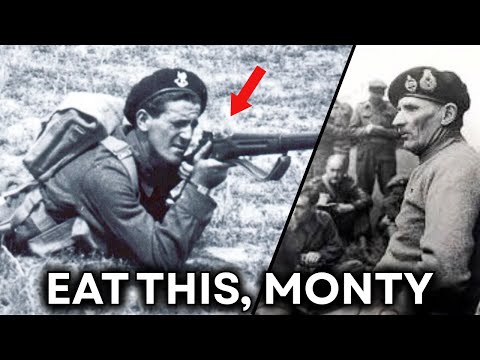
The war in Europe had ended just seventy-three days ago, on May 8th. Germany had surrendered. The bloodshed had stopped. And now Montgomery wanted his due—the adulation, the salutes, the recognition as the greatest British general since Wellington.
That morning he had already inspected three thousand British troops, each one snapping to attention with pride. Now he would review the Canadian units—the colonials from across the sea who had fought under British command. Montgomery stepped down from the platform and began walking along the first row of Canadian soldiers. His staff officers followed three paces behind, clipboards in hand, faces grave.
The Canadians stood rigid, rifles at their sides, eyes fixed forward. Montgomery barely looked at them. He walked briskly, as if bored, like a man checking items off a list. These were Dominion forces. Colonial troops. Important enough to be in his parade, but not important enough for his full attention.
Then he stopped. Directly in front of a young corporal with a face like stone. The corporal stood straight, back rigid, chin high. But his hands hung at his sides. No salute.
Montgomery’s eyes narrowed. Surely this was a mistake. Perhaps the boy was nervous, overwhelmed by the heat and the moment. “You, Corporal,” Montgomery said, his voice sharp and clear. “Salute your superior officer.”
Silence. The corporal didn’t move. Didn’t blink. Four thousand men held their breath. The entire parade ground seemed to freeze, as if time itself had stopped.
Montgomery’s face began to redden. “I said, salute.”
The corporal’s voice was steady and calm, loud enough for everyone nearby to hear. “No, sir.”
The words hit like a bomb. Officers gaped. Soldiers’ eyes went wide. Some in the rear ranks stood on their toes to see what was happening. This wasn’t supposed to happen. This had never happened. No one refused to salute a field marshal. No one had the audacity to disrespect Montgomery. It was career suicide. It was madness. It could mean ten years in prison.
This is the story of the Canadian soldier who did what George Patton could only dream of. Patton, the American general with the pearl-handled pistols and the volcanic temper, loathed Montgomery. He thought him a publicity hound, a credit thief, a man who cared more about his image than his soldiers. But Patton was American. He could insult Montgomery at dinner parties, curse him privately, mock him to reporters. He couldn’t touch him professionally.
This Canadian corporal had no such protection. He was Commonwealth. He was under British command. He was nothing compared to Montgomery’s power. And yet he stood there, in front of thousands of witnesses, refusing to perform the simple ritual of military respect.
The war was over, but the real war between Montgomery and the Canadians had been raging for months. While the guns roared and soldiers died, Montgomery was writing reports, giving speeches, crafting the history that would be told after the war. And in his story, the British forces were the heroes. British planning had won the battles. British courage had saved the day. The Canadians? They were barely mentioned. Extras in Montgomery’s grand cinematic vision.
The statistics told a different story. Canadian forces in Northwest Europe had suffered 44 percent casualties—77,000 men out of 175,000. Of every hundred men who landed in France, forty-four were killed, wounded, or missing. It was the highest casualty rate of any Western Allied force. Higher than the Americans. Higher than the British. The Canadians had bled the most, died the most, sacrificed the most. And Montgomery was acting as if they hadn’t been there at all.
Now, those Canadian soldiers stood in the sweltering Berlin heat and watched one of their own refuse to bow his head. They had fought from Normandy to Holland to Germany. They had seen their friends torn apart, drowned in freezing rivers, burned alive in tanks. They had done more than was asked of them. And their reward was to be forgotten. Erased from history. To watch Montgomery take credit for their blood.
The corporal standing before Montgomery knew all of this. He carried it in the scar on his leg from a shell fragment at Ortona. He carried it in the ringing in his ear from a blast at Caen. He carried it in the faces of the seventeen men from his platoon who would never go home again. Seventeen names. Seventeen graves. Seventeen families who would collapse in tears when the telegram arrived.
What makes a man risk his future? What makes him stare down prison, disgrace, and shame? What had Montgomery done that was so vile, so unforgivable, that a court-martial seemed justified?
The answer was written in the blood of 12,000 Canadian soldiers scattered across Belgium and Holland, who died clearing the Scheldt Estuary so Montgomery could claim another victory. The answer was in the mysteriously vanished medal recommendations, in the rewritten battle reports, in the speeches where Canadian names were never mentioned.
The corporal stood firm, and the entire parade ground held its breath, waiting to see what happens when arrogance meets principle, when power meets truth, when a field marshal’s ego collides with a soldier’s grief.
Bernard Montgomery had always believed himself to be someone special. Even before the war, he thought himself cleverer than the other officers, better than his peers, born for greatness. But after his promotion to Field Marshal in September 1944—that third star, the highest rank in the British Army—it was as if he had become convinced he could do no wrong.
His staff officers had noticed it first. He stopped listening to advice. He began rewriting history before the war had even ended. Every victory became his victory. Every success became his own intelligence. And the soldiers who had actually fought—they were merely instruments in the construction of his legend.
Montgomery had a famous rivalry with George Patton, the American general who had driven his tanks across France like a madman. The two men despised each other. Patton thought Montgomery was so slow and cautious it bordered on cowardice. Montgomery thought Patton was reckless and undisciplined. They argued in meetings. They insulted each other through the press. But Patton was American, which meant Montgomery couldn’t control him, couldn’t damage his career, couldn’t erase him from official reports.
The Canadians were different. They were Commonwealth troops, which meant they fell under the British command structure. Montgomery could shape their story however he pleased—and he did.
After every battle, reports had to be written. These reports stated who fought where, who won what, and who deserved credit for the victory. All reports on Commonwealth forces passed through Montgomery’s headquarters, and somehow, one after another, the Canadian achievements shrank. Battles fought by Canadians became British operations. Victories won with Canadian blood became British successes. The words ‘Canadian’ and ‘Canada’ began to vanish from official documents like ghosts fading at dawn.
The Canadians noticed. How could they not? The First Canadian Army had grown to 175,000 men at its peak. In 1943 they had fought up the Italian coast, captured towns like Ortona, and broken the German defensive lines at the Liri Valley. They had fought through battles that British historians would later call some of the toughest of the entire war.
The Gothic Line in Italy was a wall of German concrete and steel across the mountains. The Canadians smashed through it. Then they were transferred to Northwest Europe for the invasion of France. On June 6, 1944, Canadian troops landed on Juno Beach. They pushed further inland than any other Allied force on D-Day and captured more ground against the strongest German defenders.
Then came months of savage fighting through the French hedgerows, where every field was a fortress and every road a killing ground. The Canadians captured Caen, though it cost them thousands of men. Montgomery’s reports called it a British victory.
But that was nothing compared to the Battle of the Scheldt Estuary. In October and November 1944, the Canadians were given an impossible task. The Allies had captured the port of Antwerp in Belgium, but the Scheldt River leading to the sea was still in German hands. Without opening that river, no ships could bring supplies into Antwerp. Without supplies, the Allied advance would grind to a halt.
The task of clearing the Scheldt fell almost entirely to the Canadians. It was a nightmare. The terrain was flat and low, crisscrossed with canals and flooded fields. The Germans had fortified every house, every dike, every inch of mud. They could see the Canadians coming from miles away. The weather was cold and wet, rain pouring down in sheets, turning the ground into a quagmire. Soldiers fought waist-deep in water. Some drowned in their sleep when they rolled into flooded shell holes. Others froze to death in the bitter November cold.
The battle lasted from October 1st to November 8th. In those thirty-nine days, 12,873 Canadian soldiers were killed, wounded, or missing. Ninety percent of the force was Canadian. Ninety percent of the fighting was done by Canadians. Montgomery had delayed the operation for six weeks because he wanted to focus on a different campaign that would bring him more glory. When the Scheldt was finally opened and the ships could reach Antwerp, Montgomery declared it a British victory. He barely mentioned the Canadians.
The corporal standing before Montgomery on that Berlin parade ground was named Leo Clarke. He was twenty-four years old, raised in Winnipeg, Manitoba, where the winter cold could freeze the breath in your lungs. He had joined the army in 1941, when he was just twenty. He wanted to do his duty, to fight the Nazis, to make his country proud.
He had shipped overseas and landed in Sicily in 1943, wading ashore under machine-gun fire. Clarke fought his way up Italy. At Ortona in December 1943, he was in the thick of the brutal house-to-house fighting, where soldiers killed each other with shovels and knives when their ammunition ran out. A piece of German shrapnel tore into his leg, ripping through muscle and chipping the bone. He spent two weeks in a field hospital before returning to his unit. His platoon had started with thirty men. By then, only thirteen were left.
Then came France. He landed after D-Day but fought through the hedgerows of Normandy in June and July 1944. Near Caen, an artillery shell exploded so close that he was knocked unconscious. When he came to, blood was pouring from his ear and a strange ringing had started—a sound that never fully went away. He returned to his unit three days later. By then, seventeen of the thirty men in his original platoon were dead. Seventeen names he knew by heart. Seventeen faces he saw every time he closed his eyes.
Clarke had been recommended for medals twice. His commanding officer had written of his bravery, his leadership after his sergeants were killed, his refusal to stop fighting despite his wounds. Both recommendations had been sent to British headquarters. Both had mysteriously vanished. No medal. No recognition. Just the fighting.
Now it was July 1945, and Clarke stood in Berlin, being ordered to polish his boots for Montgomery’s parade. The same Montgomery who had written that the Scheldt was a British operation. The same Montgomery who was writing his memoirs and taking credit for everything. The same Montgomery who couldn’t even remember the names of the Canadians.
The evening of July 19th was hot and muggy, the kind of heat where wool uniforms felt like furnaces against the skin. Clarke and his company were called into the barracks courtyard to prepare for the parade. British officers moved among the Canadian soldiers, inspecting boots and uniforms, making sure every button shone and every crease was perfect. Tomorrow was Montgomery’s big day, and everything had to be flawless.
A British lieutenant handed out printed programs on thick, glossy white paper. Clarke took one and looked at the cover. At the top, in large letters, it read: ‘Field Marshal Montgomery’s Victorious Forces—Berlin Victory Parade.’ He opened it and scanned the pages quickly. There were sections for British regiments, lists of British commanders, descriptions of British achievements in France, Belgium, and Germany.
He turned page after page. On page seven, the word ‘Canadian’ appeared exactly once, in a single sentence: ‘Dominion forces also contributed to this operation.’ Contributed. As if they had donated a few cans of food to a charity. As if they hadn’t fought. Hadn’t bled. Hadn’t died. Contributed.
Clarke’s friend Tommy grabbed the paper from his hand and read it himself. Tommy was from Toronto, tall and lean, with a scar on his cheek from a German bayonet. “Dominion forces,” Tommy said, his voice flat and cold. “That’s all we are to them. They don’t even think we’re worth naming.”
The sun was setting, but the temperature was still ninety-two degrees. Clarke’s back was soaked with sweat as he polished his boots for the third time. A British sergeant stopped as he walked past and pointed at Clarke’s rifle. “That barrel better shine like glass tomorrow, Corporal. The Field Marshal notices these things.”
Clarke wanted to say that the Field Marshal hadn’t noticed 12,000 dead Canadians, but he kept his mouth shut and went back to cleaning his rifle.
After dinner, Clarke sat on his bunk and picked up a copy of the American military newspaper Stars and Stripes. He turned to page three and felt his blood run cold. The headline read: ‘Montgomery: British Troops Cleared Scheldt Area.’ The article contained a direct quote from Montgomery. “The opening of the Scheldt Estuary was a unique demonstration of British planning and British courage,” Montgomery had said. “British forces overcame enormous obstacles to achieve this vital victory.”
British forces. British planning. British courage. Clarke read the words three times, wanting to be sure he wasn’t seeing things. There was no mention of Canada. No mention of the 12,873 casualties. No mention of the soldiers who had drowned in flooded fields or frozen in the November rain.
Clarke’s best friend from training had died in the Scheldt. His name was Robert Hughes, a farm boy from outside Winnipeg who could fix any engine and tell jokes that made everyone laugh even in the worst moments. On November 2, 1944, during an attack on a German position at the Walcheren Causeway, Robert was killed. A German machine gun caught him as he crossed open ground. He fell into a water-filled crater and drowned before anyone could reach him. He was nineteen years old.
When Robert died, Montgomery was nowhere within fifty miles of the Scheldt. Montgomery was at his headquarters, in a comfortable château with hot food and warm beds, writing press releases and planning his next campaign. And now he was standing in front of journalists, saying that British forces had won the battle.
Something inside Clarke broke—like a rope pulled too tight finally snapping. He got up from his bunk and walked outside. Tommy and three other Canadians were sitting on ammunition crates, smoking cigarettes in the fading light.
“You see the paper?” Clarke asked. Tommy nodded. “Yeah. ‘British forces cleared the Scheldt.’ British forces.”
“He wasn’t even there,” another soldier said. His name was Jack, a quiet kid from Nova Scotia who rarely spoke. “I was there for thirty-nine days. I watched my sergeant burn to death in his tank. British forces, my ass.”
Clarke sat down on a crate. “Tomorrow,” he said quietly, “when he walks past me on that parade ground, I’m not going to salute him.”
The others stared at him. Tommy’s cigarette stopped halfway to his mouth. “Leo, that’s a court-martial. That’s prison.”
“I know,” Clarke said. His voice was steady and calm, as if he were discussing the weather. “But I can’t do it. I can’t stand there and salute the man who erased Robert’s name from history. Who erased all our names.”
“They’ll destroy you,” Jack said. “Ten years in a military prison. Your whole life.”
Clarke looked at the crumpled program in his hand. “I’ve fought for three years. Lost everyone I came with. For what? So he can play Caesar? So he can pretend we weren’t there?” He shook his head. “Someone has to say something. Someone has to stand up for the truth.”
The night passed like a wounded animal, slow and painful. Clarke lay on his bunk, staring at the ceiling. Around midnight, his sergeant knelt by his bed. Sergeant Williams was a good man, had been with the company since Italy, had saved Clarke’s life twice.
“Whatever you’re thinking,” Williams whispered, “don’t do it. I know you’re angry. We’re all angry. But throwing your life away won’t fix anything.”
“It’ll make a difference,” Clarke replied quietly. “He won’t get my salute, and everyone there will know why.”
Williams looked at him for a long moment, then got up and walked away without another word.
At 4 AM, a British brigadier arrived at the Canadian barracks. He stood at the front of the room and announced that any breach of protocol would mean immediate court-martial. “Do I make myself clear?” The room thundered, “Yes, sir.” But Clarke noticed the brigadier’s eyes were fixed directly on him.
At 6 AM, reveille sounded. Four thousand soldiers assembled in perfect ranks. Montgomery arrived in his black Rolls-Royce, medals flashing. He walked the British lines with a smile, then turned toward the Canadians. His smile faded. He walked faster now, barely glancing at them. Then he stopped directly in front of Clarke.
“You, Corporal. Salute your superior officer.”
The silence was absolute. Clarke’s voice carried across the parade ground. “No, sir.”
Montgomery’s face turned purple. “I said, salute!”
Clarke didn’t move. “You led from a château fifty miles away, sir. We led from the front. That’s where my friends died while you were writing press releases.”
The parade ground erupted. Military police seized Clarke’s arms. Montgomery screamed for a court-martial. As they dragged him away, Clarke looked back and said, “I’ll face a court-martial, sir—as long as you explain to the court why 12,873 Canadian casualties aren’t in your victory reports.”
Behind him, 2,000 Canadian soldiers began to applaud. The sound echoed through Berlin’s ruined streets like thunder.
General Harry Crerar, commander of the First Canadian Army, threatened to withdraw every Canadian soldier from British command unless Clarke was released. Within days, the story reached newspapers across North America. Patton reportedly said he’d give the corporal a medal. Eisenhower wrote in his diary: “I should have reined in Montgomery, not that corporal.”
On August 1, 1945, Allied headquarters issued new orders: all Commonwealth battle reports would be reviewed by the respective nations. The word “British forces” could no longer be used to describe Commonwealth troops. The system that had erased Canadian achievements was dismantled—because one corporal refused to salute.
Leo Clarke returned home to Winnipeg. He married, raised two children, worked in construction, and served on the city council. He never spoke publicly about that day for decades. When asked in a 1970 interview if he regretted it, he said: “Every man killed in that war deserves his story told truthfully. If the price of that truth was not saluting, that was the easiest thing I ever did.”
Montgomery’s memoirs were forced to acknowledge Canadian contributions. His reputation never fully recovered. Military leadership courses worldwide now study this moment—not as a lesson in disobedience, but as a warning about what happens when ego outgrows duty.
Leo Clarke died in 1994, aged 73. He was buried with full military honors. A street in Winnipeg bears his name. At the Scheldt Memorial in the Netherlands, Dutch children still lay flowers every November 8th, honoring the Canadians who freed them.
The salute that was never given became more powerful than any salute ever could be. Because it stood for something Montgomery never understood: respect cannot be demanded. It must be earned.
And once earned, it lasts forever.
So here’s the question for you: In a world where power so often demands silence, would you have the courage to refuse the salute—or would you stand in line and look away?
Report this article
Select a reason for reporting:






