His fingers were broken, his nails torn out, his ribs cracked—yet Konstantin Rokossovsky refused to sign the confession. In the freezing cell, he stood tall, a silent defiance against the very system that sought to destroy him. This was the man who would go on to become one of the Soviet Union’s most brilliant military minds, but in 1938, he was just another victim of Stalin’s Great Purge.
Rokossovsky’s journey from a decorated cavalry officer to a prisoner of the NKVD is a story of extraordinary resilience. Born in Warsaw when it was part of the Russian Empire, he dedicated his life to defending his homeland, only to be betrayed by the regime he served. “I will not sign a lie,” he reportedly told his interrogators, even as they subjected him to mock executions and relentless beatings.
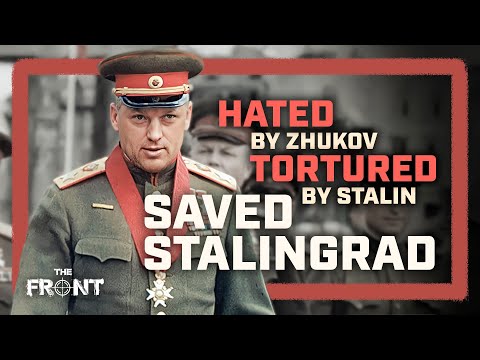
His refusal to break under torture was rare—most men signed. But Rokossovsky was not most men. A fellow prisoner later recalled: “He was a brave and strong man, tall and broad-shouldered. He was beaten too, but he did not sign.” That stubborn courage would eventually save his life, but not before he endured years of suffering.
Before the purges, Rokossovsky had already proven himself on the battlefield. He joined the Russian Army in 1914, fighting in World War I, where he earned the Cross of St. George for bravery. After the revolution, he joined the Red Army and distinguished himself during the Russian Civil War, commanding a cavalry brigade and earning the Order of the Red Banner. By the 1930s, he had risen through the ranks, but his use of innovative tactics—similar to those of Marshal Tukhachevsky—caught Stalin’s paranoid eye.
Tukhachevsky was executed in 1937, and Rokossovsky was arrested shortly after. Accused of spying for Japan and Poland, he was thrown into prison, where the real battle for his soul began. The interrogators wanted a confession, but Rokossovsky gave them nothing. “Bring me Yushkevich,” he demanded, referring to a comrade whose false testimony had been used against him. But Yushkevich had died in 1920, and the court had no choice but to acquit him—yet he remained imprisoned until 1940.
When he was finally released, the Soviet Union was on the brink of war. His old commander, Semyon Timoshenko, desperately needed experienced officers. Rokossovsky was reinstated as a colonel and given command of the 5th Cavalry Corps. He had every reason to be bitter, yet he remained loyal. Why? That question would haunt him for the rest of his life—and it is the key to understanding the man behind the legend.
As the Nazi war machine advanced, Rokossovsky’s talents would soon be put to the ultimate test. His defense of Moscow, his triumph at Stalingrad, and his pivotal role at Kursk would cement his place in history. But the scars of the purges never fully healed, and the tension with his rival, Georgy Zhukov, would simmer beneath the surface. “We cooperated as much as we could,” Rokossovsky later wrote, “but our different styles of command caused friction.” That friction would come to a head at the most critical moment of the war.
The friction with Zhukov reached its breaking point in November 1941, as German panzers closed in on Moscow. Rokossovsky’s 16th Army was nearly encircled, and he saw only one path to survival: retreat and regroup. Zhukov, however, would not hear of it. “Hold your positions,” he ordered, his voice like ice over the wire. Rokossovsky, unwilling to sacrifice his men for a point of pride, went over Zhukov’s head and appealed to the next commander in the chain. The permission was granted—but Zhukov, furious, immediately revoked it.
The consequences were swift. The German 4th Panzer Group punched through the weakened Soviet lines and seized a strategic position north of the capital. Had Zhukov allowed the withdrawal, the Germans might never have advanced so far. Yet Stalin, ever the pragmatist, did not punish Rokossovsky. He needed him. And Rokossovsky, despite the humiliation, never spoke a word against Zhukov in public.
That silence was characteristic. Rokossovsky had learned, in the torture chambers of the NKVD, that survival required a certain kind of discipline—not just of the body, but of the tongue. He carried that discipline into every command. When Stalin personally assigned him to lead the 16th Army, Rokossovsky accepted without protest, even though he knew Zhukov would be watching his every move.
But it was at Stalingrad that Rokossovsky truly came into his own. In October 1942, Stalin sent him to the ruined city with a simple order: destroy the remaining German forces. He was given 218,000 men, 6,500 guns, 2,500 tanks, and 300 aircraft—a force that reflected Stalin’s growing trust in him. On January 10, 1943, after weeks of meticulous planning, Rokossovsky launched Operation Ring.
The Germans fought with the ferocity of the doomed. In the first three days, Rokossovsky lost 26,000 men and half his tanks. But he did not waver. He reorganized, struck harder, and seized the last German airfield before driving into the heart of the city. When General Paulus asked Hitler for permission to surrender, the Führer refused. Rokossovsky simply split the German forces in two and ground them down, day by day.
In the end, he destroyed or captured 22 German divisions. The German advance into the Soviet Union was finished. For this, Rokossovsky was promoted to colonel general—and his name became legend. Yet in his memoirs, he wrote with characteristic understatement: “I was appointed commander of the Central Front. This meant Stalin had entrusted me with a pivotal role in the summer campaign at Kursk.”
Kursk would be the greatest armored clash in history—over 8,000 tanks and 2.6 million men. Rokossovsky, now commanding the Central Front, prepared defenses in depth. When the German offensive began in June 1943, he narrowly escaped death when his headquarters was bombed in a night raid. He moved his command underground and directed the battle from there.
At first, he ordered a counterattack that cost him dearly. Realizing his mistake, he switched back to defense, letting the Germans bleed themselves on Soviet minefields. By the end, nearly 2,000 tanks were destroyed and over 200,000 soldiers killed. The Germans could not break through. They withdrew—and Rokossovsky had won again.
By the war’s end, he wore the rank of Marshal of the Soviet Union. He stood on the podium at the Moscow Victory Parade, one of Stalin’s most trusted commanders. But the man who had survived the purges, the torture, and the mock executions had also learned something else: how to serve a system without ever fully trusting it. That lesson would shape everything he did in the years to come—especially when Stalin sent him to Poland.
Stalin’s decision to send Rokossovsky to Poland was no accident. The Marshal was Polish by birth, yet he had spent his entire adult life in Soviet uniform. Who better to install a Stalinist regime in Warsaw than a Pole who had proven his loyalty to Moscow? In 1944, he was placed in command of the 1st Belorussian Front, the Soviet forces poised to enter Polish territory. But his role went far beyond military matters.
As the Red Army pushed the Germans back, Rokossovsky found himself walking a tightrope. On one side stood Stalin, demanding absolute control over postwar Poland. On the other were the Polish resistance fighters of the Home Army—men and women who had fought the Nazis for five brutal years and dreamed of an independent Poland. Rokossovsky knew their hopes. He had been born in Warsaw. He had once been one of them, in spirit if not in uniform.
Yet when the Warsaw Uprising erupted in August 1944, Rokossovsky did not intervene. The Home Army rose against the German occupiers, expecting Soviet help as the Red Army approached the Vistula. That help never came. Stalin deliberately halted his forces, allowing the Germans to crush the uprising and destroy the city. Rokossovsky, standing at the gates of Warsaw, followed orders. Whether he could have acted differently—or whether he even wanted to—remains one of history’s most painful questions.
After the war, Stalin made his intentions clear. Rokossovsky was appointed Minister of National Defense in the new Polish People’s Republic—a Soviet marshal in a Polish uniform. He was, in effect, the watchdog of Stalinism in Poland. His task was to build a Polish army loyal to Moscow, not to Warsaw’s own traditions.
He did so with the same discipline he had shown on the battlefield. He purged officers suspected of nationalist sympathies. He enforced Soviet doctrine. He signed off on the imprisonment of thousands of Poles who had fought for independence—many of them former comrades-in-arms from the Home Army. Some historians argue he had no choice. Others say he had simply learned, in the torture chambers of the NKVD, that obedience was the only path to survival.
But the mask slipped in 1956. When workers in Poznań rose up against Soviet-imposed conditions—low wages, food shortages, and the heavy hand of the secret police—Rokossovsky did not hesitate. He ordered 10,000 soldiers and 360 tanks into the streets. Seventy-four civilians were killed. Tanks crushed barricades. Rifle fire echoed through the city. The uprising was smashed.
For many Poles, that day sealed his reputation. He was no longer a Polish son returning home. He was a Soviet enforcer, a man who had turned his guns on the very people he was supposed to protect. “He was a Russian marshal to the end,” one Polish historian later wrote. “Poland was just another front to him.”
Yet Rokossovsky’s loyalty was never rewarded with peace. In 1956, as Stalin’s successors began to loosen the reins, the Polish government quietly removed him from his post. He was sent back to the Soviet Union, a marshal without a command. The man who had survived torture, purges, and the bloodiest war in history had become an embarrassment—a relic of a darker age.
He returned to Moscow not in disgrace, but in silence. The man who had once been the toast of the Red Army now lived quietly, his name rarely spoken in the corridors of power. His memoirs, published years later, were careful—almost too careful. He praised Stalin as a military leader, defended the decisions of the Party, and never once mentioned the torture chamber or the broken fingers.
Some saw it as cowardice. Others saw it as the final act of a survivor. “He had learned that memory itself could be a weapon,” one biographer wrote. “So he kept his memories locked away, like a soldier keeps his last bullet.”
When Rokossovsky died in 1968, he was buried with full military honors. The official obituary called him a loyal son of the Soviet Union. But in Warsaw, where he had once been born and where he had later sent tanks into the streets, the reaction was colder. Some remembered the boy from the cavalry. Others remembered only the guns.
His life remains a paradox. He survived the Purge by refusing to lie, yet he served the system that tortured him. He defended Moscow and Stalingrad, yet he stood by as Warsaw burned. Was he a hero, a victim, or a collaborator? Perhaps he was all three.
In the end, Konstantin Rokossovsky never explained himself. He left that task to history—and to us. So now we ask you: Can loyalty to a nation ever justify loyalty to a tyrant? And if you had endured what he endured, would you have signed the confession? Share your thoughts in the comments below.
Report this article
Select a reason for reporting:






