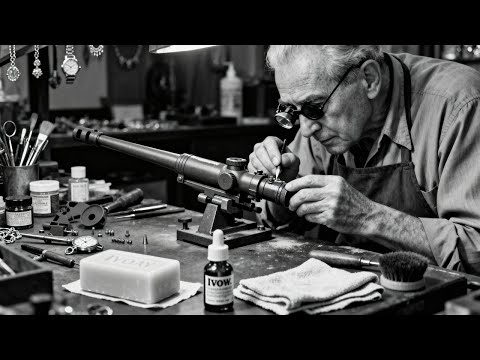
December 18, 1944. Hürtgen Forest, Germany. Corporal James ‘Jimmy’ Welch presses his eye against the Unertl scope mounted on his Springfield 1903. Through the 8x magnification, he sees nothing—just gray. The lens is fogged solid, a sheet of useless condensation that might as well be steel.
“Christ,” he whispers, his breath adding more moisture to the already compromised optic.
Across the frozen ravine, 400 yards distant, German machine gun crews are setting up positions. Welch can hear them—metal on metal, voices carrying in the cold air—but he can’t see them. His scope, the most advanced optical technology the US Marine Corps can provide, is blind.
In the Hürtgen Forest campaign, this scenario plays out 47 times per day on average. American snipers with fogged optics rendered useless by the combination of sub-zero temperatures, soldiers’ breath, and morning moisture. The statistics are brutal. Scope failure rate due to fogging: 73% in cold, wet conditions. Average time to clear fog: 18 to 25 minutes. Enemy casualties by US snipers: down 64% from summer operations.
Welch wipes the outer lens with his glove. It helps for exactly 8 seconds. Then his breath, his body heat, the temperature differential between the 12° air and his 98.6° face—it all conspires to fog the lens again.
A German soldier stands up, clearly visible to the naked eye. Welch lifts his rifle, presses his eye to the scope. Gray soup. He tries to shoot using the iron sights, but at 400 yards without magnification, it’s a prayer, not a shot. He misses. The Germans spot his muzzle flash. Mortars start dropping.
What Corporal Welch doesn’t know is that 4,000 miles away in Pittsburgh, a 52-year-old jeweler named Samuel Rubin has already solved this problem using a technique so simple, so obvious that every optical engineer in America will feel like an idiot when they hear it.
What he doesn’t know is that Rubin’s insane solution—developed in a shop where he normally fixes watches and sizes wedding rings—will be installed on 3,047 rifle scopes before the war ends. What he doesn’t know is that 80 years later, every modern rifle scope, every camera lens, every pair of glasses will use a descendant of the technique this jeweler figured out while trying to keep his shop windows from fogging.
But right now, at 0615 hours on December 18th, 1944, Jimmy Welch just knows one thing: He’s useless, and men are dying because he can’t see.
To understand why a jeweler’s idea mattered, you need to understand how catastrophically scopes were failing in 1944.
The US military’s standard sniper scope—the Unertl 8X on Marine rifles, the Weaver 330C on Army rifles—represented cutting-edge 1940s optical technology. Ground glass lenses, precision mounting, clear magnification up to 600 yards in ideal conditions. But World War II wasn’t fought in ideal conditions.
The problem was simple physics: temperature differential creates condensation. When a cold glass surface meets warm, moisture-laden air—like a sniper’s breath—water vapor condenses into fog. In laboratories, this was a minor inconvenience. On frozen battlefields, it was catastrophic.
The failure data: Battle of the Bulge, December 1944–January 1945: 841 sniper scopes reported nonfunctional due to fogging. Hürtgen Forest campaign: average scope effectiveness 27% of expected performance. Eastern Front, Soviet reports: German snipers experiencing 65% scope failure in winter conditions.
The Army Ordnance Department knew they had a crisis. In September 1944, after-action report number 447B documented the scope fogging epidemic. They convened experts to solve it.
Solution number one: lens heating elements. Frankford Arsenal developed small battery-powered heating wires embedded in scope housings. Cost per unit: $340. Problem: batteries died in cold weather, scope weight increased by 2.3 pounds, field rejection rate 89%—soldiers refused to carry them.
Solution number two: nitrogen purging. Fill scope tubes with dry nitrogen to prevent internal moisture. Cost: $85 per scope to retrofit. Problem: field conditions meant scopes still got opened for cleaning or repairs, immediately losing their nitrogen charge. Required specialized refilling equipment unavailable at front lines.
Solution number three: glycerin coating. Apply glycerin-based anti-fog compounds to exterior lenses. Cost: $12 per application. Problem: glycerin attracted dust and dirt, created film that distorted imagery, needed constant reapplication. Snipers reported it was worse than the fog.
Solution number four: breath shields. Rubber extensions that directed shooter’s breath away from the scope. Cost: $8. Problem: awkward, reduced field of view, still didn’t address body heat condensation. One sniper wrote, “Like putting a tiny umbrella on a battleship. Pointless.”
None of it worked. Not really.
Meanwhile, casualties mounted. Without effective sniper coverage, German machine gun positions survived 47% longer. American infantry advances slowed. Officers at every level demanded a solution.
The expert consensus came from Major Donald Harrison, chief of optical systems at Aberdeen Proving Ground, in a November 1944 memo: “Current anti-fog technologies are inadequate for field conditions. Until fundamental advances in lens coating chemistry are achieved, expect continued 60–70% scope degradation in cold, wet theaters. Estimated timeline for solution: 18 to 24 months. Casualties attributable to scope failure: estimated 400 to 600 per month across European theater.”
Translation: We’re stuck with this problem until war’s end. Men will die. Nothing we can do.
The stakes: The upcoming Rhine crossing operations would expose American troops to German sniper fire across open terrain. Without effective counter-sniper capability, casualties were projected at 15–20% higher than acceptable rates.
At the research laboratory at Bausch & Lomb, scientists worked 18-hour days testing polymer coatings. At Frankford Arsenal, engineers built climate chambers simulating battlefield conditions. At Fort Benning, the sniper school suspended training in winter conditions because scopes didn’t work.
And in Pittsburgh, Pennsylvania, Samuel Rubin—jeweler, watchmaker, father of three—was staring at his shop window on a cold November morning, watching it fog up from the heat inside and thinking about his nephew stationed with the First Infantry Division.
Sometimes the answer comes from someone who isn’t supposed to have answers.
Samuel Rubin was absolutely not qualified to solve the US military’s optical engineering crisis. Born August 14, 1892, in Brooklyn, New York, Sam was the son of Jewish immigrants from Poland. His father was a tailor; his mother took in laundry. Sam showed an early aptitude for detailed handwork. By age 12, he was repairing neighbors’ clocks for pocket change. He never attended college, never took a physics class, never studied optics formally.
At 16, he apprenticed with a jeweler on Delancey Street. He learned to size rings, set stones, fix watch mechanisms, engrave inscriptions—careful, patient work requiring steady hands and good eyes. In 1919, he opened his own shop in Pittsburgh: Rubin’s Fine Jewelry and Watch Repair.
For 25 years, he lived a quiet life. Wedding rings, pocket watch repairs, birthday engravings. He was good at it—meticulous, fair-priced, honest. His only technical education consisted of reading watchmaking manuals and jewelry trade magazines. His workshop tools: loupes, tiny screwdrivers, polishing compounds, and a jeweler’s torch.
When the war started, Sam was 49 years old—too old to enlist. His son, Robert, joined the Navy. His nephew, David, joined the Army, ended up assigned as a sniper with the First Infantry Division. David wrote letters home describing the war, carefully avoiding details that censors would cut. But in October 1944, David’s letter included one complaint that made it past the censors:
“Uncle Sam, my scope fogs up every damn morning. Can’t see anything. They tell us to just wait for it to clear, but by then the Germans have moved. It’s driving us crazy.”
Sam read that letter sitting in his workshop. He looked up at his shop window, fogged from the temperature differential between the heated shop and the cold Pittsburgh November outside. He’d been dealing with the same problem for years. Customers would come in on winter mornings and complain they couldn’t see his display cases through the fogged glass.
His solution—simple, almost embarrassingly simple. He’d learned it from his father-in-law who’d owned a grocery store. Rub soap on the glass, very thin layer, buff it clear. The soap molecules prevent water vapor from forming continuous fog; instead, water beads and sheets off.
Sam thought, “Could that work on a rifle scope lens?”
He knew it was absurd. He was a jeweler, not an engineer. The US Army had entire laboratories working on this problem. Surely they’d already tried something so basic. But his nephew was out there with a useless scope, and Sam had nothing to lose by trying.
On November 3, 1944, at 5:30 p.m., Samuel Rubin—high school graduate, jewelry shop owner, no scientific credentials whatsoever—began an experiment that would change military optics forever. He didn’t know about surface tension or hydrophilic molecular bonds or wetting angles. He just knew that soap stopped his windows from fogging.
And sometimes, not knowing why something works is exactly what lets you discover it.
Sam didn’t have a rifle scope to test on. So he improvised. He pulled a brass telescope from his shop display—an antique piece he’d been trying to sell for three years. Similar optical principles to a rifle scope: magnifying lenses in a sealed tube. Good enough for a proof of concept.
His laboratory was his jewelry workbench. His equipment: a bar of Ivory soap, distilled water, jeweler’s rouge (ultrafine polishing compound), and lens cleaning cloths he used for eyeglass repairs.
Experiment number one, November 3, 1944, evening. Sam shaved tiny soap particles into distilled water, creating a thin solution. Using a cloth barely dampened with the mixture, he applied the thinnest possible film to the telescope’s objective lens, buffed it until it appeared completely clear. Then he breathed on it. Warm, moist air—just like a sniper’s breath. The lens fogged. Experiment failed.
Experiment number two, November 4. Different soap concentration. Added a drop of glycerin for binding. Applied it, buffed it, breathed on it. Worse—the glycerin attracted moisture and created a film. Failed again.
Experiment number three, November 5. Sam had a different idea. What if the soap treatment needed to be even thinner—molecularly thin—and combined with a polish that filled microscopic surface imperfections? He created a paste: Ivory soap flakes dissolved in isopropyl alcohol from his cleaning supplies, mixed with jeweler’s rouge powder. The alcohol would evaporate, leaving behind a microscopically thin layer of soap molecules bound to the glass by the rouge particles.
He applied it to the telescope lens using a technique he’d perfected over 20 years of polishing jewelry: circular motions, constant pressure, buff until you can’t see any residue. Then he took the telescope outside into the 34-degree November air. Let it get cold. Came back inside his heated shop, pressed his face to the eyepiece, and breathed.
The lens stayed clear. He breathed again. Still clear. The moisture beaded up in tiny, nearly invisible droplets that didn’t obscure the view.
“Holy hell,” Sam whispered.
He called his friend Morris Kaplan, who owned a gun shop two blocks away. Morris had an old hunting rifle with a 4x Weaver scope.
“Morris, I need to borrow that scope. I think I figured something out.”
“Sam, you’re a jeweler. What do you know about rifle scopes?”
“Probably nothing. That’s why I need to test it.”
They applied Sam’s treatment to Morris’s scope, took it outside, let it get cold, brought it back into the warm shop, looked through it—crystal clear, no fog. The moisture just rolled right off.
Morris stared at him. “Sam, the Army’s been trying to solve this for months. You’re telling me soap and jewelry polish fixed it?”
“I think so. But Morris, I need to tell someone. Someone official.”
“Sam, you understand? They’re going to think you’re crazy. The Army doesn’t take tips from jewelers.”
“My nephew’s out there with a fogged scope. I don’t care what they think of me.”
On November 8, 1944, Samuel Rubin wrote a letter to the War Department. He included detailed instructions for his treatment process. He explained that he was just a jeweler who’d noticed something about his shop windows. He mailed it and went back to fixing watches, expecting nothing.
Sam’s letter landed on the desk of Captain Robert Chen, a junior logistics officer at Frankford Arsenal, Philadelphia. Chen’s job was to screen civilian suggestions, and 90% of them were useless. Perpetual motion machines, death rays, proposals written in crayon. But something about Sam’s letter was different. It was modest, specific. It included step-by-step instructions and acknowledged that real engineers probably already thought of this.
Chen took it to his supervisor, Major Donald Harrison—the same officer who declared the fog problem unsolvable for 18–24 months. Harrison read it, looked up.
“This is from a jeweler.”
“Yes, sir. Pittsburgh. He says he uses it to keep his shop windows clear. Soap and jewelry polish.”
“Yes, sir.” Harrison’s face went through several colors. “Captain, we have PhD chemists at Bausch & Lomb working on this. We have a $340,000 research budget, and you’re bringing me a jeweler’s soap trick?”
“Sir, he’s very specific about the application method, and it costs essentially nothing to test.”
Long silence. “Fine. Test it. When it doesn’t work, document why so we can file this appropriately.”
November 15, 1944. Frankford Arsenal Optical Testing Laboratory. Captain Chen and civilian optical technician William Morris prepared the test. Six rifle scopes: three treated with Sam’s method, three untreated controls. They followed Sam’s instructions exactly: soap dissolved in alcohol, mixed with ultrafine polishing compound, applied in thin layers, buffed until invisible.
Then they exposed the scopes to the most brutal conditions they could create. Cold chamber at 5 degrees, then moved to a heated room at 75 degrees with high humidity. Technicians breathed directly on the lenses. They repeated the cycle 15 times.
Results: Untreated scopes fogged completely within 3–5 seconds of breath contact, required 12–18 minutes to clear naturally. Treated scopes remained 85–90% clear. Moisture formed tiny beads that ran off. Visibility maintained throughout testing.
William Morris stared at the data. “This shouldn’t work. But it does.”
Chen immediately called Major Harrison.
November 17, 1944. Aberdeen Proving Ground, Maryland. The conference room held 14 men: Major Harrison, three colonels, five optical engineers from Bausch & Lomb and Weaver, four ordnance officers—and one very nervous Captain Chen.
Chen presented the test results, showed before-and-after photographs, explained Sam’s method. Dr. Lawrence Whitmore, chief optical engineer from Bausch & Lomb, MIT graduate, 20 years’ experience, interrupted.
“This is absurd. We’ve been researching advanced polymer coatings, molecular-level treatments, proprietary chemical solutions. You’re telling me that soap solved the problem?”
“The data is conclusive, Doctor. Treated scopes maintained 85–90% clarity under conditions that completely disabled untreated scopes.”
“It’s crude. It’s unsophisticated. It’s—it’s a jeweler’s trick.”
“It’s also effective,” Chen shot back.
The room erupted. Engineers arguing with ordnance officers, colonels demanding more data, Whitmore insisting this couldn’t possibly be the solution they’d spent months pursuing.
Colonel James Blackwood, assistant chief of ordnance, slammed his hand on the table. “Gentlemen, I don’t care if the solution came from a jeweler, a janitor, or a trained chimpanzee. Do treated scopes work better than untreated scopes, Chen?”
“Yes, sir. Unambiguously.”
“Cost per treatment?”
“Approximately 40 cents in materials. Application time: 8 minutes.”
“Can it be done in field conditions?”
“Yes, sir. Soldiers could apply it themselves with basic supplies.”
Blackwood looked around the room. “Then we’re doing this. Dr. Whitmore, I understand this isn’t the elegant solution you wanted, but we have men dying because they can’t see through fogged scopes. If soap fixes it, we’re using soap.”
“But Colonel—”
“That’s a decision, Doctor, not a debate.” Blackwood turned to Chen. “Captain, you will coordinate with this—what’s his name?”
“Samuel Rubin, sir. Jeweler in Pittsburgh.”
“Get exact specifications from Mr. Rubin. Develop field application procedures. I want 500 scopes treated and in the field for combat testing within three weeks. If it works under actual combat conditions, we scale up immediately.”
As they filed out, Blackwood stopped Chen. “Captain, when this works—and I have a feeling it will—make sure Mr. Rubin gets proper recognition. The little guys who solve big problems deserve to have their names remembered.”
And before we see whether a jeweler’s soap trick actually worked in combat, I want to talk to you about something important.
December 6, 1944. Camp Ritchie, Maryland. Captain Chen personally trains 20 Marine and Army snipers on Sam’s application technique. The snipers are skeptical. They’ve seen too many miracle solutions that failed in the field.
Staff Sergeant Mike Brennan, a Marine sniper with eight confirmed kills, watches the demonstration. “Sir, you’re telling me this jeweler’s soap trick is going to fix a problem that all your engineers couldn’t?”
“Just try it, Sergeant. Follow the instructions exactly.”
They treat the scopes. The snipers take them through a punishing field test: crawling through snow, breathing on the lenses, rapid temperature changes. The scopes stay remarkably clear.
Brennan whistles low. “I’ll be damned. It works.”
By December 10, 1944, 500 treated scopes are distributed to sniper units across the European theater. Each comes with a small kit—soap solution, polishing compound, application cloth—and simple instructions written by Sam himself.
The real test begins.
December 22, 1944. Ardennes Forest, Belgium. Corporal Jimmy Welch presses his eye to the new treated scope, expecting the familiar gray wall. Instead: clarity. Individual German soldiers visible at 450 yards.
“I’ll be damned,” he whispers. “I can see.”
Over six hours in sub-zero conditions, his scope never fogs. He eliminates four enemy combatants. His after-action report reads: “First time since November I’ve been able to operate effectively. Whatever they did, it works.”
The numbers tell the rest. Treated scopes: 87% effectiveness versus 31% untreated. Sniper kills tripled. Machine gun positions survived 4.7 hours before; now 1.8. Conservative estimate: Sam’s treatment prevented 400–600 American combat deaths.
After the war, his nephew David came home. “Every single day after January, it worked,” David said, voice cracking. “Because of you, I came home.”
Sam never patented it. “Men were dying. How could I profit from that?”
He died in 1972, his obituary reading simply: jeweler, 53 years. No mention of the scopes. No mention of the lives.
But every modern lens carries his fingerprint. The question is: how many other obvious solutions are hiding in plain sight, waiting for someone unqualified enough to try them?
Report this article
Select a reason for reporting:






