Seven bullets entered one man’s body in broad daylight, point-blank, in front of dozens of witnesses, and the man kept moving forward. He absorbed every round, swung his rifle like a club, drove his bayonet through everything in reach, and by the time the last German dropped his weapon and ran, the entire counterattack had been shattered by a single, half-blind, bleeding lieutenant from Victoria.
This is documented fact, verified by the most rigorous military historian Australia has ever produced. It happened on the morning of the 7th of August, 1916, at a smashed French village called Pozières. And what happened there remains the single most extraordinary act of individual battlefield violence in the history of the Australian Army.
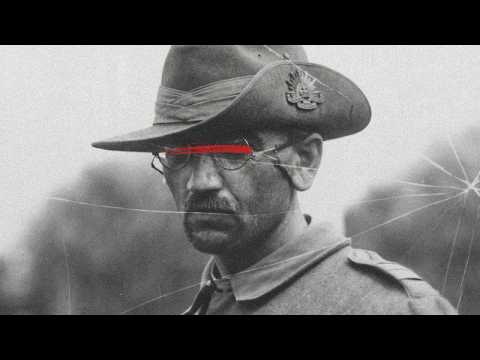
The Battle of Pozières sits buried under the weight of the Somme’s monstrous casualty lists, absent from Hollywood films and British school textbooks alike. But for Australia, Pozières was something uniquely terrible. Between the 23rd of July and the 3rd of September, 1916, Australian divisions suffered approximately 23,000 casualties at Pozières and nearby Mouquet Farm, more than the total Australian losses at Gallipoli across the entire 8-month campaign.
The British High Command fed men into the Somme like coal into a furnace, and the Australians, newly arrived on the Western Front and already carrying the hard reputation they had built at Anzac Cove, were placed at the sharpest end of the blade. The blade, as usual, was pointed straight into a wall.
Pozières itself was a small limestone village on a ridge above the Somme Valley, a quiet farming community before the war ground it to powder. By the summer of 1916, it was nothing but rubble, shell craters, and German concrete. A fortified position the British had been trying to capture for weeks while losing thousands of men in the process. When the Australians were given the job, they took the village in a single night assault on the 23rd of July. But taking a position and holding it were two entirely different problems, and the Germans were far from finished.
What followed was 6 weeks of the most concentrated artillery bombardment Australians had ever experienced. Charles Bean, official historian and eyewitness, described the ground around Pozières as having been turned over more completely, more times, by shell fire than almost any other position in the war. The Australians held on. They always held on. But by the first week of August, the men of the 14th Battalion were exhausted, under manned, and facing German counterattack operations that grew more sophisticated and more dangerous every day.
It was into this grinding, lethal situation that Albert Jacka had arrived, and the situation was about to make him immortal.
Jacka was already famous by the time he reached Pozières, which is itself a remarkable fact. In a war nearly 2 years old, producing heroes at an industrial rate on every front from Flanders to Mesopotamia, the name Albert Jacka had risen above the noise. He was 23 years old, the son of a farmer from Wedderburn in rural Victoria, and he had won the Victoria Cross at Gallipoli in the first week of June, 1915, the first Australian to receive the decoration in the First World War.
The action that earned it was a night raid on a Turkish trench at Courtney’s Post. A Turkish bombing party had overrun the position, killed or wounded every Australian defender, and occupied the trench. Jacka crawled into the position alone, fought through it, and drove the Turks out single-handedly. He shot five and bayoneted two more. His commanding officer’s recommendation for the VC called it the most courageous act he had ever witnessed. General Sir Ian Hamilton, commanding the entire Gallipoli operation, reportedly described Jacka’s action as the finest individual act of the war.
That reputation preceded him to France. Among the men of the 14th Battalion, Jacka was a lieutenant who shared their mud, their rations, and their contempt for staff officers issuing suicidal orders from comfortable chateau. The men trusted him with something more fundamental than official loyalty. They trusted him with their lives, which in the summer of 1916 at Pozières was a more serious matter than usual.
He was known for a quality that sits at the core of the Australian military character, a calm, implacable refusal to accept bad outcomes without fighting every possible inch. He demonstrated it quietly and without ceremony every time the situation demanded it. By August 1916, he had already survived more close-range violence than most soldiers experience in an entire war. He was about to top everything that had come before.
The night of the 6th of August bled into the early hours of the 7th. The 14th Battalion had been holding a section of the front line near Pozières under constant artillery pressure. Jacka had just come off duty and moved into a dugout with several of his men to rest, a relative term in a front-line position being shelled almost continuously.
The German High Command had committed to recovering the lost ground around Pozières, and in the early morning darkness, a force of elite German storm troops, storm trooping, trained specifically for this kind of raid, moved forward under a barrage and hit the Australian line at its weakest point. The attack was swift, professional, and devastating. The German storm troops moved through the trenches with grenades and bayonets, clearing each section before advancing to the next, avoiding prolonged firefights that would bring up reserves.
Within minutes, they had broken through the 14th Battalion’s defenses, killed or wounded a significant portion of the defenders, and taken more than 40 Australian soldiers prisoner. The captured men were disarmed and being herded to the rear under armed escort. A large section of the front line had effectively ceased to exist as a defensive position. By every conventional military calculation, the counterattack had succeeded.
Then a German grenade rolled down the steps of Albert Jacka’s dugout.
What happened next is one of those moments where history and legend press so close together they become almost inseparable, except that unlike most legends, this one has independent witnesses, official documentation, and the corroboration of Charles Bean himself. The grenade detonated inside the dugout. The explosion killed several of Jacka’s men and threw him across the confined space. He emerged into the early morning light, concussed, deafened by the blast, wearing what remained of his uniform, carrying his Lee-Enfield rifle.
His first coherent visual impression of the outside world was a group of heavily armed German soldiers marching a column of unarmed Australian prisoners toward the German lines. There was no tactical calculation in what followed. No assessment of odds, no sending for reinforcements, no retreat to a defensible position. One man looked at the situation in front of him, let out a war cry that witnesses later described as inhuman, and charged.
He charged alone. He charged toward a group numbering somewhere between 40 and 50 armed German soldiers. He charged into point-blank small-arms fire from multiple directions. He was hit almost immediately and then hit again and then again. Seven German bullets entered his body before the action was over. One entered his head just below the right eye, carving a groove through flesh and bone at the side of his skull. Two hit his shoulder. Two hit his legs. The details of the remaining wounds vary slightly between accounts, but the total is consistent, seven.
Any single one of those wounds would have removed most men from the fight. The combination of them all, by any physiological standard, should have dropped him before he reached the German formation. He kept moving.
What the German storm troops saw coming at them, a blood-covered, screaming Australian lieutenant who had absorbed enough lead to stop a much larger man and showed absolutely no sign of slowing, produced an effect that professional soldiers are trained to handle in theory, but rarely encounter in practice. Fear is a predictable tactical factor. A man who ignores lethal injury and keeps accelerating is something else entirely.
The German fire became less accurate. Their formation began to lose coherence. The men at the edges of the group started moving backward.
The action, though, did not belong to Jacka alone. The Australian prisoners being marched to the German rear had been watching everything unfold. They saw their officer, riddled with bullets, carving into their captors with a bayonet and a rifle butt, and they did what the entire moral architecture of Australian military culture demanded. They turned on their guards. Unarmed men threw themselves at soldiers with rifles. The escort collapsed in the chaos that followed. Fists, boots, and improvised weapons turned the situation over completely. The professional soldiers found themselves at a sudden and catastrophic disadvantage.
The German counterattack had evaporated. By the time the fighting stopped, the Australians had reversed the entire tactical situation.
Jacka and his men retook the section of trench that had been lost, repelled a successful German storm troop operation, and captured approximately 50 German soldiers. A greater number than had originally taken the Australian position. The men who had been prisoners were now guards. The men who had broken the Australian line were now themselves behind Australian wire.
Jacka had been shot seven times and was standing. He was evacuated, barely conscious, and the medical staff who received him expressed open disbelief that he was alive at all. The wound below his right eye alone should have been immediately fatal or incapacitating. The compound effect of seven gunshot wounds on a single body sustained during sustained physical exertion was something military surgeons did not see and describe as routine. He was listed as seriously wounded. The army began the paperwork appropriate to that category.
Albert Jacka returned to his unit. He was mentioned in dispatches for Pozières, and his commanding officers recommended him for a Victoria Cross. His second, which would have made him the only man in Australian military history to receive the decoration twice. The recommendation was reviewed and downgraded to a Military Cross. A decision that generated considerable controversy at the time and has continued generating it ever since.
Charles Bean did not accept the official explanation. He recorded his assessment in plain language. Jacka’s counterattack at Pozières was the most outstanding individual act of the entire war. The most outstanding individual act, full stop.
It is worth pausing on what that assessment actually means, given the scale of the conflict in which it was made. The First World War lasted approximately 51 months. It involved 65 million combatants across every continent. It produced acts of extraordinary courage on every front, in every army, under every flag. For a historian of Bean’s caliber and intellectual rigor to make an absolute comparative claim of that magnitude was not something he did lightly. He had access to more documented accounts of individual battlefield action than almost any other person alive. His conclusion, reached after years of research and reflection, was unequivocal.
One man, seven bullets, one morning at Pozières.
The men Jacka served with required no historian’s assessment to tell them what they already knew. In the informal economy of soldier respect, ruthlessly honest and immune to rank or official recognition, Jacka’s standing was categorical. The other ranks of the 14th Battalion would follow him into any situation, under any conditions, without question. That kind of trust is earned in moments where every other option has been exhausted and one man is still moving forward.
The soldiers who had been prisoners that morning, who turned on their guards with bare hands because their lieutenant was coming for them through German fire, carried what had happened with them for the rest of their lives. Several gave accounts to Bean and to other historians that remained consistent across decades. The details did not drift or inflate in the way ordinary memory does over time. What they described was simply too extreme to require embellishment.
Jacka’s story also reveals something essential about the Australian infantry experience in the First World War. These men had survived Gallipoli, learning to fight amid total tactical collapse, improvising survival through individual initiative and the dense practical loyalty compressed into the word mateship.
At Pozières, that word had a specific, exact meaning. When Jacka charged 50 armed men to recover his captured soldiers, he expressed it as a physical act. When those men responded by attacking their guards with bare hands, they completed the circuit. The mateship moved in both directions, and the combined force shattered a professional military operation.
Jacka was carried out bleeding from seven wounds. Witnesses noted his main concern was for the soldiers wounded in the initial attack. He asked about specific men by name. The focused inquiry of a sergeant checking his section after a contact, with no awareness he had just performed a historically significant act.
He received his Military Cross, returned to his unit, and kept doing what he had always done: keeping his men alive through maximum personal ferocity. He survived the war, returned to Melbourne, and died in 1932 at 39, his lifespan shortened by accumulated physical damage. 10,000 people lined the streets for his funeral. Among them stood men who had been prisoners at Pozières, watching the cortege pass in silence.
The German storm troops who fled almost certainly never learned the name of the man who did that to them. But the reputation spread. Bean recorded German prisoners describing their units’ reluctance to face identified Australian positions. The enemy feared them, and the Australians laughed at it the way people laugh at something that pleases them but they would never admit to taking seriously.
The VC recommendation, downgraded to a Military Cross, remains contentious. Bean believed Jacka deserved a second VC. Several historians have agreed. The official position has never changed. What this tension reveals is how military institutions assess courage that fits poorly into established categories. The machinery of official recognition was built by people who think in formations and objectives, not in the individual human decision to charge alone into 50 rifles.
The men of the 14th Battalion had no such calibration problem. They had served alongside Albert Jacka long enough to understand that Pozières was the logical extreme of qualities he displayed every day, amplified by fury and moral clarity.
Seven bullets. One man still moving. 50 German soldiers running.
That morning has been over for more than a century. The village was rebuilt. The ridge was planted with grain. The trenches are gone. The men who fell lie across the cemeteries lining the Somme Valley, under white headstones tended with quiet precision year after year. The war has receded beyond living memory. The record remains. Bean’s words remain. The accounts of the men who turned on their guards with bare hands because their lieutenant was coming for them through German fire—those accounts remain.
They describe a man who decided the calculus of survival did not apply to him when his soldiers were in danger, and proved the point by absorbing seven bullets and continuing forward until there was nothing left to fight.
The Germans woke up the wrong Australian. They found that out at Pozières on the 7th of August 1916 at the first light of morning. Quickly, violently, and with absolutely no opportunity for a second opinion.
What do you think—was the downgrade of Jacka’s second VC a bureaucratic failure, or was there a reason the official record has never changed?
Report this article
Select a reason for reporting:






