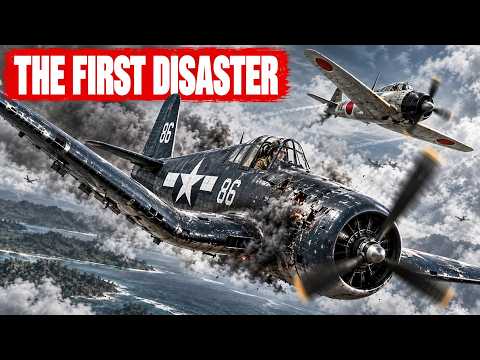
The sky over Guadalcanal was a graveyard of expectations. On February 14, 1943, twelve brand-new Corsairs—an airplane the Navy had already rejected—flew north to meet the most feared fighter in the Pacific. They came back mauled, two of their number shot down, and the survivors haunted by the realization that the legendary Zero was still untouchable in a turning fight. It was a massacre that seemed to prove every doubter right.
But across the water, a quiet Marine from Brooklyn named Kenneth Walsh was already thinking differently. He wasn’t a showman; he was a former mechanic who had learned airplanes from the inside out. And as he sat in the sweltering heat of that battered island, listening to the rain and the distant thump of artillery, he began to suspect the Corsair hadn’t failed because it was a bad airplane. It had failed because it had been flown the wrong way.
On the other side of that same sky flew a Japanese petty officer named Kenji Yanaga. He was 23 years old, a veteran of the brutal Solomons campaign, and in two months he would be guarding the bomber carrying Admiral Isoroku Yamamoto—the architect of Pearl Harbor. Yanaga had watched friends take off and never return. He had flown long missions over open water in a light fighter with no armor at his back. And he belonged to a world that still believed the Zero was invincible.
Within a year, one of these two men would stand in the White House beside the President of the United States. The other would go home with only one hand. And the airplane nobody wanted was about to change the war in the sky.
To understand what happened over the Solomon Islands in 1943, you first have to understand the machine that ruled that sky. The Mitsubishi A6M—the Zero—was a masterpiece of sacrifice. Its designer, Jiro Horikoshi, had been given impossible demands: a fighter that could fly farther, climb faster, and turn tighter than anything it might meet, all on an engine of under 1,000 horsepower. There was only one way to get there. Horikoshi made the airplane brutally, almost recklessly light. He shaved weight from every rib and spar. There was no armor plate behind the pilot’s seat. The fuel tanks had no rubber lining to seal themselves when a bullet passed through. Every pound saved went into range and agility.
For a while, it worked like magic. Over China, Pearl Harbor, the Philippines, and the Dutch East Indies, the Zero cut through everything that rose to meet it. Allied pilots who tried to turn with it died doing it. Rumors spread through ready rooms from Australia to California: the Zero could do anything. The Zero could not be caught. Some men began to believe the rumors. The Japanese pilots who flew it were the finest in the world in early 1942—many had years of combat experience over China, trained in a system so demanding that only a fraction of the young men who entered it ever earned their wings. They were few, and they were superb.
That was the strength of the Japanese naval air arm. It was also the flaw buried deep inside it. Because when you build an air force out of a small number of perfect men in perfectly light airplanes, you had better not lose too many of either.
Half a world away in Stratford, Connecticut, a very different idea had been taking shape. The Vought company had been asked to build a Navy fighter around the most powerful engine it could get: the Pratt & Whitney R-2800 Double Wasp, a massive 18-cylinder radial delivering some 2,000 horsepower. Nothing about it was light. To turn all that power into thrust, the engineers needed an enormous three-bladed propeller, more than 13 feet across—and a propeller that big needed room to clear the ground. So the designers bent the wings. They dropped them down from the fuselage and then swept them back up like the wings of a gull seen from the front. It let them keep the landing gear short and strong. It also gave the airplane a shape no one ever forgot.
They called it the Corsair. In October 1940, the prototype became the first American single-engine fighter to fly faster than 400 mph. For a moment, the Navy was thrilled. Then the problems began.
To make room for a big fuel tank in the fuselage, the cockpit had been pushed far back toward the tail. The pilot now sat behind a long, high nose that blocked almost everything ahead of him on the ground and during the final seconds of a landing. Men took to calling it the hog nose. Coming in low and slow toward a pitching carrier deck, a Corsair pilot often could not see the deck at all.
And when the airplane did touch down, it had a nasty habit. The stiff landing gear could throw it back into the air in a hard bounce. At low speed, one wing could stall before the other, and the airplane could roll without much warning. On a narrow flight deck, there is no room for any of that.
In September of 1942, the Corsair went through carrier trials aboard the escort carrier USS Sangamon. The Navy watched carefully, and the Navy made its decision. For now, the Corsair was not ready to operate from carriers.
The airplane nobody on the carriers wanted went to the Marines. The Marines would fly it from land—from rough island airstrips cut out of jungle and coral, where a bounce on landing meant a bent airplane instead of a dead pilot in the sea. It was not an honor. It was a hand-me-down.
One of the Marines waiting to receive it was a man named Kenneth Ambrose Walsh. He was born in Brooklyn, New York, in November of 1916, and he grew up during the hard years when work was scarce and a steady paycheck meant everything. In December of 1933, at seventeen years old, he enlisted in the United States Marine Corps.
He did not start out as a pilot. He worked as an aviation mechanic and radioman—a young enlisted man with grease under his fingernails, learning airplanes from the inside out. He learned how engines ran and how they failed. He learned how cables and pulleys moved control surfaces. He learned what a wrench feels like at two in the morning on a cold flight line.
Then, in a service where flying was mostly reserved for officers, Walsh earned his wings in 1937 as an enlisted man. He was a private when he did it. For years he flew quietly, without fanfare, building hours that many young officers could only envy. In 1942, the Marine Corps commissioned him. By early 1943, Second Lieutenant Kenneth Walsh was twenty-six years old—older than most of the men around him, and more experienced than nearly all of them.
He was not a showman. Men who knew him remembered him as steady, serious, a little reserved. He did not talk about glory. He talked about how airplanes worked.
His squadron was Marine Fighting Squadron 124—VMF-124—the first Marine squadron to take the Corsair into battle. There had been no time to do it properly. The squadron had trained in the new fighter for only a few months in California. Pilots were still learning the airplane’s quirks when the orders came. They were going to the South Pacific. They were going now.
On the 12th of February, 1943, VMF-124 arrived on Guadalcanal. The island had just changed hands for good. Only days earlier, the last Japanese troops had slipped away by night. The six-month struggle for Guadalcanal was over. But the war for the islands to the north—the long ladder of the Solomons running up toward the great Japanese base at Rabaul—had only begun.
The Marines who stepped out of those new Corsairs found heat that pressed down like a wet blanket. They found mud, mosquitoes, malaria, and dysentery. They found crashed airplanes pushed off the edges of the runways. They found ground crews in ragged clothes who had been fighting this war for months and looked at the shiny new fighters with a mixture of curiosity and doubt.
Three hundred miles to the northwest, at the southern tip of the island of Bougainville, the Japanese were waiting. Their airfield there was called Kahili, near the area the Japanese called Buin. From fields like it, Zeros could reach down the Slot—the long channel of water between the islands—and strike at anything the Americans put into the air.
Among the Japanese naval pilots in that region was a young man from Hokkaido, the cold northern island of Japan. His name was Kenji Yanaga. He was born in March of 1919, which made him about twenty-three years old in early 1943. He was a petty officer, an enlisted naval aviator, much like Walsh had been for so many years.
He had trained with the Kisarazu Naval Air Group in Japan. Later he joined the Sixth Air Group, a fighter unit sent south to the Solomons in the autumn of 1942 that became known as the 204th Air Group. That autumn and winter, Yanaga flew over Guadalcanal during the worst of the fighting. He flew long missions over open water in a light fighter with no armor at his back. He watched friends take off and not come home. By early 1943, he was no beginner. He had become one of the experienced men in his unit.
We know far less about his inner life than about Walsh’s. Japanese records from the Solomons were incomplete, and many were lost. But we know where he was, and we know the war he fought. His was a world of thin rations, tropical sickness, constant American bombing, and a growing silence in the barracks as familiar faces disappeared.
Two young enlisted pilots, two men who loved airplanes, two ideas about how a fighter should be built—one light, the other heavy; one perfected, the other still unfinished. Within forty-eight hours of landing, the Corsair would meet the Zero.
On the morning of the 14th of February, 1943—Valentine’s Day—a strike force took off from Guadalcanal and headed northwest toward Bougainville. At its heart were nine big Navy Liberator bombers, four-engine aircraft heading for Japanese targets in the Buin area. Flying with them were Army Lightnings, twin-boom fighters of the 339th Fighter Squadron. And for the first time, there were Corsairs. Twelve of them from VMF-124.
It was a long flight. The islands slid by below, dark green against a blue so deep it almost looked black. Pilots checked their gauges, checked their fuel, checked the sky. Most of the Corsair men had never fired at an enemy airplane before.
Near Kahili, the Zeros came up to meet them. Accounts disagree about how many. Some say around forty, some say more. What everyone agrees on is that the Japanese pilots knew exactly what they were doing. They were flying from their own field, over their own ground, with fuel to spare. The Americans were at the end of a long flight, burdened by the job of protecting slow bombers.
The Zeros struck. They came in fast, slashed through the formation, and pulled away. They picked off the top cover. They went after the bombers head-on. The sky over Bougainville filled with tracers, smoke trails, and falling wreckage. One of the Liberators was hit in a head-on pass and went down. Another, badly damaged, did not make it home either. The Lightnings of the top cover were overwhelmed. Four of them were lost, and two of the brand-new Corsairs went down.
When the survivors limped back to Guadalcanal and the reports were added up, the numbers were sickening. The Americans had lost two bombers, four Lightnings, and two Corsairs. The Japanese had lost very few airplanes—possibly only one. Men began calling that day the Saint Valentine’s Day Massacre.
For the doubters, it seemed to prove everything. The new fighter was big and fast, but what good was that if its pilots could not survive their first real fight? The Zero still ruled the sky. The rumors were still true.
Somewhere at Kahili that night, Japanese pilots returned to their quarters with a victory to celebrate. Whether Kenji Yanaga flew in that fight, the surviving records do not clearly tell us—but he belonged to that world, and that world was confident.
On Guadalcanal, Kenneth Walsh sat in the heat, listening to the rain, thinking about what had gone wrong. He was not a man who panicked. He was a mechanic before he was a pilot. And mechanics do not curse a machine. They study it.
The Corsair had not failed because it was a bad airplane. It had failed, he suspected, because it had been flown the wrong way. And if that was true, then everything was about to change.
In the weeks after Valentine’s Day, the Marines of VMF-124 lived with two enemies. One was the Japanese. The other was their own airplane. The early Corsairs were temperamental machines. The ground crews on Guadalcanal worked on them under tarps and palm trees, in heat that made metal too hot to touch by mid-morning. Spare parts were scarce. Tools were shared. Mechanics stripped wrecked airplanes to keep the flyable ones in the air.
Oil and hydraulic fluid had a way of misting back from the engine area and smearing across the windscreen, turning a pilot’s view into a greasy blur at the worst possible moment. The canopy of the early model was framed with heavy metal bars, so pilots called it the birdcage. The bars cut the sky into pieces. A Zero could hide behind one of them.
The mechanics themselves were young men, most barely out of high school. They worked in shifts through the night by the dim glow of shaded flashlights, because a lit hangar was an invitation to Japanese bombers. Many were sick with malaria, shaking with fever one day and back on the flight line the next. Their uniforms rotted on their bodies. Their boots fell apart in the mud. They ate canned rations and drank water that tasted of chemicals and rust.
When a Corsair came back shot full of holes, they patched it. When it came back with a dead engine, they swapped it. When it did not come back at all, they stood quietly by the empty parking spot for a moment—and then went back to work on the next one. Every pilot in the squadron knew that his life rested on the hands of men whose names would never appear in any newspaper.
Kenneth Walsh knew it better than anyone. He had been one of those men. He would sometimes stand with the mechanics talking about engines, looking at a problem the way they did. They noticed. Not every officer bothered.
And always there was the nose. That long, high nose. On every landing a Corsair pilot had to come in crabbed slightly sideways, peering around the edge of the engine cowling, hoping the strip was clear, ready for the bounce.
But as the pilots flew more, they began to notice other things, too. When a Corsair pointed its nose down, it accelerated like a falling anvil. Nothing the Japanese had could stay with it in a dive. In level flight at altitude, it was faster than the Zero. It climbed hard at high speed. Its .50-caliber machine guns threw out a stream of heavy bullets that could tear a light airplane apart in a heartbeat.
And there was something else—something the Japanese engineers had deliberately given up. The Corsair had armor plate behind the pilot. Its fuel tanks were self-sealing. It could take hits, sometimes a great many hits, and still bring a man home. The Zero could not.
Slowly, the Americans worked out the rules. They were written in the blood of men who had learned them too late. Never try to turn with a Zero. Never get slow. Never get drawn into a low, tight, twisting fight, because that is the Zero’s world, and in that world it will kill you. Instead, get above it. Use altitude. Come down in a fast diving pass, fire, and keep going. Use the speed to climb back up and do it again. Fly in pairs. Watch your partner’s tail and let him watch yours. Never fight alone if you can help it.
It sounded simple. It was not. It meant fighting against every instinct a young pilot had. When an enemy fighter is right in front of you, everything inside you wants to stay on him, to turn after him, to finish the job. The new rules said, No—take your shot, break away, live.
Kenneth Walsh understood this better than most. He had spent years learning how machines behave, how they wanted to be flown, and what happened when they were pushed past their limits. He thought in terms of energy. Speed and height were money in the bank. A pilot who spent them carelessly would soon be broke, and a broke pilot was a dead one.
He also understood the Zero. He had studied its strengths and its weaknesses. He knew it could outturn him. He knew it could outclimb him at low speed. But he also knew that if he hit it, it would burn.
At night, under the mosquito netting, with the rain hammering the canvas and the distant thump of artillery somewhere out in the darkness, he would turn it over in his mind—the angle of approach, the moment to open fire, the moment to stop firing and get out, how much speed he needed to climb away before a Zero could swing around and bring its cannons to bear. He was not dreaming of medals. He was solving a problem, and the problem had a body count.
All he needed was the chance to prove it.
The chance came on the 1st of April, 1943. That day, Japanese aircraft came down from the north and American fighters rose to meet them. In the tangle of combat over the central Solomons, Walsh did exactly what he had been thinking about for weeks. He kept his speed. He used his height. He picked his moments.
When it was over, he had been credited with three enemy aircraft—two Zeros and a dive bomber. Three kills in his first real fight. It was not luck, and he knew it. It was method. In the ready tent, the younger pilots listened to him more carefully after that.
Far to the north, in the steaming harbor town of Rabaul, the most famous admiral in Japan was preparing a blow of his own. His name was Isoroku Yamamoto. He was fifty-nine years old, the commander-in-chief of the Combined Fleet, the architect of the attack on Pearl Harbor. He had studied in the United States as a younger man. He had seen American factories and American oil fields. He had warned his own government that Japan could run wild for six months or a year—but that after that, he had no confidence at all.
Now, a little more than a year after Pearl Harbor, his warning was coming true. Midway had been lost. Guadalcanal had been lost. The Americans were growing stronger by the month. Yamamoto decided to strike at them from the air. He gathered carrier aircraft and land-based aircraft at Rabaul and in the northern Solomons and launched a great air offensive. The Japanese called it Operation I. Its purpose was to smash American ships and airfields in the Solomons and New Guinea. And Yamamoto came to Rabaul himself to oversee it.
Witnesses remembered him standing at the edge of the airfield in his crisp white uniform, waving his cap as the young pilots took off.
On the 7th of April, 1943, the largest Japanese air raid since Pearl Harbor came down on the waters around Guadalcanal. There were nearly two hundred Japanese aircraft—dive bombers escorted by swarms of Zeros. American fighters scrambled from every field on the island. The sky above Guadalcanal and Tulagi filled with tangled contrails and falling airplanes. Ships in the anchorage threw up walls of anti-aircraft fire.
When it was over, the Americans had lost a destroyer, the USS Aaron Ward, along with a tanker, and the New Zealand Navy had lost a small warship. It was a painful blow—but it was nothing close to what the Japanese pilots reported. The pilots returned with claims of many ships sunk and many American aircraft destroyed. These were young men, many of them inexperienced, reporting what they believed they had seen in the chaos of battle. Smoke looked like fire. A ship hidden by a bomb splash looked like a ship gone under. One damaged plane seen by five different pilots became five victories.
Every air force in the war exaggerated. The Americans did it too. But for Japan at that moment, the exaggerations were dangerous. Because the man at the top believed them.
Yamamoto had reason to think Operation I had succeeded. In mid-April, he ended the offensive and decided to do something he believed would lift the spirits of the exhausted men in the front lines. He would visit them in person. He would fly south to the bases around Bougainville.
A message went out laying out his schedule in detail—when he would leave Rabaul, when he would arrive at Ballale, a small island airfield off the southern tip of Bougainville, where he would go next. The message was encrypted. The Japanese believed it was safe.
It was not. American codebreakers read it. In Washington and at Pearl Harbor, men looked at the decoded text and understood what it meant. Yamamoto was known to be punctual. If his plane took off on time, it would be at a predictable place in the sky at a predictable moment. And that place was within reach of American fighters from Guadalcanal—if those fighters could fly far enough.
The Corsairs did not have the range for a mission like that. The job went to the Army’s twin-engine Lightnings, fitted with extra fuel tanks.
On the morning of the 18th of April, 1943, two Japanese bombers took off from Rabaul. Yamamoto was aboard the first. Members of his staff were aboard the second. Flying above them were six Zeros from the 204th Air Group. Only six. It was a small escort for the most important man in the Imperial Navy. But this was supposed to be a routine inspection flight over territory Japan still controlled.
One of those six pilots was Petty Officer Kenji Yanaga.
The flight went south over the sea in bright morning sunshine. The bombers flew in close formation. The Zeros flew above and behind them, watching. After hundreds of miles of empty water, the jungle of Bougainville rose ahead. They were nearly there.
Then the Lightnings came.
Sixteen American fighters had flown a long, low, carefully planned route from Guadalcanal, staying close to the water to avoid detection. They had timed it almost to the minute. As the Japanese formation began to descend toward its destination, the Americans climbed toward it. The Zero pilots saw them and dove to intercept. The bombers dropped toward the treetops, trying to escape.
For a few frantic minutes, the sky over southern Bougainville became a swirl of twin-boom fighters, Zeros, and two desperate bombers. Yanaga and the other escort pilots fought to get between the Americans and the bombers. They could not.
The first bomber—the one carrying Yamamoto—was hit. It trailed smoke and fire and went down into the jungle. The second bomber was shot down too, crashing into the sea. A few of its passengers survived. No one survived on Yamamoto’s plane.
The next day, a Japanese search party found the wreckage in the jungle. Yamamoto was dead. The surviving Zeros circled for a while over the smoke rising from the trees. There was nothing they could do. Their fuel was limited. Below them lay only jungle, thick and silent, swallowing the wreckage. Eventually they turned away and landed at a nearby base, where they had to report what had happened.
Imagine standing on that airfield, still in your flight gear, sweat soaking through, and saying the words out loud. The commander-in-chief is down.
Imagine being one of the six. You were given one task—to guard the most important man in your navy. A man revered across Japan, the face of the war itself. You had trained for years. You flew one of the best fighters in the world. And you watched his airplane go down in flames below you, and you could not stop it.
The Japanese Navy did not formally court-martial the six escort pilots. But many historians believe that in the months that followed, they were sent into combat again and again with little rest. Whether or not anyone said it aloud, the weight of that morning was on their shoulders.
For Kenji Yanaga, life at the forward bases went on in the same grinding rhythm. Up before dawn, engines coughing to life in the damp air. Long flights over the water, scanning the sky until his eyes burned. Back to a hut where the heat never broke and the mosquitoes never stopped. Rice when there was rice. Sleep when the American bombers allowed it. And around him, the empty spaces kept growing—a cot left untouched, a name no longer called at morning briefing, a set of personal belongings packed into a small box to be sent home to a family in some distant prefecture. The war took them one by one.
On Guadalcanal, the Americans did not announce what they had done. Many of the men who flew that mission were told to keep quiet. If the Japanese realized their codes had been broken, they might change them, and an advantage worth thousands of lives would be lost. So the war in the sky went on as if nothing had happened.
But something had. The man who had planned Pearl Harbor was gone, and the Japanese had lost one of their most capable commanders. And still the Zeros came down the Slot.
On the 13th of May, 1943, Kenneth Walsh was in the air again, east of the Russell Islands, a small group northwest of Guadalcanal where the Americans had built airstrips. Japanese fighters were in the area. Walsh went after them. By the end of the fight, he had shot down three Zeros and damaged a fourth. Added to his earlier victories, that made him an ace. Not just an ace—the first Corsair ace in history. The first man to prove, in a way no one could argue with, that the airplane nobody wanted could beat the Zero.
At the end of May, the Marine Corps promoted him to first lieutenant. Back home, newspapers would eventually tell the story. But on Guadalcanal, nobody threw a parade. There was another mission in the morning. There was always another mission in the morning.
What made Walsh dangerous was not daring. Plenty of men were daring, and many of them were dead. What made him dangerous was discipline. He waited for the right moment. He refused the bad fight. He took the shot that made sense and let the rest go.
Other Corsair pilots were learning the same lessons. More Marine squadrons were arriving with Corsairs. Across the South Pacific, American pilots were becoming more comfortable with the big fighter. They learned to use its speed and its dive. They learned to protect each other. The loss rates began to change.
But the deepest change was happening on the other side of the sky.
The Japanese Naval Air Force had begun the war with a magnificent core of veteran pilots over China. They had polished their skills for years. At Pearl Harbor and through the early victories, they had seemed unbeatable. But the Coral Sea had cost them. Midway had cost them terribly. And Guadalcanal had been a slow, grinding meat grinder that took their best men week after week.
Every veteran shot down over the Solomons was a man Japan could not replace. The pilot training system that had produced such superb aviators was never built for a long war. It turned out too few men too slowly. By the spring and summer of 1943, more and more of the faces in the Japanese ready rooms belonged to young men with only a fraction of the experience their predecessors had had. They were brave. Many of them were very good. But they did not have the years, and their airplanes were starting to show their age.
Maintenance at the forward bases was a constant struggle. Spare parts came slowly down a long supply line under attack by American submarines and aircraft. The Zero itself was still a dangerous fighter in the right hands, but it was no longer the only fast, deadly airplane in the sky—and it had no armor to forgive mistakes.
For the American side, the opposite was happening. Factories in the United States were producing fighters by the thousands. Flight schools were turning out pilots who had more training hours than many Japanese replacements. Squadrons rotated out of combat to rest and came back. Fresh units arrived with new airplanes.
Think of what that meant for a single Japanese pilot at a forward base in the summer of 1943. He looked out over the water and saw more American airplanes every month. Bigger airplanes, faster airplanes, airplanes that did not burn when he hit them. He looked around his own airfield and saw fewer familiar faces every month. He did not need a chart or a report to understand which way the tide was running. He could feel it.
It was not one airplane against another anymore. It was one system against another.
On the 7th of June, 1943, the Japanese launched a large fighter sweep against the Russell Islands. Dozens of Zeros came south looking for a fight. They wanted to draw American fighters into the air and destroy them. They got their fight.
American and Allied fighters rose to meet them. Marine Corsairs, Navy and Marine Wildcats, Army fighters, New Zealand pilots in their own fighters. It became one of the biggest air battles over the Solomons that year.
Kenji Yanaga was flying in that sweep. By now he was one of the veterans. He had survived months of combat. He had survived the Yamamoto mission. He had watched many of his comrades disappear. That day, he was in the tail position of his formation. In a fighter group, that is one of the most dangerous places to fly—the tailman is the one the enemy reaches first.
Two American fighters came at him. They were not Corsairs. They were Wildcats. Grumman F4F Wildcats, the stubby older fighter that had held the line over Guadalcanal in the darkest days of 1942. Slower than the Corsair, slower than the Zero in many respects—the airplane Zero pilots had been taught to look down on.
The two Wildcats caught him and opened fire. Bullets tore into his cockpit. His right hand—the hand that held the control stick—was hit. Most of it was shot away. According to the accounts that survive, only his little finger remained attached.
Imagine the pain of that moment. The blood, the shock, the airplane suddenly without a steady hand on the stick, the open sea far below, and enemy fighters all around. Yanaga survived. How exactly he got out of that sky, the details have faded with time, but he lived. His war as a fighter pilot was over. He was sent back to Japan for treatment and recovery. He would never fly in combat again.
Think about the young man from Hokkaido, lying in a hospital bed, looking down at a bandaged arm where a hand used to be. Two months earlier, he had been chosen to guard the most important man in the Imperial Navy. Now the admiral was dead. Many of his friends were dead. And the war he had given everything to had moved on without him. He was twenty-four years old.
There is something hard and simple in this twist. It was not the famous new Corsair that ended Kenji Yanaga’s war. It was the old Wildcat—one of the airplanes his comrades had once dismissed.
The lesson of 1943 was not that one fighter had suddenly become magical. The lesson was that Japan could no longer afford to lose men, and America could afford to keep coming. The Wildcat and the Corsair, the Lightning and the Warhawk, the bombers and the ground crews and the codebreakers and the shipyards—all of it was coming.
When American and Japanese counts of that June battle were later compared, they did not agree. American pilots claimed far more Zeros than Japan actually lost that day. The Japanese had their own exaggerated claims. In the smoke and confusion, every side saw more than was really there. But the real numbers still told a story. Japan lost experienced pilots it could not replace. America lost men, too—but each loss was followed by a replacement, and another, and another.
By the end of June, the Americans were ready to move again. On the 30th of June, 1943, they landed on New Georgia, aiming for the Japanese airfield at Munda. The ladder up the Solomons had another rung.
The fighting on New Georgia would be miserable, slow, and bloody. For weeks, Marines and soldiers fought through swamp and jungle. Overhead, the air war went on—and Kenneth Walsh was still flying. He had become one of the most experienced Corsair pilots in the Pacific. He had learned the rules and lived by them. He had become what the Japanese Naval Air Force was losing faster than it could replace: a veteran.
But the summer of 1943 was not finished with him yet. Two days in August were waiting. Two days that would bring him closer to death than he had ever been—and closer to the highest honor his country could give.
In early August of 1943, after weeks of brutal jungle fighting, American troops captured the Japanese airfield at Munda on New Georgia. It was a ruined place. Bomb craters pocked the coral runway. Shattered palm trees stood like burned matchsticks. The smell of the dead hung in the humid air. But it was an airfield, and it was closer to the enemy than Guadalcanal. American engineers went to work at once, filling the holes, laying down fresh coral, making it ready for fighters.
The ladder was being climbed one rung at a time. The next rung was Vella Lavella. Instead of attacking the strongly held Japanese positions on the island of Kolombangara, the Americans decided to go around them. On the 15th of August, 1943, troops landed on Vella Lavella, farther up the chain. Leave the strong points behind to starve. Strike where the enemy is weak.
The Japanese answered from the air. Dive bombers and fighters came down to hit the landing beaches and the ships unloading offshore. American fighters were overhead to stop them. Kenneth Walsh was among them.
His division was outnumbered. The Japanese formation was larger than his small group of Corsairs. But Walsh did what he had done all year. He used his speed. He picked his angle. He went in. In the fight that followed, he was credited with two dive bombers and a fighter.
But this time, the enemy hit back. Twenty-millimeter cannon shells slammed into his Corsair. They tore holes in a wing. They punched into the fuel tank. In a Zero, hits like that would very likely have meant a fireball and a death in seconds. In the Corsair, the self-sealing tank and the sturdy structure held. Walsh nursed the battered fighter home and got it down. He climbed out of the cockpit and looked at the damage. Torn metal, holes where there should not be holes. The kind of damage that makes a man understand how thin the line really is.
He had survived because the engineers in Connecticut had decided to build a heavy airplane. Armor and self-sealing tanks—the same weight that made the Corsair harder to handle—had just saved his life.
Two weeks later, he would need every bit of that luck again.
On the 30th of August, 1943, American heavy bombers took off to strike the Japanese airfield at Kahili—the same base where the Corsairs had been mauled on Valentine’s Day. Walsh was part of the fighter escort. Then his engine started to fail.
A fighter pilot with engine trouble over enemy territory has no good options. Walsh turned back and landed at Munda. Most men would have called it a day. They had a valid reason. Their airplane was broken. Nobody would have blamed them.
Walsh did not call it a day. At Munda, he found another Corsair—an airplane from the pool, not even assigned to his own squadron. He climbed in, started it up, and took off alone.
Think about that. A single fighter, flying north by itself, chasing a formation that was already far ahead, toward one of the most heavily defended Japanese bases in the Solomons.
He caught up with the bombers near the target area, and he found them under attack. A large number of Zeros were swarming around the formation. Walsh dove in. He was outnumbered by a huge margin. There was no wingman to watch his tail. Every lesson he had taught younger pilots said not to fight alone. But the bombers were being hit, and he was the one fighter in position to help.
He went after the Zeros attacking the bombers. He fired, pulled away, came around, fired again. In the swirling fight, he was credited with shooting down four Zeros—two near the Shortland Islands and two more near Rennell Island.
But one man cannot fight a crowd forever. His borrowed Corsair was hit badly. Cannon shells and bullets tore into it. The engine began to fail. The airplane was losing power and altitude, still far from any friendly runway. He headed south toward American-held waters. Off the coast of Vella Lavella, he could go no farther. He brought the damaged fighter down onto the sea.
A Corsair ditching in the ocean is a violent thing. The long nose plows into the water. Spray explodes over the canopy. The sudden stop slams the pilot against his harness. And then the airplane starts to sink, and the pilot has only seconds to get out.
Kenneth Walsh got out. He was rescued and brought back to the American lines—bruised and battered, but alive.
Two days: the 15th and the 30th of August. Seven enemy aircraft credited to him in those two fights. Two damaged Corsairs—one shot to pieces, one at the bottom of the sea. And a man who simply refused to stop.
In October of 1943, he left the combat zone and returned to the United States. He had been credited with around twenty enemy aircraft in the Solomons. He had come to the Pacific as the quiet former enlisted mechanic from Brooklyn. He left it as one of the most successful Corsair pilots of the year.
Meanwhile, the war kept moving north. On the 1st of November, 1943, American Marines landed at Empress Augusta Bay on Bougainville. Engineers began building airfields there. Soon, Allied fighters and bombers could reach Rabaul itself. Raid after raid struck the great Japanese fortress. Over the following months, Japanese air strength at Rabaul was ground down. By early 1944, Rabaul was no longer the threat it had been. The Allies did not need to invade it. They simply cut it off and left it to wither.
The Zero kept flying until the end of the war, but it would never again rule the sky the way it had in 1942. Its greatest pilots were mostly gone. The young men who replaced them were brave, but they had less training, fewer hours, and worse odds. The light, beautiful fighter that had once seemed unbeatable had become a fragile airplane in a war of heavy machines.
On the 8th of February, 1944, Kenneth Walsh stood in the White House. President Franklin Roosevelt presented him with the Medal of Honor for his actions on the 15th and the 30th of August, 1943. The private who had earned his wings in 1937, the mechanic who had learned airplanes from the inside out, now wore the highest military decoration the United States can give.
He did not become a celebrity. He stayed in the Marine Corps. He kept flying. He served through the rest of the war and beyond, and he retired as a lieutenant colonel in 1962. He settled with his family in Southern California—a quiet man, as he had always been.
And what about the airplane nobody wanted? The Corsair stayed in service with the Marines and eventually the Navy and the British Fleet Air Arm. Its carrier landing problems were gradually solved, and later in the war, it flew from carriers. After all, over the course of the war, Corsair pilots were credited with a kill ratio often quoted at around 11:1.
It is worth being honest about that number. It comes from claims made in the heat of combat. And like every air force in the war, American pilots sometimes claimed more than they truly destroyed. The real ratio was almost certainly lower. But even after the exaggerations are stripped away, the direction is clear. The Corsair had become one of the most feared American fighters in the Pacific.
And yet, the Corsair did not win the battle for the Solomons alone. Neither did Kenneth Walsh. The victory belonged to a whole machine. The codebreakers who read Yamamoto’s schedule. The mechanics working through malaria nights. The factories that turned out thousands of fighters. The training schools that sent pilots west with hundreds of flying hours. The old Wildcats that kept fighting long after their glory days. The engineers who chose armor over lightness.
Japan had built a perfect sword. America had built a forge.
So what became of Kenji Yanaga?
He went home to Japan. He survived the rest of the war. He lived through the bombing of Japanese cities, the surrender, the American occupation, and the long, hard rebuilding afterward. Of the six pilots who flew escort for Admiral Yamamoto on that April morning in 1943, he is generally described as the only one who lived to see the end of the war. None of the others survived.
He carried that morning with him for the rest of his life. He carried the memory of the burning bomber, the empty sky afterward, the friends who did not come back. And he carried the absence of his right hand—a permanent reminder of a June day over the Russell Islands and two American Wildcats.
Decades later, his signature appeared on a commemorative poster marking the anniversary of the Yamamoto mission, alongside the names of veterans from the other side of that sky. Former enemies, now old men, remembering the same morning from opposite ends of the gunsights.
Kenji Yanaga died in Tokyo on the 29th of February, 2008. He was eighty-eight years old.
Two young enlisted pilots—one from Brooklyn, one from Hokkaido. They never met in the air, as far as any record shows. They fought in the same sky, in the same year, over the same islands, in two very different airplanes built on two very different ideas.
One idea said: Make it light, make it perfect, and trust the best men in the world to fly it. The other said: Make it strong, make it fast, make a lot of them, and train enough men to keep them in the air.
In 1942, the first idea looked unbeatable. By the end of 1943, over the jungles and the dark blue water of the Solomon Islands, the answer was written in burning wreckage, in empty cots, and in a medal pinned on a quiet Marine. The Zero had been a legend. The Corsair—the airplane nobody wanted—had shown the world that legends can be beaten.
So here is the question that remains, hanging in the air like a contrail at dusk: if a machine is built to be perfect for a short, brilliant moment, and another is built to endure a long, ugly war—which one would you choose, knowing that the men who fly them are never perfect at all?
Report this article
Select a reason for reporting:






