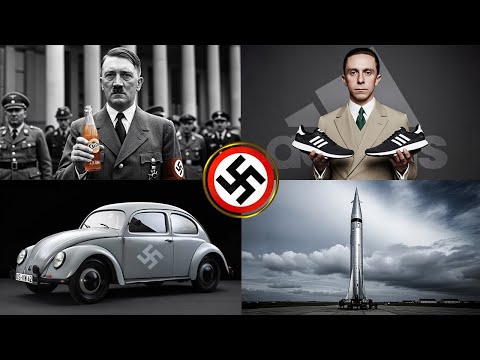
You’re surrounded by Nazi inventions—and nobody told you. The can of Fanta in your hand, the highway you drive on, even the sleek design of a BMW—all trace back to the darkest chapter of the 20th century. How did inventions born from a totalitarian regime become everyday essentials? The answer is more unsettling than you think.
During World War II, Nazi Germany unleashed an unprecedented wave of innovation, driven by military desperation and economic isolation. From the first assault rifle to the jet fighter, these creations didn’t just change the battlefield—they reshaped civilian life forever. But the story begins with a simple soft drink, born out of scarcity and survival.
In 1939, as trade embargoes cut off Coca-Cola’s German branch from key ingredients, director Max Keith faced a choice: shut down or improvise. He chose the latter, ordering his team to concoct a substitute from whey, apple residues, and fruit scraps. The result was a yellowish, sweet liquid that would soon be named Fanta. “We weren’t aiming for a perfect flavor, but a viable product amidst scarcity,” Keith later recalled. Little did he know, this improvised drink would sell over 3 million cases by 1943 and become a global icon.
But Fanta was just the beginning. In the military realm, the STG-44 assault rifle revolutionized combat, introducing the concept of an intermediate cartridge and selective fire. “It allowed soldiers to alternate between precise shots and rapid bursts, reducing exposure to the enemy,” one report noted. Its influence echoed in the AK-47 and M16, shaping modern warfare for decades.
Meanwhile, the Volkswagen Beetle, conceived as a “people’s car” under Hitler’s vision, survived the war to become a symbol of practical mobility worldwide. And the Autobahn, initially a propaganda tool, inspired Eisenhower’s interstate highway system. “The highways were meant to showcase the state’s organizational capacity,” a historian explained, “but their legacy is one of connectivity, not ideology.”
Even the Olympic torch relay, a tradition now celebrated globally, was invented for the 1936 Berlin Games as a propaganda spectacle. These inventions, tainted by their origins, were later reinvented and embraced by the world. But their stories raise a troubling question: can we separate innovation from the regime that birthed it?
As we delve deeper, you’ll discover how a night vision device, a stealth bomber prototype, and even a stimulant pill left indelible marks on technology and society. The paradox of Nazi legacy is that it surrounds us—often unnoticed, yet impossible to ignore.
Take the jet engine, for instance. The Messerschmitt Me 262 was the world’s first operational jet fighter, capable of exceeding 870 km/h—far faster than any Allied propeller-driven aircraft. “It went by like we were standing still,” one Allied pilot recalled. Its swept wings and underslung engines became the blueprint for postwar jet design, from the Soviet MiG-15 to the American F-86 Sabre.
But the Me 262’s story is also one of missed potential. Hitler insisted it be used as a bomber rather than a fighter, wasting its speed advantage. “The aircraft was a fighter, not a bomber,” engineer Willy Messerschmitt protested, but to no avail. By the time it entered combat in 1944, Germany was already crumbling.
Yet its influence was undeniable. After the war, Allied engineers dissected captured Me 262s, and its design principles—swept wings, axial-flow engines—shaped the first generation of Cold War jets. In Czechoslovakia, it was even produced as the Avia S-92, serving until the early 1950s.
Similarly, the V-2 rocket, the first human-made object to reach space, became the foundation for both American and Soviet space programs. “We were building on Nazi technology,” admitted Wernher von Braun, who later led NASA’s Apollo program. The V-2’s liquid-fuel engine and guidance system were directly adapted into the Redstone and R-1 missiles.
And then there’s the HO 229, the flying wing prototype that hinted at stealth technology. Its triangular shape and lack of vertical tail were decades ahead of their time. “It was a glimpse of the future,” said one American engineer who examined it. The HO 229’s principles later influenced the B-2 Spirit bomber, though the connection is rarely acknowledged.
Even the Enigma machine, the Nazi encryption device, inadvertently spurred the birth of modern computing. Alan Turing’s efforts to crack it led to Colossus, the first programmable digital computer, and laid the groundwork for cryptography as we know it.
These inventions, born from a regime of oppression and desperation, were later stripped of their political context and embraced for their utility. But their origins remain a stark reminder: innovation can emerge from the darkest places, and its legacy is never simple.
Consider the Vampir ZG 1229, an infrared night-vision scope mounted on the STG-44 in the final months of the war. It weighed over thirty kilograms with its battery pack, yet it allowed a soldier to distinguish a human silhouette at seventy meters in total darkness. “Some veterans recalled seeing rifles with flashlights that didn’t shine,” one account noted—the infrared beam invisible to the naked eye.
Impractical as it was, the Vampir foreshadowed everything from Vietnam-era starlight scopes to the thermal cameras in today’s security systems and hunting optics. The principle—illuminating the dark with light the enemy cannot see—was born in a collapsing Reich and perfected by generations that followed.
Then there is Pervitin, the methamphetamine pill distributed by the millions to Wehrmacht troops during the Blitzkrieg. Soldiers marched for days without sleep, feeling invincible, only to crash into paranoia and addiction. “The high command prioritized immediate performance over consequences,” a military historian observed.
After the war, its chemical base—N-methylamphetamine—became the template for modern stimulants, both prescribed and illicit. Derivatives like Desoxyn found legitimate medical use; crystal meth found the streets. The line between a soldier’s ration and a public health crisis runs straight back to a Berlin pharmaceutical lab.
And what of the Autobahn? Eisenhower never forgot the smooth, grade-separated roads he saw in Germany. As president, he pushed through the Interstate Highway System in 1956, openly crediting the German model. “The German model’s influence was direct and openly acknowledged,” engineers of the era admitted. Today, billions of drivers travel networks whose DNA was written in the 1930s.
Even the humble Hugo Boss uniform contracts tell a story of reinvention. From SS uniforms sewn by forced laborers to the suits of Wall Street executives, the brand rebuilt itself across decades. “It shifted from dressing soldiers to dressing businessmen,” a fashion analyst noted, though the company’s wartime past resurfaced in 2015 when a Fanta anniversary campaign sparked outrage for erasing history.
That controversy is the thread running through all these inventions: the refusal to forget. Each product—the Beetle, the jet, the rocket, the pill—carries a dual identity, one of ingenuity and one of complicity. The world adopted the technology but often buried the context.
So the next time you crack open a cold can, merge onto a highway, or board a jetliner, remember: the modern world was built in part by hands we would rather not thank. The question is not whether these inventions shaped our lives—they clearly did. The question is what we do with that uncomfortable inheritance.
That inheritance is not just a museum piece. It lives in the quiet architecture of your day. The can in your hand, the road under your tires, the encryption protecting your messages—each carries a faint, uncomfortable fingerprint.
Perhaps the real lesson is not to condemn or celebrate, but to see clearly. “Every technology has a biography,” one historian wrote, “and ignoring its first chapters doesn’t erase them.” The Nazi regime proved that necessity and ideology can accelerate invention—but also that progress without conscience leaves scars.
After 1945, the world chose to study, adapt, and rebrand. Von Braun went to NASA. The Me 262’s DNA flew in Cold War skies. Fanta returned as a cheerful orange drink, its wartime origin buried in corporate archives. The STG-44’s logic armed the AK-47. The Autobahn became a global standard. None of it was inevitable—it was a choice.
Today, as new technologies race ahead—AI, gene editing, autonomous weapons—the same questions return. Who benefits from innovation? Who bears its costs? And when the dust settles, what will we choose to remember?
The paradox endures: the modern world was shaped by hands we would rather not thank. But acknowledging that debt is the first step toward ensuring the next chapter is written differently.
So here is the question for you: knowing what you now know, can you still enjoy a cold Fanta on a German highway—or does the history change the taste? Share your thoughts in the comments below.
Report this article
Select a reason for reporting:






