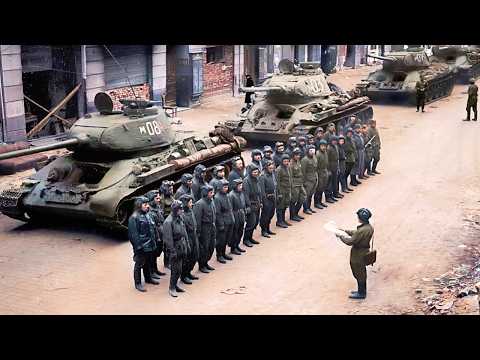
The roar of artillery shattered the silence of the night. On April 16, 1945, the Soviet war machine unleashed hell upon the gates of Berlin. For four years, the Red Army had clawed its way westward, and now, just 70 kilometers from the Führer’s bunker, the final reckoning had begun. The sky burned red as thousands of guns opened fire, and the earth trembled under the weight of 6,000 tanks and 7,500 aircraft. This was not just a battle—it was the death knell of the Third Reich.
But Berlin was no easy prize. Hitler had turned the city into a fortress, ringed by three defensive lines, with every street, every building, every subway tunnel transformed into a killing ground. The Germans had learned from Stalingrad and Budapest; they would make the Soviets bleed for every inch. “The Führer believes Berlin is impregnable,” one officer remarked, but the men in the trenches knew better. They had seen the endless columns of Soviet armor, the sheer scale of the onslaught, and they whispered among themselves: “This time, there is no retreat.”
Stalin was impatient. He feared the Western Allies might reach Berlin first, and he ordered Zhukov to take the city at any cost. The race was on. But as the first waves of Soviet infantry advanced, they were met with a hail of fire from the Seelow Heights. The German defenses, dug into the ridges, poured down murderous fire, and the advance stalled. “We are crawling over the bodies of our comrades,” a Soviet sergeant later recalled. The cost was staggering—some rifle divisions lost up to 60% of their men in the first two days.
Zhukov, under immense pressure from Stalin, threw his reserves into the meat grinder. The air was thick with smoke and the stench of death. Tanks burned, and the screams of the wounded echoed across the fields. “Comrade Stalin expects results,” Zhukov reportedly snapped at his commanders, “and we will deliver them.” But the Seelow Heights held, and the delay cost precious time. Meanwhile, Konev’s 1st Ukrainian Front, advancing from the south, was making better progress. Stalin, ever the pragmatist, redirected Konev’s tank armies northward, hoping to encircle Berlin from below.
By April 20—Hitler’s 56th birthday—the first Soviet shells began to fall on the city center. The Führer, holed up in his bunker, refused to believe the reports. “The Russians are at the gates? Nonsense!” he raged, but the explosions above ground told a different story. The end was near, and everyone knew it. The question was no longer if Berlin would fall, but when—and at what cost.
As the Red Army pushed into the suburbs, the fighting devolved into a brutal street-by-street slaughter. German troops, many of them old men and boys from the Volkssturm, fought with desperate fanaticism. “Better to die than surrender,” was the mantra, but death came all the same. The Soviets, hardened by years of war, showed no mercy. “We have seen what they did to our homeland,” one soldier said. “Now it is their turn.”
The city became a labyrinth of death. Subway tunnels echoed with gunfire, and the ruins of buildings became sniper nests. The Soviets adapted, using flamethrowers and explosives to clear each strongpoint. “The fascists fight like rats,” a Soviet lieutenant noted, “but rats can be smoked out.” And so they were—one bunker, one building, one street at a time.
By April 28, the Red Army had reached the Moltke Bridge and the Reichstag. The symbol of Nazi power was within sight, but the Germans defended it fiercely. “For the Reichstag! For the Führer!” they cried, but their cries were drowned out by the thunder of Soviet guns. The end was coming, and nothing could stop it.
Inside the bunker, Hitler made his final preparations. He married Eva Braun, dictated his will, and prepared for the end. The news from the front was catastrophic—the 12th Army’s counterattack had failed, and the 9th Army was encircled. “The war is lost,” Hitler admitted to his generals. “But we will not surrender.” And so the bloodshed continued, as the Red Army closed in for the kill.
The final assault on the Reichstag began on April 30. Soviet soldiers, many of them from the 150th Rifle Division, fought their way into the building, clearing room after room in savage hand-to-hand combat. “The flag! Raise the flag!” someone shouted, and soon the red banner fluttered over the shattered dome. It was a moment of triumph, but the fighting was not over. The Germans fought on, and the streets of Berlin ran red with blood.
By May 2, the city was silent. The guns had stopped, and the survivors emerged from their cellars, blinking in the sunlight. “Is it over?” a woman asked. “Yes,” a Soviet soldier replied. “It is over.” But the cost had been immense—over 80,000 Soviet soldiers lay dead, and the Germans had lost hundreds of thousands more. Berlin was a ruin, and the Third Reich was no more.
Yet even as the smoke cleared, the world was changing. The Cold War was already beginning, and the division of Germany was just the first chapter. But for now, the soldiers celebrated, their tanks adorned with red flags, their hearts filled with relief. “We have won,” they cheered, “but the price was terrible.” And as the sun set on Berlin, the survivors knew that nothing would ever be the same again.
The silence that followed was heavier than any bombardment. In the cellars and subway stations, where thousands had huddled through the final days, people began to emerge—tentatively at first, then in a flood. They walked past burning tanks and shattered facades, past the bodies of soldiers and civilians alike, their faces blank with shock. “I never thought I would see the sun again,” an old woman whispered, clutching a photograph of her son. A Soviet medic offered her water, and she took it without a word.
For the Red Army soldiers, the victory was bittersweet. They had dreamed of this moment for four long years, but the reality was a city of ashes and corpses. “We wrote our names on the Reichstag walls,” one sergeant recalled, “but I could not stop thinking of my brother, who died at Stalingrad.” Others simply sat on the rubble, too exhausted to cheer. The vodka ration was passed around, but few drank. The war was over—at least in Berlin.
Yet the fighting continued elsewhere. In Czechoslovakia, the last German forces were still resisting, and the 1st Ukrainian Front was ordered to push toward Prague. “We have no time to rest,” Konev told his commanders. “The war is not over until the last fascist lays down his arms.” And so, even as Berlin smoldered, the tanks rolled eastward once more, toward a final reckoning in the hills of Bohemia.
Meanwhile, in the ruined Chancellery, Soviet officers searched for Hitler’s remains. The reports were confused—some said he was dead, others that he had fled. “Find him,” Stalin ordered. “I want proof.” The charred bodies found in the garden were identified as Hitler and Eva Braun, but the Soviet leader remained suspicious. The myth of the Führer’s escape would linger for decades, feeding conspiracy theories and doubt.
The political fallout was immediate. Churchill, who had urged the Western Allies to take Berlin, watched with grim satisfaction as the Soviet flag flew over the Reichstag. “The Russians have won the race,” he wrote to Roosevelt, “but at what cost to Europe?” The division of Germany was already being drawn on maps in London, Washington, and Moscow, and the lines of the Cold War were hardening even before the guns fell silent.
For the ordinary soldiers, however, the politics mattered little. They had survived. “I am going home,” a young Soviet private wrote in his diary. “I do not know what I will find there, but I am going home.” His words echoed the thoughts of millions—Germans, Russians, Americans, and Britons alike—who had endured the greatest war in history and now faced an uncertain peace.
On the night of May 8, the surrender was signed in Karlshorst. The ceremony was brief and somber. Zhukov, representing the Soviet Union, signed the document with a steady hand, while the German generals, led by Field Marshal Keitel, looked on in silence. “The war is over,” Zhukov declared, and the room erupted in cheers. Outside, the soldiers fired their rifles into the air, and the sky over Berlin was lit with flares and fireworks.
But the celebrations were muted by the scale of the destruction. The city was a graveyard, and the task of rebuilding would take decades. “We have won the war,” a Soviet general remarked, “but now we must win the peace.” It was a sentiment that would define the coming era, as the former allies turned their eyes toward each other and the world settled into a new and dangerous equilibrium.
In the weeks that followed, the Red Army began the grim work of clearing the rubble and burying the dead. The smell of decay hung over the city, and disease threatened to spread. “We must act quickly,” the Soviet command ordered, and soon thousands of German civilians were conscripted into labor brigades, clearing streets and rebuilding bridges. It was a harsh peace, but few complained—they had seen too much to expect mercy.
The surrender signed at Karlshorst was not the end of the bloodshed. In the hills of Bohemia, the last German armies still held out, and Konev’s tanks raced toward Prague to cut them off before they could surrender to the Americans. “We must reach Prague first,” Konev ordered, and on May 9 his spearheads rolled into the Czechoslovak capital to find it already rising in revolt. The German garrison collapsed, and the final pocket of resistance in Europe was snuffed out.
For the men who had stormed the Reichstag, the victory brought no rest. They were set to work clearing the ruins, burying the dead, and feeding the living. Berlin was a city of women and children now, and the occupation was as harsh as the war had been. “We did not come to be kind,” one Soviet officer admitted. “We came to make sure this never happens again.”
The world that emerged from the ashes was already divided. In Potsdam, the victors argued over the future of Germany, and the alliance that had won the war began to crack. “The Soviets have taken half of Europe,” Churchill warned, and the Iron Curtain began to fall. The soldiers who had fought side by side in Berlin now eyed each other across a new and dangerous line.
Yet for a brief moment, there was peace. The guns fell silent, the fires burned out, and the survivors—German and Russian alike—looked up at the same sky. “We have seen the worst of humanity,” a Soviet veteran wrote, “and now we must build the best of it.” It was a hope as fragile as the ruins around them, but it was all they had.
And so the war ended—not with a grand gesture, but with a signature, a flag, and a city in ruins. The Reich that was to last a thousand years had crumbled in twelve, and the world would never be the same. The survivors carried their scars into a new age, and the question that haunted them all was simple: could humanity learn from its own destruction, or would it simply build new weapons and new walls?
What do you think—was the fall of Berlin truly the end of an era, or just the beginning of a new and colder conflict?
Report this article
Select a reason for reporting:






