Just after midday on June 18, 1815, a giant ax-wielding Frenchman named Sous-Lieutenant Legros—known to his men as “the Smasher”—led 40 soldiers in a desperate charge at the north gate of Hougoumont farmhouse. Cutting down red-coated Guardsmen, he hacked into the thick oak gate, desperate to break through. Inside, British soldiers pushed frantically to keep it closed. What followed was one of the bloodiest, most brutal episodes of the Battle of Waterloo—a fight so pivotal that the Duke of Wellington later declared, “The success of the battle turned upon the closing of the gates at Hougoumont.”
But why was this farmhouse so crucial? What was at stake? And how did that desperate struggle unfold? Using veteran testimony, a previously unseen 3D reconstruction, and the latest archaeological evidence, we explore the story of the battle for Hougoumont—a fight that would decide the fate of Europe.
By 1814, Napoleon Bonaparte—once master of 50 million Europeans—ruled only a tiny island exile. But on February 26, 1815, he slipped past guards and sailed back to France, landing near Monaco. Within 20 days, the Bourbon monarchy had fled, and Napoleon was carried into Paris on the shoulders of his men, emperor once more.
Meanwhile, the Allied leaders at the Congress of Vienna scrambled to respond. An Anglo-Dutch army of 74,000 under Wellington gathered in Belgium, while Marshal Blücher’s Prussians mobilized 99,000 to the south. The plan was to invade France by July 1, but Napoleon struck first.
On June 15, his Army of the North crossed the border, aiming to split the Prussians and Anglo-Dutch before they could unite. Wellington, caught off-guard at a ball in Brussels, exclaimed, “Napoleon has humbugged me, by God! He has gained 24 hours march on me.”
Two days later, Napoleon defeated the Prussians at Ligny, but they withdrew intact. He sent 30,000 men under Marshal Grouchy to pursue them, while Marshal Ney attacked the crossroads at Quatre Bras. Wellington’s forces held, and by nightfall, the advantage was lost.
On the morning of June 17, Wellington learned Blücher had retreated toward Wavre. He decided to fall back to a ridge south of a little-known town called Waterloo—crucially within reach of Prussian support.
The battlefield was compact: just one mile deep and two miles wide, where 200,000 combatants and 60,000 horses would clash. Wellington placed the bulk of his 70,000 men along the reverse slope of the Mont-Saint-Jean ridge, protecting them from French guns.
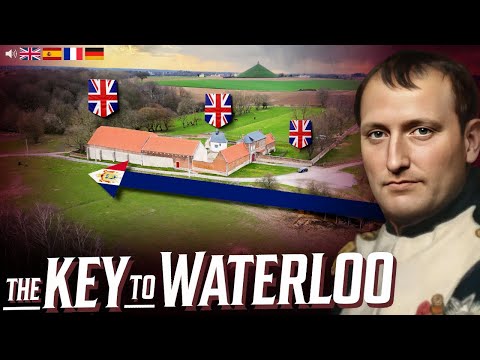
He anchored his position on three strong points: Fichermont and Papelotte on his left, La Haye Sainte in the center, and Château Hougoumont on his right—our focus for the fight to come.
Hougoumont was a sprawling farm complex with two courtyards, a chapel, a formal garden, and an orchard. To its south lay a large wood, and between the wood and the garden wall was a 30-meter open gap—soon to be known as “the killing ground.”
Defending this vital position were 1,850 Allied troops, including Lieutenant Colonel James Macdonell of the Coldstream Guards, 19-year-old Guardsman Matthew Clay, and Nassau private Johann Peter Leonard. Across the valley, 19-year-old Private Louis Deloe of the 93rd Regiment prepared to assault with 13,000 Frenchmen.
As dawn broke on June 18, Guardsman Clay recalled: “We procured some fuel from the farm at Hougoumont, then lighted fires and warmed ourselves, our limbs being very much cramped from sitting on the side of the wet ditch the whole night.” Defensive preparations were underway—loopholes knocked in walls, makeshift fire steps built. The French too prepared.
Napoleon’s plan was to smash Wellington’s center with a massive artillery barrage, then launch a diversionary attack on Hougoumont to draw reserves away from the ridge. At 11:30 AM, the battle began as Prince Jérôme Bonaparte’s division advanced on the farm.
French battalions marched forward, but as they entered the wood, Nassau and Hanoverian skirmishers picked them off. “The English batteries opened a lively fire, which knocked over 20 men of the second battalion,” recalled Private Deloe. “It is very trying to wait for death in such circumstances.”
It took an hour for the French to clear the wood. Emerging into the killing ground, they were met by a hail of musket fire from loopholes and walls. “The shower of balls that we loosed off on the French was so terrible that the grass was soon covered with French corpses,” said Private Leonard.
In the first wave alone, bodies piled up at the base of the wall. General Pierre Bauduin, leading the assault, was killed. The French briefly broke into the orchard, but Lord Saltoun’s light companies counterattacked, driving them out. The first assault had failed.
Around midday, Jérôme launched a second assault. This time, Legros and his 40 men reached the north gate, hacking it open. “The ferocity of Legros’s attack was rapidly clearing the lower courtyard,” but Colonel Macdonell, with Sergeant James Graham, rushed to close the gate. “With the gates closed, Macdonell and his men turned and dispatched Legros and every single one of the attackers save a young French drummer boy.”
By 1 PM, the second wave had failed. But Napoleon ordered Marshal d’Erlon’s corps against Wellington’s center, and the fight at Hougoumont intensified. General Foy’s division joined the assault, enveloping the position. The defenders, outnumbered four to one, held on.
French artillery was brought forward, including howitzers lobbing shells into the farm. Fires broke out. Wellington sent a message to Macdonell: “I see that the fire has communicated itself to the roof of the château. You must however still keep your men in the parts to which the fire does not reach.”
Over 700 of Macdonell’s men were wounded, many burned alive as fire spread. Sergeant Graham saved his wounded brother from the burning barn. In the chapel, a wooden crucifix was scorched but the fire abated—many believed it a miracle.
As ammunition ran low, Private Joshua Brewer of the Royal Wagon Train drove a wagon of cartridges down to the farm under heavy fire. “To that man’s service the guards owe their ammunition,” a staff officer noted. With resupplied ammunition, the defenders held.
By late afternoon, Hougoumont remained in Allied hands. The French assault had failed, and Napoleon’s diversion had become a costly stalemate. The battle would rage on, but the defense of Hougoumont had already shaped the outcome.
As darkness fell, the cries of the wounded echoed through the night. Matthew Clay, exhausted, cooked his pork over a fire that turned out to be a burning corpse. “My meat which was unsavory in the morning became much more so by its redressing.”
Ten days later, a visitor described the funeral pyres: “The fire was being fed solely by human fat. There were thighs, arms, and legs piled up in a heap.”
The defenders of Hougoumont could not have known that the fate of Europe for a century had been shaped by their actions. But theirs is only one part of the story. We will return to Waterloo again soon to march on other corners of the battlefield.
Yet even as the sun sank and the guns fell silent, the true cost of Hougoumont was only beginning to be counted. Inside the great barn, the wounded lay in rows upon straw blackened with powder and blood, and the surgeons worked by candlelight with saw and probe. “The groans of the dying and the shrieks of those under the knife were enough to chill the blood of the stoutest man,” one Guardsman remembered. Many of the men who had held the walls through nine hours of hell would never lift a musket again.
Among the survivors, exhaustion gave way to a strange, hollow quiet. Private Leonard of the Nassau battalion sat against the scorched chapel wall and stared at the orchard he had helped defend. He would later write that he could not recall a single face of the Frenchmen he had killed—only the endless grey coats emerging from the smoke, and the terrible slowness of the musket reload.
For the French, the failure at Hougoumont cut deeper than any single defeat. Private Deloe, who had watched his battalion shredded in the killing ground, recorded the bitterness of the retreat: “We had been told the farm would fall in an hour. We left a third of our comrades in that cursed orchard, and the farm still stood.” Jérôme Bonaparte’s division—once 7,500 strong—limped from the field a broken formation, its attack having consumed the flower of Reille’s corps for no gain.
But the story of Hougoumont did not end with the battle. In the years that followed, the farm became a place of pilgrimage—and of plunder. Sightseers hacked splinters from the famous gate, and farmers dug lead from the walls by the bucketful. The scorched crucifix in the chapel drew crowds who whispered of miracles, while the orchard was replanted over soil still thick with musket balls.
It was only in the twentieth century, as the last veterans passed into memory, that archaeologists began to uncover what the soldiers themselves had buried. Excavations by Waterloo Uncovered have since recovered hundreds of musket balls concentrated along the garden wall—precisely where the fighting raged fiercest—along with buttons, buckles, and the grim detritus of a close-quarters slaughter.
One find in particular stunned the researchers: a human skeleton, buried hastily in a shallow trench near the south gate, still bearing the marks of a violent end. Whether Guardsman or Frenchman, no one can say for certain. “He was one of the men who decided the fate of Europe,” the lead archaeologist observed, “and history had forgotten even his name.”
Yet the question remains: why did Hougoumont matter so much? Wellington himself answered it plainly. The farm anchored his right flank, and so long as it held, the French could not turn his line. Every brigade Jérôme threw against those walls was a brigade that never marched on the Allied center. The diversion Napoleon intended had become a trap of his own making—a wound that bled his army white while Wellington’s center stood firm.
And there is another, quieter reason. Hougoumont was never merely a strongpoint. It was a promise—that the Allied line would not break, that the men who held it would not yield. “We were told to hold the farm,” Matthew Clay wrote years later, “and we held it. That is all.”
But the battle was far from over. As night gathered over the ridge of Mont-Saint-Jean, Napoleon prepared his final, desperate gamble—the assault of the Imperial Guard itself. And at La Haye Sainte, the center of Wellington’s line, another farm was about to fall.
As the Imperial Guard’s columns surged up the slope toward Wellington’s ridge, the men who had bled at Hougoumont listened from their shattered walls. They could not see the crisis, but they heard it—the rolling thunder of cannon, the distant cheers, then suddenly the strange, swelling roar of the Allied line as the Guard broke and fell back.
“The whole army advanced at once,” one defender recalled, “and we stumbled out of the farm to join them, too exhausted to cheer.” Matthew Clay, his musket still fouled from the morning’s pork, followed the line forward through the wood, driving the last dejected Frenchmen before them.
By nightfall, the field belonged to the Allies. Napoleon’s empire was finished, and the farm that had held his diversion in check became a legend. Wellington later wrote that “the whole of the battle hinged upon the closing of the gates at Hougoumont.” Yet for the men who fought there, it was simpler: they had been told to hold, and they held.
Today, the chapel crucifix still bears its scorch marks, and the walls still hold the scars of musket balls. Waterloo Uncovered continues to uncover the stories of those who fell—and of those who survived to tell it.
But one question lingers over the quiet orchard: if those gates had fallen that day, would Europe’s map look the same today? What do you think—was Hougoumont the true turning point of Waterloo? Share your thoughts below.
Report this article
Select a reason for reporting:






