The silence in the briefing room at Firebase Coral was suffocating. On the projector screen, a grainy reel from a joint patrol three days earlier looped endlessly: four Australian SAS soldiers walking within two meters of a Viet Cong listening post. The enemy fighter was clearly visible, AK-47 resting on his knees, eyes scanning the jungle. Yet the Australians—each carrying over 30 kilograms of gear—strolled past him at a normal pace. They didn’t run. They didn’t crawl. They simply moved like ghosts through hostile territory, and the enemy never noticed.
Captain Reeves, a hardened Green Beret with two tours under his belt, stopped the footage and rewound it. Same result. He leaned forward, squinting at the screen as if the image might reveal a trick. “How in the hell do they do that?” a sergeant behind him muttered. The question hung in the air, unanswered.
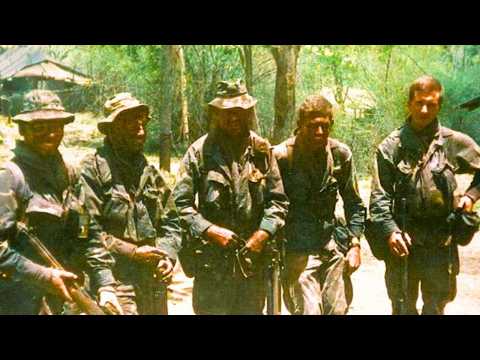
It was January 1967. The US military had been fighting in Vietnam for over two years with the most technologically advanced arsenal ever assembled. They had napalm that could incinerate forests, artillery that could level grid squares, and helicopter gunships that turned night into day. They had the best training facilities in the world, unlimited ammunition, and a military doctrine written by generals who had won World War II. But in that room, watching four Australians do something American doctrine said was impossible, those advantages suddenly felt hollow.
The Australians weren’t just surviving the jungle—they were thriving in it, becoming part of it, mastering it in ways that made American methods look clumsy and outdated. And the most unsettling part wasn’t what the Australians did. It was how the Americans reacted.
These weren’t raw recruits fresh off a plane from basic training. These were seasoned Green Berets, men who had survived the brutal selection process at Fort Bragg, men who considered themselves the elite of the elite. And they were staring at that screen like children watching a magic trick they couldn’t comprehend.
The reaction spread far beyond that room. Across Phuoc Tuy Province, wherever American and Australian forces operated in close proximity, the pattern repeated. American soldiers would watch their allies prepare for patrol, and the confusion would start immediately. It began with the smell—or rather, the absence of it.
American soldiers in Vietnam maintained strict hygiene standards because that’s what professional soldiers did. They shaved every morning, brushed their teeth with mint-flavored paste, used deodorant to combat the oppressive humidity, and changed their socks regularly to prevent foot rot in the jungle. The Australian SAS preparing for a long-range patrol did the exact opposite.
Three weeks before infiltration, they stopped using soap entirely. Two weeks out, they abandoned deodorant. One week before the patrol, they quit toothpaste and chewed local plants instead to maintain oral health. By the day of insertion, they smelled exactly like the jungle—a blend of earth, sweat, and vegetation rot that was biologically indistinguishable from the environment they were about to enter.
The first time an American logistics officer caught a whiff of an Australian patrol staging area, he assumed there had been a catastrophic breakdown in unit discipline and reported it immediately up the chain of command. The response he received was not what he expected. He was told that the smell wasn’t evidence of failure. It was tactical doctrine—the very reason Australian patrols achieved contact rates American units couldn’t match.
Confusion deepened when American observers watched how the Australians prepared their equipment. US military doctrine emphasized standardization. Every soldier carried the same basic load, used the same weapons systems, wore the same uniform. This created logistical efficiency and ensured that any soldier could use any other soldier’s equipment in emergencies. The Australians treated their gear like custom race cars, modifying everything until it barely resembled the original.
They took brand-new L1A1 rifles—precision weapons accurate to 400 meters—and attacked them with hacksaws. They cut 15 centimeters off the barrel and welded crude forward grips made from scrap metal. They wrapped every metal surface in cloth or tape to eliminate noise. They removed manufacturer labels, painted over anything reflective, and rubbed mud into zippers until the equipment had a matte finish that absorbed light rather than reflecting it.
American armorers who inspected these modifications were horrified. The Australians had destroyed the ballistic properties of their rifles, ruined their accuracy, and created weapons that looked like something a desperate gorilla might assemble in a basement workshop. But when those same armorers saw the results in after-action reports, horror turned to grudging respect.
In the dense jungles of Vietnam, where visibility rarely exceeded 15 meters, a precision rifle accurate to 400 meters was a useless luxury. The shorter barrel eliminated snagging problems with vegetation. The reduced weight allowed faster target acquisition, and a 7.62mm round—even from a shorter barrel—delivered devastating stopping power at close range. One American weapons expert spent an entire afternoon examining a modified Australian rifle, measuring barrel length, checking sight alignment, and testing the action. When he finished, he looked at the Australian sergeant who owned the weapon and asked a simple question. “Does it work?” The Australian’s reply was equally simple. “I’m still here.”
But the modifications went far beyond weapons. American soldiers noticed that Australian patrols carried almost no food, relying instead on a handful of dehydrated rations and whatever they could forage from the forest. They wore soft hats instead of helmets, carried minimal ammunition compared to American standards, and moved without the symphony of rattling metal that announced American presence from hundreds of meters away.
The weight difference was staggering. A fully loaded American soldier on patrol carried 35 to 45 kilograms of equipment, ammunition, rations, water, radios, and personal items. An Australian SAS soldier on the same mission carried 20 to 25 kilograms and could sustain operations twice as long on half the supplies.
American platoon leaders demanded explanations. How were the Australians surviving on so little food? How did they maintain communication with minimal radio equipment? How did they defend themselves with such light ammunition loads? The answers they received revealed a fundamentally different philosophy—one that required a complete mental reset to understand.
The Australians weren’t preparing to fight through the jungle. They were preparing to avoid fighting entirely. Every piece of equipment, every modification, every decision about what to carry and what to leave behind was designed with one goal in mind: to become invisible, to stay invisible, and to break that invisibility only when the target was in a perfect position and the fight would end before the enemy could respond.
This was alien to American military thinking, which emphasized overwhelming firepower, rapid maneuver, and offensive action. American soldiers were trained to engage the enemy, destroy them, seize the initiative, and dominate the battlefield through superior firepower and technology. The Australians were doing something American doctrine didn’t even have a name for. They were blending into the environment, erasing their presence so completely that they could operate in the same physical space as the enemy without being detected.
The psychological impact on American soldiers who witnessed this transformation was profound. These were men trained by the best military in the world, men who believed American methods represented the pinnacle of modern warfare. And here were soldiers from a country most Americans couldn’t locate on a map, using techniques that seemed primitive, demonstrating capabilities American technology couldn’t match.
The reaction wasn’t jealousy or resentment. It was fascination bordering on obsession. American officers began requesting permission to observe Australian training. Special Forces teams volunteered for joint operations specifically to learn Australian methods. Intelligence officers prepared detailed reports on Australian tactics, trying to reverse-engineer the methodology and incorporate it into American doctrine.
But observing the Australians was one thing. Doing what they did was something else entirely.
The first joint patrol between an American Special Forces team and an Australian SAS section was scheduled for five days in enemy territory northwest of Nui Dat. The American team leader, a captain with two combat tours, treated the operation as a routine familiarization exercise. He had operated in the jungle for 18 months, led dozens of successful patrols, and was confident in his team’s abilities. That confidence evaporated approximately 45 minutes into the insertion.
The patrol moved into dense jungle, and the point man in the Australian lead took one step forward, then froze completely. He didn’t slow down, didn’t take a defensive posture—he simply stopped, becoming as motionless as the trees around him. The entire Australian section stopped with him. Four men turned to statues with such speed and completeness that the American captain actually lost track of where three of them had been standing. He could barely see the man in front. The other three had simply vanished.
A minute passed. Then five. Then ten. The Americans, trained for aggressive patrolling and continuous forward movement, began to fidget. They shifted their weight, adjusted their gear, and scanned their sectors with obvious head movements. The Australians didn’t move at all. No weight shifts, no gear adjustments, no head scans. They had entered a state of observation, using only their eyes to scan the environment, controlling their breathing so precisely that their chests barely moved.
At the 15-minute mark, the American captain began to feel uneasy. There was no enemy contact, no obvious threat, no reason to halt the patrol. He was about to signal his team to move around the Australians when the Australian patrol leader made a tiny movement with two fingers, indicating a position 30 meters ahead. The American captain looked and saw nothing—just shadows and jungle vegetation. He looked harder, using his binoculars, scanning the area the Australian had indicated. Still nothing.
Then the Australian made another gesture, this time touching his nose twice. The American captain understood. Smell. He raised his head slightly, testing the air, and caught it. Faint, almost imperceptible. The smell of unwashed human bodies, fish sauce, and tobacco that wasn’t American. There were enemy soldiers ahead, close enough to smell, but completely invisible in the thick brush.
The patrol remained frozen for another 20 minutes. Then, slowly, with movements so gradual they seemed to defy physics, the Australians began to back away, retracing their steps with surgical precision. The American team followed, trying to mimic the Australians’ movement and failing miserably. Every American step seemed to snap a twig, rustle a leaf, or disturb the quiet of the jungle. The Australians moved in complete silence.
When they had withdrawn 200 meters, the Australian patrol leader finally spoke, his voice barely above a whisper. “Enemy platoon resting in a prepared position 40 meters from where we stopped. If we had continued, we would have walked into a killing zone.” The American captain felt his blood run cold. His offensive doctrine, his focus on forward momentum and seizing the initiative, had nearly gotten his entire team killed. The Australians had saved them with their caution and their slow, deliberate movement.
That night at a temporary patrol base, the American captain sat with the Australian section commander and asked the question that had been gnawing at him. “How did you know?” The Australian’s answer was simple but shocking. “We listened. We watched. We smelled. We didn’t assume the jungle was empty just because we didn’t see the enemy. American doctrine assumes you can move through enemy territory quickly and safely. Our experience says you can’t. You can move fast or you can move safe, but you can’t have both. So we choose safe every time because dead men can’t complete the mission.”
The lesson hit the American captain like a physical blow. Everything he had learned about patrolling, about maintaining momentum, about offensive action was designed for a different war, a different enemy, a different environment. In the dense forests of Vietnam against an enemy who had been fighting in this terrain for decades, American doctrine wasn’t just ineffective. It was getting people killed.
But the education was just beginning. Over the next four days, the American team watched the Australians demonstrate capabilities that seemed to violate the laws of physics.
On day two, the patrol needed to cross a stream. The American approach was standard doctrine: secure both banks, move quickly through the danger area, continue the mission. The Australians refused to cross at the obvious ford. Instead, they moved 300 meters upstream to a rocky bank that wouldn’t leave footprints, then waded into the water and spent 40 minutes moving upstream completely submerged to their necks, using the current to mask their movement. When they finally emerged on a rocky outcrop that left no trace of their passing, they were shivering, covered in leeches, and looked utterly exhausted.
The Americans thought it was paranoid overkill until they saw, six hours later, a Viet Cong tracking team arrive at the original stream crossing with dogs. The animals went straight to the water’s edge, sniffing for the scent of wet cloth on dry mud. They found nothing. The enemy spent 20 minutes searching for tracks that didn’t exist, then moved on, frustrated and empty-handed.
The American team leader realized with painful certainty that if they had crossed at the ford as regulations dictated, those dogs would have picked up their scent immediately. The entire patrol would have been compromised, tracked, and ambushed. The Australians weren’t paranoid. They were professional, thinking three steps ahead and eliminating threats before they materialized.
On the third day, the patrol established an observation post overlooking a known enemy corridor. American doctrine called for rotating guard shifts—one man on security while others rested, maintaining 25% alertness. The Australians didn’t rotate. They all lay in their observation positions and simply stopped moving. For eight hours, they maintained absolute stillness, watching the trail, barely breathing, ignoring insects crawling across their skin and cramps seizing their muscles. The Americans tried to match this discipline and failed within 30 minutes.
At hour six, the payoff came. A Viet Cong patrol of 18 men walked through the corridor, weapons slung, chatting quietly, utterly relaxed. They passed within 12 meters of the observation post. If one man had coughed, sneezed, or made any sound, the patrol would have been discovered and slaughtered. The Australians watched, counted, recorded equipment, and let the enemy pass.
By day five, the American captain understood. “We were playing checkers while they were playing chess,” he later told his sergeant over weak coffee. “We’re not even playing the same game.”
The jungle had taught its lesson—ruthlessly, effectively, and only to those willing to learn. But how many American soldiers would have to die before the institution itself listened?
Report this article
Select a reason for reporting:






