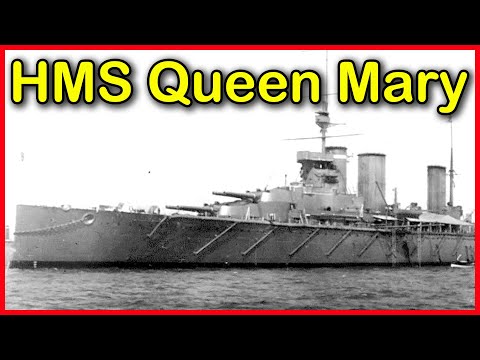
She was the pride of the Royal Navy, a sleek battlecruiser built to dominate the seas. But on May 31, 1916, HMS Queen Mary would meet a fate so catastrophic that it would shock a nation and leave only twenty survivors to tell the tale. In the icy waters of Jutland, a single shell would trigger a chain of explosions that broke the mighty ship in two, sending 1,266 men to their graves in minutes. This is the story of the last battlecruiser built for the Royal Navy before the First World War—a story of ambition, innovation, and ultimate sacrifice.
Laid down in 1911 at Palmer’s Shipbuilding in Jarrow, HMS Queen Mary was a marvel of her time. She was slightly larger than her predecessors, with a length of 700 feet and a displacement of over 32,000 tons. Powered by Parsons steam turbines, she could reach speeds of 28 knots, making her one of the fastest ships afloat. Her armament was formidable: eight 13.5-inch guns in four twin turrets, along with sixteen 4-inch guns and two submerged torpedo tubes. But it was her unique design feature—the stern walk, a private balcony for the highest-ranking officer—that set her apart from other battlecruisers.
Commissioned in September 1913 under Captain Reginald Hall, Queen Mary was assigned to the First Battlecruiser Squadron, commanded by Rear Admiral David Beatty. Her first taste of action came at the Battle of Heligoland Bight on August 28, 1914, where she provided distant support to British cruisers and destroyers. As the mist cleared, the battlecruisers emerged, and Queen Mary’s guns roared for the first time. She helped cripple the German light cruiser SMS Cöln and set the veteran SMS Ariadne ablaze. It was a promising start, but the war was just beginning.
By December 1914, the Germans devised a plan to lure out the Royal Navy by bombarding British coastal towns. On December 15, the German fleet sailed west, but British codebreakers had intercepted their plans. However, a breakdown in communication left Beatty’s battlecruisers unaware of the enemy’s presence until it was too late. The German light forces exploited a gap between the British squadrons and escaped, leaving hundreds of civilian casualties in their wake. The public outrage was immense, and the Royal Navy was criticized for its failure to prevent the bombardment.
Queen Mary’s final action came at the Battle of Jutland on May 31, 1916. Decoded messages revealed the German High Seas Fleet would be sailing into the North Sea, and the Royal Navy lay in wait. At 3:48 PM, Beatty’s battlecruisers sighted the enemy and opened fire. Queen Mary targeted the battlecruiser SMS Seydlitz, scoring two hits that disabled one of her aft turrets. But as the range increased, Beatty ordered a turn to close the distance, exposing his lead ships. The smoke from the damaged HMS Lion obscured the German gunners’ view, so they shifted their attention to Queen Mary.
At 4:26 PM, the German battlecruiser SMS Derfflinger found the range. Two shells struck Queen Mary in quick succession. The first hit the forward part of the ship, detonating at least one of her forward magazines. The explosion broke the ship in two near the foremast. The second shell struck aft, possibly near Q turret, and as the aft section began to roll over, a further explosion ripped through the hull. Within minutes, the mighty Queen Mary was gone, taking 1,266 men with her. Only 20 were rescued.
The wreck of HMS Queen Mary was discovered in 1991, lying in three pieces at a depth of 187 feet. Examination suggested the initial explosion was not in the main magazines but in the 4-inch battery, which triggered a chain reaction. Today, she is a protected place under the Protection of Military Remains Act, a silent memorial to the men who perished in the icy waters of Jutland.
The story of HMS Queen Mary, however, does not end with her sinking. In the decades that followed, her name would be carried forward by three more ships, each embodying a different era of maritime history. The second Queen Mary was a turbine steamer launched in 1933, operating on the River Clyde for Williamson-Buchanan’s Steamers. She was a modest vessel compared to her warlike namesake, but she kept the name alive in the public imagination.
Then came the most famous of them all: the RMS Queen Mary. Launched in 1934 and entering service in 1936 for the Cunard White Star Line, she was a symbol of elegance and engineering prowess, capturing the world’s attention with her Art Deco interiors and record-breaking transatlantic crossings. During the Second World War, she was converted into a troopship, ferrying thousands of soldiers across the globe. Her speed and size made her a valuable asset—and a constant target for German U-boats.
The fourth and most recent ship to bear the name is the RMS Queen Mary 2, which entered service in 2004 as the flagship of the Cunard Line. She is the largest ocean liner ever built, a floating palace that continues to cross the Atlantic in the grand tradition of her predecessors. But while these later ships carried the name with pride, none could escape the shadow of the first Queen Mary—the battlecruiser whose brief, dramatic life ended in fire and thunder at Jutland.
The wreck of the battlecruiser remains a haunting site. When divers first reached her in 1991, they found the ship broken into three distinct sections, the forward part completely devastated by the explosion that had torn her apart. The stern, however, was remarkably intact—including that unique stern walk, the private balcony that had once offered a peaceful view of the sea to her commanding officer. Now it lies in darkness, a silent balcony overlooking a watery grave.
Examinations of the wreck have revealed more about her final moments. The initial explosion likely occurred in the 4-inch battery magazine, not the main 13.5-inch magazines as previously thought. The resulting blast was powerful enough to break the ship’s back, triggering secondary explosions that sealed her fate. It was a catastrophic chain reaction, one that highlighted the inherent vulnerability of battlecruisers—ships designed for speed and firepower at the expense of armor.
The loss of Queen Mary, along with two other battlecruisers that day—HMS Indefatigable and HMS Invincible—prompted a reckoning within the Royal Navy. Questions were asked about the design of these ships, particularly their magazine safety arrangements. The lessons learned at Jutland would influence naval architecture for decades to come, shaping the warships of the future.
Today, the name Queen Mary lives on in different forms. The Clyde steamer of 1933 has long since been scrapped, but the ocean liner of 1936 survives as a floating hotel in Long Beach, California—a beloved landmark and a testament to a golden age of travel. The Queen Mary 2 continues to sail the Atlantic, carrying passengers in luxury across the same waters where her namesake fought and died.
Yet for historians and naval enthusiasts, the first Queen Mary holds a special place. She was the last battlecruiser built for the Royal Navy before the First World War—a ship that represented the pinnacle of pre-war ambition, only to become a symbol of the brutal realities of modern naval warfare. Her story is one of technological innovation, strategic miscalculation, and human cost.
What do you think was the most significant lesson learned from the loss of HMS Queen Mary at Jutland? Share your thoughts in the comments below.
Report this article
Select a reason for reporting:






