April 18, 1943. The jungle of Bougainville Island erupts in fire and smoke. A Japanese bomber, the Betty, spirals toward the earth, a trail of black smoke marking its final descent. Inside lies Admiral Isoroku Yamamoto—the mastermind of Pearl Harbor, the man who brought America to its knees. In less than a minute, the tide of the Pacific War shifts forever. But the story of how he got there, and who pulled the trigger, is far more complex than the history books suggest.
It began on a serene Sunday morning in Hawaii. December 7, 1941. At 7:55 a.m., 353 Japanese aircraft descended upon Pearl Harbor, transforming a quiet naval base into a scene of unimaginable devastation. Over 2,400 Americans lost their lives, and eight battleships were damaged or sunk. President Roosevelt declared it “a date which will live in infamy,” and America entered World War II with a burning resolve for vengeance.
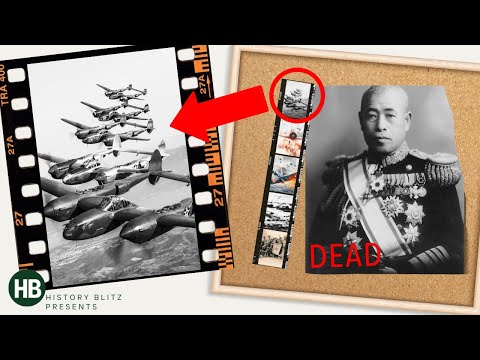
The architect of that attack was Admiral Isoroku Yamamoto. He had warned his superiors that Japan could not win a prolonged war against America’s industrial might, but he hoped a decisive blow would buy time. Instead, Pearl Harbor galvanized the American public and military, setting the stage for a relentless counteroffensive.
Six months later, the Battle of Midway turned the tide. American cryptographers had broken the Japanese naval code, allowing Admiral Chester Nimitz to ambush the Japanese fleet. Four Japanese carriers were sunk, and 248 aircraft destroyed. It was a crippling blow from which Japan’s navy would never fully recover.
By April 1943, American codebreakers had cracked the entire Japanese naval code. Intercepted messages revealed that Yamamoto would be inspecting troops in the Solomon Islands. The details of his itinerary—down to the minute—were in American hands. Operation Vengeance was born.
On April 18, 1943, 18 P-38 Lightning fighters took off from Guadalcanal. Their mission: fly over 1,000 miles through enemy territory, skimming just 50 feet above the ocean to evade radar, and intercept Yamamoto’s plane. The pilots knew the odds were against them, but they also knew the stakes.
At 9:34 a.m., they spotted two Mitsubishi G4M bombers escorted by six Zero fighters. The P-38s attacked with precision. Captain Thomas Lanphier and First Lieutenant Rex Barber both targeted Yamamoto’s bomber. The plane crashed into the jungle, killing the admiral instantly. His body was found still strapped in his seat, clutching his samurai sword.
The mission was a success, but it sparked a heated debate that continues to this day: who actually fired the fatal shots? Both Lanphier and Barber claimed credit, and official credit was initially given to Lanphier. Later studies suggested Barber was the one. Regardless, the mission was a joint effort, and both pilots were celebrated as heroes.
But the story doesn’t end there. The death of Yamamoto sent shockwaves through Japan’s military leadership and boosted Allied morale. It was a testament to the power of intelligence and the bravery of the aviators who flew into the heart of danger. Yet, the question remains: who really killed Yamamoto? And what does that debate reveal about the nature of heroism and history?
The debate over who fired the fatal shots was not merely a matter of pride—it became a bureaucratic war fought in memos, after-action reports, and eventually, in the pages of history books. Lanphier insisted he had swung his P-38 around after the initial pass and raked the Betty with a burst of fire that sent it plummeting. Barber countered that he had pursued the bomber from behind, pouring rounds into its fuselage until it smoked and fell. Both men believed they were telling the truth. Both men had reason to.
The official Army Air Forces report credited Lanphier, largely because he was the senior officer and submitted his account first. Barber, a junior lieutenant, was quietly sidelined. For decades, Lanphier toured the country giving speeches about the kill, while Barber returned to civilian life and seethed in silence. It wasn’t until 1985—after Lanphier’s death—that a panel of historians reexamined the evidence and concluded Barber most likely delivered the fatal blows. Yet the Air Force never officially overturned its original finding.
What most accounts overlook is the chaos of those twenty seconds over Bougainville. The P-38s had been flying at wave-top height for over two hours, and their fuel reserves were razor-thin. When the Japanese formation appeared, the American pilots had to jettison drop tanks, climb hard, and engage Zeros that were far more agile than their twin-engine fighters. It was less a surgical strike than a brawl in the sky.
Lieutenant Besby Holmes, one of the killer flight pilots, had mechanical trouble with his drop tanks and nearly missed the intercept entirely. He arrived late, saw a bomber already trailing smoke, and fired at a Zero instead. First Lieutenant Ray Hine, another pilot, was never seen again—his P-38 vanished over the water, and his fate remains unknown to this day. The mission that killed Yamamoto also cost American lives, a fact often lost in the glow of victory.
On the Japanese side, the aftermath was equally wrenching. Chief of Staff Rear Admiral Matome Ugaki survived the crash of his own bomber, which had been carrying him on the same inspection tour. He was pulled from the water, injured but alive, and would later write in his diary of the shame he felt at surviving while his commander perished. The Japanese public was told nothing for weeks. When the news finally broke on May 21, 1943, state radio broadcast a solemn announcement, and millions bowed their heads in mourning.
But grief soon curdled into paranoia. Japanese military leaders suspected the Americans had been reading their codes—how else could they have timed the ambush so perfectly? Yet instead of overhauling their encryption, they convinced themselves it was a coincidence, a chance encounter. The codes remained in use, and American intelligence continued to feast.
The consequences rippled far beyond the Solomons. In Washington, Admiral William Halsey, commander of the South Pacific, received word of the kill with grim satisfaction. He had reportedly told his pilots before the mission, “There’s only one Yamamoto, and I want him dead.” When confirmation came, he ordered the base at Guadalcanal to celebrate—quietly, so as not to reveal how precisely the Americans had known where to strike.
For the pilots of the 339th Fighter Squadron, the return flight was a strange mixture of exhilaration and exhaustion. They had flown for nearly three hours, fought for less than a minute, and now faced the long haul home with fuel gauges hovering near empty. Some planes landed on fumes. Others touched down with engines sputtering. Major John Mitchell, who had led the flight, later said he never doubted they would succeed—only that they might not all come back.
The mission’s secrecy was so tight that many of the pilots didn’t fully understand what they had done until days later. They had been told to intercept “an important high officer,” not the architect of Pearl Harbor himself. When the truth leaked out, the men who had flown the mission became instant legends—though the legend would prove more complicated than any of them expected.
Back in Japan, the cover-up began almost immediately. Yamamoto’s death was classified as a “state secret,” and his staff was ordered to keep the truth from the public. But the admiral’s body had to be cremated, and the ashes had to return to Tokyo. The funeral, held on June 5, 1943, was a grand state affair—complete with a million mourners lining the streets—but the government refused to admit how he had died. Officially, Yamamoto had fallen in battle, a vague euphemism meant to preserve morale.
The lie didn’t hold. Within weeks, rumors swept through the Japanese fleet. Sailors whispered that the Americans had known exactly where to find the admiral. Some officers demanded a formal investigation into the security breach, but the naval high command buried the inquiry. To admit the code had been broken would be to admit that every subsequent order, every fleet movement, every supply convoy was potentially compromised. So the Japanese Navy chose silence over security, and it would pay for that choice at Leyte Gulf, at the Philippine Sea, and in every battle to come.
Meanwhile, the Americans were already moving on. The death of Yamamoto was a psychological victory, but it did not end the war. The Pacific campaign ground on—island by island, atoll by atoll—through Tarawa, Saipan, and eventually Okinawa. Yet the men who had flown Operation Vengeance carried the memory of that April morning with them for the rest of their lives.
Some of them never spoke of it. Others couldn’t stop. Rex Barber, in particular, spent decades fighting for recognition, writing letters to historians and lobbying the Air Force for a correction to the record. He never got the official vindication he wanted, but in the court of historical opinion, his case slowly gained ground. In 2003, a documentary aired on the Discovery Channel that reenacted the mission and concluded Barber had fired the fatal shots. He watched it from his home in Oregon, by then in his late eighties, and reportedly said, “It’s about time.”
But the story of who killed Yamamoto may never be fully settled. The P-38s attacked in a chaotic melee, with multiple pilots firing at multiple targets. The Betty was hit from several directions. It is entirely possible that both Lanphier and Barber hit the plane, and that neither man’s account was entirely accurate or entirely false. War rarely offers the clean narrative that history books prefer.
What remains undisputed is the mission’s impact. Yamamoto was irreplaceable. His strategic vision, his willingness to challenge his own superiors, and his understanding of American industrial power had made him a singular figure in the Japanese military. His successor, Admiral Mineichi Koga, was a competent but cautious commander, and the Japanese fleet would never again operate with the same aggression or confidence.
The pilots of Operation Vengeance had done more than avenge Pearl Harbor. They had decapitated an enemy’s military leadership in a single stroke, proving that intelligence and courage could combine to change the course of a war. And yet, as the years passed, the men themselves grew old, and the debate over credit faded into a footnote.
What endures is the image of those P-38s, skimming the waves at fifty feet, engines roaring, pilots squinting through their windshields for a glimpse of a bomber in the distance. They flew into enemy territory with no guarantee of return, knowing that failure meant death or capture, and they did it anyway. That is the part of the story that no debate can diminish.
But the Pacific War was far from over, and the men who had killed Yamamoto would soon be called upon again. The same codebreakers who had intercepted his itinerary were already turning their attention to the next target, the next fleet movement, the next ambush. The war of intelligence had only just begun, and the Americans were winning it.
As the P-38s touched down on Guadalcanal, the pilots were told to keep quiet. No press, no photos, no celebration. The mission stayed classified for years, and the men who flew it slipped back into the war as if nothing had happened. Some would never speak of it again.
Yamamoto’s ashes returned to Tokyo in a sealed urn, and Japan mourned a hero it could not fully explain. The code they refused to change would betray them again and again. By the time they realized the truth, it was far too late.
Operation Vengeance remains a masterpiece of intelligence and daring—a single morning that altered the Pacific War’s trajectory. Yet the men who flew it were not legends. They were young, frightened, and running on fumes. They did their job, and history did the rest.
So here is the question that lingers: if the credit for history’s great moments is always contested, who truly owns them—the one who pulled the trigger, or the one who told the story? What do you think really happened over Bougainville that morning?
Report this article
Select a reason for reporting:






