In the foggy dawn of January 1942, the first American GIs stepped off ships in Liverpool and Southampton, their boots echoing on cobblestones that had known only the muted footsteps of a nation under siege. They carried Hershey’s chocolate, silk stockings, and a swagger that seemed to defy the blackout curtains and ration books. To the British women watching from behind those curtains, these men were messengers from another world—a world where lights stayed on and shelves were full.
The Blitz had already stolen so much: husbands and sons sent to fight in distant lands, nights spent huddled in air-raid shelters, the constant ache of hunger. “They’re overpaid, oversexed, and over here,” the British grumbled, but their eyes followed the Americans with a mixture of curiosity and longing. In church halls turned into dance floors, the first sparks flew. Red Cross volunteers organized socials where women in mended dresses and precious lipstick met men who spoke of California sunshine and Texas ranches.
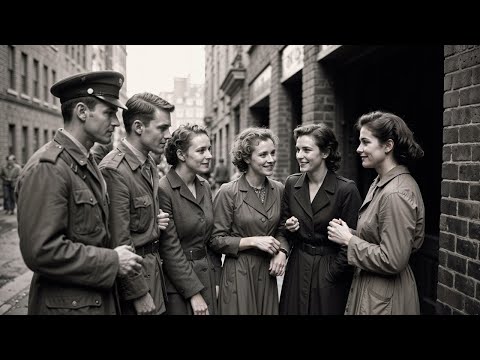
Mary Jenkins was one of the first to feel her heart flutter. When Joe pulled a whole chocolate bar from his pocket, she nearly wept at its sweetness. At the dances, the Americans taught them to swing, lifting them off their feet with arms that smelled of cologne instead of factory oil. In Hyde Park, Susan Thompson shared sandwiches with Bobby from Kansas—white bread soft as clouds, real butter, and meat that wasn’t a thin, gray slice. “It was like eating a dream,” she later recalled.
But the magic came with a price. By March 1943, morning sickness crept into factory bathrooms and cramped bedrooms. Margaret Powell bent over a sink, the smell of metal polish sending her stomach heaving. She had missed two periods, but told herself it was the war. “Your body does strange things when bombs fall every night,” she thought. But deep down, she knew. The truth was growing inside her.
In front of cracked mirrors, women counted days on calendars, hoping they were wrong. They touched their bellies with trembling fingers and wondered how to explain this to parents who still believed their daughters were good girls following the rules. For some, the realization came with a sudden wave of nausea at the morning tea. For others, it was the tightening of a bra strap or the need to sleep longer than the day allowed. Betty Morrison fainted on the concrete floor of the munitions factory, and fifty women whispered behind their hands.
The American reactions revealed the men behind the charm. Some, like Joe Martinez, held their girlfriends close and promised marriage before the baby came. They spoke of big weddings and ocean voyages to America, where the women would live in houses with white picket fences. These men were sincere, their eyes shining at the thought of families in a land of plenty. But others vanished like smoke. Private Tommy from Ohio told Sarah Hughes he loved her on a Tuesday night, then was transferred to a base in Scotland on Wednesday morning without a goodbye.
For women who found themselves alone, the choices were impossible. Marrying an American meant leaving everything familiar—crossing an ocean to live with strangers in a place they knew only from stories. But having a baby without a husband meant shame that would follow them for life. Families whispered, neighbors pointed, and children would grow up with questions that had no answers. “What happens to love when the war ends and the soldiers go home?” the women asked themselves, the question echoing in the silence of blacked-out nights.
The answer arrived with the ships. In August 1945, three million American soldiers sailed home across the Atlantic, and from the docks of Liverpool and Southampton, women watched the great vessels disappear into the morning mist. Some held babies in their arms—children of American fathers who had kept their promises of marriage. Others stood alone, hands empty but hearts full of memories that would last a lifetime.
The lucky ones clutched papers in their handbags. The War Brides Act allowed sixty thousand British women to follow their husbands to America. But the process took months of waiting, form-filling, and medical examinations. They packed their lives into a single suitcase, leaving behind fathers they might never see again and friends who had shared air-raid shelters and factory shifts. The ships carrying them west were crowded with crying babies and anxious mothers who wondered if their new homes would match their husbands’ tales.
But thousands of other women faced a very different future. They returned to houses that seemed too quiet after years of American laughter. They went back to factories now producing peacetime goods instead of bullets and bombs.
Their children grew up asking questions about fathers with names like Johnny and Bobby and Frank—men who vanished like characters in fairy tales that ended too soon. In the small English towns where everyone knew everyone’s business, these mothers faced stares and whispers that followed them into shops, schools, and churches. The children learned to fight with their fists before they learned to write their names, defending mothers who had loved across the color line in a world unprepared for such love.
Some fathers tried to stay in touch, sending letters with American stamps and photographs of houses with wide yards and cars and private driveways. They sent money when they could, and promises of reuniting their families in America once immigration laws changed. But distance and time and new lives made these bonds fray like old photographs left in the sun.
The children who grew up on these stories learned hard lessons about love and loss and the price of grand dreams in wartime. They carried their fathers’ names but missed their presence. They inherited American features in British faces, prompting questions they spent their lives trying to answer. Some searched for their fathers decades later, using letters and photographs as treasure maps to men who had moved on to new lives, new wives, and new children who knew nothing of wartime romances.
The true legacy of those sixty thousand women was not just the children they raised or the oceans they crossed. It was the proof that love is born even in the darkest times—that human hearts find ways to hope even when bombs fall and horizons seem impossible.
But the story did not end with the ships. It sank into silence, buried under decades of shame and secrecy. In the 1950s, as Britain rebuilt itself and America prospered across the ocean, thousands of children grew up in households where a father’s name was never spoken aloud. Some were told their fathers had died in the war. Others were told nothing at all. The truth was locked in drawers, in faded photographs, in the tight-lipped silence of mothers who had learned that love in wartime carried a price no one wanted to pay.
Jean Carter, born in 1944 in a small town outside Bristol, discovered her father’s existence at age sixteen. She found a bundle of letters tied with blue ribbon in her mother’s wardrobe—letters from a Sergeant Harold Price of Nebraska, full of promises and plans and a photograph of a young man with a wide grin and a cowboy hat. “Your father loved you,” her mother finally admitted, tears streaming down her face. “But he had a wife back home. He never knew.”
The revelation shattered Jean’s world. She had spent her childhood believing she was the daughter of a dead war hero. Now she learned she was the daughter of a secret, a shame, a chapter her mother had tried desperately to erase.
For mixed-race children, the burden was even heavier. In post-war Britain, racism was not spoken of openly, but it lived in the stares, the whispers, the job applications that were never answered. David Williams, born to Dorothy Williams and the Black GI James, grew up in a children’s home after his mother, unable to bear the shame, gave him up. He never knew his father’s face, only the stories his mother had left behind—a man from Alabama who had held her hand in the shadows and promised to return. He never did.
David spent thirty years searching. He wrote letters to the American Embassy, to veterans’ associations, to anyone who might know the name James Williams from Alabama. In 1998, he finally received a reply. James had died in 1972, leaving behind a wife and three children who had never heard of David or Dorothy. The letter came from James’s daughter, who wrote: “My father never spoke of England. I am sorry for your loss.” David read the words a hundred times, trying to find the father he had never known in the spaces between them.
The silence began to break in the 1980s and 1990s, as historians and journalists started to uncover the stories of the war brides and the children they had left behind. In 1992, a BBC documentary called “The Lost Children of the War” aired, and for the first time, women who had kept their secrets for fifty years spoke openly about the American soldiers they had loved and the children they had raised alone. The response was overwhelming. Letters poured in from across Britain and America, from children searching for fathers and fathers searching for children.
Some reunions were joyful. In 1995, Margaret Powell, now in her seventies, traveled to Texas to meet the daughter of her GI, who had died in 1980. She stood on the porch of a house with a white picket fence—the very house he had promised her—and wept. His daughter, a woman in her fifties, embraced her and said, “He never forgot you. He kept your photograph in his wallet until the day he died.”
But many reunions never happened. Thousands of American fathers had died, or vanished into new lives, or simply refused to acknowledge the children they had left behind. For every joyful reunion, there were ten unanswered letters, ten closed doors, ten families who chose to keep their secrets buried.
The legacy of those sixty thousand women lives on in their children and grandchildren, in the questions they still ask and the answers they may never find. It lives in the documents now preserved in archives, in the oral histories recorded by historians, in the books and films that have finally begun to tell their stories. It lives in the proof that love, even in wartime, even across oceans and decades and silence, leaves a mark that cannot be erased.
In the end, the most enduring monument to those sixty thousand women isn’t made of stone. It’s the quiet courage of their descendants, who gather every year in small halls across Britain, sharing faded photographs and half-remembered names. “We are the children of the war’s best-kept secret,” they say, and in that room, the shame finally turns to something like pride.
Some still search. Some have stopped. But all of them carry the same inheritance: proof that their mothers dared to love in the darkest hours, and that love, however brief, was never nothing.
So now the question passes to us. When we look at the old photographs, the letters tied with ribbon, the names whispered and then buried—what do we owe the children of those wartime promises?
Should the silence finally be broken for good, or do some secrets deserve to rest? Tell us in the comments below.
Report this article
Select a reason for reporting:






