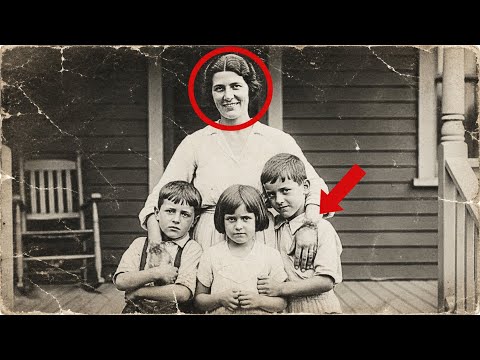
Elizabeth Morgan had spent four decades capturing life through a lens, but nothing prepared her for the moment her fingers brushed against a faded photograph in a dusty Portland auction house. The image was ordinary at first glance: a young mother with three children on a wooden porch, her smile radiant, her eyes crinkling with genuine joy. Yet something gnawed at Elizabeth’s instincts—a whisper from the past that demanded she look closer.
She lifted the photograph to the window’s afternoon light, the paper brittle beneath her touch. The mother’s left hand rested on her eldest son’s shoulder, and there it was—a dark, smudged mark circling her wrist, barely visible but unmistakable. Elizabeth’s breath caught. She knew bruises. She had photographed enough survivors of domestic violence to recognize the deliberate concealment of long sleeves on a warm June day in 1926.
“Are you buying that box, ma’am?” The auctioneer’s assistant hovered nearby, clipboard in hand. Elizabeth nodded without looking away. “Yes. Yes, I’m buying it.”
That night, in her studio, the magnifying lamp revealed what the naked eye had missed. Both wrists bore deep, widespread contusions—fingers clenched too hard, too often. The mother’s right knuckles were swollen, and beneath the fabric of her sleeve, more bruises lurked in shadow. Elizabeth documented every detail in her notebook, her heart pounding. The back of the photograph held only a faint pencil inscription: Mother and us, Seattle, June 1926. No names. No address. No photographer’s mark.
But the mother’s eyes—Elizabeth saw it now—held not sorrow but resolve. A fierce, unyielding determination. She had chosen this pose, this smile, this moment. Why?
Elizabeth called her old colleague Thomas Chen at dawn. “I’ve found something, Tom. A photograph from 1926 Seattle. I need your help to find the story behind it.” Thomas listened without interruption, then exhaled slowly. “1926 was a hard year for Seattle. Labor unrest, domestic violence swept under the rug. Women had no recourse.”
“I know,” Elizabeth said quietly. “That’s why I have to find out what happened. This woman was trying to tell someone something. I can feel it.”
Within days, Thomas connected her with Sarah Bennett, a historian specializing in early twentieth-century Seattle. Sarah unearthed a ledger from Dorothy Hayes, a traveling portrait photographer who documented working-class families. One entry, dated June 18, 1926, stopped Elizabeth cold: “Client requested portrait with three children. Extensive bruising observed on hands and wrists. Client insisted on long sleeves despite warm weather. Husband not present. Client was very specific about quick copies. Extra care taken with lighting to emphasize her smile. She wanted the children to remember her as happy.”
The address followed: 1247 Dawson Street, Georgetown. A mother named Helen. A husband named Robert. Three children—William, James, and Mary. And three days after the photograph was taken, Robert was found dead at the bottom of the basement stairs.
Elizabeth stared at the newspaper clipping Sarah sent, her pulse roaring in her ears. The official report called it an accident. Neighbors reported shouting. Helen claimed he was drunk, lost his balance. The case was closed.
“She posed for that portrait three days before he died,” Elizabeth whispered to the photograph. “She wanted her children to remember her smile—not the bruises, not the fear.”
But where had Helen gone? And what had become of the children who held her so trustingly in that frozen moment of love and defiance?
Elizabeth’s hands trembled as she unfolded Sarah’s latest letter, the one that had arrived that morning with a Sacramento postmark. Inside, a single photograph slipped free—a woman in her thirties with Helen’s dark hair and intense eyes, standing beside a teenage girl who shared the same determined set of her jaw. On the back, in careful handwriting: Mary, 1958. With my daughter, Helen.
“She named her daughter Helen,” Elizabeth breathed, the revelation striking her like a physical blow. Mary had carried her mother’s memory forward not just in stories, but in the very name she had given her own child.
She called Sarah immediately. “I need to find Mary’s daughter. The younger Helen. She would be in her seventies now if she’s still alive.” Sarah’s voice crackled with barely contained excitement. “I’ve already started looking. There’s a Helen Ramirez in Sacramento—born 1944, maiden name Helen Chen. She was a schoolteacher, retired now. Elizabeth, I think we’ve found her.”
Two weeks later, Elizabeth sat in a sunlit café in Sacramento, across from a woman whose eyes held the same fierce intelligence she had seen in the 1926 photograph. Helen Ramirez was seventy-four, her hair silver-streaked but her posture still straight, commanding. She held the original photograph in her hands—Mary’s most treasured possession, now passed to her daughter.
“My mother showed me this picture a hundred times,” Helen said, her voice thick with emotion. “She told me Grandmother Helen was the bravest woman she ever knew. But she never told me why. She said some stories were too heavy to carry until you were old enough to set them down.”
Elizabeth slid the folder across the table—Dorothy Hayes’s ledger entries, the newspaper clippings, the census records, the death certificate. Helen read in silence, her fingers tracing the blurred bruises on her grandmother’s wrists. When she looked up, tears streamed freely down her cheeks.
“She planned it,” Helen whispered. “Grandmother Helen planned her escape. She documented her abuse, secured proof of her love for her children, and then—” She stopped, unable to continue.
“Then she made sure her children would never be victims again,” Elizabeth finished gently. “She taught your mother what strength looked like. And your mother taught you.”
Helen nodded slowly, wiping her eyes. “I was a teacher for forty years. I worked with troubled kids, abused kids. I always felt like I understood them in a way other teachers didn’t. Now I know why.” She laughed softly, bitterly. “It’s in my blood. The need to protect. The refusal to look away.”
Elizabeth reached across the table and took Helen’s hand. “Your grandmother’s photograph is going to be in an exhibition at the Oregon Historical Society. Your mother gave permission before she passed. I want you to be there. I want you to see how many people her story will reach.”
Helen’s grip tightened. “I’ll be there. And I’ll bring my granddaughter. She’s twenty-two, studying to be a social worker. She needs to know where she comes from.”
Three months later, on a rainy Portland afternoon, Elizabeth stood at the entrance of the exhibition hall, watching Helen Ramirez and her granddaughter walk through the doors. The younger woman—also named Helen, a fourth-generation bearer of the name—stopped before the central display, her eyes fixed on the 1926 portrait.
Elizabeth approached quietly. “What do you see?” she asked.
The young woman was silent for a long moment. “I see a woman who was terrified but refused to let fear win,” she said finally. “I see a woman who knew that love wasn’t just about holding on—sometimes it was about letting go, about fighting, about surviving.” She turned to Elizabeth, her eyes bright. “I see my great-great-grandmother. And I see myself.”
Elizabeth felt the tears come then, hot and unexpected. “That’s exactly what she wanted,” she managed. “She wanted her children to remember her smile. But she also wanted them—and us—to remember her strength.”
Helen Ramirez stood beside her granddaughter, both of them silent before the photograph that had traveled through four generations. The younger Helen reached out, her fingers hovering just above the glass case, tracing the outline of her great-great-grandmother’s smile. “She looks so young,” she murmured. “Younger than me, almost.”
Elizabeth nodded. “She was twenty-nine when that photograph was taken. By the time she was your age, she had already survived more than most people endure in a lifetime.”
The exhibition hall filled slowly, a steady stream of visitors drawn by the story that had begun with a five-dollar box of forgotten memories. Elizabeth watched them pause before Helen’s portrait, watched their expressions shift from curiosity to something deeper—recognition, perhaps, or empathy. Some lingered for minutes, reading the accompanying text, studying the magnified images of the bruises that had been hidden for so long.
A middle-aged man in a worn jacket stood before the display for nearly half an hour, his hands clasped behind his back. When he finally turned away, his eyes were red. He approached Elizabeth, his voice low. “My mother went through something similar,” he said. “She never talked about it. She died last year, and I found her journals. I didn’t know what to do with them. Now I think I do.”
Elizabeth touched his arm. “Bring them to the historical society. Sarah Bennett will help you. Your mother’s story deserves to be told, too.”
By late afternoon, the exhibition had become something Elizabeth hadn’t anticipated—a gathering place for people carrying invisible burdens. Women approached Helen Ramirez and her granddaughter, sharing fragments of their own histories. A young mother with a fading bruise on her cheek whispered that she had left her husband three weeks ago. An elderly woman spoke of a grandmother who had disappeared in the 1930s, never spoken of again. Each story was different, yet they all echoed the same refrain: I thought I was alone.
“You’re not alone,” Helen told them, one after another. “My grandmother made sure of that. She couldn’t have known her photograph would end up here, but she knew someone would find it someday. She left a trail of breadcrumbs, and we followed them home.”
As the exhibition drew to a close, Elizabeth noticed a woman standing apart from the crowd, her posture rigid, her eyes fixed on the 1926 portrait with an intensity that bordered on desperation. She was perhaps forty, her dark hair pulled back severely, her clothes expensive but ill-fitting, as if she had borrowed them from someone else. Elizabeth approached cautiously.
“Are you all right?” she asked softly.
The woman flinched, then forced a smile that didn’t reach her eyes. “I’m fine. I just—I saw the advertisement for this exhibition in the newspaper. I didn’t expect to feel so…” She trailed off, her gaze drifting back to Helen’s photograph. “My grandmother had a picture like that. A family portrait from the twenties. She burned it before she died. Said she didn’t want anyone to see.”
Elizabeth’s heart clenched. “What was her name?”
“Margaret. Margaret Collins. She lived in Seattle her whole life. She never talked about her childhood. My mother said she was ashamed of something, but she never knew what.” The woman’s voice cracked. “I’ve spent years trying to find out what happened to her. I hired genealogists, searched archives. Nothing. It’s like she didn’t exist before she was eighteen.”
Elizabeth reached into her bag and pulled out a business card. “Call Sarah Bennett at the Washington State Historical Society. Tell her I sent you. If there’s a record of your grandmother anywhere, Sarah will find it.” She hesitated, then added, “And if you find something—something painful—remember that your grandmother survived it. Whatever she was ashamed of, it wasn’t her fault.”
The woman took the card with trembling hands. “Thank you,” she whispered. “I don’t even know why I came here. I just felt… pulled.”
“That’s how these stories find us,” Elizabeth said. “They wait until we’re ready to listen.”
After the woman left, Elizabeth found Helen Ramirez standing alone before her grandmother’s portrait, her granddaughter having wandered to another display. The older woman’s face was wet with tears, but she was smiling.
“I used to wonder why my mother kept this photograph on her desk,” Helen said, not turning around. “She told me it reminded her that love and courage look the same. I never understood what she meant until now.” She finally looked at Elizabeth. “You gave my family something we didn’t know we were missing. A beginning. A context. A reason.”
Elizabeth shook her head. “I just found a photograph in a box. Your grandmother did the rest.”
Helen laughed softly. “You’re too modest. My granddaughter told me you used to photograph domestic violence survivors for court cases. You spent years documenting what other people wanted to forget. You were the only person who could have seen what was hidden in that picture.”
Elizabeth considered this. “Maybe. Or maybe it was just time. The story had waited ninety-one years to be told. It would have found someone eventually.”
As the exhibition hall emptied and the lights dimmed, Elizabeth stood alone before Helen’s portrait. The smile seemed different now—not just victorious, but grateful. As if Helen knew her gamble had paid off. As if she knew her children’s children would one day stand in a room full of strangers and hear her story told with love and respect.
Elizabeth thought of the young woman who had approached Mary at the first exhibition, the one who had escaped her abusive partner and was building a new life for her son. She thought of the man with his mother’s journals, the woman with the burned photograph, the countless others who had passed through this room and seen something of themselves in Helen’s eyes.
The story had grown beyond the photograph. It had become a living thing, a thread connecting past and present, victim and survivor, silence and speech. And Elizabeth, the reluctant custodian of that thread, understood that her work was not finished. There were other photographs in other boxes, other stories waiting to be found. Other women whose smiles concealed bruises, whose hands held children too tightly because they knew how easily everything could be taken away.
She reached into her bag and pulled out her notebook, the same one she had used to document her first observations of Helen’s photograph. Flipping to a fresh page, she wrote: Next project: search Portland and Seattle archives for other portraits from the 1920s-1940s showing signs of concealed domestic violence. Work with Sarah to create a database. Reach out to other historical societies. This is bigger than one photograph.
She closed the notebook and looked one last time at Helen’s smile. “I’ll keep looking,” she whispered. “For all the others who couldn’t speak. For all the ones who are still hiding.”
The lights in the exhibition hall flickered off, one row at a time, until only the emergency exit signs glowed in the darkness. Elizabeth walked out into the cool Portland evening, the rain having stopped, the streets glistening under streetlamps. Her phone buzzed in her pocket—a text from Sarah: Just got a call from a woman in Tacoma. Her grandmother posed for a portrait in 1931. She wants to know if we can help her find it.
Elizabeth smiled and typed back: Tell her we’re on our way.
The years that followed blurred into a quiet mission. Elizabeth and Sarah built their database, one portrait at a time, each bruised wrist and hidden smile a thread in a growing tapestry of survival. “We’ve documented forty-three women so far,” Sarah reported one autumn afternoon, her voice thick with wonder.
Elizabeth stood before Helen’s portrait in her study, now framed beside the young mother’s photograph from that first exhibition. Two women, seventy-one years apart, bound by the same fierce love.
She thought of Helen, who chose joy over anguish, proof over silence. “You started this,” Elizabeth whispered. “All of it.”
The smile in the photograph never wavered—victorious, eternal, waiting. And somewhere, in another dusty box, another story was waiting to be found.
If a single forgotten photograph could change so many lives, how many more are still hidden in the dark—and who among us will be brave enough to look?
Report this article
Select a reason for reporting:






