In the vast, sun-scorched deserts of North Africa, a silent crisis was bleeding the Allied war effort dry. Fuel—the lifeblood of mechanized warfare—was vanishing into the sand at an alarming rate. 70,000 gallons of fuel leaves the depot; only 30,000 arrives at the front line. A 57% loss. The quartermaster in charge reports this as a good effort. This was the reality of Allied logistics in World War II, where the solution existed since 1940, but American engineers changed one invisible detail that turned German perfection into a leaking disaster.
September 1942. American chemical engineer Richard M. Daniel arrives in Egypt, sent by the War Department to investigate reports of catastrophic fuel losses in the desert campaign against Rommel’s Afrika Corps. What he finds is worse than Washington imagined. British quartermaster units report losses of 30 to 40% between port and front line. War correspondent Alan Moorehead observed, “The great bulk of the British army was forced to stick to the old flimsy 4-gallon container. We could put a couple of petrol cans in the back of a truck. Two hours of bumping over desert rocks usually produced a suspicious smell.” British General Auchinleck estimates 30% of all fuel never reaches its destination. In one documented case, 70,000 Imperial gallons leave the depot. Only 30,000 gallons arrive—a 57% loss. The quartermaster considers this a good effort.
The British are using containers soldiers call “flimsies.” Thin tin cans with soldered seams. Four-gallon capacity. They buckle when stacked, split when dropped, leak when heated. The seams fail constantly. Many of these flimsies are packed in pairs in wooden cases, later replaced by plywood and eventually cardboard, making them effectively single-use containers discarded once emptied. American containers aren’t much better. Five-gallon rectangular cans with screw caps and cork gaskets. Designs dating back to World War I. Fifty-five-gallon drums requiring pumps. Equipment designed for stationary storage, not mechanized desert warfare.
Daniel watches fuel seep into sand. Soldiers struggle with containers requiring wrenches, funnels, and two men to pour. The entire Allied logistics system hemorrhages the one resource that powers everything. He sends a cable to Washington estimating 40% fuel losses. Years later, in his 1987 article, The Little Can That Could, Daniel admitted this figure was actually a guess intended to provoke alarm. Whether 40%, Auchinleck’s documented 30%, or that specific 57% case, the losses are devastating.
The Germans face no such crisis. Allied soldiers capturing German supply dumps find green steel containers that look new after months of desert use. These containers become more valuable than almost any other captured equipment. Soldiers hoard them. Supply officers request them by name. After the second capture of Benghazi at the end of 1941, large numbers of Axis jerry cans were captured, sufficient to equip elite units such as the Long Range Desert Group, who by early 1942 had switched entirely from flimsies to these captured German containers.
The Wehrmacht Einheitskanister (armed forces unit canister) was developed in 1937 by German engineer Vinzenz Grünvogel at Müller Engineering Works in Schwelm, Westphalia. After a competitive tender in 1935–36, a test series of 5,000 cans was sent to troops in 1936 for field trials. The German army officially adopted it on July 8, 1937, via order AHM number 324. Three years of testing and refinement before the war began. By 1939, the German military had stockpiled thousands of these cans in anticipation of war. Motorized troops were issued jerry cans along with lengths of rubber hose to siphon fuel from any available source—a tactical advantage supporting their rapid advance through Poland at the war’s start.
The design: 20 liters, approximately 5.3 US gallons. Two stamped sheets of steel welded together with a recessed X-shaped seam running across both faces. That seam construction would prove crucial. The interior featured a dip coat of paint to protect against corrosion. Three handles—two short ones on the sides for one-handed carrying, one long one across the top for two-handed carrying or passing in a chain. The Wehrmacht had specifically required that a soldier should be able to carry either two full containers or four empty ones, which determined the triple handle configuration. The handles are recessed, so cans stack without interference. One soldier carries two full cans comfortably. A strong soldier carries four.
The cap—not a screw top, but a cam lever system with an internal breather pipe. A hole in the closure retainer allowed for a securing pin or wire with a lid seal. Flip the lever. The seal releases. Air enters through the breather. Fuel pours smoothly without glugging. One person pours the entire can in seconds. No funnel, no second person, no wrench required. An air chamber design would even keep the can afloat if it fell into water.
The X-shaped indentations pressed into both faces serve three critical engineering purposes. First, structural rigidity. The crease creates four triangular sections much stiffer than flat panels. Second, expansion relief. Gasoline expands roughly 2 to 3% when heated, and the indentation flexes outward to relieve pressure. Third, when fuel cools and contracts, the indentation flexes back, preventing vacuum pressure. The design was classified as a military secret, with its patent filed in 1939 but kept from public knowledge until Allied forces captured examples during the war. German testing shows minimal losses and superior durability. The container survives drops, impacts, extreme heat, extreme cold. Stackable, portable, fast to use.
In 1939, American engineer Paul Pleiss had built a vehicle to journey to India with a German colleague. After building the car, they realized they lacked storage for emergency water. The German engineer had access to the stockpile of jerry cans at Berlin Tempelhof airport and managed to take three of them, also providing Pleiss with complete specifications for manufacturing the can. The account claims Pleiss continued to Kolkata, stored his car, and flew back to Philadelphia, where he told American military officials about the can. He could raise no interest. Without a sample, he realized he could not get anywhere. He eventually shipped the car to New York by a roundabout method and sent a can to Washington. Official records cannot verify all details of this journey. The bureaucracy rarely documented its failures. However, this much is documented: in summer 1940, samples of the German jerry can arrived at the US Quartermaster General’s office.
Later in 1940, when Pleiss was in London, British officers asked him about the design and manufacture. Pleiss ordered the second of his three jerry cans flown to London. The US military initially rejected them. No official reason appears in clear documentation. Institutional inertia, not-invented-here syndrome, concerns about manufacturing complexity—speculation varies. The War Department decided instead to use World War I 10-gallon cans with two screw closures which required both a spanner and funnel for pouring.
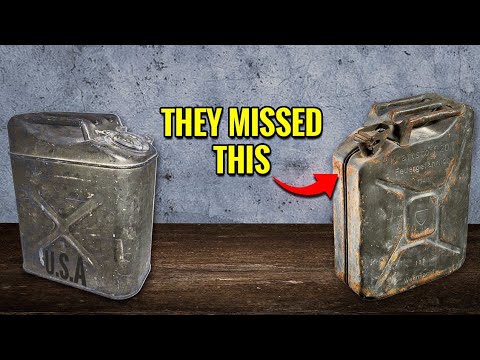
Eventually Camp Holabird in Maryland took interest. The Quartermaster Corps research facility agreed to evaluate the design. They measured every dimension, photographed every feature, tested the cam lever mechanism, analyzed the steel composition. Then they redesigned it. American engineers at Camp Holabird in late 1940 and early 1941 created their version. They retained the dimensions, the three handles, the capacity, the cam lever cap. They kept the X-shaped indentations, though slightly simplified. What they changed was invisible from outside: the seam construction.
The German jerry can uses a welded seam. Two stamped steel halves are pressed together and electric resistance welded along the X-shaped joint. The weld is recessed below the surface—strong, sealed, extensively tested. The American version uses rolled seams. The edges of the two halves are folded together and crimped. Faster to manufacture, requires less specialized equipment, cheaper. The US design was slightly lighter than the German can—10 lb versus 11.5 lb for the German version. For containers holding water or nonvolatile liquids, it works adequately. For gasoline and desert heat, it proves disastrous.
Richard M. Daniel later wrote with the authority of a chemical engineer who witnessed the consequences: “As any petroleum engineer knows, it is unsafe to store gasoline in a container with rolled seams.” The crimped metal joint flexing under temperature changes and impact stress develops microscopic gaps—not gushing leaks, but seepage, a slow, steady loss that multiplies across thousands of containers. American engineers also removed or simplified the interior breather tube in some versions, requiring separate tools for pouring. They eliminated the interior plastic lining present in German fuel cans. The rolled seam is the critical failure.
Production begins. Tens of thousands of American jerry cans shipped to North Africa, the Pacific, training bases. Immediately, universally, they perform worse than German originals. The leaks aren’t dramatic enough to trigger immediate alarm. A wet ring around the cap, a slight gasoline smell, a dark stain under stacked cans in the sun. Multiply that seepage by thousands of containers. Losses become significant. Not as bad as British flimsies, but far worse than German jerry cans.
American jerry cans arrive in North Africa in late 1941 and throughout 1942. As Daniel documents the fuel crisis, Allied logistics officers sort containers into three categories: German jerry cans for critical operations, American jerry cans for less demanding uses, British flimsies for everything else. The rolled seams fail identically to British soldered seams. Temperature cycling in desert heat destroys them. Daytime temperatures regularly exceed 120°F. Nighttime temperatures drop 40 to 50°. Metal expands and contracts. Seams flex. Microscopic gaps become visible gaps.
Daniel’s September 1942 alarm cable reaches Washington. His 40% estimate, admittedly designed to provoke alarm, wasn’t far from documented British estimates of 30% or that specific 57% loss. The War Department finally notices—not because of 1940 warnings, not because of obvious German engineering superiority, but because Allied operations are strangling on their own logistics. Tanks run out of fuel during operations. In late August 1942, Rommel made a final attempt to break through at Alam el Halfa, but was repulsed, short of fuel and supplies, unable to sustain his offensive. Supply columns carry double requirements because everyone knows significant portions won’t arrive.
The response isn’t fixing American manufacturing. The response is letting the British handle it. British factories in 1943 begin mass-producing faithful copies of the German original. Welded seams, full internal breather tubes, proper plastic linings, no manufacturing shortcuts. By early 1943, 2 million British-made jerry cans shipped to North Africa. By early 1944, jerry cans were being manufactured in the Middle East as well. Millions more follow for the European campaign. These British jerry cans work. They don’t leak. They survive desert heat and European mud. They stack properly. They pour quickly. Everything the German original was, now manufactured by the British.
American production continues making inferior rolled seam versions alongside British welded versions. In fuel and other petroleum products, which represented about 50% of all supply needs measured by weight in overseas theaters, a single standard US 2.5-ton truck could carry 875 US gallons of fuel loaded in jerry cans. The jerry can shortage would haunt Allied logistics throughout the European campaign. In August 1944, lack of cans caused by losses actually limited the supply of fuel that could be brought forward to combat units even though the fuel itself was available in rear areas. Patton’s rapid advance across France came to an abrupt halt at Metz in early September due to fuel shortages, deteriorating weather, and increased enemy resistance. His Third Army had outrun its supply lines.
By October 1944, 3.5 million jerry cans were unaccounted for because the can accounting system was often disregarded. According to official logistics records, these cans were found in a trail from Normandy to the West Wall. Hundreds of thousands lay in abandoned dumps and bivouacs. Thousands more were used to build sidewalks in the mud or used as chairs. The Quartermaster Corps concluded in early January 1945 that not 800,000 but 1.3 million new cans were needed each month. By VE Day in May 1945, over 19 million jerry cans were required to support US forces in the European theater alone. Total Allied production reached approximately 21 to 22 million jerry cans of various designs.
President Roosevelt observed in November 1944: “Without these cans, it would have been impossible for our armies to cut their way across France at a lightning pace.” The exact volume of fuel lost specifically to American rolled seam jerry cans cannot be calculated from surviving records. As Daniel noted in his 1987 article, little about the jerry can appears in the official record. The bureaucracy that initially rejected the superior German design continued minimizing documentation of the problem.
What is documented? Severe Allied fuel losses in 1942–43, German container superiority, British manufacturing of proper welded copies by 1943, and eventual Allied logistics improvement. The German jerry can succeeded because Grünvogel and Müller Engineering understood that every detail matters in field conditions. The welded seam wasn’t optional. The internal breather wasn’t optional. The X-shaped indentation wasn’t decorative. Everything served a purpose, tested under extreme conditions. American engineers kept visible features and changed invisible ones. They assumed rolled seams would suffice. They assumed simplified manufacturing would be acceptable. They assumed the details didn’t matter as much as overall design. They were wrong.
While exact statistics remain elusive, consequences were measured in fuel soaking into sand, operations delayed for lack of supplies, and Allied soldiers preferring captured German containers to American-made ones. This is what happens when form is copied but not function. When cost reduction is prioritized without understanding why every design decision was made. When “good enough” is assumed without field testing.
Postwar military specifications governing jerry can construction eventually mandated welded seams, effectively abandoning the American rolled seam approach. The NATO standard 20L military fuel container used today is essentially the 1937 German design with minor modifications, codified in specifications like MIL-C-2835F from 1985 and its successors. The jerry can remains in use worldwide. Still recognizable as the 1937 design. Still manufactured with welded seams because that’s what works. Still a testament to getting every detail right the first time. Military bases, UN relief operations, expedition vehicles—nearly 90 years later, the basic design hasn’t needed fundamental changes. The American rolled seam versions are now collector’s items and cautionary tales.
Germany created a masterpiece through necessity and thorough engineering. America initially botched the copy through cost cutting and assumptions. The design that prevailed was the one where every detail had a purpose. Engineering details matter. Manufacturing shortcuts have costs. Sometimes the best approach is faithful replication of proven excellence. The jerry can story reminds us that invisible engineering choices often matter more than visible features. That institutional resistance to foreign innovation carries real consequences. That in engineering, as in war, details determine outcomes.
Daniel’s 1987 article closed with a quiet admission: “The little can that could… was not invented here, and we paid for that pride in fuel.” The rolled seam faded from production lines, replaced by the weld it should have copied all along.
Today, a 1942 American jerry can sits in a collector’s shelf, a rust-ringed reminder. Beside it, a 1937 German original still holds pressure, still seals, still pours. Nearly ninety years, and the weld has never needed fixing.
Details decide wars. Pride decides whether we learn from them.
So here’s the question for you: when your team copies a proven design, do you protect the invisible details—or quietly cut them to save time?
Report this article
Select a reason for reporting:






