The sea was calm that April morning in 1945, but the air crackled with finality. Aboard the Yamato, the largest battleship ever built, young cadets wept as they were ordered off the ship. They had just arrived from the naval academy, their uniforms still crisp, and now they were being sent ashore—a clear sign that no one expected the ship to return.
As their small boat pulled away, they turned to look at the massive grey hull stretching across the water, the crew lining the rails in silence. No one needed to explain: the ship was going on a mission from which it would not come back.
Twenty-four hours later, people in Kagoshima saw a column of smoke rising beyond the horizon, climbing miles into the sky and spreading like a dark flower. They had no idea what it was. Most had never even heard the name Yamato. But that smoke was all that remained of the mighty ship.
From the moment the first American planes dove from the clouds to the instant the ship tore apart, one hour and fifty-one minutes had passed. Seventy-two thousand tons of steel, wrapped in the thickest armor any navy had ever built, lasted about as long as a football match.
Most people remember this story as the day aircraft proved they could sink a battleship. That’s true—but it misses the part that makes it worth telling. The Yamato wasn’t just caught in the open. It was trapped. The trap was set piece by piece over a night and a morning, by submarine crews, floatplane crews, and an admiral who didn’t wait for orders. And in the final minutes, by a few torpedo pilots who saw a gap no one had planned for.
Here’s the part that’s hard to forget: before a single American laid eyes on her, the Yamato was already inside a trap—one set by her own countrymen. The men who remained aboard after the cadets left knew exactly what was coming, and yet they sailed anyway.
To understand how the two traps closed, you have to start with what this ship was supposed to be.
The Yamato was a secret before it was a ship. When her keel was laid at the Kure Naval Yard in 1937, the slipway was hidden behind enormous curtains woven from rope. So much rope went into those curtains that fishermen along the coast, as the stories go, suffered a shortage of netting twine. Her main guns were listed in official records as 16-inch weapons—a paper lie, deliberate. The real number was 18.1 inches. The biggest guns ever mounted on a ship. Each could fire a shell weighing as much as a small car more than 25 miles.
Her side armor was over 16 inches of steel. The faces of her turrets were half again as thick. The thinking behind her was simple and desperate: Japan knew it could not outbuild the United States ship for ship, so it decided to build a few ships so powerful that each could fight several American battleships at once and outrange them.
The Japanese Navy spent decades planning for a great decisive battle—line against line, in some corner of the western Pacific. The Yamato was designed to win that battle. That battle never came.
The Pacific War turned out to belong to aircraft carriers. The Yamato spent long months tied up at Truk Lagoon, so comfortable that sailors on smaller ships nicknamed her “Hotel Yamato.” In more than three years of war, her great guns were trained on enemy ships in only one engagement, off Samar Island in the Philippines, against American escort carriers and destroyers—small, thin-skinned ships never designed to fight her.
In that same campaign, her sister ship Musashi fell to American carrier planes, pounded all day before finally sinking that evening. By the spring of 1945, the Yamato was the last of her kind. She sat in the Inland Sea with fuel tanks the navy could barely fill and with almost no fleet left around her.
Then the Americans landed on Okinawa, and one quiet question sealed her fate.
In the last days of March, the Chief of the Navy General Staff, Admiral Koshiro Oikawa, went to the Imperial Palace to brief Emperor Hirohito on the navy’s plans for Okinawa. Those plans depended entirely on aircraft—successive waves of kamikazes. The Emperor listened, then asked, in effect, whether that was all. What about the navy’s ships? Was there no fleet left?
It was not an order. It didn’t need to be. In that question, the throne carried more weight than any command.
Within days, the staff of the Combined Fleet had an answer, and the answer was Yamato.
The plan was called Ten-Go. The Yamato, the light cruiser Yahagi, and eight destroyers would sail for Okinawa and force their way through the American fleet. The Yamato would beach herself off the landing beaches to become an unsinkable fortress, firing her guns until nothing was left to fire. Survivors would wade ashore and fight as infantry.
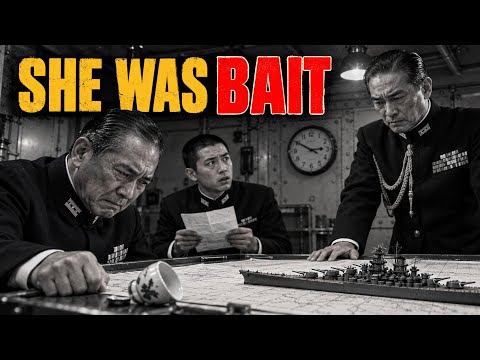
There was a second objective rarely mentioned. In those two days, Japan was launching hundreds of kamikaze attacks on American ships off Okinawa—the largest suicide offensive of the war so far. Every American fighter sent to chase a battleship meant one less fighter waiting for those kamikazes. The Yamato was the spearhead of an operation, yes. But she was also, in part, bait.
The man chosen to command her was Vice Admiral Seiichi Ito, commander of the Second Fleet. Ito was no fanatic. He looked at the plan and said it was hopeless: no air cover, no realistic chance of reaching the beaches, and thousands of lives thrown away for nothing. So the Chief of Staff of the Combined Fleet, Vice Admiral Ryunosuke Kusaka, traveled personally to persuade him.
What finally convinced Ito was not tactics. It was the idea that the navy’s last ships should go first, before an entire nation was expected to fight to the end. Ito accepted. And once he accepted, the first trap closed—and every man aboard knew it.
At 3:20 that afternoon, the Yamato weighed anchor and led the rest out. What happened aboard her over the next hours was private business for three thousand men preparing to die. Many wrote last letters. Many followed an old custom of placing a lock of hair and clippings of fingernails in an envelope, so their families would have something of them to bury.
Sake was brought out the night before, and there were songs and toasts and a great deal of silence.
In the junior officers’ quarters, the debate that night circled the one question no one could settle: What was it all for? We know this because one young man in that room survived and wrote it down. His name was Mitsuru Yoshida, a 22-year-old lieutenant who had been pulled from the law faculty at Tokyo Imperial University and placed on the bridge.
Some officers said they were dying for the Emperor and needed no other reason. Others, many of them university men like Yoshida, said that wasn’t enough. Death in a hopeless operation had to mean something more, or it meant nothing at all.
It was a lieutenant named Usubuchi who finally quieted the room. As Yoshida remembered him, Usubuchi told them that Japan had been too proud to learn from her mistakes, and that only defeat would wake the country. They would simply be the first to go. They would die clearing the way for whatever Japan came after them.
No one argued after that. It’s worth pausing on, because it tells you who these men were. Not the shouting fanatics of the war newsreels, but young men who had done their arithmetic and were looking for a reason they could live with for the few hours they had left.
What none of them knew was that the Americans had been expecting them for more than a week.
At the Navy’s codebreaking unit in Hawaii, analysts had intercepted the Ten-Go operation order and broken it in late March. As the sailing date approached, more intercepts filled in the gaps, and by April 5 the name Yamato itself appeared in the traffic. Admiral Raymond Spruance, commanding the Fifth Fleet off Okinawa, understood the purpose of the mission before most of the sailors aboard Yamato did.
So the American trap did not begin with visual sighting. It began with a stolen sentence, read by men with pencils in a room more than 4,000 miles away.
The next part was the gate. For ships heading south out of the Inland Sea, there was really only one exit—the Bungo Channel, the narrow strait between Kyushu and Shikoku. That evening, the gate had watchers. Two American submarines, Threadfin and Hackleback, waited at the mouth with orders to report, not attack.
In the faint light, one of the commanders studied the largest shape in the Japanese formation through his periscope and guessed it was an aircraft carrier, because he had never seen anything that size. His contact report went out by radio. From that moment, the Japanese force was never alone again.
The submarines were never meant to be the jaws of this trap. A submerged submarine in 1945 was barely half as fast as the ships it was watching. They were a tripwire. They recorded the time and the heading, sent them, and then watched the shapes slip away into the darkness, and they would learn how it ended the way everyone did—indirectly, days later.
It’s easy to forget how many nights of the war were exactly like that one. A few men in a steel tube, watching something they couldn’t touch, noting a time and a bearing, not knowing what it would come to. The war was made of nights like that, thousands of them, where no camera ever arrived.
In the past, I’ve told a good number of those stories on this channel. I’ve since deleted eleven of them myself, so you won’t find them here anymore. The only place they still exist is in a collection called Behind the Wire—all eleven stories complete, nearly six hours of narration, with a companion booklet to keep beside you while you listen. The link is in the description.
Meanwhile, Ito’s ships were running through the dark at better than 20 knots. By dawn on April 7, Ito had taken his ships around the southern tip of Kyushu and turned them west into the open East China Sea, well away from Okinawa. It was a feint, meant to make the Americans think he was headed somewhere else before he turned south toward the beaches.
Aboard his flagship, the carrier Bunker Hill, Vice Admiral Marc Mitscher guessed the truth exactly. Mitscher was a short, leathery man who wore a long-billed cap to shield a face that looked older than his 58 years from the sun. He had been flying for the Navy since the days of cloth-and-wire airplanes, and he had spent most of his career arguing with battleship admirals about what really decides wars at sea. And here, sailing straight toward him, was the chance to settle that argument forever.
At about 8:20 that morning, a search plane from the carrier Essex broke through the clouds and found the Japanese force. Shortly after, two large Navy flying boats from the seaplane base at Kerama Retto arrived and began to circle slowly, just out of range of Yamato’s guns. For hours they did nothing but circle, reporting every change of course and speed back to the base. A few Japanese fighters sent from Kyushu to cover the ships stayed for a while, then ran low on fuel and went home. After that, the only aircraft above the world’s largest battleship would be American.
Spruance’s orders for that morning were precise. The carriers were to focus on defending the fleet against the kamikazes. The old battleships were to deal with Yamato. But Mitscher and his staff read those orders the way a lawyer reads a contract, and noticed there was nothing in them that forbade the carriers from attacking.
At about 10:00, the first carrier groups began launching. Two hundred eighty planes went out in the first strike—Hellcat and Corsair fighters, Helldiver dive bombers, and Avenger torpedo planes. Another group would add more than 100 aircraft. Only once his planes were in the air did Mitscher signal Spruance, essentially asking whether the admiral wanted to take charge himself.
Spruance was a battleship man to his bones. He was riding one. He had every reason to want the last great gun duel in history to be his. His reply was three words: You take them.
South of there, Admiral Morton Deyo was leading his battle line north to meet Yamato. Six old battleships, ringed by cruisers and destroyers. These were the ships that had spent the war bombarding beaches, and their crews had waited years for one real battle against another battleship. Deyo’s chief of staff had sent him a signal hoping he’d come back with a nice fish for breakfast. Deyo wrote back that he would try. Then word arrived that Mitscher’s planes were already airborne, and Deyo added a dry line to his reply. If the pelicans haven’t caught them all, the pelicans are heading northwest into bad weather.
The cloud ceiling was about 3,000 feet, with rain squalls hanging over the water like curtains. Several air groups never found the target at all in that murk. Those who did found it the only way possible that day—by dropping below the clouds and searching.
To understand what those pilots were about to do, forget the planes for a moment. Imagine a man carrying a heavy suitcase in one hand. He doesn’t fall over; he leans to the other side and keeps walking. Put a suitcase of equal weight in his other hand, and he straightens up and walks more easily. That, more or less, is how a battleship survives a torpedo.
When the sea floods into one side, damage-control teams deliberately flood compartments on the other side to keep her upright. It costs her some buoyancy and speed, but a balanced ship can sail and steer and fight. A ship listing too far can do none of these things. And if she lists far enough, she capsizes.
So how do you drop that man? Hand him bags on both sides and you’re helping him. Keep loading the same hand, and sooner or later he goes down, no matter how strong he is. That, at least, was what many American pilots worked out from the way Musashi died. Torpedo hits had come from both sides and in places had canceled each other out, doing some of the damage-control work for her.
For Yamato, the idea was to put water in from one direction as much as possible—mostly her port side—so that each successive hit made the next one worse. The fighters and dive bombers had a different job. Tear up her upper decks. Smash the radar, the fire-control stations, the exposed gun mounts, and the men working them, so the torpedo planes could get close enough to attack.
Now, put yourself in one of those torpedo planes. Three of you in an Avenger: pilot forward, gunner in a turret facing back, radioman curled below at a small window who will see almost nothing of the attack but the sea rushing past. Beneath you hangs a torpedo weighing about a ton. To drop it right, the pilot must fly low and hold the plane straight and level toward the target—the one thing instinct tells you not to do while a battleship fires at you. He releases from about 1,000 yards. The torpedo needs nearly a minute to cross that distance, while the plane still has to clear the ship through every gun aimed at it.
At 12:32 p.m., Yamato’s lookouts spotted the first planes breaking from the clouds. Two minutes later, every gun on the ship that could point at the sky opened fire—even her main battery, loaded with special shells designed to burst in the air like giant shotgun blasts. The cloud cover was a double-edged weapon. It hid the Americans until they were close, but it also meant Yamato’s gunners had only seconds between a plane appearing and reaching them.
Yamato was not the first ship to sink. The destroyer Asashimo, lagging behind with engine trouble, was found alone by planes from the light carrier San Jacinto and went down with all hands—perhaps the loneliest death in the whole story, and hardly anyone remembers her name.
Above the battleship, Helldivers from Bennington dove through the flak, and at about 12:40 two bombs struck Yamato aft near her mainmast, destroying her air-search radar and one fire-control station and starting a fire her crew could never put out. Ten minutes into the attack, the largest battleship in the world could no longer see anything coming beyond human eyesight. In that weather, that wasn’t far.
Minutes later, the first torpedo hit her port side forward. Hundreds of tons of seawater poured in. Damage control flooded the opposite side, and within minutes the ship was level again—still making better than 20 knots, still on course. From the air, it looked as if nothing had happened at all.
Her escorts were not so lucky. The destroyer Hamakaze was hit and broke apart in moments. The light cruiser Yahagi took a torpedo directly in her engine room and stopped dead in the water. On Yahagi’s bridge stood Captain Tamichi Hara, one of the most famous destroyer commanders in the Japanese Navy, a man who had survived years of night battles in the Solomons. Now he could only watch the clouds and wait. His ship would endure more than an hour of pounding before she went down.
Then, with startling speed, the first wave was gone. On Yamato’s bridge, officers could take stock: bomb damage aft, a fire burning, radar out. One torpedo forward, the list already corrected. Painful, yes—but not fatal at all. She was still heading for Okinawa at over 20 knots. Standing on that bridge, you might have believed she could take what was coming.
What came next dropped out of the clouds just after 1:30. This was the second wave, led by planes from Yorktown, Intrepid, and Langley. And this time, the torpedo planes lined up on her port side and attacked one after another. Torpedo after torpedo struck midships from the same side. Her list passed 15 degrees.
On the bridge, Lieutenant Yoshida felt the deck tilt under his feet and stay tilted. Charts slid off the tables. Men grabbed the rails to stay upright. The voice pipes that had been crackling with reports went silent one by one as the compartments at the other end stopped answering.
Below, the counter-flooding was a losing race. Damage-control teams flooded every empty space they could reach on the starboard side. Then they ran out of empty spaces. What remained were the engine rooms and boiler rooms on the starboard side, and those were not empty. They were full of men on watch, keeping the ship moving.
The order was given to flood them. The men below had no time to get out, and most never received a warning. Hundreds of Yamato’s sailors drowned at their posts on their officers’ orders, so the ship could regain a few degrees of balance. It worked for a short while. Her list eased. But with much of her machinery underwater, her speed dropped to about 10 knots, and the Americans kept attacking from port.
Then came the moment that gives this story its name. By about 2:00, Yamato had listed so far to starboard that her starboard side began to lift out of the water. The armored belt that protected her waterline on that side rose into the air, and the curve of her hull appeared beneath it—the part of a battleship that is supposed to spend its entire life underwater, and that carries almost no armor at all.
Torpedo pilots from Yorktown looked down and saw it. Instead of joining the others on the port side, a group of them turned toward starboard and set their torpedoes to run deep—about 20 feet. Deep enough to pass under the belt and strike the exposed bottom of the ship.
Think about the trap Yamato was in. Every torpedo that hit her port side pulled her further over. Every degree she listed exposed more of her unprotected bottom on the other side. Every hit down there destroyed the last spaces that could have been flooded to balance her. She could not save one side without exposing the other. That was the trap. Not a single bomb or a single torpedo, but a situation in which every choice her crew made brought the end closer.
At some point around 2:00, the executive officer reported to the bridge that the list could no longer be corrected. There was nothing left to flood, and no one left below to flood it. Admiral Ito ordered the operation canceled. He ordered the crew to save themselves. Then he shook hands with his staff, turned, and entered his cabin and closed the door.
Captain Kosaku Ariga stayed at his post. A few miles away, at almost the same minute, Yahagi finally capsized and sank. Captain Hara found himself in the water, swimming in fuel oil, watching the sky above the battleship darken with planes.
Yamato capsized at about 2:20. She rolled to port, slowly at first, then all at once. Men poured off her rising side and slid down the hull into the water. Lieutenant Yoshida fell in with her and felt himself pulled down by the suction, into deeper and deeper darkness, with no idea which way was up.
Then, somewhere beneath him, the fires that had burned since the first bombs reached one of her magazines. The explosion tore the ship apart. Columns of smoke and flame shot thousands of feet into the clouds and spread across the sky. American pilots overhead felt their planes rock from the blast. And Yoshida, who had been about to drown, was thrown upward toward the light by the same shockwave that had just ended his ship. He broke the surface to find a sea of oil and wreckage, and some of the men still alive.
That was the smoke the people of Kagoshima saw from more than 100 miles away. The time was 2:23 p.m.
The first attackers had come out of the clouds at exactly 12:32. From that moment to the last explosion, the whole thing had taken one hour and fifty-one minutes.
Of Yamato’s crew of more than 3,300 men, only about 270 were pulled from the water. Admiral Ito died in his cabin. Captain Ariga died on his bridge. Across the whole force, Yamato, Yahagi, and four destroyers were lost, with roughly 4,000 Japanese sailors. The four surviving destroyers picked up whoever they could find—including Captain Hara—and turned for home. The Imperial Japanese Navy never sent a fleet to sea again.
The Americans lost 10 aircraft that day and 12 men. South of the battle, Admiral Deyo’s six battleships never came within 100 miles of their target. When strike reports made clear there was nothing left to fight, the battle line turned back toward Okinawa. The pelicans, as Deyo had partly predicted, had caught them all.
But the day of the battleship was not quite over. At dusk, while the column was still at sea, a kamikaze appeared out of the fading light and struck the third turret of the battleship Maryland—a ship that had been moored in Battleship Row at Pearl Harbor on the morning the war began. The bomb she carried wrecked the antiaircraft guns on top of the turret and killed or wounded more than 50 of her crew. On the day that was supposed to bring the last great battleship duel, the only enemy the American battle line met was an airplane. It is hard to think of a clearer verdict on the entire age of the battleship than that.
When the planes returned home that evening, the paperwork began. Each squadron filed an action report, typed in ready rooms that still smelled of sweat and hydraulic fluid. Time of launch, weather over the target, bombs dropped, hits claimed, intensity of flak—and near the bottom of some of those reports, a line for the planes that had not come back, with the names of the men aboard.
For the families of those 12 men, the record was less detailed. Usually a telegram arrived first, saying their son was missing in action. Months later, often, a second notice came saying the Navy now presumed him dead. Sometimes a letter from his squadron commander arrived, careful and brief. And eventually, a small box came home containing his effects, inventoried and packed: a watch, a razor, a bundle of letters, a few photographs no one could identify. Many such boxes are still in closets and attics today. Maybe there is one in your family—a picture of a young man in uniform squinting into the sun, a patch no one can name. If that young man was your grandfather, he left a paper trail too, and it can still be traced.
Twelve American families waited for news that spring. In Japan, thousands waited. One of the few men who came home from Yamato kept his own record. Mitsuru Yoshida, the lieutenant thrown back to the surface, spent hours in the oil before a destroyer picked him up. After the war, he sat down and wrote everything he had seen and heard on that bridge—the officers’ argument in the dark, the reports that stopped coming, the deck that would no longer lie flat, the admiral’s handshake. When he tried to publish it, the American occupation censors blocked it. It appeared in full only in 1952, after the occupation ended. Known in English as Requiem for Battleship Yamato, it is the source nearly every account of that night draws on, including this one.
Yoshida went on to a quiet career in banking, but he kept returning to that manuscript, revising it for decades, as if the men who had not come up with him were still waiting for him to get it right.
So go back to where this all began. A small boat pulling away from the side of the largest warship ever built, carrying a few dozen young cadets sent ashore so that one of them might live. The ship they watched recede was trapped twice. Once by her own commanders, who sent her out without air cover on a mission partly meant to draw fire, because no one wanted to tell the Emperor the navy had nothing left to offer. And once by the Americans, who read her orders before her crew did, watched her leave through a channel they had already covered, tracked her all morning from the edge of the clouds, and then destroyed her in a way that turned her own damage control against her.
The pilots who ended her mission did not win because they were braver than the men who sailed her. They won because by the time the first bomb fell, there was no move left on the board that could have saved her.
One hour and fifty-one minutes. That is how long the greatest battleship in history lasted once the trap closed. The people standing on the shore at Kagoshima that evening, staring at a column of smoke on the horizon, never knew what they were looking at. Now you do.
But here is the question that still hangs over that smoke: when a weapon is built to win a battle that never comes, who is really to blame—the enemy who destroys it, or the nation that sent it out knowing it could not return?
Report this article
Select a reason for reporting:






