July 6th, 1942. “Have you ever been in combat? Don’t volunteer for anything. I ruined my life with that.” These words, scrawled by a soldier named Fander Debeekine, open a window into the shattered souls of men who fought on the Eastern Front. His letter continues with a haunting admission: “I’m writing to you with difficulty since I have no fingers on my right hand.” This is not a tale of glory, but of disillusionment, horror, and the slow erosion of humanity.
The war between Nazi Germany and the Soviet Union was no ordinary conflict. It was a war of extermination, a clash of ideologies that turned the vast landscapes of Russia into a graveyard for millions. The letters and diaries of German soldiers reveal a descent into a nightmare where survival was measured not in victories, but in moments of fleeting normality.
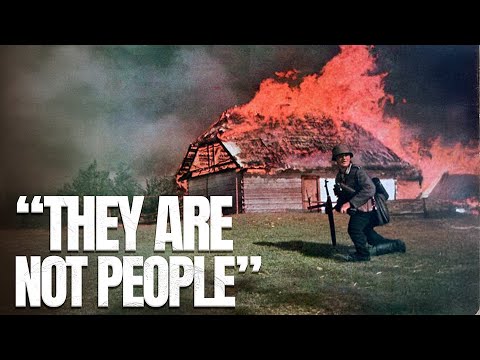
As the German war machine rolled eastward in the summer of 1941, soldiers like Sergeant Curt Hmel wrote home with a mixture of arrogance and shock. “Bolshevik conditions are indescribable,” he penned from Northern Russia. “I never imagined such misery was possible.” These men had been fed propaganda about a Soviet paradise, but what they found was a world of primitive huts, rotten thatched roofs, and a population living in conditions worse than animals. “This is what people call the Soviet paradise,” Hmel scoffed, his words dripping with contempt and a dawning realization of the chasm between Nazi ideology and reality.
The roads themselves became a metaphor for the struggle. Soldier Hinrich, marching kilometer after kilometer under the scorching sun, complained to his co-workers in Hamburg: “The main roads are no better than country trails.” Dust clouds choked the air, and the endless expanse of swamps and forests made every advance a grueling ordeal. “We keep moving forward,” he wrote, but the cost was measured in exhaustion and the creeping doubt that this land could ever be tamed.
Amidst the physical hardships, the ideological poison of anti-Semitism ran deep. Medical Corporal Paul Lens echoed the Nazi line: “Only a Jew can be a Bolshevik. For these bloodsuckers, there’s nothing better to be.” His letters painted a picture of a world where Jews lived in luxury while true workers starved—a grotesque distortion that justified the horrors to come. Soldier Reynold Manka, writing from Latvia, described scenes of unimaginable brutality: “They nailed men and even children to the walls. These are things we saw.” Such atrocities, far from being condemned, were often framed as just revenge against a perceived enemy.
But as the tide turned and the Russian winter set in, the tone of the letters shifted. The arrogance of the summer gave way to despair. A German lieutenant wrote on November 29th, 1941: “The Russians are devils. We have to deal with them.” He confessed to a chilling practicality: “A pistol to the head that cools the fervor.” Another soldier, Simon, dreamed of Moscow’s towers and luxurious winter apartments, only to find himself 30 kilometers away, facing a siege that would never come.
The hunger was relentless. Supply soldier Ming wrote to his wife: “We are feeding ourselves with potatoes and other goods we take from the Russian inhabitants. As for the chickens, they no longer exist.” He described searching for buried barrels of salted pork and honey, day and night, driven by starvation. “Everyone here is our enemy. Every Russian, regardless of age or gender, be it 10, 20, or 80 years old.” His conclusion was genocidal: “They must all be exterminated. Every single one.”
Yet even in this moral abyss, some letters reveal a flicker of humanity—or at least a yearning for it. A corporal from the 269th Infantry Division wrote on January 11th, 1942: “You can’t imagine what we’ve been through in the last 6 weeks. I can’t even write about it.” He described frozen hands and feet, comrades dying in the snow, and the constant fear of encirclement. “We can’t hold on much longer,” he admitted. “The Russians will never surrender.”
These letters, smuggled out of the inferno, are more than historical documents. They are confessions—of complicity, of suffering, of the terrible things men do when they are pushed to the edge. As we delve deeper into these accounts, we will uncover the full extent of the horror, the moments of compassion that defy belief, and the ultimate fate of those who fought in the war of extermination.
The diary of Ober Lieutenant Krower, killed in Ukraine, offers no such flicker of conscience. His entries read like a catalogue of predation: “I seduced French, Polish, Dutch peasant girls. Today, finally, I let it out. A 15-year-old girl. She was extremely frightened. She bit my hands. Poor thing. I had to tie her up.” His lieutenant’s reply was equally obscene: “For such feats, you deserve the Iron Cross.” Here was violence stripped of even the pretense of military necessity—a raw exercise of power over the defenseless.
Tank crewman Carl saw the land and its people through a lens of pure contempt. “Not a remotely attractive, intelligent face to be seen here,” he wrote. “Only savagery, confusion, not even worth giving or taking.” Yet in the same breath, he invoked the grand ideological justification: a Europe led by Jews and criminals, destined to subjugate the world. “Thank God we didn’t allow that.” The contradiction was lost on him—he was the one waging a war of annihilation.
By the spring of 1942, the swagger had curdled into something darker. A soldier writing from a trench on May 10th confessed: “Shells and bullets are whizzing past our ears. Behind us, three difficult battles. My friend is already dead.” Then came the threat, delivered as if it were a promise: “Where the German soldier passes, not even grass grows anymore.”
Corporal Hans Blumendorf remembered the good days with bitter nostalgia. “During a 5-day rest, a friend and I ate 45 chickens,” he wrote on May 4th, 1942. “That was how it used to be. But now we must starve significantly.” The contrast between the feast and the famine told its own story: the blitzkrieg had failed, and the Wehrmacht was bleeding out in the Russian mud.
The diary of a soldier from Army Group Center, dated August 20th, 1941, captured the seesaw brutality of the front. “The losses are terrible. Nothing like it was in France. Today it’s our road. Tomorrow the Russians take it. Then we again.” His description of the enemy was raw and unguarded: “I’ve never seen anyone crueler than these Russians. Real rabid dogs. You never know what to expect from them.”
Some letters were reduced to the barest essentials. Walter wrote to his brother a single line: “I’m still alive.” Others begged for packages of bacon and butter, a hundred grams at a time, as if small comforts could stave off the abyss. One soldier, stationed near the Dnieper in May 1942, described the river as “overflowing like a sea,” the fields uncultivated, the land stripped of labor and life. “The impressions of this foreign land are bleak,” he concluded—an understatement that bordered on the absurd.
But it was the corporal of the 269th Infantry Division who gave the fullest account of the winter catastrophe. Writing on January 11th, 1942, he described six weeks in the forest with no roof overhead and the Russians always pressing. “Daily so many semifrozen comrades are leaving us. I also have frozen hands and feet. And I’m just waiting for the day when it ends for me, too.” Of the radio operators, only two remained; the rest were in hospital. “At Christmas, we were surrounded by the Russians. We only managed to escape with the help of tanks.”
His final words carried the weight of a man staring into the void: “In the movies, they show one thing. Reality is much more tragic. But all of this wouldn’t be so terrible if we knew it would end one day. But who knows how much longer this war in the forest will last.” Even the lice, he noted with grim humor, were a constant companion: “There is definitely no German soldier without lice in Russia.”
And then there was the anti-tank gunner from Breslau, whose letter of June 22nd, 1941—the very first day of the invasion—recorded a moment that foreshadowed everything to come. “Just as we went on the attack, one of ours killed himself with his own weapon. Holding the rifle between his knees, he put the barrel in his mouth and pulled the trigger.” The man had chosen oblivion over the war, and in doing so, he had perhaps understood what the others would learn only through months of blood and ice: that the Eastern Front was not a campaign, but a sentence.
The letters and diaries fade into silence, but the voices linger. Fander Debeekine, writing with a maimed hand, had warned against volunteering—a warning that echoed across the frozen steppes and burned villages. “I ruined my life with that,” he confessed, and in those words lies the sum of a generation’s shattered dreams.
Sergeant Hmel’s disgust at the Soviet paradise, Corporal Lens’s poisonous anti-Semitism, Ober Lieutenant Krower’s predatory violence—these are not isolated sins but strands in a tapestry of collective guilt. The soldier who wrote “Where the German soldier passes, not even grass grows anymore” spoke a truth far beyond his intent: the war of extermination had consumed the exterminators themselves.
Yet amid the horror, a single line from Walter—“I’m still alive”—carries the fragile weight of survival. It is a whisper against the roar of artillery, a stubborn assertion of existence in a world bent on erasure. The corporal of the 269th Division, waiting for his end in the frozen forest, understood what so many refused to see: “Reality is much more tragic.”
The anti-tank gunner’s suicide on the first day of the invasion remains the most chilling prophecy. He chose oblivion before the first shot was fired, as if he already knew that the Eastern Front was not a war to be won, but a sentence to be endured. The letters end, but the question hangs in the air: how do we reckon with the testimony of those who were both perpetrators and victims?
What do you think—can these voices from the past teach us anything, or are they simply echoes of a darkness we can never fully comprehend? Share your thoughts in the comments below.
Report this article
Select a reason for reporting:






