The sun hung low over the South African veld, casting long shadows that seemed to whisper of impending doom. On January 22, 1879, the British Empire suffered its most catastrophic defeat at the hands of a native African army—a force of 1,500 men annihilated by the Zulus at Isandlwana. Yet, as the sun set on that day of infamy, a tiny garrison of just over 100 British soldiers stood firm at Rorke’s Drift, holding off a Zulu force 40 times their size in one of the most gallant defenses in military history. This is the story of those two battles—of hubris and heroism, of disaster and defiance.
The seeds of this conflict were sown by ambition. Sir Bartle Frere, the British High Commissioner, dreamed of a confederation of South African states under British rule. But the independent Zulu kingdom, forged by the legendary Shaka, stood in his way. Frere engineered a war, sending an ultimatum he knew the Zulus could not accept. In January 1879, British forces invaded Zululand, confident of a swift victory. They were wrong.
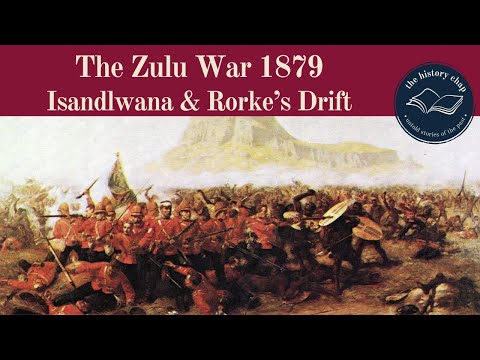
Lord Chelmsford, the British commander, split his forces, leading the main column into Zululand while leaving a portion behind at Isandlwana. His scouts reported Zulu movements to the east, and Chelmsford, eager to crush the enemy, took 1,100 men and most of the artillery to pursue what he believed was the main Zulu army. He left 1,700 men under Colonel Pulleine to guard the camp. It was a fatal error. The Zulus had brilliantly moved 25,000 men undetected to the north of the camp, and they were lying in wait.
On the morning of January 22, Pulleine’s men spotted Zulus on the nearby heights. Lieutenant Raw, leading a scouting party, peered over a ridge and was horrified to see over 20,000 Zulu warriors silently waiting. His men fired a volley, and the Zulu army rose, forming the famous ‘horns of the buffalo’ attack. The right horn swept around the British flank, the left horn engaged Dunford’s men, and the main body charged down upon the camp.
The British fought with discipline, their Martini-Henry rifles cutting down wave after wave of Zulus. But they were overwhelmed. Ammunition ran low, and the native contingent fled. Within three hours, the camp was overrun. Soldiers fought back-to-back, using bayonets and fists, but it was futile. The Zulus showed no mercy. Lieutenant Melville and Coghill attempted to save the Queen’s colors, but they too fell. A partial eclipse darkened the sky, adding to the hellish scene. By 2:30 PM, it was over. Not a single British soldier on foot escaped. Over 1,300 men were massacred.
Meanwhile, at Rorke’s Drift, a small garrison of 139 men, including 35 sick and wounded, prepared for the worst. They had been left to guard a supply depot and hospital. When news of the disaster at Isandlwana reached them, they knew the Zulus were coming. They could have fled, but they chose to stand and fight. Under the command of Lieutenant Chard and Lieutenant Bromhead, they fortified the mission station with mealie bags and biscuit boxes.
At 4:30 PM, the Zulu reserve force, 4,000 strong, appeared. They were fresh, eager for battle, and had not been at Isandlwana. The British had three advantages: 20,000 rounds of ammunition, a fortified position, and a narrow front that negated the Zulu numerical advantage. For hours, the Zulus charged, and the British repelled them with devastating fire. The hospital was set ablaze, and the defenders fought room by room, evacuating patients through walls as the Zulus attacked with spears. Private Henry Hook, a cook, fought with incredible bravery, suffering a severe head wound.
As darkness fell, the Zulus attacked relentlessly, but the British held. Their rifles grew hot, their shoulders ached from the recoil, and their lips cracked from thirst. Yet they did not break. By 2:30 AM, the Zulus, exhausted and having lost over 600 warriors, withdrew. The garrison had held.
When Chelmsford’s column returned the next morning, they found the mission station still standing, the Union Jack flying. The defenders were too parched to cheer, but their survival was a beacon of hope amid the devastation. Eleven Victoria Crosses were awarded—the most ever for a single action in British military history. But the victory at Rorke’s Drift could not erase the shame of Isandlwana. The British government, shocked by the defeat, poured reinforcements into South Africa. Chelmsford invaded again, and on July 4, 1879, he crushed the Zulu army at Ulundi. The Zulu kingdom was no more.
The battles of Isandlwana and Rorke’s Drift faded from memory, but the heroism and the horror lived on. The Zulu War was a clash of empires, a story of ambition, courage, and tragedy. And as the sun set on that fateful day, the world had witnessed the worst defeat and the most gallant defense—a tale that would echo through history.
Yet the story does not end on the battlefield. The survivors of Rorke’s Drift returned to a Britain that celebrated them as heroes, but their lives afterward told a far more complicated tale. The men who had held the line against impossible odds found that peace offered no such clarity.
Private Henry Hook, who had fought room to room through the burning hospital, left the army to find that his Victoria Cross opened no doors. He took a job as a janitor at the British Museum, scrubbing floors beneath the marble gaze of empire. His head wound never properly healed, and the headaches that plagued him for the rest of his life were a private reminder of a night the public preferred to remember as a triumph.
William Jones, another VC recipient, carried darker scars. In his later years in Manchester, he would seize his grandchildren and flee from the house, screaming that the Zulus were coming. There was no name for what tormented him then, no treatment, no understanding. He pawned his Victoria Cross in the 1890s to survive, and when he died in 1913, he was buried in a pauper’s grave.
Perhaps the most poignant fate belonged to Lieutenant Gonville Bromhead, the deaf officer who had commanded the defense alongside Chard. He never escaped the shadow of that night. Promoted and posted to India, he died of typhoid fever in 1891 at the age of forty-five, far from the mission station where he had become a legend. His grave in Allahabad was largely forgotten until a later generation of historians went searching for it.
John Chard fared somewhat better. He was promoted to major and enjoyed a respectable career in the Royal Engineers, but he rarely spoke of Rorke’s Drift. When he died in 1897, his obituary noted his role in the famous defense, yet those who knew him said he seemed almost embarrassed by the attention. He understood, perhaps better than anyone, how close they had come to annihilation. The 650 rounds that remained at dawn—barely enough for ten more minutes of fighting—was a secret he carried to his grave.
The Zulu side of the story, for decades, went almost entirely untold. The warriors who survived Isandlwana and Rorke’s Drift returned to a kingdom that was already crumbling. King Cetshwayo, paraded before Queen Victoria as a curiosity, was eventually allowed to return to Zululand, but his authority was broken. The great military society Shaka had built was dismantled, its regiments disbanded, its lands carved up among British administrators and Boer settlers. The men who had charged the barricades at Rorke’s Drift with nothing but spears and courage faded into the anonymity of a conquered people.
It was not until the 1960s, with the release of the film ‘Zulu’ and the publication of Donald Morris’s ‘The Washing of the Spears,’ that the world rediscovered these battles. The film turned Bromhead into a stiff-upper-lipped hero and Hook into a drunken rogue—a characterization so inaccurate that Hook’s descendants protested for years. But it also ignited a fascination that has never faded.
Today, the battlefield at Isandlwana is marked by white stone cairns, each one marking where a group of British soldiers fell. The Zulu dead lie in unmarked graves, their names lost to history. At Rorke’s Drift, the mission station has been rebuilt as a museum, its red corrugated iron roof a landmark for pilgrims who come from around the world to stand where a hundred men refused to die.
And yet, standing there at dusk, with the wind moving through the grass and the Buffalo River murmuring in the distance, one cannot help but feel that the true story is not about victory or defeat at all. It is about the ordinary men—British and Zulu alike—who were caught in the machinery of empire, who fought with a courage that transcended their circumstances, and who returned home, if they returned at all, to lives that could never match the intensity of that single, terrible, glorious night.
The wars that followed were many, and the world moved on. The British Empire fought in Afghanistan, in the Sudan, in the dusty veld of a second Boer War, and then in the mud of Flanders. The names Isandlwana and Rorke’s Drift slipped into the footnotes of regimental histories, remembered chiefly by the families of the men who had been there.
But memory is a stubborn thing. In the 1960s, a film called Zulu brought the story roaring back to life, and with it a new generation of pilgrims began making the journey to that bend in the Buffalo River. They came to stand where a hundred men had held against four thousand, and they came, too, to climb the slopes of Isandlwana and wonder how an empire could have been so careless.
What they found was not glory, but grass and stone. White cairns marked where the British fell; the Zulu dead lay in unmarked earth, their names carried only in the songs of their descendants. The mission station was rebuilt, its red roof gleaming again under the African sun, and the river still ran as it had on that January night in 1879.
Perhaps that is the truest monument—not the crosses or the medals, but the quiet persistence of the place itself. The wind still moves through the thorn trees. The river still floods in the rainy season. And the story still asks its uncomfortable questions about ambition, courage, and the cost of empire.
So the next time you hear the names Isandlwana and Rorke’s Drift, remember the men on both sides of the barricade—the redcoats and the Zulu warriors alike—and ask yourself: what would you have done?
What do you think history has gotten right, and what has it gotten wrong, about these two battles? Share your thoughts in the comments below.
Report this article
Select a reason for reporting:






