On May 1st, 1945, a four-year-old girl in a white nightgown stood in the cramped corridor of Hitler’s bunker, teasing a soldier. She sang Misch, Misch, du bist ein Fisch, and Rochus Misch, the bunker’s telephone operator, forced a smile. Minutes later, the girl’s mother led her away. By morning, six children lay dead in their bunk beds, ribbons still tied in the girl’s hair.
Most people think that is where the Goebbels story ends, in concrete and cyanide beneath Berlin. But one of Magda Goebbels’ children survived. And his family still controls one of the most valuable companies on Earth today.
The story of what happened next involves billion-dollar empires, Nazi judges who walked free, and a secret Soviet operation that lasted 25 years.
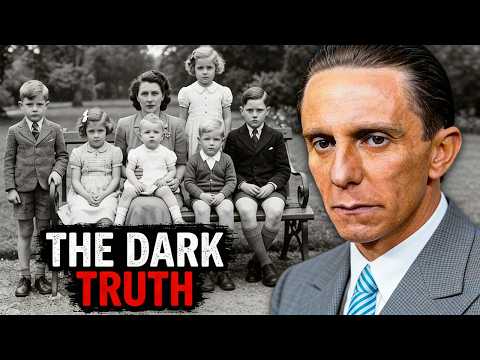
In the final weeks of the war, Magda Goebbels had options. Albert Speer offered to smuggle her children out of Berlin to safety. Others proposed escape routes through neutral territory. She refused every single one.
On April 22nd, 1945, the family moved into the Vorbunker, the antechamber connected to Hitler’s underground headquarters. Joseph Goebbels was the propaganda minister, one of the last true believers still standing beside the Führer as Soviet artillery shook the city above.
He added a postscript to Hitler’s final will, declaring he would disobey orders to leave Berlin for reasons of humanity and personal loyalty. But Magda’s reasons had nothing to do with loyalty. In her farewell letter addressed to her surviving son Harald, who was a prisoner of war and could not receive it, she explained her thinking. She could not bear for her children to live in disgrace and humiliation. The world without National Socialism, in her mind, was not worth living in.
She made a choice no parent should make. She would take her six children with her.
The children themselves knew nothing of this. They spent their final days playing in the bunker corridors, drawing pictures, and acting out scenes from their favorite fairy tales. Helmut, the nine-year-old boy with a gap in his teeth, had mocked Hitler’s speaking style that very day. A small rebellion that would have horrified his parents if they had noticed. Heide, the six-year-old, had announced to anyone who would listen that she planned to marry SS Adjutant Schwägermann when she grew up.
They trusted their mother completely.
Around 8:00 on the evening of May 1st, 1945, roughly 18 hours after Hitler’s suicide, Magda gathered the children in their shared room. She told them they would be receiving injections. Some accounts say she mentioned vaccinations. Others say she promised a trip to Berchtesgaden, Hitler’s mountain retreat, where they had spent happier times.
The children were given morphine, 0.5 cubic centimeters each, enough to render them unconscious within minutes. They were tucked into their bunk beds, still wearing their nightgowns, the girls with ribbons still in their hair. What happened next remained disputed for decades.
SS dentist Helmut Kunz later testified that he administered the morphine, but refused to complete the killing. He claimed Magda herself, possibly with the help of Hitler’s physician Ludwig Stumpfegger, crushed cyanide capsules between the children’s teeth while they slept. The official story was peaceful, quiet, like drifting off into endless sleep. But the old autopsies told a different story.
When Soviet forces discovered the bodies two days later, they documented everything with clinical precision. Five of the children showed no signs of struggle. They had died in their drugged sleep, unaware of the poison filling their lungs. Helga was different. At 12 years old, she was the eldest, old enough to sense something was wrong. Perhaps old enough to metabolize the morphine faster than her siblings. Her face bore heavy bruising around the jaw and cheeks. The autopsy photographs showed defensive marks.
Helga had woken up. Helga had fought back. Someone had to hold her down while the cyanide did its work.
This detail transforms the narrative we have been told for 80 years. This was not a peaceful death. For at least one child, it was murder in the most visceral sense. A 12-year-old girl struggling against her own mother in a concrete bunker while the Third Reich collapsed above them.
Helmut Kunz wasn’t a monster. That’s what makes his story so disturbing. Before the bunker, before that night in May, Kunz had been an ordinary military dentist. He had a wife and two daughters, ages five and one. In early 1945, an American bombing raid killed them both. Within months, he had lost everything that mattered to him.
Then came the order. Sedate the Goebbels children. Kunz later claimed he was coerced. He said he administered the morphine because he had no choice, but he refused to give the fatal cyanide dose. Whether this is true remains impossible to verify. Stumpfegger, the only other adult present besides Magda, died attempting to flee the Soviets just hours later. He never testified.
But the larger question looms. Surely, when the war ended, someone was held accountable for what happened to those six children.
In 1959, Helmut Kunz finally stood trial in a West German court. The charges were serious. Accessory to murder, six counts, all children under the age of 13. The judges who heard his case were Gerhard Rose and Gerhard Arlt. Both men had something in common with the defendant: Nazi Party membership numbers.
The trial was brief. The verdict was acquittal. The legal reasoning relied on a 1954 amnesty law originally designed to protect civil servants from prosecution for actions taken during the Nazi period. The judges determined that Kunz’s role was too peripheral, his coercion too credible, his suffering too sympathetic. The man who had injected six children with morphine walked out of the courtroom a free man. He was never tried again. He lived quietly in West Germany until his death, the last survivor of that night in the bunker besides the scattered guards and secretaries who had witnessed the horror from a distance.
For the victims, there would be no justice. But while six children died in that bunker, one of Magda Goebbels’ children did not just survive—he became one of the richest men in German history.
Harald Quandt was 23 years old when his mother killed his half-siblings. He was not in Berlin. He was not even in Germany. He was a Luftwaffe officer captured by Allied forces in Italy in 1944 and held as a prisoner of war in Benghazi, Libya.
Harald was Magda’s son from her first marriage to industrialist Günther Quandt. He had grown up in a different world—wealth and privilege, and the complicated politics of a mother who had divorced one powerful man to marry an even more powerful one. By the time Magda entered the bunker with Joseph Goebbels, Harald was beyond her reach.
The farewell letter she wrote was addressed to him. It was her justification, her explanation, her goodbye to the only child she could not take with her.
Harald did not learn his half-siblings were dead until his liberation in 1947. For two years, he had wondered about the six children he had grown up alongside. Helga, who admired her father with fierce devotion. Helmut, who made jokes about Hitler. And little Heide, who sang nursery rhymes to soldiers.
They had been dead the entire time.
Harald Quandt returned to a Germany in ruins. But the Quandt family fortune—built on armaments and industrial manufacturing—had survived the war better than most. Working alongside his half-brother Herbert, Günther Quandt’s son from another marriage, Harald began rebuilding.
By the 1960s, the brothers had acquired controlling stakes in two major companies. One was Varta, the battery manufacturer. The other was BMW. At the time, BMW was struggling—a company with a storied history but an uncertain future. The Quandt brothers saw potential. They invested heavily, restructured management, and positioned the company for the economic miracle transforming West Germany.
On September 22nd, 1967, at the age of 45, Harald Quandt died in a plane crash in Italy. But his children inherited his shares, and the family’s stake in BMW only grew more valuable. Today, Harald Quandt’s descendants—particularly Susanne Klatten and Stefan Quandt—are among the wealthiest people in Germany. Their fortune is measured in tens of billions.
The cars rolling off BMW assembly lines represent one of the most successful industrial stories of the 20th century. And it all traces back to a woman who chose a bunker over escape, who wrote a farewell letter to a son she could not kill, whose bloodline prospered even as her ideology collapsed.
The car in your neighbor’s driveway connects directly to that concrete room beneath Berlin.
While Harald Quandt built an empire, the bodies of his half-siblings began a strange journey of their own. Soviet forces discovered the six children on May 3rd, 1945. They photographed everything. They conducted autopsies with meticulous detail, recording weight, height, the contents of their stomachs, and the bruises on Helga’s face.
The bodies became evidence, then propaganda tools, then problems. Over the next year, the remains were moved at least three times. The Soviets kept them as leverage—potential proof of Nazi barbarism that could be deployed whenever useful. In February 1946, they were buried at a SMERSH counterintelligence facility in Magdeburg, East Germany. For 24 years, they lay there in secret.
Then came April 4th, 1970. KGB director Yuri Andropov—the same man who would later lead the Soviet Union—issued an unusual order. “Exhume the remains of the Goebbels children and other Nazi figures buried at the Magdeburg facility. Cremate them. Crush the ashes to powder. Scatter them into the Biederitz River, a tributary of the Elbe.”
The order was carried out under strict secrecy. No records were kept of the exact location. No markers were left. Why 1970? Historians have theories but no definitive answers. Perhaps the Soviets worried about the graves becoming pilgrimage sites for neo-Nazis. Perhaps it was simple bureaucratic housekeeping, clearing out relics of a war that had ended a quarter century earlier.
The truth died with the men who gave the orders. Auguste Behrend, Magda Goebbels’ mother, spent years searching for her grandchildren’s graves. She never found them. She never learned that by the time she gave up, there was nothing left to find.
In 2005, Rochus Misch made an unusual proposal. For 60 years, he had carried the memory of the six children in white nightgowns, the sound of their voices, the sight of Magda combing their hair and kissing them goodbye. He proposed a memorial plaque for the six children.
His argument was simple. They were innocent victims murdered by their parents, bearing no responsibility for the crimes of the Third Reich. The proposal sparked immediate controversy. Can you memorialize the children of Nazis, even children who bore no guilt? Does honoring them honor the family name? Does refusing to honor them punish the innocent for the sins of the guilty?
The memorial was never built. The children remain unmemorialized, their ashes long since dissolved into a river that flows toward the North Sea.
One final myth needs to be addressed. For decades, popular history claimed the six children were given names beginning with H in honor of Adolf Hitler. It is not true. Magda’s mother later confirmed the naming pattern was simply a family tradition—an innocent hobby. Günther Quandt had also given his children names beginning with H. There was no sinister homage, just coincidence elevated to conspiracy.
The myth also persists that Joseph Goebbels ordered the murders. The evidence suggests otherwise. Magda made the decision. She insisted on it even when Joseph expressed reluctance. She was the one who refused Speer’s offer of escape. She was the true believer who could not imagine her children surviving in a world without Hitler.
And the deaths were not peaceful. Cyanide does not kill instantly. It interferes with cellular respiration, essentially suffocating the victim from the inside. Even drugged, those six children died gasping for air that could not save them. Helga’s bruises prove that at least one of them knew exactly what was happening.
We prefer the sanitized version—the sleeping children, the gentle mother, the merciful end. But the bunker was not merciful, and neither was Magda Goebbels.
The bunker took six innocent children on the night of May 1st, 1945. But it did not end the Goebbels story. It just redirected where the money went. The ideology died. The family name faded into history, but the fortune built on the ruins of the Third Reich is still growing.
So here is the question that refuses to die: when a fortune is built on a foundation of unspeakable complicity, does the passage of time—or the innocence of later generations—ever truly cleanse it? Or does every BMW on the road still carry a whisper of that concrete room beneath Berlin?
Report this article
Select a reason for reporting:






