Summer, 1944. A dusty road in Normandy, somewhere behind the American lines. A column of German prisoners shuffles forward, uniforms crusted with mud and sweat, boots wet since June. They have not bathed in weeks. Then they see it: a canvas enclosure between two trucks, steam rising, and a line of American soldiers waiting with towels. Hot showers. Miles from the front. The Germans slow down, staring. They cannot process what they are seeing.
This is not a story about luxury. It is a story about a fundamental difference in how two armies understood war. The Germans believed in Härte—hardness, the will to endure. The Americans believed in maintenance. And that difference would prove decisive.
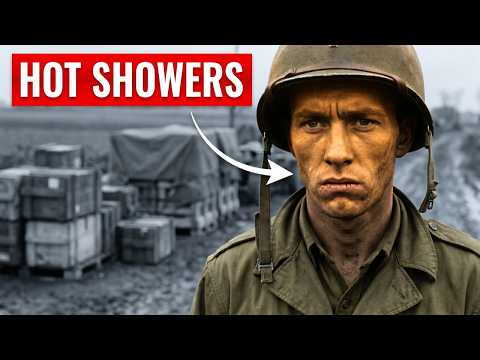
The German military tradition was built on suffering. Frederick the Great’s Prussian infantry was trained to fear officers more than the enemy. By the 1930s, the Wehrmacht had turned hardship into a cultural requirement. Hitler demanded a hard people, not soft. Rommel embodied it, sharing his men’s hardships. It worked—until it didn’t. The flaw: willpower is not renewable. The body breaks.
The Americans saw it differently. They treated war as an engineering problem. At Kasserine Pass in 1943, the Germans saw exactly what they expected: an amateur army with chocolate, cigarettes, and razor blades. “An army that brought razor blades to a battlefield was not a serious army,” one German report sneered. They missed the point. The razor blades were the point.
Behind the rifleman came the Quartermaster Corps, with a plan for every human need. Hot food, clean uniforms, and showers were not luxuries—they were ammunition. The Army Medical Corps had proven that exhausted men eating cold rations lost alertness and disease resistance. So the system delivered. By 1945, 91% of rations were kitchen-prepared. Mobile bakeries produced fresh bread. Marmite cans kept stew hot for miles. And the Fumigation and Bath Companies ran shower trailers with 36 heads, processing 3,600 men a day.
At Homberg Haut, one platoon showered 1,500 men daily, eight miles from the front. The men walked in filthy, walked out clean, and received fresh uniforms from a revolving stock of 2,000 sets. Corporal Benjamin Berry of the 863rd Quartermaster Fumigation and Bath Company recalled: “They brightened up when they saw us.” Not tanks. Not air support. Shower trucks.
The scale was staggering. The Red Ball Express ran 5,958 trucks around the clock, 75% driven by African-American soldiers. On August 29, 1944, they delivered 12,342 tons in a single day. The U.S. operated 64 Coca-Cola bottling plants overseas and spent $1 million on a floating ice cream factory. “I know how you defeated us,” one German prisoner said, looking at a supply dump. “You piled up the supplies and then let them fall on us.”
The German army had no equivalent. Lice were endemic. Trench foot ravaged units. Soldiers went weeks without clean clothes. The Americans pushed dry socks to every frontline soldier daily because trench foot caused more casualties than bullets in some divisions. The Germans wrapped their feet in rags and kept walking until they couldn’t.
At Trent Park, British intelligence secretly recorded captured German generals. They were baffled. American logistics wasn’t just keeping men alive—it kept them fighting. German officers described finding hot coffee in American foxholes, drainage channels, shelves cut into dirt walls. “The Americans seemed to be living in their foxholes as if they intended to be comfortable.”
German tank crews made errors by the third day of continuous combat—not from lack of skill, but from exhaustion. American crews were fresher, more alert. The reason was simple: they slept in dry clothes, ate cooked food, and rotated through rest areas. The German system could not provide that.
Even in captivity, the contrast continued. German POWs in American camps were astonished by the food—fresh meat, vegetables, coffee. Rations often better than what the Wehrmacht served. Word filtered back: American captivity was survivable. The incentive to fight to the death diminished.
The pre-war German stereotype of Americans as soft was the central miscalculation of the war. It was exactly backwards. The Americans were comfortable because comfort was a weapon. They were well-fed because food was ammunition. They were clean because hygiene was a force multiplier. Willpower runs out. Hot coffee does not.
So why were the Americans taking hot baths in the middle of a war? Because a hot bath was not a bath. It was a statement: We have enough. And you, the man holding a towel, matter. The German army said: You do not need comfort, you need will. But that is a lie. The body has limits. Willpower only delays the moment when the man hits them. And when he hits them, he does not become harder—he becomes a casualty.
The American army understood this because it came from a country that built machines and learned that the machine runs better when you maintain it. A soldier was a magnificent, irreplaceable human machine. And you maintain the machine by giving it what it needs.
Every gallon of hot water, every clean undershirt, every bottle of Coca-Cola, every insulated can of hot coffee carried forward at dawn—each was a deposit in a bank account the Germans could not see. An account that paid out in alertness, resilience, and the will to keep fighting. Not because a manual said so, but because a man who has been treated like a human being will fight like one.
That was the secret. The Germans never broke it because there was nothing to break. There was no code. There was just an army that decided the man in the foxhole was worth a hot shower. And that decision, repeated millions of times, was the weight that fell on the Wehrmacht and crushed it.
Not bullets. Not bombs. Supplies piled up, as the prisoner said, and then let fall.
But there is one more layer to this story, and it is the layer the German generals at Trent Park could never bring themselves to say aloud. It was easier to blame material. It was easier to say the Americans had more trucks, more ships, more factories. What they could not admit—what would have required them to indict their own system—was that the Americans had also solved a problem of trust.
Consider what it takes to run a shower point eight miles from the front. It takes a corporal who believes that if he drives his truck forward through intermittent shellfire, someone will have told the infantry he is coming. It takes a mess sergeant who believes the company commander will actually pull men off the line to rotate them back. It takes a quartermaster private sorting uniforms into large, medium, and small who believes the system will resupply him before he runs out. Every one of those beliefs is a link in a chain. Break one link and the hot water never reaches the foxhole.
The German system broke those links constantly. Not from malice, but from design. A supply officer in the Wehrmacht who promised a battalion hot food and then could not deliver it because the horses had died or the fuel had been diverted to a panzer division did not merely fail a logistics task. He taught the men in that battalion that the system behind them was unreliable. And a soldier who believes the system is unreliable hoards. He eats his iron ration before he needs to. He stops trusting the man beside him to share. The unit begins to fracture from the inside, quietly, long before it fractures under fire.
The American system taught the opposite lesson every single day. You will be fed. You will be rotated. You will be resupplied. And because the men believed it, they did not hoard. They did not panic. They did not spend their last reserves of energy worrying about whether tomorrow would bring a meal. That saved energy went into fighting.
There is a name for this in modern military theory. It is called logistical assurance, and it is now taught in every serious war college on earth. But in 1944, it was not a theory. It was a habit. It was a culture. It was the accumulated result of a thousand decisions made by men who had never met each other, in offices in Washington and depots in England and truck parks in Normandy, all pulling in the same direction because the institution had taught them that the man at the end of the chain mattered.
And here is the detail that still stops historians cold. The American system was not perfect. It wasted enormous amounts. It lost supplies to theft, to mismanagement, to bureaucratic confusion. Trucks broke down. Ships were sunk. Entire depots were overrun. The Red Ball Express burned through tires at a rate that staggered its own commanders. And yet the system kept delivering, because it had been built with slack. It had been built to absorb failure and keep functioning. The Germans built a system with no slack, and it functioned beautifully until the first thing went wrong—and then it collapsed all at once.
That is the real lesson of the shower trailers. Not that comfort wins wars. That redundancy wins wars. That an army which plans for things to go wrong, and builds in the capacity to absorb the blow, will outlast an army that plans for everything to go right and demands that its men make up the difference with their bodies.
The Germans planned for everything to go right. When it didn’t, they demanded that their men absorb the failure with their bodies. And the men did—for a while. Then their bodies broke, and the system broke with them.
Corporal Benjamin Berry never fired a shot in anger. He found water, heated it, and kept the showers running. His citation in the Quartermaster Hall of Fame mentions reliability. It mentions service. It mentions the thousands of men who walked into his shower unit carrying the weight of combat and walked out carrying a little less of it.
That is the whole story, really. Not the tonnage. Not the Liberty ships. Not the 12,342 tons in a single day. Those things were necessary, but they were not sufficient. What made them decisive was that they were aimed, deliberately, at the body of the man in the foxhole—because the American system had decided that the body and the spirit were the same machine, and you could not have one without the other.
The Germans looked at the shower trailers and saw waste. What they were actually seeing was an army that had answered a question they had never thought to ask: What is a soldier worth? The Wehrmacht answered with a doctrine of endurance. The American army answered with a bar of soap, a clean pair of socks, and a cup of hot coffee.
One answer produced harder men. The other produced the last men standing. And when the war ended, the prisoners on that road in Normandy finally understood which answer had been the right one—not because anyone explained it to them, but because they had felt the difference in their own exhausted, lice-ridden bodies, and had watched the Americans walk out of a canvas enclosure clean, warm, and ready to fight again.
So the next time you see a photograph of a soldier holding a towel, remember what you are actually looking at. You are not looking at luxury. You are looking at a weapon that does not kill—it keeps men alive, alert, and willing to keep going. You are looking at the quiet, unglamorous, and utterly decisive arithmetic of an army that decided its soldiers were worth maintaining.
And that raises a question for all of us, eighty years later: if a nation at war could find the trucks, the fuel, the water, and the will to give a man a hot shower eight miles from the enemy—what is our excuse for treating the people who serve us, in uniform or out of it, as anything less than worth the same care?
Report this article
Select a reason for reporting:






