In the autumn of 1881, deep inside a silver mine at Lake Valley in southern New Mexico, a pick swung through the east wall of the richest silver chamber in the world and broke into empty space. Behind the wall was a passage that appeared on no map—straight, smooth, and utterly unnatural. At its far end, in a hollow as tall as a church, lay an ancient tool far too large for any human hand to lift: a body of dark metal as long as a railroad car, a toothed wheel at one end taller than a man, and at the other, a nose of four curved blades folded shut like a flower that had never opened. The mining company never gave it a name. The Apache already had one—and they said it had been left behind.
A thick, pale crust of cave mineral covered every groove, the kind that only forms over centuries. But when the youngest miner scraped a corner away with the point of his pick, the metal underneath was smooth and bright, without a trace of rust, as if it had been cast the day before. The Apache said only this: “Do not touch it. Do not wake it. And do not take the silver that grows around it.” The company took the silver. What follows is the record of that chamber and of how that record disappeared.
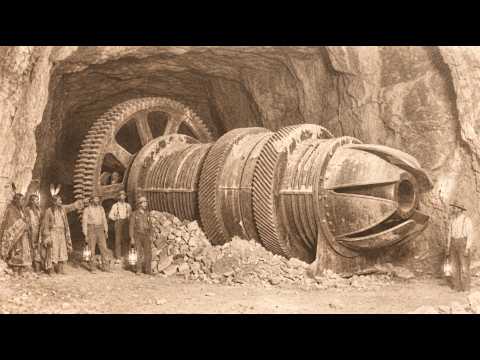
But before we can understand what was found at the end of that passage, we need to understand why the wall was there at all—and why the chamber in front of it had become the most famous room in the American West.
Lake Valley was a mining town built at the foot of a low hill beside a small dry lake on the eastern slope of the Black Range in what is now Sierra County. In 1881, Sierra County did not exist yet, and on paper, this ground belonged to Doña Ana County. That small detail will return at the end of this story. The town took its name from that lake, which shrank to a white crust of salt in the dry months, filled again like a mirror after the rains, and every morning the shadow of the hill lay across the water.
A cowboy named George Lufkin found the first silver on that hill in 1878, but other men made the real money. In February 1881, a mining promoter named George Daly came out to look at the load. In April, a young English-born stock dealer named J. Whitaker Wright joined him. Between them, they gathered up sixteen claims and put their weight behind the Sierra Grande Mining Company.
Then came the 19th of August, 1881. That day, a blacksmith turned prospector named John Levit broke into a cavity only a few dozen feet below the surface, and its walls were lined not with ore, but with silver that was very nearly pure. The miners called it horn silver, and in lantern light it gave off a soft gray shine. The mine superintendent, Bernard Macdonald, said the crystals on the walls caught the light the way a bride’s room is lit on her wedding night, and he gave the place the name it still carries: the Bridal Chamber.
According to the records, more than 2.5 million ounces of silver came out of that single chamber—so rich that some of it was cut out with saws instead of picks. In the first few months alone, more than a million dollars in silver was carried up into the daylight.
But on that same day, the 19th of August 1881, something else was happening in the canyons west of Lake Valley. An Apache leader named Nana, a Chihenne man well past seventy, was crossing the country with a small band of warriors. The Chihenne, the Warm Springs Apache, were the people to whom the Black Range had always belonged. That summer, Nana’s band had ridden more than a thousand miles in six weeks, fought eight engagements against forces many times their size, and never once been caught, though army records put their number at no more than forty.
A town militia and a cavalry detachment rode out after them and rode straight into an ambush. George Daly was killed that day, and with him a lieutenant and at least four soldiers.
So on the day the richest silver chamber in the world was opened, the man who had built the mine around it died on the land of the people who had always owned that hill. That is most likely coincidence. But set against what the Apache said about that hill, the date will look different.
The first record is not a legend or a rumor. It is a field book. That year, the Sierra Grande Company kept an assayer and surveyor at Lake Valley named Thomas Ellery Whitcomb. He was thirty-six years old, born in Scranton, Pennsylvania, and a graduate of the Columbia School of Mines in New York, class of 1869. His first position in 1870 was at an assay office in Georgetown, Colorado, and from 1874 to 1878 he worked in Virginia City, Nevada, in the shadow of the Comstock Lode. It was there, in front of a room full of investors, that he caught a sample someone had salted with silver dust, caught it on his balance, and stopped the sale of a mining claim on his own. Eleven years in Colorado and Nevada had given him a reputation for correcting reports that had been inflated to sell stock, and his colleagues said the same thing about him again and again: Whitcomb did not judge a vein with his eyes. He judged it with his scales.
He kept three field books bound in black oilcloth, and at the top of every page he wrote the date, the depth, and the compass bearing. He never wrote down a guess, and he never wrote down anything he had not measured. That is why the page dated the 11th of October 1881 matters.
That morning, the crew on the east wall of the Bridal Chamber was led by a forty-one-year-old shift boss named Jory Penhallow from Camborne in Cornwall, who had grown up in the tin mines, crossed to America, and worked his way west from Nevada down into New Mexico. Penhallow had noticed something about the silver. It grew thicker toward the east wall, reaching four feet there, and it was nowhere near that thick on any other wall—as if the silver had gathered toward something.
There were three more men on his crew: the Treor brothers, also Cornish, two quiet men, and a twenty-three-year-old Irishman from County Mayo named Pat Dunlevy. Dunlevy was the youngest of them, and his name will come back once more in this story, because he was the one who first cut through the crust.
Penhallow drove east. A little before eleven, one of the picks broke through into open space, and the men stepped back because air was coming out of the hole. It was neither warm nor cold, but dry—nothing like the damp, sulfur-heavy air of the mine. One of the Treor brothers held his candle up to the opening, and the flame did not bend away from the hole. It bent toward it. Air was being drawn in, as if something inside that hill was slowly breathing in the air of the mine.
Penhallow sent for Whitcomb. When Whitcomb arrived, he saw a straight passage beyond the hole, and the first thing he wrote was a measurement: six feet wide, seven feet high. The second thing he wrote was an objection. He assumed he was looking at an old Spanish working, since the Spanish had dug for copper and silver in southern New Mexico a century earlier, and an abandoned Spanish drift was the obvious answer.
He stepped into the passage, and the obvious answer lasted ten steps. There were no chisel marks on the walls and no powder fractures. The limestone was flat and unbroken, as clean as a block of cheese cut with a wire. Whitcomb read his compass at the start of the passage, at the middle, and at the end, and all three readings were identical. The passage ran due east on a single bearing, without a single degree of drift, for 190 feet.
Whitcomb wrote: “No vein of ore runs this straight. Neither does any human hand.” He wrote one thing more. In any mine drift, every step leaves a print in the dust. But there was no dust on the floor of this passage. It was as clean as a hallway someone had just finished sweeping. Next to that observation, Whitcomb drew a question mark—the only question mark in all three of his books.
At the end of the passage, the floor suddenly opened out, and the lantern light reached forward and struck nothing. They could see neither the far wall nor the roof. Penhallow lifted his lantern, and the light fell on metal.
Whitcomb wrote nothing else that day, and the rest of the page is blank. The next entry is dated two days later, the 13th of October, and its first word is a measurement. But something happened in those two silent days. In the company’s payroll ledger, there is a single line dated the 12th of October recording that Penhallow’s crew was paid a full day’s wages for a day on which they did no work. Beside the entry are the initials of Bernard Macdonald, and no reason for the payment is given.
The second record is not something anyone told. It is the object itself.
On the morning of the 13th of October 1881, Whitcomb went back into the passage with twelve lanterns, a surveyor’s chain, a steel tape, and a pocket thermometer. Only Penhallow and Dunlevy went with him, because Macdonald had ordered the rest of the crew to stay above ground that day. He measured the hollow first: 118 feet long and 52 feet wide. He could not measure the height of the roof because the chain would not reach, so he wrote down an estimate of 70 feet—as high as the roof of a church.
The floor was level. Cave floors slope and dip and swell with the debris of centuries, but this one was as level as the floor of a barn, and the only debris was broken rock that had fallen from the roof and piled up against the lower flank of the object. And on that rock there was silver—a thin gray film of it, thinning out the farther it lay from the object, and gone entirely at twenty feet. Whitcomb compared it to frost, the frost that forms on the outside of a cold pot. It was as if the silver had grown toward the thing.
Then he turned to the object. It lay on its side in the middle of the hollow, and Whitcomb chained it from end to end: fifty-four feet, longer than a railroad car. Its highest point, the wheel at the back, stood seventeen feet tall, and when Penhallow stood at its foot, his head did not reach a third of the way up.
Whitcomb described the object in three parts. At the back was a double wheel, two toothed rings set side by side with their teeth locked together. Whitcomb counted the teeth on one ring one by one and reached ninety-six. He began on the second ring and stopped halfway, and the note he left is a single word: “Same.”
In the middle was the body. Five broad drums, each a slightly different width from the one beside it, from eleven feet across to thirteen. Every drum was wrapped in dense raised grooves that were not straight but curled, turned back on themselves, and wound inside one another. Whitcomb compared them to the whirls on the tip of a thumb. The seams between the drums were so fine that he tried to work the blade of his pocketknife into one, and the blade would not go in.
At the front was the nose. Four long curved blades of fourteen feet each, their tips bent toward one another and closed around a dark opening in the center three feet wide. Whitcomb held his lantern to it, and the light went in and struck nothing. Then he pushed his ten-foot measuring rod into the opening all the way, and the end of the rod touched nothing at all. In his book he wrote: “No bottom, or deeper than the rod.”
The whole object was sheathed in crust—a pale, rough mineral crust that had filled the grooves and built up into little mounds along the tops of the drums. On top of the nearest drum, Whitcomb measured it at four and a half inches thick. It was the same kind of crust that dripping water lays down in caves, and Whitcomb knew how slowly that crust grows. In limestone caves, a single inch can take centuries. This was not a new crust. It was an old one.
Penhallow said only one thing while they worked. Cornish miners believed in small beings underground who tapped on the walls of the workings—beings they called knockers. Penhallow looked at the object and told Whitcomb that this was no knocker’s work, and that even the knockers would keep their distance from it. Whitcomb copied the sentence into his book inside quotation marks.
This is where Dunlevy’s name comes back. Whitcomb asked the young miner to clear the crust from the side of the nearest drum at the height of his chest. Dunlevy swung his short pick. The crust came away in thick slabs, and underneath it was metal. The metal was dark and smooth, and it gave back the lantern light with a flat, dull sheen. There was not a single mark on it—no rust and no tarnish. In the sulfur-laden air of a silver mine, under four and a half inches of crust, the metal looked exactly as it must have looked on its first day.
Whitcomb scratched the surface with his thumbnail, then with his knife, and neither left a mark. With a steel drill point he managed at last to lift one small flake, which he put in a glass vial, stopped with a cork, and labeled with a number: Specimen 44.
That evening he put the flake in the furnace of the assay office. An assay furnace melts silver and lead in a matter of minutes, but the flake did not melt. Even when Whitcomb drove the furnace as hard as it would go, the flake still did not melt. At the bottom of the crucible there was no bead of silver, no lead, no copper—nothing at all. Only the same small dark flake, coming out of the fire exactly as it had gone in.
That night he wrote: “This is not iron. It is not copper. It is not silver. And it is not any metal I have ever weighed.” And he wrote one more line, and underlined it: There is air going into the nose.
The official account was not long. It runs to a single paragraph, written two months later. In December 1881, the Sierra Grande Company sent its quarterly report to its investors in the East. The report spends pages on the record output of the Bridal Chamber. But about the east wall, it says only this: “In driving east from the Bridal Chamber, the men broke into a natural limestone cavern containing large calcareous formations of no commercial value, and the opening has been closed for reasons of safety.”
That account may be correct, and to be fair to it, we should first see how sensible it is. The silver at Lake Valley sits inside a bed of limestone that geologists now call the Lake Valley Formation, and that limestone is more than 300 million years old. Limestone makes caves, and in caves dripping water shapes calcite into extraordinary forms—columns and curtains and swollen clusters. By lantern light, to men in the grip of silver fever, a great mass of calcite could look like a machine. And the history of mining is full of stories like that.
But there are a few things it does not explain. A natural cave does not run 190 feet on a single compass bearing without drifting by a single degree. Chipping into a natural mass of calcite does not uncover smooth, untarnished metal. And a flake that will not melt in an assay furnace is not limestone, because at that heat limestone crumbles into powder. The assay furnaces of 1881 had their limits, and some metals—platinum among them—will not melt at those temperatures. So Whitcomb’s flake could have been a fragment of some platinum-group mineral that had somehow found its way into a limestone cave. That is possible. But then the question changes. How does a mass of platinum fifty-four feet long, wrapped in grooves and fitted with a toothed wheel, come to be sealed inside a limestone hill?
No one asked that question, because the report had left nothing to ask. And there is one more thing the report leaves out. A cave with no commercial value is not usually closed. It is simply left alone. Yet the company’s supply ledger shows that at the end of October, forty-two timbers, two barrels of lime mortar, and a pair of iron hinges were sent down to the mouth of the East Passage. The East Passage was not just closed. It was put behind a locked door.
And there is a third source. J. Whitaker Wright spent that winter in Philadelphia using his Lake Valley money to launch new companies in the East, and a copy of a letter he wrote in January 1882 to a Philadelphia investor survives in the company’s letterpress copybook. Most of the letter is about share prices, but one sentence is not. Wright writes: “The less said about the East Gallery, the better for the stock.” Twenty-two years later, in London, on the day he was convicted of a fraud worth millions of pounds, Whitaker Wright swallowed cyanide inside the courthouse and died. All his life he exaggerated almost everything, but he never exaggerated the East Gallery at Lake Valley. He never mentioned it at all.
As the town grew, it came to have two newspapers, which reported every wagonload of silver out of the Bridal Chamber, every record assay, and every new saloon. But about the East Gallery, they printed not one line. A thousand people lived in Lake Valley, and not one of the six men who had walked into that passage ever spoke to a newspaper. The company wanted to sell silver, and a company that sells silver does not write to its investors that there is something inside its mine that nobody can explain. It closes the door, and it writes the word cavern in its report.
The third record was not written down by the people who gave it. It was spoken—and in fact it was spoken twice, fifty-two years apart.
The first time was in 1881. Through October and November of that year, the company’s payroll ledger carries a single Apache name—or rather, not his name but one that someone else gave him. The ledger lists him only as Tomás, woodhauler, a dollar and a half a day. Tomás was a Chihenne man who had married into a Mexican family in Hillsboro, and the town’s people called him Tomás because no one had ever asked what his own people called him. It might seem strange for a Chihenne man to be hauling firewood in a mining camp in 1881, but it was not. In 1877, the army had taken the Warm Springs Apache out of their own valley at Ojo Caliente and marched them hundreds of miles west to San Carlos. Some slipped away and went back to the mountains. Some fought with Victorio and later with Nana. And some quietly disappeared into Mexican villages, took a Spanish name, and hoped that nobody would ask. Tomás was one of those.
According to Whitcomb’s book, Tomás came to the door of the assay office on the evening of the 20th of October. He did not come inside, but stood on the threshold, because he had heard the talk going around among the miners. Their conversation, carried on in Whitcomb’s broken Spanish, fills half a page. Tomás asked one question: Was the flower open? Whitcomb said no, it was closed. Tomás nodded, and then he said four things, which Whitcomb wrote down in a numbered list. The first was that it had been left behind. The second, that the Chihenne do not camp at the foot of that hill. The third, that the white metal on the walls is its frost. And the fourth: “If you take the frost, the cold goes somewhere else.” Whitcomb did not understand the fourth sentence, and he said so in writing, in two words: not understood. After November 1881, Tomás never appears in the payroll ledger again.
The second time was in 1933, and this time the person listening was an anthropologist. Morris Opler was twenty-six years old that year. Trained at the University of Chicago, he had come to the Mescalero Reservation in New Mexico to record the lives of the Chiricahua and Warm Springs Apache, and between 1931 and 1935 he recorded hundreds of hours of conversation there—work that would later become one of the foundation stones of American anthropology.
Opler’s unpublished field notebooks, though, are something else: boxes of paper that now sit in a university archive, and in one of them, four pages from the summer of 1933 speak about the hill at Lake Valley. The speaker is an elderly Warm Springs woman whom Opler identifies only by her initials, S.K. By his account she was seventy-one years old, and in the summer of 1881, at nineteen, she had ridden with Nana’s band. In 1886 she was sent to Florida as a prisoner of war along with the rest of her people, then moved to Alabama and then to Fort Sill in Oklahoma, and she was held for twenty-seven years. When she was released in 1913, she went to Mescalero, the nearest place to the mountains where she had been born.
They spoke outdoors in front of her house, through Opler’s interpreter, because S.K. did not want to talk inside. Opler notes that when she began to speak about the hill, she picked up a stick and drew a shape in the dry ground in front of her: a circle with four curved lines bending in from its edge toward the center. The ends of the lines did not meet, and in the middle a small space was left open. Opler copied the drawing into his notebook exactly as she made it.
S.K. told Opler that the hill above the dry lake had a name in the Chihenne language. Opler tried to write the name down as it sounded, and beside it he wrote a translation: the hill that holds the closed flower. So the Apache already had a name for it long before the miners came.
And S.K. gave a date: late in the summer of 1881. As Nana’s band passed close to that hill, the young men wanted to make camp at its foot beside the water, but Nana would not allow it, and he kept them riding through the night. According to S.K., Nana said only one thing that evening: “The White Eyes cut into the hill today.” White Eyes was the name the Apache used for the white settlers, and today was the day the Bridal Chamber was opened—the same day George Daly died.
Opler wrote down what she told him in the order she told it, and her sentences move with a calm, repeating rhythm. They said it was here before this world was made the way it is now, before the water covered everything. They said that when the water went back down, the flower was still in its place, and that the ones who left it went away and did not take it with them. It was left behind. They said there is a road into the belly of the hill, and the road does not bend, but runs like an arrow. They said the mountain spirits live inside other mountains, and that they do not go into that hill. They said the white metal is its frost, and that it grows out of its cold. You may take silver from any other hill, but do not take it from that one.
S.K. told him one more thing. When she was a small girl, her mother taught her never to point at that hill with her finger. When the Chihenne showed someone that hill, they made only a slight motion toward it with the chin, as if the hill could see.
Opler asked what the flower was doing. S.K. answered that it stays closed, that it is waiting. Opler asked what it was waiting for. According to his notes, she was silent for a long time. Then she said that this knowledge belonged to the Chihenne and that it was not something to be given to an outsider. At the bottom of the page, Opler wrote a single line: not recorded at the speaker’s request. Opler respected that line. So will this story.
These two records were never meant to be read together. Now set them side by side. On one side is the oilcloth field book of an assayer from Scranton, full of measurements, compass readings, and furnace results. On the other is the memory of a woman who had been carried through Florida, Alabama, and Oklahoma before she came home to Mescalero. Fifty-two years and two languages lie between them. Whitcomb died in 1906, before Opler was even born, and neither of them ever read the other’s record.
Whitcomb wrote that four curved blades closed around a dark opening at the center. He never once called it a flower. S.K. did. And there is more. On the 13th of October 1881, Whitcomb drew the nose in pencil as it looked from the front: a circle, four blades curving toward the center, and an open space in the middle. In 1933, Opler copied the shape S.K. had drawn in the dirt: a circle, four lines curving toward the center, and an open space in the middle. Today those two drawings sit in two different archives in two different states, and in both of them the blades curl in the same direction—clockwise. An assayer and a prisoner of war. One of them drew what he had seen, and the other drew something she had never seen but that her people had always known.
Whitcomb wrote that the silver on the rocks grew thicker the closer it came to the object, and he compared it to frost on a cold pot. S.K. said the white metal was its frost, and that it grew from its cold. Whitcomb measured a passage that did not drift a single degree in 190 feet. S.K. spoke of a road into the belly of the hill that ran like an arrow and never bent. Whitcomb wrote that the candle flame leaned into the passage and that air was going into the nose. S.K. said the flower was waiting. Whitcomb measured four and a half inches of crust, knowing that in a cave a single inch can take centuries. S.K. said it was there before the water covered everything. And Tomás, in 1881, without anyone asking him anything, gave his fourth sentence: “If you take the frost, the cold goes somewhere else.” Whitcomb had written that he did not understand it.
But two years later, in August 1883, he wrote something more. The Bridal Chamber was worked out in two years. The last of the silver was stripped from its walls in the summer of 1883, and that August the Sierra Grande Company shut down its operations at Lake Valley. Whitcomb’s last task was to take the final measurements of the mine before it closed. And on his last day alone, he unlocked the door to the East Passage.
According to his book, the passage had changed. The air that had been so dry two years before was cold now, and a thin sweat of moisture lay on the walls, and the silver on the rocks—that thin frost—was completely gone, as though it had never been there. Whitcomb walked into the hollow and held his lantern to the mouth of the flower. The air was still being drawn inward, but now there was a sound as well, very faint, like wind moving across the mouth of a bottle. He laid his hand on the smooth metal, on the place where Dunlevy had cleared the crust two years before. According to his book, the metal was neither warm nor cold, but exactly the temperature of his hand, and when he took his hand away, it left no print on the metal, not even a trace of moisture.
Whitcomb wrote no comment on that page and no conclusion. On the last line, he simply wrote out again the sentence he had not understood two years earlier, this time inside quotation marks: “If you take the frost, the cold goes somewhere else.” Then he closed the door and he locked it.
The fourth record was not written by anyone who went looking for it. It was written sixty-two years later, because of a war.
In 1943, the United States was making steel for tanks, for ships, and for guns, and steel needs manganese. A government agency called the Metals Reserve Company began buying manganese from old mine workings all over the country, and the abandoned tunnels at Lake Valley held manganese, too. The United States Geological Survey was sending geologists into the field to map strategic minerals, and the geologist it sent to Lake Valley was a forty-four-year-old named Walter Emmons Conkling, who had grown up in Golden, Colorado, and graduated from the Colorado School of Mines in 1922. With him was a field assistant, Ruth Anne Seeley, a twenty-four-year-old geology student from the University of New Mexico. The war had taken the young men overseas, and in those years the Survey was sending more women into the field than ever before.
Conkling had never seen Whitcomb’s books and knew nothing about the East Passage. He found it by accident. In March 1943, while Conkling and Seeley were sampling the worked-out walls of the Bridal Chamber for manganese, they noticed an opening in the east wall that had been closed off with timbers. The timbers had rotted, the hinges had rusted through, and the lock was broken, so Conkling pulled the timbers down. The passage was there, straight and clean. According to Seeley’s field notes, there was not even a footprint on the floor from the men who had walked it sixty-two years before, because a floor that would not hold dust would not hold footprints either.
Conkling’s manganese crew included eight laborers from the Hollis brothers’ outfit, and he did not let any of them into the passage. On the first day, he went in with Seeley alone. According to her notes, he lit a cigarette at the mouth of the passage and watched the smoke, which was pulled down the passage in a straight thread. Even when it reached the hollow, it did not spread, but traveled in one thin line all the way to the mouth of the flower and went inside and did not come back out.
Inside the hollow, the first thing Conkling did was take a bearing on the object with an instrument Whitcomb had never heard of: a Brunton compass. And the needle swung. Conkling walked a circle around the object. Beyond thirty feet, the needle pointed north. But inside thirty feet, it turned every time and pointed at the mouth of the flower. Then Conkling took a magnet from his bag and held it to the metal, and the magnet would not hold. The metal was not iron, and yet the needle turned toward it. The needle did not care what it was made of.
Then Seeley found a patch at chest height where the crust had been cleared away. It was the place Dunlevy had cleared in 1881, though neither of them knew that. Seeley recognized the notches and old pick-point leaves along the edge of a cut, and over the bare metal she saw a new crust, as thin as paper. Conkling measured it with calipers: three-tenths of a millimeter. That small number would become the most important number in Conkling’s report, because Conkling did the arithmetic. If three-tenths of a millimeter of crust had formed in sixty-two years, how long had it taken the four and a half inches on top of the drums to form? He worked the figures out in his field book, and the answer came to a little over 23,000 years. Then he drew a single line through the calculation and wrote beside it: method not valid for this surface. He did not write why.
Seeley recorded one more thing. The silver frost on the rocks—the film Whitcomb had written was gone in 1883—was coming back, but only at the very foot of the flower, in a thin gray half circle about three feet across. Seeley scraped off a sample and sent it out for assay, and the result was silver chloride: horn silver, the same silver that had once lined the walls of the Bridal Chamber. The frost was growing back, very slowly, and only where it was closest.
That evening, Conkling sent a short telegram to the Survey’s office in Denver, and a copy of it is attached to his report. It is a single sentence: “Unexplained metallic mass in Lake Valley east workings, unrelated to manganese, awaiting instructions.” The reply came three days later: Continue with manganese.
Conkling continued with manganese, but he had new timbers put up across the mouth of the East Passage. And on that page of her field notes, knowing nothing of Tomás and nothing of Whitcomb, Ruth Seeley wrote a single sentence: “It is as if the cold is coming back.”
The fifth record is not at Lake Valley at all, and that is exactly why it matters. Everything so far belongs to a single hill, with one assayer, one geologist, and one elderly woman. And a skeptic could fairly ask whether this is only the story of one place, or whether anywhere else in this country there is another trace of the same thing. There are two.
The first lies to the west, about forty miles west of Lake Valley. On the far side of the Black Range runs the valley of the Mimbres River, where a thousand years ago the Mimbres people lived. They left behind something that is now known all over the world: painted bowls covered in black designs on white, with people and animals and geometric patterns. And the strangest thing about those bowls is this. When the Mimbres buried their dead, they turned a bowl upside down and laid it over the face of the person being buried. And before they did, they punched a small hole through the very center of the bowl. Archaeologists call it a kill hole. One bowl, one hole, one open center.
Between 1924 and 1927, a couple named Harriet and Burton Cosgrove excavated a site in the Mimbres Valley called Swarts Ruin on behalf of Harvard University’s Peabody Museum, taking hundreds of bowls from hundreds of graves. And in the report they published in 1932, on one of the plates there is a small photograph of a bowl. Around the rim of that bowl runs a toothed band of small, sharp, evenly spaced triangles, circling the mouth of the bowl like the teeth of a gear. Inside the band, four black curved blades bend in toward the center, clockwise, and their tips do not meet. And there, in the one place the blades leave uncovered—the one space the potter left open—the kill hole has been punched through. Beneath the photograph, the report gives it two words: Geometric whirl.
The bowl is not displayed today. Since the NAGPRA law was passed in 1990, objects taken from Native graves are not shown or photographed without consultation with the descendant communities. And that is the right decision. But it means that today that bowl can be seen only in a small gray photograph in a report more than ninety years old. According to the archaeologists, the burial at Swarts Ruin dates to somewhere between the years 1 and 1130. The hill at Lake Valley is forty miles away, and between them stands a mountain range that took two days to cross.
The second trace lies to the north, in a newspaper. In the 1880s, in a mining town inside the Black Range called Chloride, a weekly paper was printed under the name The Black Range. In one of its issues from 1884, on page 4, there is a short item about two miners working a silver claim south of Chloride—a claim the paper does not name. The men had gone down into a flooded blind shaft, and under the water, by the light of their lanterns, they had seen a curved metal edge the size of a wagon wheel, with teeth along it. Their pumps could not bring the water down, and the claim was abandoned that summer. The paper did not even give the item a headline, and directly beneath it is an advertisement for a mule. Perhaps the two men saw an old Spanish mill wheel, or perhaps the lantern light fooled them. But the item was printed in the very years when no newspaper anywhere had printed a word about the East Passage at Lake Valley. The miners at Chloride had never read Whitcomb’s book, and the potter at Swarts Ruin had never met a miner.
And there is one more trace to the south. Two hundred miles south of Lake Valley, in what is now the Mexican state of Chihuahua, stand the ruins of a great adobe city called Paquimé. Between 1958 and 1961, the American archaeologist Charles Di Peso excavated Paquimé for the Amerind Foundation, and his reports filled eight volumes. In one of those volumes there is an object taken from a storeroom: a disc carved from sandstone about two feet across, with a toothed edge and four channels curving across its face toward a hole bored through the center. The report classes it as a ceremonial stone and dates it to between 1200 and 1450. Four places and four different centuries, with the same toothed ring and the same closed blades. And every time, the same space left open at the center.
The sixth and last record is not a document. It is the story of how the documents were lost.
After Lake Valley closed, Thomas Ellery Whitcomb moved north to Socorro and spent the rest of his life there as an assayer, until he died in 1906. Five years later, in 1911, his widow Margaret Whitcomb gave his three field books and a small wooden box of specimens to the New Mexico School of Mines in Socorro. In the box was a small glass vial stopped with a cork, and its label read Specimen 44. When the school’s librarian cataloged the books, she looked at the heading on the first page, where Whitcomb had written the district. And in 1881, remember, there was no Sierra County yet. So Whitcomb’s heading read Doña Ana County, 1881. So the librarian filed the books with the mining records of Doña Ana County, in the boxes for the Organ Mountains District. Nobody hid anything and nobody destroyed anything. They just filed it. The books simply went into the wrong box, and everyone who ever went looking for Lake Valley looked in the boxes for Sierra County.
The school’s specimen inventory for 1935 contains a single line: Specimen 44, metallic flake, Whitcomb collection, unidentified. The inventory of 1962 lists Whitcomb’s box, but it does not list the vial.
Conkling’s report has a similar story. In 1944, Conkling submitted a preliminary report on the manganese deposits of Lake Valley. And on its contents page, section 7 is titled Anomalous Metallic Mass, East Workings, four pages long. But in the archived copy of the report, section 7 is missing, and in its place there is a single note: deleted, not pertinent to Strategic Minerals. For an agency hunting manganese in the middle of a war, that was a sensible decision.
Whitcomb’s books were not found until 1971, when a history student from Las Cruces named David Arosco was working through the Organ Mountains boxes, saw the words Lake Valley, and stopped. He typed out copies of all three books, and those typed copies are the source that the few researchers who know this story still work from today. Arosco went looking for Specimen 44 and could not find it. In the margin of the 1962 inventory, there was one note in pencil, in a hand no one has identified: Vial found empty. Empty. Not broken and not missing, but with the cork still in place and nothing inside.
In the same box, Arosco found something else: a small folded slip of paper, a two-line note in Bernard Macdonald’s handwriting, addressed to Whitcomb, and dated the 12th of October 1881. Macdonald had gone down into the passage himself that day—the day the crew was paid for work they never did. The note reads: “Write nothing to the Philadelphia people until Wright arrives. I have spoken to the men.”
Conkling died in 1958, and his family gave his field books to the archive of the Colorado School of Mines in Golden. In the book for March 1943, after the page with the crossed-out calculation, three pages are missing. They were not torn out but cut neatly with scissors, close to the binding.
And the last piece came from Ruth Seeley. Seeley left geology after the war, became a schoolteacher in Albuquerque, and died in 1999. In 1987, after she had seen Arosco’s typed copies, she wrote him a long letter setting down what she remembered of the missing section 7, and in it she gave one measurement with its figure. In 1943, Conkling had measured the width of the dark opening at the center of the flower at 38½ inches. In 1881, Whitcomb had measured the same opening at 36¼ inches. In sixty-two years, the opening had grown two and a quarter inches wider. Seeley did not write that the two figures should be set beside each other. And she wrote that Conkling had not set them beside each other either. She simply wrote both of them down, one above the other.
S.K. had said the flower stays closed, and that it was waiting. She never said what it was waiting for.
There is a version of this story in which everything resolves into comfortable categories, and that version deserves to be told here in its strongest form. First, the rock at Lake Valley is limestone, and limestone makes caves, and caves make calcite. By lantern light, to men in the grip of silver fever, calcite can become almost anything. In 1898, two hundred miles to the east, a young cowboy named Jim White began exploring the cave that would become Carlsbad Caverns, and he gave its formations names like the Totem Pole and the Rock of Ages. For years the people of Carlsbad treated his descriptions as tall tales. The formations were real. They were also only stone.
Second, the most important document in this story is one man’s field book. And if we know that book at all, it is because of a typed copy made by a single student in 1971—a typescript of 212 pages, produced on a borrowed machine over one summer. Copies carry errors, and a figure can be misread. Thirty-six inches can become thirty-eight, or the other way around.
Third, the company in this story belonged in part to a man who would go on to become one of the most notorious mining swindlers in history—a man willing to say anything for the price of a share. A locked door may point not to a hidden secret but simply to a cavern that might collapse, and locking it can be nothing more than a safety measure.
Fourth, S.K.’s account was recorded fifty-two years after the fact, through an interpreter, by a researcher from outside her community. The hill that holds the closed flower may be only one of many possible translations of an Apache place name, and Opler’s own choice among them. And a circle with four curving lines is one of the oldest shapes that human beings have drawn, everywhere in the world.
Fifth, whirl motifs are common on Mimbres bowls, toothed bands are common too, and Paquimé may produce dozens of carved stone discs. Look at enough bowls, and the shape being looked for will eventually appear.
Sixth, it makes perfect sense for an agency searching for manganese in wartime to remove four pages that had nothing to do with manganese. And pages cut from a field book could be anything at all: private notes, a mistaken calculation, the draft of a letter.
In this version, no one hid anything. A cavern was closed, a book went into the wrong box, a vial went missing, and a section was removed. And none of it was done in bad faith. None of it was suppressed. It was simply never followed up.
That version may be correct, and every one of its points on its own is reasonable. But every reasonable explanation accounts for just one record. The cavern accounts for Whitcomb’s crust, but not for his compass. A copying error accounts for Seeley’s measurement, but not for what Tomás said in 1881. A translator’s choice accounts for S.K.’s flower, but not for why Nana kept his people riding through the night. Each explanation carries away one piece, and none of them explains why all the pieces meet on the same hill. That is not a weakness in the story. It is the story.
The hill is not a secret today, and anyone can walk to it. So what is on that hill now?
Lake Valley emptied slowly. In 1893 the price of silver collapsed, and the mines shut down. In 1895 a fire on Main Street burned half the town, which was never rebuilt. The railroad spur was pulled up in the 1930s. The post office closed in 1955, and the last resident left in 1994. Today the town is a historic site cared for by the Bureau of Land Management. The schoolhouse and the church still stand, and visitors can follow a trail up the hill and look into the mouth of the Bridal Chamber, which is empty now, without a single thread of silver left on its walls.
The East Passage cannot be seen at all. Nothing marks it. In the 2000s, New Mexico’s program for making abandoned mines safe closed dozens of old openings around Lake Valley with steel grates—grates that keep people out but let bats come and go. For every opening, the program kept a closure record, and one of those records belongs to an opening on the east side of the Bridal Chamber workings, numbered LV17. The record carries four notes: Timber bulkhead collapsed. Strong continuous inward airflow. Grate installed. No entry. And there is a fifth note, added in the margin by a bat biologist working with the program: Every other opening on this hill holds a bat colony, but LV17 holds none at all. And from the signs outside, it never has. Nothing lives there.
The inspection record from one year later is even shorter: Grate intact. Thin gray film on the inner bars. Not sampled. A thin gray film—what Whitcomb called frost, and what Seeley called the cold coming back. This time, on the inside of a gate.
Whitcomb’s books have been moved to the right box at the New Mexico School of Mines, known today as New Mexico Tech. Opler’s notebooks are in a university archive in New York State, and Seeley’s letter is with the Arosco family. The empty vial that once held Specimen 44 is nowhere at all.
The Chihenne did not vanish. Their descendants live today at Mescalero and within the Fort Sill Apache Tribe of Oklahoma. And in 2011, the Fort Sill Apache Tribe won recognition of a small parcel of land at Akela Flats near Deming, New Mexico, as reservation land—their first land in New Mexico since 1886. The hill at Lake Valley lies less than a hundred miles away. And the Chihenne name for that hill still belongs to the Chihenne.
In the dry months, the lake still shrinks to a white crust of salt. And after the rains, it still fills like a mirror. And every morning, the shadow of the hill still falls across the water. Inside that hill, at the end of a straight road, in a hollow as tall as the roof of a church, something fifty-four feet long is lying in the dark, with a toothed wheel at one end and four curved blades at the other. In 1881, the space between those blades measured thirty-six inches. In 1943, it measured thirty-eight and a half. No one has measured it since.
In 1881, Tomás said four things, and no one understood the fourth. If you take the frost, the cold goes somewhere else. The silver of the Bridal Chamber—that frost, 2.5 million ounces of it—was stripped out of the hill in two years, loaded into wagons, and scattered across the world. S.K. said the flower was waiting, but she did not say for what. That knowledge belonged to the Chihenne, and it stayed with the Chihenne.
Maybe it was a cavern, or a mass of calcite. Maybe it was lantern light, a copying error, a translator’s choice. But the Chihenne did not call it a stone or a machine. They called it a flower.
If your family worked at Lake Valley, at Hillsboro, at Kingston, or at Chloride—if you carry a story, a letter, or a photograph that belongs to that hill, and it is yours to share, write it below. Every one of these records was once held by a single person. And keep one question with you: If that flower opened two and a quarter inches in sixty-two years, how far open is it now?
Report this article
Select a reason for reporting:






