The coffee maker was set for 5:15 a.m., a habit thirty years old that outlasted the woman who started it. I didn’t wake at 5:15 that night. I woke at 10:47 because the air tasted wrong—thick, chemical, hot. Thirty-five years of pulling wire taught me to recognize that smell before my brain finished deciding I was still dreaming.
I sat up. The hallway outside my bedroom door glowed orange. I said Eleanor’s name before I remembered she wasn’t there to answer.
I grabbed my phone and ran. The garage was already gone—the old wooden shelving I’d built, Eleanor’s garden tools, two decades of hardware I swore I’d use—all fuel now. I called 911 from the front yard, standing in dry July grass in my pajama pants and undershirt. The dispatcher’s voice was calm. “Move away from the structure. Do not go back inside.”
I gave her my address—4211 East Caesar Chavez Avenue, Boyle Heights. The mailing address Eleanor had written on a hundred birthday cards. The driveway where I taught our daughter to back out without clipping the fence post. The mango tree Eleanor planted from a seed because she read somewhere it could be done in Southern California if you were patient enough. All of it glowing orange at 10:48 on a Tuesday night in July.
I opened my contacts and found Emily’s name. My daughter, thirty-eight, lived twenty minutes away in Silver Lake, in a house with a view of the reservoir she’d called “exactly what we always dreamed of.” I had helped make that dream possible in ways she never fully accounted for.
The phone rang once, twice, three times. On the fourth ring, I heard the bass thump of music, the bright scatter of voices and laughter—the acoustic signature of a party going well.
“Dad.” Her voice had the clipped, barely-there quality of someone checking caller ID and answering out of obligation. “What is it?”
“The house is on fire. The garage is gone and it’s spreading. I’m standing in the front yard.”
A pause. Three seconds, maybe four. “On fire,” she repeated, flat, processing the way you’d process a minor inconvenience in a schedule.
“I need somewhere to stay tonight. I need you to come.”
Another pause. Behind her, someone laughed—a big, open laugh, the kind you only get when the drinks have been flowing and the night feels endless and good.
“Dad.” Her voice dropped, not with concern but with irritation. “That’s your house. That’s your problem to handle. I have people here.”
My hand tightened around the phone until my knuckles ached. Down the block, the first siren began to wail.
“Emily, I’m standing in the street in my pajamas. The house your mother and I lived in for thirty-one years is burning down. I need my daughter.”
“Call your insurance. They have emergency lines. That’s literally what they’re for.” A muffled sound—she’d turned her head away. “I can’t do this right now. I’m sorry.”
The line went dead.
I stood there with the phone against my ear and the fire trucks turning onto my block, lights sweeping red and white across the faces of neighbors on their porches. Something happened inside my chest that I didn’t have a word for. Not surprise exactly—more like the specific pain of watching something you’d chosen to believe in collapse in the space of forty-five seconds.
The firefighters moved fast. A young one with a blond beard put his hand on my shoulder and asked if anyone was still inside. I told him no. He asked if I had somewhere to go. I opened my mouth to say yes and found I didn’t have an answer ready.
The answer came twenty minutes later in the form of headlights. Gary Simmons’s truck—a 2009 Silverado the color of old pewter, dent above the rear wheel well from the time he backed into a concrete pillar at the Home Depot on Olympic. I’d known Gary since we were seventeen. We’d worked construction together, raised our kids at the same time, buried our wives three years apart. He lived four blocks away, and I had not called him.
He climbed out, looked at the fire for a moment—not at me, at the fire—then put his arm around my shoulders. “Come on. Let’s go.”
I didn’t argue. I got in the truck. Neither of us spoke on the drive because there was nothing that needed to be said yet.
At his house, he pointed me toward the couch, brought me a glass of water I hadn’t asked for, and set it on the coffee table. “You heard anywhere?” he asked.
“No.”
He studied my face the way a man does when he knows you’re answering a different question than the one he asked. Then he went to the hall closet, pulled out a blanket, and set it on the arm of the couch. “I’ll be in the kitchen if you need me.” He left the lamp on.
I sat there listening to the distant sound of the fire truck still working, the smell of smoke in my hair and on my skin—that heavy chemical smell that meant something had been destroyed that could not be put back together. And I thought about Emily’s voice. The music behind her. The way she’d said, “That’s your problem,” the same way you’d say that’s your side of the closet.
Somewhere around midnight, I picked up my phone and looked at it. And for the first time since I’d watched my garage roof cave in, I thought: This was not an accident.
I didn’t know yet why I thought that. I just knew that I did. I didn’t sleep.
At 3:00 in the morning, I was sitting at Gary’s kitchen table with the smell of smoke still in my hair when he appeared in the doorway in his robe and slippers, squinting at me the way old friends do when they already know the answer but ask anyway.
“You haven’t moved,” he said.
“No.”
He started the coffee maker without being asked. Gary had always been that kind of man—not the kind who asked what you needed, but the kind who looked at the situation and figured it out. He set a mug in front of me, poured one for himself, and sat down across the table.
“Emily know about the fire?”
“She knows.”
He wrapped both hands around his mug. “She coming?”
I looked at him across the table. Something in my face must have answered for me, because Gary pressed his lips together and nodded once—the slow nod of a man confirming something he’d suspected for a long time.
“I’ve been watching this for seven years, Arthur,” he said quietly. “I didn’t say anything because it wasn’t my place. But I’ve been watching.”
The words hit me somewhere behind the sternum. Seven years. And I had spent every one of those seven years telling myself things were fine.
I picked up my coffee and held it and thought about ten years of transfers I had never once regretted—until right now, at 3:00 in the morning, in someone else’s kitchen, wearing smoke-stained clothes.
It started in 2014. Emily had just finished her master’s at USC and the student loan payments were brutal, she said, and could I help just for a few months? I wired the money from my savings account on a Thursday afternoon while Eleanor was in the backyard talking to her mango tree the way she always did—like the tree was a person who needed updates on the neighborhood.
The few months became two years. Then came the house. The Silver Lake property Emily described as a fixer-upper with good bones, except the bones turned out to be expensive. The down payment gap was forty thousand dollars. I covered it. The bank approved the mortgage because I put up my investment property in Riverside as additional collateral. Emily told Daniel’s parents that she and Daniel had saved aggressively for years to make it happen. I know because Daniel mentioned it once, proud, like he was quoting something he’d memorized.
Then the car. Then the business capital for the media company Emily said she was building. Then the golf club membership for Daniel’s first year because Emily explained professional networking required a certain kind of presence.
Two hundred forty-seven thousand, eight hundred dollars over ten years. I had counted it the night before on my phone in the dark. And now I said the number out loud for the first time, quietly, just to hear what it sounded like in Gary’s kitchen at 3:00 in the morning.
Gary didn’t flinch. He just looked at his coffee. “Eleanor knew,” he said. It wasn’t a question.
My throat tightened so hard I had to breathe through it. “She tried to tell me something was wrong. She said we were helping Emily confuse love with entitlement.”
I set the mug down. “I told her she was being too hard on the girl.”
Gary looked at me for a long moment. “And now?”
“And now my house burned down and my daughter told me it was my problem to handle.”
Outside, a mockingbird started up in the tree at the edge of Gary’s yard—that relentless cataloging song, running through every sound it had collected, not caring that it was 3:00 in the morning. Eleanor had loved mockingbirds. She said they reminded her that you could build something remarkable out of pieces you picked up along the way.
I pushed back from the table and stood up. “I need to make a call.”
Gary looked at the clock on the microwave. “It’s 3:15 in the morning.”
“I know. Thomas won’t mind.”
Thomas Reed had been my lawyer for fifty years and my friend for longer than that. He answered on the second ring, his voice carrying the particular alertness of a man who had learned long ago that late-night calls were rarely about nothing.
“Arthur,” he said. “Talk to me.”
“I need you to do three things first thing tomorrow morning. Pull the collateral on Emily’s house. Close Eleanor’s trust account. And revise my will.”
A beat of silence—not hesitation, just Thomas absorbing the weight of what I was asking. “Arthur, once we start this, it’s not easy to walk back.”
I looked out Gary’s kitchen window at the dark yard, at the shape of the tree against the sky. “I know. I’ve walked back too many times already.”
Thomas exhaled slowly. “Nine o’clock. Be at my office.”
“I’ll be there.”
I hung up and stood at the window until the mockingbird finally stopped.
Thomas Reed’s office on Cordova Street looked the same as it had for thirty years—dark wood, leather chairs, a brass lamp casting everything in warm yellow light. He didn’t shake my hand. “Sit down, Arthur.”
He slid a manila folder across the desk. The header read: Petition for Appointment of Conservator of the Estate. Under proposed conservator: my name. Under petitioner: Emily Brooks Carter.
My hands didn’t shake—thirty-five years of steady work had built that into me—but something hot pressed behind my eyes. “When was this filed?”
“It hasn’t been. A clerk recognized your name last week.” Thomas leaned forward. “This was prepared three weeks before your house caught fire.”
Three weeks. I set the folder down carefully, choosing not to throw it. “There’s more.”
Thomas nodded. “A physician’s declaration from a Dr. Raymond Foley. He’s never examined you. And two weeks before the fire, Emily called your insurance carrier to ask who’d receive the payout if you were declared incapacitated.”
The room tilted. I pressed one hand flat against the desk and breathed through it—slow, the way I used to on job sites when panic wasn’t an option. “She was setting up a runway.”
“That’s what it looks like.”
I sat back down. “Then let’s not treat it like a coincidence. Do the three things I asked. And get me Marcus Hail—the fire investigator.”
Thomas wrote it down. “What are you expecting to find?”
I thought about the garage panel I’d replaced myself less than two years ago. “I’m expecting to find out I was right.”
At eleven, I stood in the blackened shell of my garage with Marcus Hail, who crouched by the EV charger and pointed with his pen. “This wire was worked. Someone loosened the terminal manually. That’s not wear—that’s intent.”
He showed me a still from a neighbor’s camera: a white SUV parked near my curb the afternoon before. Emily drove a white Lexus. I’d put the down payment on it myself.
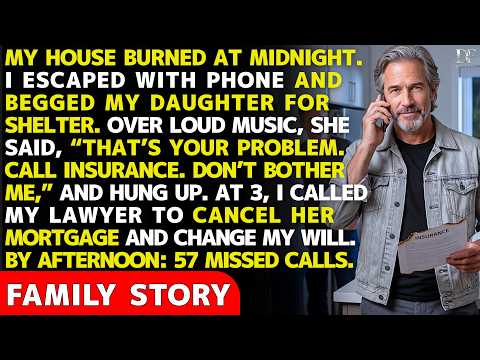
By evening, my phone showed fifty-seven missed calls. Every text was about the bank, the collateral, the house. Not one asked if I was hurt.
Then Emily showed up at Gary’s door. She walked in like she owned the room, sat on the edge of the chair, and said, “There’s been a misunderstanding.”
I let her finish. Then I handed her the conservatorship petition. “Three weeks before the fire, Emily. You were building a runway.”
Her composure cracked—just a fraction. “I was trying to protect you.”
“I’m sixty-five, not a hundred and five. I pulled a permit and wired an addition last spring and passed inspection without a single correction.” I met her eyes. “Last night you told me I was my problem to handle. So I’ve decided to take the same position.”
She stood, trembling with fury. “You’ll regret this.”
“Maybe. But not tonight.”
The door closed behind her. Gary picked up the fallen folder and set it on the table. “She’ll be back.”
“I know.”
But I also knew something else—something Eleanor had tried to tell me for years. Love isn’t a check you write. It’s a door that opens from both sides. And I had finally stopped holding the handle for someone who never intended to turn it.
What would you have done in my place—opened the door again, or let it stay closed?
Report this article
Select a reason for reporting:






