He was 21 years old, alone, and diving into 22 enemy fighters. His canopy fogged at the edges, his left hand on a throttle his grandfather would have called witchcraft, and below him, climbing in a long line out of the clouds, were the German fighters he was never supposed to survive alone. His name was Chuck Yeager. Seven months ago, he was hiding in a French barn from the Gestapo. Six weeks ago, by every rule the Army Air Forces had written, he was never supposed to sit in a cockpit again. He was here because the supreme Allied commander changed that rule. He pushed the stick forward.
To understand the next quarter hour—one of the most remarkable single combat actions of the air war over Europe—go back four years to a hangar in California where an immigrant engineer drew a fighter nobody asked for. Go back further still to a sky over Germany where an entire American Air Force was being slaughtered in numbers Washington would not put on paper.
The Eighth Air Force was dying. Not metaphorically—mathematically. On October 14th, 1943, 291 B-17 Flying Fortresses lifted off from East Anglia to bomb the ball bearing factories at Schweinfurt. Sixty bombers did not come home. Six hundred American airmen were dead, captured, or missing by sundown.
In briefing huts across England, men stopped eating breakfast before missions. They wrote letters home, sealed them, and left them on their bunks in case they did not return to unseal them themselves. At October’s loss rates, the odds of a crew completing 25 missions sat near one in four. The reason was range. The P-47 Thunderbolt could reach the German border, then had to turn for home. The bombers continued alone. German pilots called the zone past escort range the death zone. They waited there every morning.
By December 1943, planners were doing arithmetic nobody wanted to do. At current rates, the Eighth Air Force would cease to exist as a fighting force well before the invasion of France. There was no fighter in the inventory that could escort bombers all the way to Berlin and back. There was, however, a fighter nobody wanted.
Travel back to the spring of 1940, Inglewood, California. A man named Edgar Schmued stood in a hangar at North American Aviation. He was 40, born in Germany, and not yet an American citizen. The British Purchasing Commission needed fighters and asked North American to build Curtiss P-40 Warhawks under license. Schmued’s boss, James Kindleberger, made a different offer: “We will build you a better one from scratch.” The British asked how long. Kindleberger answered without consulting his designer: “120 days.”
117 days later, an aircraft rolled out into the California sun with a shape that did not look like anything else flying. The wings were different. The radiator sat far back behind the pilot. Schmued had bet everything on a laminar flow wing—a theory that if you shaped a wing precisely enough, air would slide across it without churning, no turbulence, no drag, just speed. On October 26, 1940, the prototype took off for the first time. It flew beautifully. It was also, in one important way, useless.
The engine bolted into this first version was an American Allison V-1710. At sea level, the Allison was a fine engine—sturdy, reliable, good power. Above 15,000 feet, it gasped. The supercharger was single stage. It could not pull enough air at altitude. Power dropped off a cliff. By 20,000 feet, the aircraft was sluggish. By 25,000, it was a brick. The British discovered this in early 1942. They flew their new Mustangs up to the altitudes where German fighters lived, and the Germans did not even bother to engage. The Mustang could not climb to where the Messerschmitts were. It could not chase them when they dove away. It could not do the one job a fighter exists to do.
The Royal Air Force made a decision. The Mustang, with its beautiful wing and its disappointing engine, was reassigned. It would not be a fighter. It would be a low-altitude reconnaissance aircraft, skimming hedgerows at 500 feet, photographing German positions, strafing trucks. In the American press, the news was reported with quiet satisfaction. The British had wasted American steel on a failure. Edgar Schmued read the papers. He did not say much. He went back to work.
4,000 miles from that hangar, in a hollow outside the town of Hamlin, West Virginia, a boy named Chuck Yeager had never seen an airplane up close in his life. He had, however, been hunting in these hills since he was six years old. He could shoot a squirrel out of a chestnut tree at 40 yards with a single .22 caliber round and not damage the meat. Army doctors would eventually measure his eyesight at 20/10. He saw things ordinary men did not see, and he saw them further away.
His father drilled natural gas wells for a living. His mother stretched a single dollar across five children. In September 1941, three months before Pearl Harbor, 17-year-old Yeager walked into a recruiting office and enlisted in the Army Air Corps. Not as a pilot—he had not finished high school. The pilot program would not take him. He enlisted as an aircraft mechanic. He spent the first year of the war taking engines apart and putting them back together. He was good at it. He had been good at it since he was 12 and his father handed him a wrench. He learned the sound a tired bearing makes before it fails. He learned the smell of a fuel leak before he could see it.
Then, in July 1942, the Army Air Forces did something out of pure desperation. They needed more pilots than the universities and officer academies could produce. They opened the cockpit to enlisted men—a program some called the flying sergeants. To qualify, a candidate needed only a high school equivalency and a passing score on a battery of tests. Yeager took those tests in a sweltering Quonset hut in Nevada. He passed. He sat in a fighter cockpit for the first time in March 1943. He was 20 years old. He had never been more than 200 miles from West Virginia in his life.
An instructor strapped him in, slapped the canopy shut, and walked away. The Mustang had not reached him yet. He was still flying Curtiss P-40s and Bell P-39s, learning to trust an airplane with his life. But the Mustang was coming for him, and in a wet gray English winter only months away, a boy from a coal hollow and an airplane built in 117 days were going to meet for the first time. Neither of them was finished being shaped. Neither of them was what anyone yet expected them to become.
The boy from Hamlin stepped off a troopship at Greenock on the west coast of Scotland on November 29th, 1943. He was 20 years old. He had crossed a submarine-infested ocean packed shoulder to shoulder with 15,000 other men. England in late November smelled of wet wool and coal smoke. The trains ran blacked out. The country had been at war for four years and three months.
Trucks carried the replacement pilots east through a landscape his West Virginia eyes had never seen. Flat fields, hedgerows, church steeples over villages older than his own country, and here and there bomb craters no one had had time to fill. He arrived at Royal Air Force Station Leiston, home that month to the newly arrived 357th Fighter Group. Yeager climbed out of the truck. There, in a line along the grass strip, sat two dozen P-51B Mustangs, olive drab on top, gray underneath, four-bladed propellers standing still in the winter light. He had never seen one in person.
A crew chief leaned against a wing smoking, watching another new pilot arrive the way he had watched a hundred before. Some of them, his face said without a word, would not be here in six weeks. Yeager touched the cold metal of the wing with his bare hand. He would say later that he knew in that moment this was the airplane.
He was assigned to C Flight, 363rd Fighter Squadron. The pilot who would fly on his wing for nearly every combat mission of the war was a 21-year-old California farm boy named Clarence Anderson. Everyone called him Bud. He was quieter than Yeager, drank his coffee black, and carried himself with the measured calm of a man who had already done dangerous work for a long time, though he had barely turned 21. They became friends almost immediately, sharing a hut, a bicycle, and eventually a bond that has no ordinary name. A wingman protects the leader’s tail. The leader makes the kills. If the leader dies, the wingman has failed. If the wingman dies, the leader spends the rest of his life knowing he watched it happen.
In the first week of January 1944, Yeager painted a name across the cowling of his Mustang in cursive script, the letters tilting slightly forward as if leaning into a wind: Glamorous Glennis. He had met her during stateside training in Nevada, a fair-haired 20-year-old named Glennis Faye Dickhouse, and he had already decided he would marry her when the war was over. Every fighter pilot carries a superstition. This one would carry his through six different airplanes before the war ended.
The first combat mission flew on February 11th, 1944. The Luftwaffe did not come up. The Mustangs returned to Leiston with their guns cold. Yeager flew seven more missions through February into early March, saw fighters at a distance, fired a few rounds without effect, learned the radio discipline, dropped a wing tank over the Channel by accident. He was alive. In the language of his squadron, he was still green.
The veterans told the new pilots what veterans have told new pilots since 1914. Check your six. Never fly straight and level more than ten seconds. If your engine quits, dive for cloud. If you are on fire, get out. On March 4th, 1944, Yeager got his first confirmed kill, a Messerschmitt 109 over central Germany. He pulled in behind it, fired three seconds, and watched it burn. The pilot did not bail out. Yeager was 21 years old. He had just killed a man. There were no toasts in the mess that night. The veterans nodded at him as he walked past. That was the only acknowledgement that was needed.
The next morning, the war finished finding him.
Before the war finished finding Chuck Yeager, it is worth understanding what almost saved the Mustang before he ever touched one, because the machine he was about to nearly die in was reborn only months before he arrived in England. The man who saved the Mustang was a 32-year-old test pilot named Ronald Harker. Harker worked for Rolls-Royce. He had flown nearly everything with wings. On April 30th, 1942, he was invited by the Air Fighting Development Unit at Duxford to take a Mustang up and simply tell them what he thought of it.
He took off. He climbed. He put the aircraft through its paces. He landed. Then he wrote the report that changed the war. He said the Mustang was the most beautifully designed fighter he had ever flown. He said the airframe was extraordinary, the laminar wing a revolution, the controls perfectly harmonized. Then he said the engine was wrong. He proposed something audacious. Take the Mustang’s airframe and marry it to the Rolls-Royce Merlin 61, the same engine that powered the Spitfire, the same engine that powered the Lancaster bomber. The Merlin carried a two-stage, two-speed supercharger that breathed thin air the way a fish breathes water. At 30,000 feet, the Merlin still pulled hard.
The marriage should not have worked. The Merlin was heavier. It shifted the center of gravity. It demanded a different cooling system, a different propeller, a different intake. Engineers on both sides of the Atlantic argued that it was impossible, or at best a waste of two good designs. Rolls-Royce built five prototypes anyway. The first one flew on October 13th, 1942. The engineers sat looking at the numbers from that test flight for a long time. Top speed at 23,000 feet: 441 miles per hour—faster than anything the Germans had, faster than the Spitfire, faster than any Allied fighter in service. Combat ceiling above 40,000 feet. Range with drop tanks: 1,200 miles. Berlin sat 600 miles from London. The math suddenly worked.
By the autumn of 1943, the Packard Motor Car Company in Detroit was mass-producing the Rolls-Royce Merlin under license in volumes British factories alone could never match. Tens of thousands of engines fed into new P-51B and C airframes rolling off the line in Inglewood. The airplane the newspapers once called a failure was now being built faster than any other American fighter—and it needed pilots. It needed, among many others, a coal miner’s son from West Virginia who had just learned what it felt like to kill a man from 300 yards.
There is a particular sound the Merlin makes at full throttle that the Allison never could—a deep, layered growl pilots feel in their chest before they hear it. For Yeager, still green in those early months, that sound became something close to a promise. Whatever waited above 25,000 feet, the airplane strapped to his back could now follow him there and bring him home again.
On March 5th, 1944, the mission was a bomber escort to Bordeaux. Somewhere south of Limoges, three dots descended out of the sun. Focke-Wulf 190s. He called them out and banked hard right—and never heard the second pair come in behind him. The airframe shuddered first, cannon shells punching through aluminum. Glycol sprayed white across the windscreen. The engine began to seize.
Canopy, harness, out. He fell, pulled the rip cord, and hit the wooded hills of the Limousin hard. French maquis fighters found him within ten minutes. He spent four weeks moving from farmhouse to farmhouse, teaching them delay fuses, wiring charges to derail freight trains. He turned 21 in a hayloft, listening to German boots pass on the road outside.
He crossed the Pyrenees in March snow, dragging a wounded bombardier named Patterson for four hours down the south slope. In Spain, six weeks of internment. In May, back at Leiston—where Bud Anderson stopped in the road and stared at him for ten full seconds before crossing the distance and embracing him.
The next morning he was told he was going home. Escaped evaders did not return to combat. Yeager looked at the major across the desk and said, “With respect, sir, I am not going home.” It took two months and a bench outside Eisenhower’s office. Paris fell on August 25th. Two days later, the order came through.
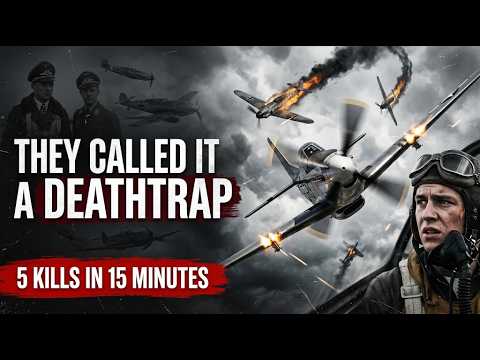
On October 12th, 1944, near the Steinhuder Meer, he counted 22 Messerschmitts below him. Bud was on the far side of the formation, too far to help. He pushed the throttle forward and dropped alone into that sky. The lead two Germans broke in the same instant, in the same direction, and their wingtips touched. He had not fired a single round, and two enemy fighters were already falling.
The remaining twenty scattered. He hunted three more through the vertical, watching the Messerschmitt stall first at the top of a climb, hanging motionless for three seconds like an insect pinned against the pale sky. He fired. Then a fourth, chased down to 10,000 feet. Then a fifth, closing patiently over three minutes, conserving ammunition, firing from 100 yards. Five kills in roughly fifteen minutes, without a scratch on his own airplane.
He landed at Leiston with the sun low. His crew chief counted close to 300 rounds fired. That night Bud bought the drinks. Yeager had one beer, then went to bed.
In November he caught a Messerschmitt 262 on final approach, gear down, throttles unable to spool up in time—one of the first propeller victories over a jet in history. His last mission flew in January 1945. Eleven and a half confirmed kills. He married Glennis that February.
Two years later, on October 14th, 1947, with two cracked ribs taped and a broken broom handle levering the hatch shut, he flew the X-1 past the speed of sound. Observers on the desert floor heard a deep double crack rolling across the dry lake bed—the first sonic boom ever made by a piloted aircraft.
He died in 2020 at 97. The Mustang, once called a failure and a death trap, became the most decorated American fighter of the war in Europe. Today roughly 150 still fly, and that Merlin growl still rolls across summer airfields like thunder you can stand underneath.
What would you have done on that wooden bench outside Eisenhower’s office—gone home, or asked for the sky again?
Report this article
Select a reason for reporting:






