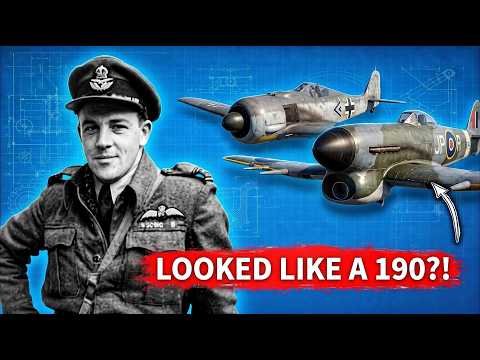
Fifty feet above the English Channel, a Focke-Wulf 190 turns for home. Its bomb already sits in an English town. The pilot has every reason to feel safe—radar can’t see him this low, and the Spitfires he’s faced are slower at this altitude. Then something appears behind him. From some angles, it looks like another Fw 190. It isn’t. It’s the fighter the RAF nearly cancelled—the one that tore its own tail off and killed 23 of its own pilots. And here, at wave-top height, it was the fastest thing in the sky.
That’s the problem with a story like this. You won’t find a clean German document where a pilot sits down and writes: “We couldn’t explain how Typhoons caught us.” That document doesn’t exist. What exists is far more interesting—a tactical system that worked for months, built on rules that were absolutely correct. Then losses occurred in the exact place those rules considered safe. And there’s a darker reason the explanation never made it home: most of the pilots who saw it up close didn’t survive to tell anyone.
To understand why, we have to start with the men who invented this danger in the first place. In July 1941, a German squadron commander in JG 2 named Frank Liesendahl was wounded. While recovering, he worked on a question most fighter pilots didn’t want to ask: what if a fighter could be a precision bomber? Most fighter pilots hated the idea. Liesendahl persisted anyway, and by November 1941 he had permission to form a squadron dedicated to fighter-bombers. The Germans called them Jabos.
His method was brutally simple. Come across the sea at roughly 450 km/h, five meters above the waves. About 1,800 meters from the target, climb a few hundred meters, then a shallow dive, release the bomb, and leave. American intelligence later described the attackers as arriving at 50 to 100 feet and spending about five seconds over the target. Five seconds. That’s the entire raid.
That altitude wasn’t just for surprise—it was for invisibility. British radar struggled to detect aircraft that low. In August 1942, of 44 such attacks, only eight had any radar warning at all. The rest arrived without notice. That same month, two Fw 190s hit Salisbury so suddenly that no British fighters took off, and the sirens only sounded when the attackers were already south of the Isle of Wight on their way home.
The British called these raids “hit and run.” The best squadron at it, 10 Staffel of II./JG 2, painted a red fox holding a ship in its mouth. And here’s the number that should worry you: in 1942, the two Jabo squadrons together rarely had more than about 28 aircraft. Twenty-eight planes against a coastline stretching from Kent to Cornwall.
Then, in the summer of 1942, those squadrons got a new aircraft: the Focke-Wulf 190. Throughout 1942, the Spitfire Mark V was the backbone of RAF Fighter Command, and the British soon learned exactly how outclassed it was—thanks to a bizarre incident. On 23 June 1942, a German pilot named Armin Faber lost his bearings after a long fight with Spitfires, confused the Bristol Channel with the English Channel, and flew the wrong way, landing his perfectly intact Fw 190 at RAF Pembrey in Wales.
The British had been planning a commando raid to steal one. He simply handed it over. They tested it ruthlessly, and the results were grim. At 1,000 feet, the Fw 190 was 25 to 30 mph faster than the Spitfire V. At 3,000 feet, the gap was even wider. Think about what that means for the attacker. A 25 mph advantage sounds small until you’re the one chasing. Every minute, the enemy pulls away nearly half a mile. Start a chase from a mile behind, and you’ll never catch him.
So the German pilot’s confidence wasn’t arrogance. It was arithmetic. Hit the target, drop the bomb, stay low, open the throttle. Nothing that can see you can catch you, and nothing that can catch you can see you. The British had the enemy’s aircraft in a hangar. They understood the problem completely. What they didn’t have was the solution.
Except, strangely, they did. The aircraft was already in service, and almost nobody wanted it. To understand why, you have to go back to the man who designed the Hurricane: Sydney Camm. Even as Hurricane production began in 1937, Camm was designing its successor. In 1938, the Air Ministry gave him the requirements under Specification F.18/37. They wanted a fighter that could reach 400 mph at 15,000 feet, with a service ceiling of at least 35,000 feet. Read that again. This was meant to be a high-altitude interceptor—something that climbed to meet bombers.
Camm built it the way he knew how: big, strong, with a thick wing, much like the Hurricane’s. At the root, the wing’s thickness was nearly a fifth of its chord. That thickness had real benefits. The wing was immensely strong. It had room for large fuel tanks and heavy cannon, making the aircraft a very stable gun platform. But the wing’s biggest tax appeared with altitude. A thick wing pushes a lot of air out of the way. At high speed and high altitude, that creates a sharp rise in drag, and the Typhoon ran straight into it.
In tests, it reached 410 mph at 20,000 feet, and its climb and performance above that were disappointing. In dives beyond 500 mph, it began to buffet and trim changes as the airflow over the wing behaved strangely. So the aircraft designed to fight high didn’t like height. Then there was the engine.
Hawker designed the Typhoon around the Napier Sabre, a 24-cylinder monster arranged in an H, meant to generate over 2,000 horsepower. That was roughly double what early Spitfires had. All that power was the point. But the engine was late. The first flight-ready engine didn’t arrive until December 1939. So the prototype didn’t fly until 24 February 1940. Ten weeks later, it nearly killed its test pilot.
On 9 May 1940, Hawker’s chief test pilot, Philip Lucas, was in the air when the prototype’s structure failed at the joint just behind his seat. He could see daylight through the crack in the fuselage. He didn’t bail out. He landed it. He was later awarded the George Medal.
Six days after that, France was collapsing, and Lord Beaverbrook, the Minister of Aircraft Production, ordered British industry to focus on five types: Spitfire, Hurricane, and three bombers. The Typhoon wasn’t one of them. Development slowed. And because Hawker’s factories were busy with Hurricanes, production was handed to Gloster at Hucclecote, within the same Hawker Siddeley group. So the Typhoon was late, marginalized, and already carrying a warning about its structure.
Then the war decided it couldn’t wait any longer. Since 1941, Fw 190s had been tearing Spitfire Vs apart over France. Britain needed something that could fight back. The Typhoon officially entered service on 11 September 1941 with No. 56 Squadron, and was rushed to the front line. Those first experiences were truly exciting. Against the Spitfire V, the Typhoon was about 40 mph faster at 15,000 feet, and faster at low altitudes. But almost everything else went wrong.
Carbon monoxide leaked from the engine into the cockpit. Engineers extended the exhausts and sealed the doors, yet the problem was never fully solved. For the rest of the war, the standard procedure for Typhoon pilots was to breathe oxygen from the moment the engine started until it shut down. Not because they were at high altitude—but because the aircraft itself could poison them.
The Sabre engine was difficult to start in cold weather. Its cylinder sleeves corroded badly, and it consumed a lot of oil. Squadrons lost aircraft with no clear explanation. The Air Ministry began to consider stopping production. Then there was the other problem—the one nobody designed on purpose. From some angles, the Typhoon looked like an Fw 190. In a quick, low, confusing moment, its shape was simply misleading. Typhoons were fired on by Allied anti-aircraft guns and other fighters. In June 1942, two Typhoons of No. 56 Squadron were reportedly shot down by Spitfires whose pilots thought they were Focke-Wulfs. The RAF tried yellow wing stripes. Then, in late 1942, they added white noses and black stripes under the wings. Then they combined the black and white stripes together. These stripes would later appear on nearly every Allied aircraft over Normandy. They began as a way to stop British pilots from killing other British pilots because of this specific aircraft. Keep that resemblance in mind. It matters later.
By the summer of 1942, the Typhoon’s reputation was poisoned. Then things got worse. On 11 August 1942, Hawker test pilot Ken Seth-Smith took off in Typhoon R7692 to test straight and level speed. The aircraft had only 11 hours of flying time. Over Thorp, the aircraft broke up and the pilot was killed. Pilots had sometimes been blamed in earlier crashes, but not this time. The investigation found the cause. A bracket securing the elevator mass balance—a weight that prevents the control surface from vibrating—had torn away. Without it, the elevator began to oscillate violently, and the vibration tore the rear fuselage apart at a joint just ahead of the tail. In simple words, the tail fell off.
The fix was crude. Twenty metal plates, called fishplates, were bolted across the outside of the rear fuselage joint, plus internal strengthening. They called it Modification 286. It reduced the failures. But it didn’t end them completely. By the end of the Typhoon’s service, tail failures had cost 25 aircraft and killed 23 pilots.
So imagine you’re a Typhoon pilot in late 1942. You breathe oxygen at sea level. Your engine is unreliable. Your own side might shoot you down. And there’s a non-zero chance your aircraft loses its tail in a dive. Why would anyone defend this thing? One man did, and his background explains why he saw something everyone else missed.
Roland Beamont flew Hurricanes in France in 1940 and through the Battle of Britain. When his combat tour ended in December 1941, he was sent on a rest posting to Hawker as a production test pilot. He tested Hurricanes, then early Typhoons. During that time, he lodged with Ken Seth-Smith. So Beamont knew the aircraft from the factory side, and he knew the man who would die in it. He didn’t see it as a machine condemned to fail. He saw an aircraft that could be fixed, with something special inside.
He returned to operations in mid-1942 and joined Typhoon squadrons, first No. 56, then No. 609. He pressed senior officers, including Trafford Leigh-Mallory, to keep the Typhoon in service while Hawker solved its problems. And here’s the turning point. In August 1942, the commanders of the three Typhoon squadrons made a direct argument. Give the offensive operations over France to the Spitfires. They’re better at it. Use the Typhoon’s speed and firepower against the fast raiders, and base the Typhoons along the coast.
Look at what that really meant. The Typhoon’s greatest failure was altitude. But the fast raid war wasn’t fought at high altitude. It was fought at 50 feet. There, the thick wing’s high-altitude drag problem didn’t matter, and the massive Sabre engine could finally show what it could do. You’ll often hear the Typhoon described as a low-altitude fighter, as if that’s what it was designed for. It wasn’t. The specification called for high-altitude interception. The low-level role was a lifeline. The aircraft didn’t win its job. It was demoted to the only place it could succeed.
The idea was accepted. By the end of September 1942, five Typhoon squadrons were assigned to the task. Beamont took command of No. 609 Squadron that autumn, and that winter the squadron moved to Manston on the Kent coast. But there was still a problem. Being faster than a raider is useless if you’re on the ground when he arrives. Remember, radar often gave no warning. By the time a Typhoon took off, climbed, and was vectored toward the coast, the five-second raid was long over.
So the RAF changed the question. Instead of responding faster, they would already be there. This is the real mechanism. From late 1942, Typhoon squadrons flew standing patrols. One method used about 15 patrols a day, each with two aircraft, flying low—often 500 feet or less—a few miles off the coast. Another pair waited on the ground at cockpit readiness. The patrols loitered there, between the coast and France, watching the water. You can probably see why a German pilot would struggle to explain what happened next. His mental model of danger was built on radar warning, quick takeoffs, and fighters scrambling from airfields. None of that applied. The Typhoon didn’t need a warning. It was already airborne, low, between him and home.
But for weeks, this produced almost nothing. No. 609 Squadron’s records describe how miserable it was. Pilots had to watch engine temperatures, search for raiders, avoid cliffs and barrage balloons, and keep track of British gun positions and Spitfires. By the end of November 1942, they had no tangible results. Anti-aircraft fire had shot down one Typhoon. The weather had cost two more with their pilots. Then the raiders vanished.
On 8 November 1942, the Allies landed in North Africa, and the Germans moved fighter units, including the Jabo squadrons, south as a precaution. Between 1 November and 16 December, only one hit-and-run attack on Britain occurred. It was carried out by a unit that had returned from North Africa to replace its twin-engine Messerschmitts with Fw 190 fighter-bombers. It cost them two aircraft. Both were intercepted by a standing patrol of two Typhoons. That was the first real evidence. It wasn’t a battle—just two aircraft—but it proved the system could work.
Now the Typhoon had to keep operating while being rebuilt. Between December 1942 and March 1943, with the raids returning, every Typhoon without Modification 286 was pulled from service and modified. On the production line, the modification began with aircraft number 820. Imagine running a front-line defense while withdrawing your assets for surgery. Gloster eventually built almost all of the 3,317 Typhoons ever made. That winter, the only number that mattered was how many aircraft were flying today.
On 20 January 1943, the Luftwaffe came to hit London. It was retaliation for RAF raids on Berlin. At lunchtime, 28 fighter-bombers struck London’s docklands with an escort of Fw 190s, diversions elsewhere, and 39 more German fighters sweeping the Kent coast to draw defenses away. Everything that could go wrong did. The barrage balloons over that part of London had been lowered for maintenance during the lunch hour. The sirens only sounded after the first bombs exploded. The raiders hit a gasworks, a power station, the Royal Naval College at Greenwich, and at Catford, a pilot named Heinz Schumann dropped a 500 kg bomb on Sandhurst Road School. Thirty-eight children and six teachers were killed. His own report only stated he attacked a large building and residential complex. Why he chose it was never settled.
No. 609 Squadron intercepted. Its Typhoons attacked the second wave of German aircraft and shot down four Messerschmitt Bf 109s of JG 26. Among the pilots who scored that day was a young flying officer named Johnny Baldwin. It was his first victory. He would later become the Typhoon’s most successful pilot of the war with 15 kills.
Now, if you read about this day, you’ll often find a much bigger story. One popular account says the Luftwaffe lost five Fw 190s to Beamont’s Typhoons in half an hour, and that this forced the Germans to abandon daylight fighter-bomber raids on London. You can understand why people believe it. The Typhoons were there. They did shoot down German aircraft. A massacre, a rapid response, and a lesson learned. But look at what was actually shot down. Most of the aircraft destroyed by Typhoons that day were Bf 109 fighters, not bomb-carrying Focke-Wulfs. Historian Chris Goss, reviewing loss records, found that almost all German losses that day were from fighters on the diversionary sweeps. Of the fighter-bombers that actually attacked London, one was lost and crashed after dropping its bomb. The bombers that hit the school returned home.
In the House of Commons, the Secretary of State for Air, Sir Archibald Sinclair, said the best deterrent to such raids was to inflict heavy losses on the attackers. That day, that was exactly what did not happen. And the Luftwaffe didn’t stop—not even close. On 7 March 1943, 18 fighter-bombers hit Eastbourne. No one detected them until the first bombs exploded. Fourteen civilians and seven soldiers were killed. Four days later, 27 bombers hit Hastings. RAF patrols were sent immediately, but No. 11 Group recorded that the attack was so swift that the enemy was heading back out to sea only six minutes after being spotted. Six minutes. That’s the entire window.
Behind the scenes, the threat was growing. The new fast bomber wing, SKG 10, had about 90 aircraft by the end of March 1943. On 23 May, Bournemouth was hit. Seventy-seven civilians were killed, and a direct hit on a hotel housing an RAF training cadre killed 31 servicemen. On 30 May, at Torquay, one fighter-bomber hit a church tower. Its bomb fell on a Sunday school. Twenty-one children and three teachers were killed.
So what were the Typhoons actually doing? They were hunting some of them, and the moment of the hunt is the key to this whole story. In January and February 1943, Typhoons shot down five fighter-bombers. Light anti-aircraft guns shot down three more. All eight went down after they had already dropped their bombs. The British noticed this themselves. An official report admitted that German losses were high, but they mostly occurred after the bombs fell.
Think about what that meant from inside a German cockpit. The dangerous part of a Jabo raid was supposed to be the target. The guns, the balloons, the buildings, the five seconds. The trip home was the safe part. The bomb was gone, the aircraft lighter and faster, and you were flying over the waves, and nothing you’d faced before could match you there. That is exactly where the Typhoons were waiting, between the coast and France, low, in an aircraft that could be mistaken for an Fw 190 until it was too close. And the men who learned this lesson most directly were mostly the ones who didn’t come back to tell it.
The squadrons that did this work compiled real records. No. 486, a New Zealand squadron flying from Tangmere, claimed 20 fighter-bombers and three bombers between October 1942 and July 1943. No. 609 claimed 27 of the Typhoon’s 47 victories between mid-October 1942 and early June 1943—more than any other Typhoon unit. Those are just claims. Now look at the bigger picture.
During the war, British analysis credited anti-aircraft guns with 55 raider kills and fighters with another 51. That’s over 100. Goss went back to German loss records and matched them against RAF records. His count was different. Twenty-eight fighter-bombers were lost to anti-aircraft fire, and 28 to fighters—and that includes all fighters, including Spitfires, not just Typhoons. One shared. Five more crashed into buildings, wires, or other aircraft. Sixty-two aircraft and 62 pilots over 15 months. That’s painful, but it was survivable.
Meanwhile, look at what this small force forced Britain to do. In March 1942, there were 43 light anti-aircraft guns on the southern coast suitable for these attacks. By November, there were 543. Observer posts were added, searchlight crews were trained on machine guns, and fighters flew standing patrols from dawn to dusk.
So did the Typhoon stop the hit-and-run raids? No. The raids ended abruptly after an attack on Eastbourne on 6 June 1943, and the reason wasn’t fighter losses. German forces in North Africa had surrendered in May. The Luftwaffe expected the next Allied blow in the Mediterranean, and the fighter-bomber units were sent south to Italy. What remained in France turned to night attacks, which went badly. Goss also argues that German intelligence severely underestimated what the daylight raids achieved. That’s the correction to the record. The Typhoon didn’t defeat the Jabo fighters. Geography, strategy, German miscalculation, and a wall of guns did more to end the campaign than any single fighter. But the Typhoon found the only answer to the assumption the entire Jabo system rested on.
There’s a strange mirror in this story, too. On 23 March 1943, a Typhoon of No. 486 Squadron flown by Flight Sergeant Mawson was hit by anti-aircraft fire while crossing the French coast at low altitude. He belly-landed near Caen and the Germans captured the aircraft before it could be destroyed. They repaired it and test-flew it at Rechlin. Nine months after Faber handed the British his Fw 190 by landing at the wrong airfield, the Germans got a close look at the aircraft that had been hunting them.
The Typhoon’s real career had only just begun, and it ran exactly along the path its failure had pointed to: low altitude. From late 1942, it carried bombs. Then, from 1943, rockets. Eight RP-3 rockets under the wings. The same thick, strong wing that hated altitude made a stable weapons platform. The same massive engine that struggled up high could haul two 1,000-pound bombs. By the Normandy invasion in June 1944, RAF Second Tactical Air Force had 18 Typhoon squadrons.
And here the story repeats itself in a way that’s almost annoying. Pilots claimed huge numbers of tanks destroyed. During Operation Goodwood in July 1944, Typhoon pilots using rockets claimed 222 tanks destroyed. When British operational research teams later examined the ground, they could confirm only 10 of 456 German armored vehicles destroyed as Typhoon rocket victims. At Mortain, only nine were verified. There’s still debate about that gap. The survey relied on debris samples rather than counting everything. German soldiers described Typhoon attacks with real terror, and Eisenhower credited Typhoon rockets with breaking the German counterattack at Mortain. But the pattern is familiar. Claims made at low altitude, at speed, in seconds, were never as accurate as the reports.
Throughout the hit-and-run campaign, British numbers came out roughly double what German records show. At Normandy, the same problem reappeared. The aircraft’s original flaw was also fixed—but not in the Typhoon. Camm’s team designed its successor with a much thinner wing. That was the Tempest. And the man who helped bring it into service was Roland Beamont, who in 1944 formed the first Tempest wing. Then came the next fast, low raider: the V-1 flying bomb. Beamont’s wing chased them, and he personally claimed 32. Different weapon, same problem. Something fast and low crossing the coast without warning.
Beamont went on to test the Canberra, the Lightning, and the TSR-2. The Typhoon took a different path. By October 1945, it was out of operational service. Of the 3,317 built, only one complete Typhoon remains, MN235, at the RAF Museum in London.
So why couldn’t Fw 190 pilots explain how Typhoons caught them at low altitude? Because their rulebook was correct. At wave-top height, the Fw 190 really was faster than almost anything Britain could put in the air. Radar really couldn’t see them. The Spitfire V really couldn’t catch them. Every fighter designed to excel at its mission confirmed what they believed. The one that broke the rule had failed at its mission. Its wings were too thick for high altitude, too heavy to climb, too dangerous to its pilots, and it looked so much like a Focke-Wulf that the British kept shooting at it. It was pushed to sea level for lack of any better use, and it was flying low off the coast when the raiders came back from dropping their bombs. And most of the German pilots who discovered that never made it home to explain it.
But here’s the final twist. The Typhoon didn’t win because it was better. It won because it was in the wrong place at the right time—and the men who flew it knew it. They breathed oxygen at sea level, watched for their own tail to fall off, and still climbed into the cockpit every morning.
Beamont later said the Typhoon was never a great fighter. It was a great weapon. That distinction matters. The men who flew it didn’t love the aircraft. They trusted it, which is harder.
So the next time you see a photo of that thick-winged, ugly brute, remember: it was designed to fail, and instead it found the one job nobody else could do. Not because it was brilliant—but because it was there.
What would you have done, standing on that Kent coast in 1943, watching the water for a silhouette that might be friend or foe?
Report this article
Select a reason for reporting:






