The city of Berlin, once the gleaming capital of Hitler’s envisioned thousand-year Reich, now lay in ruins. Soviet artillery thundered relentlessly, reducing entire neighborhoods to rubble. The air was thick with smoke and the stench of death. In the Führerbunker, deep beneath the Reich Chancellery, Adolf Hitler, a shadow of his former self, trembled as the walls shook. The Soviet juggernaut was closing in, and the end was near.
Just twelve years earlier, Hitler had stood at the height of his power, promising a Reich that would last a millennium. Now, children and the elderly were being conscripted into the Volkssturm, armed with little more than panzerfausts and desperation, to defend the capital against the relentless Red Army. The Battle of Berlin would be the final, bloody chapter of World War II in Europe.
The roots of this apocalyptic showdown traced back to the Nazis’ catastrophic miscalculations. Hitler’s decision to invade the Soviet Union in 1941, and his subsequent declaration of war on the United States, sealed Germany’s fate. By early 1945, the Red Army had swept across Eastern Europe, and the Allies were advancing from the west. Berlin, the heart of the Nazi regime, was the ultimate prize.
Stalin, driven by a mix of revenge and ego, was determined that his forces would take Berlin. He pitted his two top commanders, Marshal Zhukov and Marshal Konev, in a race to the Reichstag. The city was to be encircled and crushed. The Soviets amassed over 2.3 million troops, 6,000 tanks, and 41,600 artillery pieces—a force of unprecedented might.
Inside the city, the defenders were a motley crew: remnants of the Wehrmacht, SS units, foreign volunteers, and the Hitler Youth. They knew surrender meant likely death or imprisonment in Siberia. Propaganda Minister Joseph Goebbels had convinced many that the Soviets would show no mercy. And they were right. Stories of Soviet atrocities in East Prussia had spread, fueling a desperate will to fight.
On April 16, 1945, Zhukov’s First Belorussian Front launched its assault from the Seelow Heights. The artillery barrage was the largest in history, but the Germans, forewarned, had prepared formidable defenses. The Soviets suffered heavy losses, but their sheer numbers prevailed. By April 19, the German lines crumbled. The road to Berlin was open.
As the Red Army poured through the shattered suburbs, the streets of Berlin became a labyrinth of death. Every building, every cellar, every pile of rubble concealed a defender with a Panzerfaust or a rifle. Tanks that ventured too far without infantry support were picked off by hit-and-run teams of Hitler Youth, some barely old enough to shave.
“They’re like ghosts,” a Soviet tank commander radioed back, his voice cracking. “They come out of the sewers, fire, and vanish.”
But the Soviets had learned from Stalingrad. They adapted, sending in assault groups with flamethrowers and satchel charges, clearing buildings floor by floor, room by room. The fighting was savage, often hand-to-hand, with bayonets and entrenching tools.
On April 23, the encirclement was complete. Berlin was cut off from the outside world. Inside the Führerbunker, Hitler still pored over maps, moving divisions that no longer existed, ordering counterattacks by phantom armies. His generals, once loyal, now exchanged glances of despair. The Führer’s grip on reality had slipped entirely.
“The war is lost,” General Krebs whispered to a colleague. “But he will not hear it.”
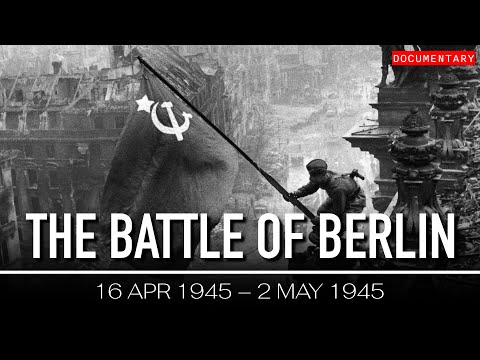
Yet even as the end approached, the fighting intensified. The Reichstag, a symbol of Nazi power, became the focal point of the Soviet assault. Zhukov threw everything he had at the building, determined to plant the red flag atop its ruined dome.
On April 30, as Hitler and Eva Braun took their own lives in the bunker, the battle for the Reichstag raged on. Soviet soldiers fought their way up the stairs, inch by inch, while German defenders, many of them SS fanatics, fought to the last bullet.
By nightfall, the tricolor of the Soviet Union fluttered from the shattered dome, though scattered resistance continued for another two days. The city that Hitler had vowed would become Germania, the capital of the world, was now a graveyard of ash and twisted steel. Its conquerors moved through the ruins with a mixture of triumph and unease, their victory overshadowed by the horrors they had witnessed—and in many cases, committed.
For the survivors of Berlin, liberation from the Nazi regime did not bring safety. Soviet soldiers, fueled by years of pent-up rage and the propaganda of revenge, unleashed a wave of violence against the civilian population. Women of all ages became targets of mass rape, an atrocity that Soviet authorities largely ignored or downplayed. “They treated us like spoils of war,” one Berliner later recalled. “The Nazis had taken everything from us, and now the victors took what little remained.”
The scale of the suffering was staggering. Historians estimate that as many as two million German women were assaulted during and after the Soviet advance, with countless victims dying from injuries, disease, or suicide. In Berlin alone, the number of suicides in the weeks following the battle numbered in the thousands.
Yet even as the city bled, the gears of the new world order began to turn. The Allies had agreed at Yalta and Potsdam that Germany would be divided into occupation zones. Berlin, though deep within the Soviet-controlled eastern sector, would be split into four sectors—American, British, French, and Soviet. It was a decision that Stalin resented, viewing it as a betrayal of his hard-won victory.
The Western Allies, for their part, were wary of Soviet intentions. General Eisenhower, who had declined to race the Soviets to Berlin, now understood the strategic stakes. The city, reduced to rubble, had become a symbol of the emerging Cold War.
In the months that followed, Berlin became a microcosm of the broader division of Europe. The Soviets installed a communist government in their zone, while the Western powers worked to rebuild their sectors, pouring resources into reconstruction. The contrast was stark: in the West, shops reopened and streets were cleared; in the East, the Soviet occupiers dismantled factories and shipped them back to the USSR as reparations.
By June 1948, tensions had reached a boiling point. Stalin, determined to force the Western Allies out of Berlin, ordered a blockade of all land routes into the city. The Western response was swift and decisive: the Berlin Airlift. For nearly a year, American and British aircraft flew round-the-clock missions, delivering food, fuel, and supplies to the city’s two million residents. At its height, a plane landed every thirty seconds.
“We were starving, and then the sky opened up,” remembered a Berlin woman who had lived through the blockade. “The planes came day and night. We called them the raisin bombers because the pilots dropped little parachutes with candy for the children.”
The airlift was a triumph of logistics and a powerful symbol of Western resolve. Stalin, faced with the choice of shooting down Allied planes or backing down, chose the latter. In May 1949, the blockade was lifted.
But Berlin remained a divided city, a flashpoint in the Cold War. The ruins of the Reichstag, the Brandenburg Gate, and the Reich Chancellery stood as grim reminders of the war that had consumed the world. In the decades to come, the city would witness the construction of the Berlin Wall, the standoff at Checkpoint Charlie, and ultimately, the fall of communism and the reunification of Germany.
The Battle of Berlin, the final act of the most destructive war in human history, had ended. But the scars it left—on the city, on its people, and on the world—would take generations to heal. The dream of a thousand-year Reich had lasted just twelve years, leaving behind a legacy of ruin and suffering that would never be forgotten.
The rubble of Berlin became the stage for a new kind of war—not of bombs and tanks, but of ideology and survival. As the Cold War tightened its grip, the city’s divided streets mirrored the fracture of the world itself.
“We had traded one tyranny for another,” an elderly Berliner remarked years later, staring at the Wall that would soon carve through his neighborhood. “But at least this time, we could see the enemy.”
The Airlift had saved the city from Stalin’s blockade, but it could not heal the wounds of 1945. The mass rapes, the suicides, the countless dead—these remained buried beneath the concrete of reconstruction, unspoken but ever-present.
When the Wall finally fell in 1989, Berliners danced on the ruins of their own history. Yet the question lingered: had the world truly learned from the ashes of Hitler’s Germania, or had it simply built new walls to replace the old?
What do you think—can a city, or a civilization, ever truly recover from such darkness?
Report this article
Select a reason for reporting:






