In the heart of World War II, as Allied forces clashed with Axis powers across the deserts of North Africa, a group of British engineers pored over battle reports and wrecked tanks. They were searching for answers—why were their tanks outgunned and outmatched? The lessons were brutal, but they would forge a revolution. That revolution would be called the Centurion, a tank so influential that it would reshape the future of armored warfare and serve in conflicts from Korea to the Middle East for over half a century.
But this is not just a story of steel and firepower. It is a story of desperate innovation, of a nation racing against time to counter a growing threat. And at its center, a machine that would become legendary.
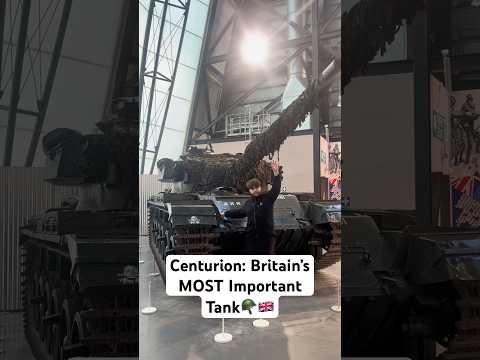
The early years of World War II exposed a harsh truth for Britain: its tanks were falling short. The desert campaigns revealed flaws in armor, firepower, and reliability. “We needed a tank that could survive, adapt, and dominate,” one engineer later recalled. The Centurion was born from that necessity—a response to the hard lessons learned in the heat of battle.
Designed as a “universal” tank, it combined the speed of a cruiser with the armor of an infantry tank. It was a radical departure from tradition, and it would set the standard for main battle tanks for decades to come.
As the Centurion rolled off the production lines, the war in Europe was drawing to a close. But its story was only beginning. It would go on to serve in 12 different wars, from the frozen hills of Korea to the jungles of Vietnam and the deserts of the Arab-Israeli conflicts. Its versatility and resilience made it a favorite among crews and a feared opponent on the battlefield.
Yet, the path to greatness was not without challenges. Early models faced teething problems, and the changing nature of warfare demanded constant upgrades. But the Centurion adapted, evolving with each conflict, proving its worth time and again.
What made this tank so special? How did it manage to stay relevant for so long, even as technology advanced? The answers lie in its design, its crews, and the battles it fought. And as we delve deeper into its history, we will uncover the moments that defined the Centurion—and the men who commanded it.
The story begins in 1943, in the dusty workshops of the Directorate of Tank Design. The British Army had just endured the disastrous Dieppe Raid, where their Churchill tanks had bogged down on the beaches and been torn apart by German anti-tank guns. The lesson was clear: the next tank had to be tougher, faster, and above all, more lethal.
Engineer George Brighton, a veteran of the desert campaign, remembered the frustration of staring through the gunsight of a Crusader tank, watching enemy armor shrug off his shells. “We were firing pebbles at giants,” he said. The Centurion was designed to flip that equation. It mounted a 20-pounder gun—a weapon that could punch through the thickest German armor—and wore 76mm of sloped frontal armor, making it one of the most protected tanks of its time.
But the Centurion wasn’t just a brute. It was a masterclass in balance. The designers gave it a Rolls-Royce Meteor engine, capable of pushing the 50-ton machine to 35 kilometers per hour on roads. That combination of speed, protection, and firepower was revolutionary. For the first time, a single tank could do the job of both infantry support and cruiser tanks.
By the time the first Centurion prototypes rolled out in 1945, the war in Europe was nearly over. The tank never saw combat in World War II, but it didn’t need to. Its true baptism of fire came just five years later, on the Korean peninsula.
In Korea, Centurions faced their first real test. The terrain was brutal—steep hills, frozen rivers, and narrow valleys—but the tank proved its mettle. “The Centurion could climb like a mountain goat and hit like a sledgehammer,” recalled a British tank commander. In one engagement, a single Centurion destroyed three North Korean T-34s in under a minute, its 20-pounder shells tearing through the Soviet-made armor.
But Korea also revealed a flaw. The Centurion’s early engine struggled in the extreme cold, and its weight made it difficult to maneuver through rice paddies. The crews adapted, learning to use the terrain to their advantage. They dug the tanks into hillsides, turning them into impromptu bunkers, and used their superior optics to pick off enemy tanks from long range.
Those lessons would be carried forward. The Centurion was not a static design—it was a living machine, constantly upgraded with new guns, better engines, and improved armor. By the mid-1950s, it had become the backbone of the British Army and a sought-after export for nations from Australia to Israel.
Israel was one of the most eager customers. The young nation, surrounded by hostile neighbors, needed a tank that could fight outnumbered and win. The Centurion—soon nicknamed the “Sho’t,” or Whip—became the backbone of the Israeli Armored Corps. But the Israelis did not simply buy the tank; they transformed it.
They swapped the old 20-pounder for the powerful L7 105mm gun, a British design that would become the standard for NATO tanks for decades. They added reactive armor, upgraded the engine, and refined the fire-control systems. “We took a good tank and made it a great one,” recalled an Israeli mechanic who worked on the Sho’t in the 1960s. The Centurion was no longer just British—it had become a global warrior.
The true test came in 1967, during the Six-Day War. Israeli Centurions spearheaded the assault through the Sinai Desert, engaging Egyptian T-55s and JS-3 heavy tanks. In one fierce battle near Rafah, a company of Sho’ts destroyed over twenty enemy tanks while losing only a handful of their own. The Centurion’s sloped armor and superior gunnery proved decisive.
But it was the Yom Kippur War of 1973 that forged the Centurion’s legend in the Middle East. On the Golan Heights, a small force of Israeli Centurions faced a massive Syrian armored assault. Outnumbered and outgunned, the Israeli crews fought for days, using the tank’s reliability and their own tactical brilliance to hold the line. “We fired until the barrels glowed red,” one tank commander remembered. “The Centurion never let us down.”
That battle alone cemented the tank’s reputation. It was no longer just a piece of equipment—it was a symbol of survival, of defiance against impossible odds. And it was not done yet.
Meanwhile, on the other side of the world, the Centurion was fighting a very different kind of war. In the jungles of Vietnam, Australian Centurions supported infantry operations, their thick armor shrugging off rocket-propelled grenades that would have destroyed lighter vehicles. The tank’s weight, once a liability, became an asset—it could crush through dense vegetation and withstand ambushes that stopped other armor cold.
But the Centurion’s story was far from over. As the Cold War raged, it stood ready in Europe, a silent sentinel against the Soviet threat. And in the deserts of the Middle East, it would fight again and again, proving that a well-designed tank, constantly improved, could outlast its creators’ wildest dreams.
The Centurion had already served in three major conflicts across two continents. But its greatest test—and its most surprising chapter—was still to come.
The 1973 Yom Kippur War had barely ended when the Centurion’s next chapter began—not on the battlefield, but in the halls of power. The tank’s performance on the Golan Heights had stunned military observers worldwide. “If a handful of Centurions could stop a Syrian division, we need to study this machine,” a Soviet analyst reportedly wrote to Moscow. The Cold War arms race had found a new benchmark.
But the Centurion was no longer just a British or Israeli weapon. It had become a global icon. From the dusty plains of South Africa to the fortified borders of India and Pakistan, the tank served in armies on every continent. In the 1971 Indo-Pakistani War, Indian Centurions clashed with Pakistani Pattons, their 20-pounder guns proving decisive in the battle of Basantar.
Yet time, as it always does, caught up with the old warrior. The 1980s brought new technologies—smoothbore guns, thermal sights, composite armor—that the Centurion’s basic design could not fully absorb. Nations began retiring their fleets, replacing them with newer models like the Leopard 2 and M1 Abrams.
But the Centurion refused to fade quietly. “We can still fight,” insisted South African crews who used upgraded Centurions, nicknamed “Olifants,” in the border wars of the 1980s. In the Middle East, Israel’s heavily modified Sho’ts soldiered on through the 1982 Lebanon War, their crews trusting the old tank’s reliability over newer, untested designs.
The final chapter came in the 2000s. By then, the last operational Centurions were in the hands of a few nations—mostly in Africa and Asia—where budgets were tight and battlefields unforgiving. In 2006, the last British-built Centurion retired from active service with the Jordanian Army. “It was like saying goodbye to an old friend,” a Jordanian officer remarked. “The tank never complained. It just did its job.”
But the Centurion’s legacy was not confined to scrapyards. Its design philosophy—the balance of firepower, protection, and mobility—became the blueprint for every main battle tank that followed. The British Chieftain, the German Leopard, the American Abrams—all traced their lineage back to the lessons learned in those dusty 1943 workshops.
Today, a few Centurions still stand on museum pedestals or as gate guards at military bases, their hulls weathered by decades of service. Children climb on their tracks, veterans pause to touch their armor, and historians debate their place in the pantheon of great machines. “It wasn’t the fastest or the most powerful,” one historian noted. “But it was there, in every war, for every cause, adapting and enduring. That’s what makes it legendary.”
The Centurion was never just a tank. It was a promise—that British engineering could rise from the ashes of defeat, that a machine built for one war could serve in twelve, and that steel and firepower, when guided by brave crews, could change the course of history.
And as the last Centurions rust in forgotten depots, one question remains: what does their story teach us about the machines we build today—and the wars we still fight tomorrow?
Report this article
Select a reason for reporting:






