On June 22nd, 1941, more than three million German soldiers crossed the Soviet border at dawn. It was the largest invasion in human history—and the beginning of the end for the Third Reich. But weeks before that date, and months before, and even a year before, there were men with stars on their shoulders who tried to stop it. Admirals pounded tables. Generals drafted memoranda. Staff officers brought maps, projections, alternative routes. They all said the same thing in different words: There is another way. Hitler listened. He considered. And then he did exactly the opposite.
This is the story of the men who saw the path to victory—and the one man who refused to walk it.
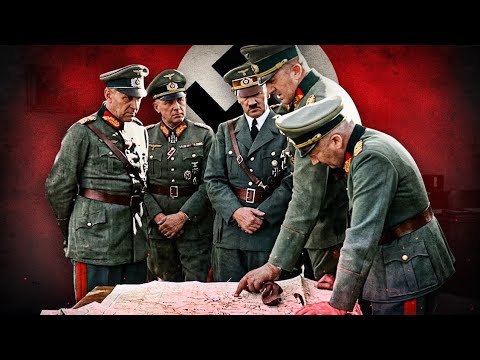
The triumph over France in 1940 was the most spectacular military victory of the 20th century, and it was possible almost entirely thanks to a man the German high command had tried to silence for months: Erich von Manstein. His plan to send armor through the Ardennes—terrain the Allies considered impassable—cut the Allied deployment in two. The OKH blocked it for three months. It was saved only by a private meeting between Manstein and Hitler on February 17th, 1940. The next day, the plan became official doctrine.
But at the peak of that victory, Hitler committed the first error that would define everything that came after. On May 24th, with Guderian’s and Reinhardt’s panzers less than 16 kilometers from Dunkirk and more than 400,000 Allied soldiers trapped on the coast, he ordered the tanks to halt for three days. Göring promised the Luftwaffe would prevent the evacuation. It did not. Between May 26th and June 4th, 860 vessels of all kinds rescued 338,000 soldiers. When Churchill stood before the House of Commons on June 4th and vowed to fight on the beaches, in the fields, in the streets, never to surrender, that was not the speech of a man seeking peace. It was the speech of someone who had just escaped a trap.
Hitler did not understand it—or did not want to. The summer of 1940 was the highest point Germany would reach in the entire war. France had fallen. The British armies were back on their islands without most of their heavy weaponry. The English Channel, barely 34 kilometers at its narrowest, was the only obstacle between the most powerful army in the world and total conquest of Western Europe. Hitler expected the British to sue for peace. Churchill’s speech of June 18th, 1940, was clear enough: “the enemy will know that he will have to break us in this island or lose the war.”
But Hitler resisted believing it. He admired the British Empire. He wanted an agreement—on the condition that Germany would have a free hand on the continent. Britain could never accept that. Without Europe, there would be no independent British power. Finally, on July 16th, Hitler ordered preparations for Operation Sea Lion, the invasion of Britain. It had to be ready by mid-August. For that, the Luftwaffe had to destroy the Royal Air Force. Hermann Göring promised he could do it in four weeks.
Britain had 675 fighters combat-ready at the start of the battle—60% Hurricanes, 40% Spitfires. Germany had 800 Messerschmitt 109s to protect 875 twin-engine bombers and 316 Stukas. In addition, 250 Messerschmitt 110s, a heavy fighter that turned out to be 100 km/h slower than the Spitfire—a major disappointment. What Göring failed to understand was that the RAF’s greatest strength was not its aircraft, but its radar. By 1940, Britain had a double line of radar stations facing the continent. One could detect high-altitude aircraft at 190 kilometers; the other picked up low-flying planes. Combined with ground observers from the Observer Corps, the radar network gave Fighter Command an advantage found in no other air force.
The Messerschmitt 109s flying from bases on the continent could only stay over England for minutes before having to return for fuel. RAF fighters could take off at the last moment, climb to altitude, intercept the formation, and return to base with fuel reserves. When the Stukas attacked radar stations on August 12th and knocked one down, the Germans did not realize what they had found. They did not concentrate their attacks on the radar. They let it go.
Eagle Day, August 13th, 1940, marked the beginning of the main offensive. Three waves of bombers, 1,500 sorties in total, damaged several RAF airfields without destroying any. On August 15th came the greatest effort: 800 bombing sorties and 1,150 fighter sorties. A hundred bombers with Messerschmitt 110 escorts coming from Scandinavia attacked northeastern Britain, expecting to find it defenseless. Hurricanes and Spitfires were waiting for them. Thirty German planes went down. Air Fleet 5 never returned to the Battle of Britain.
But in the South, it was different. The Germans damaged four aircraft factories in Croydon and five fighter airfields. And on August 24th, Göring discovered something crucial: the sector stations. These were the nerve centers that coordinated fighters in combat using radar and observer information. There were seven around London, and if they fell, the defense system would collapse. From August 24th to September 6th, the Luftwaffe launched an average of a thousand aircraft a day. Five airfields in southern England were seriously damaged. Six of the seven sector stations were hit so hard that the communication system was on the verge of collapse. Between August 23rd and September 6th, the RAF lost 466 fighters destroyed or badly damaged against 352 German aircraft. British factories were producing more than 450 Spitfires and Hurricanes a month. But the problem was not the planes—it was the pilots. 103 killed and 128 seriously wounded in that period. A quarter of those available. A couple more weeks of that, and Britain would have had no organized air defense.
And then Hitler committed the first great error of his career. On the night of August 24th, ten German bombers got lost and dropped their bombs on central London. The following day, RAF Bomber Command launched a retaliatory strike on Berlin with 80 aircraft. It was the first time bombs had fallen on the German capital. More attacks followed. Hitler, furious, announced he would wipe British cities from the map. He canceled the attacks on the sector stations and ordered terror bombing of the cities.
On September 7th, 1940, in the mid-afternoon, 625 bombers and 648 fighters came up the Thames Estuary and bombed the docks, central London, and the densely populated East End. Three hundred civilians died and 1,300 were wounded. The fires in the East End guided the second night wave. The attacks continued every night. The result was that the sector stations had time to recover. The RAF also recovered. On September 15th came a new massive daytime attack. The Germans lost 60 aircraft, the British 26. Because the costs were too high, the Luftwaffe switched completely to night attacks. On September 17th, Hitler indefinitely suspended Sea Lion.
London endured 57 consecutive nights of bombing. By the end of the year, 23,000 British civilians had died. Arms production did not fall. It rose. 9,924 aircraft produced in Britain during 1940 against 8,070 in Germany. What Hitler could not see was what was already happening in the Atlantic. On November 5th, 1940, Franklin D. Roosevelt won the presidency of the United States for a third consecutive term. On December 17th, he announced the Lend-Lease program. The United States would lend Britain weapons, aircraft, food, vehicles—everything it needed. On March 11th, 1941, it became law. The arsenal of democracy was underway.
There is a name that appears again and again in the strategic debates of the summer and fall of 1940. Always insisting, always being ignored: Erich Raeder, admiral and commander of the Kriegsmarine. Raeder was not a romantic visionary. He was a methodical naval officer who looked at maps with the same coldness with which an accountant looks at columns of numbers. And what the map showed him in the fall of 1940 was crystal clear. The victory over France had opened a route to total victory—and that route did not pass through the Soviet Union. It passed through the southern Mediterranean.
The argument was simple and devastating. When Italy entered the war on June 10th, 1940, Britain’s main maritime supply route through the Mediterranean was cut off except through heavily escorted convoys. The main British route now had to go 20,000 kilometers around the Cape of Good Hope and then through the Red Sea to Egypt—an exhausting supply line. And in Egypt, what was there? In the summer of 1940, Britain had 36,000 men, including a single incomplete armored division under General Sir Archibald Wavell. Italy, by contrast, had six divisions—roughly three times the size of the British forces—in its colony of Libya. Germany had at that moment 20 armored divisions, none in combat.
Raeder’s reasoning was laid out with total clarity to the Führer on September 26th, 1940, in a private conference. Only four German armored divisions, supported by the Luftwaffe to neutralize Malta, would have been enough to take the Suez Canal. With Suez in Axis hands, the Royal Navy would have had to abandon the eastern Mediterranean. The entire Mediterranean Sea would become an Axis lake. From there, the road was open. German armored columns could cross Palestine, Transjordan, the Arabian Peninsula, Syria, Iraq, and Iran. This would have given Germany unlimited access to the resource it needed most to wage modern war: oil. The fields of the Soviet Caucasus, the reserves of the Middle East—all of it would come within reach.
But there was more. A German position in Iran would have isolated Turkey. Turkey, with Germany in Bulgaria to the west and in Iraq to the south, would have had to join the Axis or grant free passage to German forces. Without Germany firing a single shot, Turkey would have fallen into the German orbit. A German position in Iran would also have threatened British control of India. The mere specter of German divisions in Iran, hours from the mountain passes of the Khyber, would have forced Britain to commit all its available resources to defending its crown jewel. Without firing a shot, Germany would have immobilized Britain.
And the Soviet Union—Hitler’s obsessive target—would also have been left in a desperate position. With Germany to the south controlling the Caucasus and threatening Soviet oil fields from Iran, Stalin would have had to go to any extreme to preserve peace with Germany. According to Raeder’s own analysis, without oil, the Red Army was a giant with feet of clay. Churchill understood this perfectly. Months later, he wrote to Roosevelt that if Egypt and the Middle East fell, continuing the war would be a hard, long, and grim proposition, even if the United States entered the conflict.
Raeder presented all of this to Hitler with surgical precision. Hitler replied that he was in agreement with the general thrust of the reasoning, but that he would have to consult with Mussolini, Franco, and Pétain. This detail reveals everything. The conquest of Suez did not require the agreement of Franco or Pétain. If Hitler mentioned it as an excuse, it was because his mind was not on the Mediterranean. It was elsewhere.
Major General Alfred Jodl, chief of operations of the OKW, also did not lay out the full argument to Hitler. In a memorandum of June 30th, 1940, he had recommended the Mediterranean as the best theater for defeating Britain. But Jodl presented it with less urgency than Raeder. And the OKH generals Brauchitsch and Halder never told Hitler clearly: the war can be won in the Mediterranean. Their careers depended on not disturbing the decision Hitler had already made to destroy the Soviet Union. Only Raeder had the courage to say it.
The story of Malta and Crete illustrates with stunning clarity how Hitler made decisions in 1941. After the Italian collapse in North Africa—where General Richard O’Connor had swept away 80,000 Italians with 30,000 men and 275 tanks between December 1940 and February 1941, capturing more than 130,000 prisoners in total—Hitler sent Erwin Rommel to Tripoli with the Afrika Korps in February 1941. But the force was minimal: the 5th Light Division and the 15th Panzer Division, which would not even be complete until the end of May. The problem was not Rommel. Rommel was brilliant. The problem was Malta.
Malta: 316 square kilometers of rock in the center of the Mediterranean, 96 kilometers south of Sicily and 320 kilometers north of Tripoli. From there, the RAF, the Royal Navy, and British submarines systematically intercepted Italian and German convoys heading north to Africa. Sunken ships began to carpet the seabed of the Sicilian Strait. On April 15th and 16th, 1941, a transport ship carrying supplies for the Afrika Korps was sunk by British forces operating out of Malta. It was the most visible example of what the island could do: deny Rommel the supplies he needed.
Raeder, Admiral Vichy, and several OKW officers pressed Hitler to attack Malta immediately. Capturing it, they said, was an essential condition for success in the war against Britain in the Mediterranean. The British garrison was small. The convoys arrived under constant fire. It was the ideal moment. Malta could be taken. Hitler said no. On February 22nd, 1941, the OKW informed the Navy that Hitler planned to postpone the conquest of Malta until after the conclusion of the war in the east. That is: first destroy the Soviet Union in a quick summer campaign, and then calmly return to deal with the small problem of Malta.
Instead, Hitler chose to attack Crete. Crete: 8,300 square kilometers of Greek island, 480 kilometers south of Athens and 400 kilometers north of Egypt. Once the Germans took the Greek mainland, Crete fell into a strategic gray zone. Long-range bombers based on Crete could reach the oil fields of Ploiești in Romania, but the RAF bases on the island could be bombed from southern Greece only 160 kilometers away. For the Germans, aircraft from Crete would also not be any closer to Cairo or Alexandria than from eastern Cyrenaica. Kurt Student, commander of the German airborne forces, urged Hitler to attack Crete with paratroopers. The operation was given the code name Mercury. Hitler’s decision came on April 21st, 1941: Crete would be attacked. Malta would wait. “Crete,” Hitler declared, “was more important.” With that decision, Adolf Hitler lost the war, wrote Bevon Alexander. It was the definitive rejection of a Mediterranean strategy that could have given him victory.
Operation Mercury began on May 20th, 1941. It was nearly a total disaster for Germany. The paratroopers of Student’s 11th Air Corps fell on defensive positions held by New Zealand, Australian, and British troops who were waiting for them. Most landed directly on top of enemy positions. The prevailing wind blew from inland toward the sea, and the pilots, afraid of dropping the men in the water, released them too far inland. Some gliders crashed before reaching the target. The men who reached the ground could not get to the containers with heavy weapons that had fallen far away. In the first two days, the operation was on the verge of collapse.
Only in the narrow valley of the Tavronitis River, west of Maleme airfield, did some units manage to organize. The key was a tactical error by the New Zealand commander. Convinced that his men were too weakened to hold on, he withdrew his forces from Maleme airfield during the night of May 20th to 21st. That allowed the Germans to advance and take part of the airstrip. The first transports of the 5th Mountain Division began to arrive, though under fire. Before the day of the 21st ended, 80 destroyed or badly damaged aircraft lay on the airstrip. The Royal Navy intercepted German seaborne reinforcements north of Crete and sank most of the Greek barges carrying heavy weapons, drowning 300 mountain troops. But the Luftwaffe responded in the air-sea battles around Crete. The British lost three cruisers and six destroyers. Thirteen more ships were badly damaged, including two battleships and the only aircraft carrier then in the Mediterranean. Admiral Andrew Cunningham withdrew most of his fleet to Alexandria on May 23rd.
The Germans finally won Maleme airfield and began arriving in numbers. Allied resistance disintegrated toward the end of May. On May 27th, Freyberg informed Wavell that his troops had reached the limit of their endurance. The evacuation began. The Royal Navy rescued 13,000 soldiers at Sphakia over four nights under constant air attack. When it ended on June 1st, 9,000 British soldiers and 1,000 Greeks left behind surrendered. But the victor paid a price no one at the OKW had anticipated. Student’s 11th Air Corps lost 6,000 men, two-thirds dead—the best, the most trained Germany’s elite paratroopers. “The Führer was very upset by the heavy losses suffered by the paratroop units,” Student said after the war. “He came to the conclusion that their surprise value had passed. He often told me the day of the paratroop forces is over.” Germany never again carried out a large-scale airborne operation, and Malta remained in British hands.
On February 6th, 1941, Adolf Hitler summoned Erwin Rommel, 49 years old, to entrust him with command of the newly formed Afrika Korps. The choice was more of a publicity move than a strategic one. Hitler wanted a famous name in Africa to prop up Mussolini, not necessarily to win a war. He went looking for a cat and found a tiger. Rommel arrived in Tripoli on February 11th in a Heinkel 111 bomber with his aide, Lieutenant Colonel Rudolf Schmundt. The Italian officers were packing their bags to leave. Rommel flew that same day to the front line at Sirte, 370 kilometers east of Tripoli—the only territory the Italians still controlled. Even so, they considered it indefensible.
Rommel’s first view of Africa was severe. The Via Balbia, the only paved road in Libya, stretched into the distance like a black thread across the desolate landscape where not a tree or a bush could be seen as far as the eye could reach. He wrote: “In Sirte there was only one Italian guard regiment.” The nearest British troops were at El Agheila, 290 kilometers further east—halted not by the Italians but because they were operating at the end of a supply line more than 1,000 kilometers long back to Mersa Matruh.
Rommel arrived before his own units did. The 5th Light Division would not be complete until mid-April. The 15th Panzer Division would not arrive until the end of May. But what he had—two battalions, a few hundred vehicles, audacity, and aerial reconnaissance reports—was enough to act. He had a large number of fake tanks built in a workshop near Tripoli, mounted on Volkswagens, which from the air looked like real armored vehicles.
On March 31st, 1941, with forces that on paper should not have attacked anything, Rommel struck at El Agheila. The British repelled him on the first attempt. That same afternoon, he found a way around the position above the Via Balbia and the sea. During the night, the 8th Machine Gun Battalion crossed the gap and outflanked the British, who withdrew hastily, leaving behind 50 Bren carriers and 30 trucks.
What followed was one of the most dramatic pursuits in the history of modern warfare. In ten days, Rommel took Benghazi, cut off the retreat through the interior desert of Sirte, captured El Mechili, and reached Derna. At Derna, General Neame himself, the British commander, was captured along with General O’Connor—the man who had destroyed the Italian army in the winter campaign—when his unescorted car ran into a group of Germans on the Via Balbia. On April 11th, 1941, the British had been swept out of all Cyrenaica and pushed back to the Egyptian border, except for two divisions locked up in the port of Tobruk, which the Royal Navy could still supply by sea.
Rommel had handed Hitler an extraordinary and unexpected gift. The Afrika Korps was now one strike away from the Suez Canal. It would only have taken quickly transferring two armored divisions from the Greek theater—which was already closing victoriously—to launch the offensive that O’Connor could not have resisted. Raeder and the naval staff recognized it immediately. They proposed to Hitler a decisive Egypt-Suez offensive. The garrison at Tobruk could be blockaded by Italian divisions, reinforced by a few German tanks. With an offensive launched toward the Egyptian delta, the British would not have been able to mount any counterattack from that fortress.
Hitler did not see the gift. He turned his gaze once again toward the Soviet Union. In his own notes from the time, Rommel arrived at the same conclusions Raeder had reached six months earlier. “In my opinion, it would have been better if we had kept our hands off Greece and instead created a concentration of force in North Africa to push the British entirely out of the Mediterranean zone.” The air forces used in Greece, he added, should have been used to protect the convoys to Africa. Malta should have been taken instead of Crete. Powerful German motorized forces in North Africa could have taken the entire Mediterranean coast occupied by the British as well as the Middle East as a source of oil. This would have isolated southeastern Europe. Greece, Yugoslavia, and Crete would have had no choice but to submit because supplies and support from the British Empire would have been impossible. The silence of Brauchitsch, Halder, Jodl, and Keitel in the face of this gift speaks for itself. Either they had no vision, or they were afraid of Hitler.
On June 22nd, 1941, at 3:00 in the morning, Luftwaffe planes took off from airfields in Eastern Europe and began bombing and strafing Soviet airfields. Before the day was over, German aviation had destroyed 1,200 Soviet aircraft. Within days, it had achieved air supremacy over the entire front. Three million German soldiers, plus 600,000 Romanians, Hungarians, Italians, and Finns, crossed the Soviet border at dawn. Operation Barbarossa had begun.
Hitler had formally announced it on July 31st, 1940, in a conference with his top commanders: the decision to destroy the vitality of Russia in the spring of 1941. This statement worried several senior generals. They feared leaving Britain and its potential ally, the United States, as threats in the West while Germany poured all its energy into destroying the Soviet Union. Hitler’s reasoning was torturous to the point of incoherence. Since Britain refused to sign a peace and since invading Britain was extremely dangerous with the Royal Navy in the Channel, Hitler concluded that the only way to defeat Britain was to destroy the Soviet Union. The reason: Russia was Britain’s dagger on the continent, its last hope for continental help. It was completely wrong. The British did not trust Russia. They trusted the United States. “I shall drag the United States in,” Winston Churchill told his son after the fall of France. But Hitler’s paranoia drove him east. He hated communism. He feared the growth of Soviet industrial power. He wanted the lands of the east for Lebensraum, living space for Germans. And he could reach Russia. He could not reach Britain.
Even within the disastrous decision to attack the Soviet Union, there was a way of doing it that could have worked. Hitler rejected that too. Brauchitsch and Halder, the army generals, wanted the main objective to be Moscow, with forces concentrated in the center. The argument was solid. Moscow was the nerve center of the entire Soviet Union: the rail hub that connected the whole country, the political capital, an industrial center employing more than a million workers. Stalin would be forced to defend Moscow with everything. And if the Germans took Moscow and its communications hub, Soviet forces on the northern and southern flanks would be cut off from each other. The Red Giant could be dismembered surgically—not with surgery on multiple simultaneous fronts.
Hitler rejected the concentration. He declared he wanted three objectives at the same time: Leningrad in the north because it was the symbol of Russian communism; Ukraine and the Caucasus in the south for their food resources, 60% of Soviet industry, and the bulk of the oil; and Moscow in the center as the capital and central nerve. These objectives stretched along the entire western front of the Soviet Union from the Baltic Sea to the Black Sea—a distance of more than 1,500 kilometers from north to south. The previous year’s western campaign had been decided in an area of 130,000 square kilometers. Hitler was asking for a victory across a million square kilometers—a region the size of the United States east of the Mississippi. The ratio of space per man was 20 times greater.
To cover that front, Germany deployed 107 infantry divisions, 19 armored divisions, 18 motorized divisions, and one cavalry division. In total, 3 million men with 3,350 tanks, 7,200 guns, and 2,770 aircraft. It was the largest attacking force ever assembled. But it had a critical weakness: the Russian ground. In the vast Soviet Union, there were no more than 64,000 kilometers of paved road. Most of the routes were dirt, which turned into mud with rain. In an armored division, fewer than 300 vehicles were fully tracked. The remaining nearly 3,000 were wheeled and depended on roads. In the West, the abundance of all-weather roads had made this irrelevant. In Russia, it would be fatal.
The Red Army was not prepared. Stalin had made the colossal error of placing most of his forces directly on the border, where they were exposed to being encircled. His armored formations were scattered across the entire front. The 50 armored corps and 25 mechanized corps repeated the same mistake the French and British had made in 1940. The initial result was spectacular for Germany. In two great pockets near Białystok and Minsk, the Germans captured 233,000 prisoners, 1,800 guns, and destroyed 3,300 tanks in the first 17 days. In August, following the pockets at Smolensk, another 310,000 prisoners fell. In total, at the start of the campaign, the German encirclements produced unprecedented results.
And then Hitler paralyzed everything. With Army Group Center 355 kilometers from Moscow, the road to the capital virtually open, Hitler issued a directive on July 19th ordering Hoth’s Panzer Group to turn north to help the attack on Leningrad and Guderian’s Panzer Group to turn south to help close the Kiev pocket. Guderian attended a conference on August 4th at Army Group Center headquarters in Novy Borisov. Bock, Hoth, and Guderian each told Hitler separately that continuing toward Moscow was vital. Hitler listened to them. Then he gathered the officers and showed how much logic and military considerations mattered to him. He announced that Leningrad was his primary objective and that Ukraine would come next.
Guderian went back to his headquarters to prepare the attack on Moscow anyway, without anyone having approved anything. On August 25th, Hitler’s orders became irrevocable. Guderian turned south. The Kiev campaign would take another month to complete. By the time it was over, the autumn rainy season—the Rasputitsa, literally “roadless time”—was arriving. And after that would come the Russian winter. The Kiev pocket was the greatest military success in history: 665,000 prisoners, the largest capture in a single battle of all time. But Hitler had sacrificed his only chance to take Moscow in order to get it.
By the time Operation Typhoon, the attack on Moscow, began on September 30th, the German army had lost half a million men since June 22nd. Almost no unit was at full strength. Many of the 600,000 horses used for transport were dead. The infantry was 2,000 to 4,000 men below its authorized strength. The three Panzer groups in the central sector had no more than 1,000 operational tanks combined. And winter was coming, for which the German army had made no preparation whatsoever.
October 1941. The leaves of central Russia had been down for weeks when Guderian’s panzers swept through Orel in seconds. The trams were still running in the city. The factories were being evacuated, machinery sitting in the middle of the streets. Guderian arrived before the city even realized he had. Operation Typhoon opened breaches in the Russian front at five different points, north and south of Moscow. Huge new pockets trapped hundreds of thousands of Soviet soldiers. The Vyazma pocket collapsed on October 13th: 650,000 prisoners, almost as many as at Kiev. Between the two enormous captures of summer and autumn, the total number of Soviet soldiers captured reached several million.
But Georgy Zhukov had arrived in Moscow on October 10th to direct the defense. He was not the same serene man who would appear at the end of the war in the photographs from Berlin. He was a man who knew that if Moscow fell, everything fell. He mobilized a quarter of a million people, three-quarters of them women, to dig trenches and anti-tank ditches with shovels and buckets. By early November 1941, the temperature had dropped to minus 20°C. Then it dropped further. The German army had no winter clothing, no fur hats, no parkas, no felt boots, no snow hoods. The number of frostbite cases reached 228,000. The tanks would not start. The machine guns jammed, the radios failed, locomotive boilers burst.
On November 15th, in clear freezing weather, the final offensive began. The northern wing reached the Moscow-Volga Canal. One division reached 29 kilometers from Moscow at Krasnaya Polyana. Guderian surrounded the fiercely defended Tula and approached Kashira, only 52 kilometers from Kolomna. Then, legend has it, a forward patrol glimpsed the towers of the Kremlin. It may be true, it may not be. Either way, it was all they saw.
On December 5th, 1941, Zhukov launched the counterattack. He threw in not only the reinforcements from Siberia—12 divisions with 1,700 tanks and 1,500 aircraft that Stalin had kept in the eastern rear until the spy Richard Sorge in Tokyo confirmed to him that Japan would attack south, not toward Russia—but also three new armies that had been forming deep in the Soviet East. The exhausted, frozen German regiments in their most vulnerable positions took the blow. Guderian had to give up what he had gained around Tula. The initiative changed hands for the first time in the war.
And the next day, December 7th, 1941, Japan attacked Pearl Harbor. Four days later, Hitler declared war on the United States. It was another incomprehensible decision. With American attention and anger focused on the treacherous attack by Japan, Roosevelt would have had enormous difficulty convincing Congress to declare war on Germany unilaterally. With Hitler’s declaration, the problem was solved. Germany now had as enemies the three largest industrial powers in the world. Halder did not even note it in his diary on December 11th. He was too busy trying to prevent the collapse of the Eastern Front.
Barbarossa had failed. German losses up to January 1st, 1942, reached 775,000 killed, wounded, and missing—nearly a quarter of the entire field force. Hitler never admitted the slightest error. He blamed the defeat on the unexpectedly early onset of a severe winter. In the days that followed, he relieved Rundstedt, Bock, Leeb, and Hoepner, expelled from the army for an unauthorized retreat. And most importantly, Guderian, the best armor commander in the German army, was sent into the reserve.
The summer of 1942 brought a new German offensive in the south: Operation Blue. The Russian army had recovered enough to be dangerous, but not enough to be invincible. And Hitler knew it. But once again, he divided his forces instead of concentrating them. The original plan called for one army to advance toward Stalingrad on the Volga to cut river traffic—the stated objective—while four armies headed south toward the oil fields of the Caucasus. The offensive began on June 28th, 1942, and the first days were brilliant. Hermann Hoth’s Fourth Panzer Army achieved complete surprise, broke the Russian front, and took Voronezh within days.
But on July 23rd, when the Axis took Rostov-on-Don, Hitler committed what may have been his most catastrophic error since rejecting the Mediterranean strategy. Convinced that Soviet power was broken, he ordered Hoth’s Fourth Panzer Army diverted south to help Kleist’s First Panzer Army in the Caucasus. “He could have taken Stalingrad without a fight by the end of July,” Kleist said after the war. “He didn’t need his help, and he simply congested the roads I was using.” When Hoth turned back north two weeks later, the Russians had gathered enough forces at Stalingrad to stop him. When Hoth turned back north, Stalingrad had become a fortress. The Soviets had militarized 50,000 civilian volunteers, turned factory workers into rifle and tank units, organized 3,000 young women as nurses and radio operators, and assigned 7,000 boys between 13 and 16 years old to army formations.
Friedrich Paulus and his Sixth Army with 20 divisions moved into Stalingrad in August. The Stukas bombed the city on August 24th and 25th, killing thousands of civilians, turning office blocks into rubble, and setting fire to the wooden structures of the old neighborhoods. The one-armed General Hans Hube’s 16th Panzer Division swept away the Russian militia infantry west of the city and on August 24th reached the Volga near Rynok, north of Stalingrad. The original objective had been achieved. German artillery could seal off traffic on the Volga. But Hitler no longer wanted to seal the Volga. He wanted the city. The name Stalingrad had a hypnotic effect on him. The city bearing Stalin’s name had to fall.
In the rubble-filled streets, the Germans found that all their advantages in mobility and coordination disappeared. Combat in the neighborhoods became a duel of platoons, of grenades, of hand-to-hand fighting. The Soviets were infinitely better in that terrain. General Friedrich Wilhelm von Mellenthin put it bluntly: “By concentrating his offensive on a large city and resorting to siege warfare, Hitler was playing into the hands of the Russian command. In street fighting, the Germans gave up all their advantages in mobile tactics.”
Halder brought Hitler evidence of new Soviet formations totaling 1.5 million men north of Stalingrad. Hitler advanced on him, foaming at the mouth, shouting that he forbade that idiotic chatter in his presence. On September 24th, Halder was dismissed. Stalingrad’s flanks were covered by the Third Romanian Army and the Eighth Italian Army to the north and the Fourth Romanian Army to the south. None had anti-tank guns capable of stopping the Soviet T-34s.
On November 19th, 1942, in thick fog, the Soviet Southwestern Front under General Vatutin attacked at Kletskaya and Kremenskaya on the Don. Soviet artillery had already registered the targets. The tanks used compasses to navigate in the fog. The Romanians barely held before fleeing. A 32-kilometer hole opened in the German front. The following day, General Yeremenko’s Stalingrad Front broke through the Fourth Romanian Army to the south. On November 22nd, the Soviet 26th and Fourth Tank Corps closed the pincers at Kalach. 250,000 men in 20 German divisions and two Romanian ones were trapped in a pocket 48 by 40 kilometers.
Göring promised the Luftwaffe could supply the army by air. Senior Air Force officers said it was impossible. The Sixth Army’s daily needs were 700 tons. Colonel Fritz Morzik, chief of Luftwaffe Air Transport, calculated that under the best conditions, it could send 350 tons. From November 25th to 29th, the army received a total of 269 tons. The men began to go hungry.
Manstein was given the task of rescuing the army. He formed Army Group Don from emergency forces and launched Winter Storm from Kotelnikovo on December 12th with Friedrich Kirchner’s 57th Panzer Corps. The attack surprised the enemy and advanced well, though the Russians brought troops from around Stalingrad and counterattacked again and again. On December 19th, the 57th Corps crossed the Aksai under heavy fire and reached the narrow Mishkova River, only 48 kilometers from the pocket’s perimeter. Manstein sent an urgent appeal to Paulus and to Hitler. The Sixth Army had to break contact and advance southwest to link up with the Fourth Panzer Army.
Hitler took hours to respond, and when he did, he said the Sixth Army could try to break out but must keep the northern, eastern, and western fronts of the perimeter. It was plainly impossible. Paulus asked for permission to retreat. Hitler said no. Paulus, in what many historians consider an act of moral cowardice, refused to disobey. He told Manstein that his 100 tanks only had fuel for 30 kilometers. He needed 4,000 tons of fuel before he could move. It was a lie. The fuel could have been allocated to half the tanks, giving them mobility for 60 kilometers—enough to break out of the encirclement. Paulus knew it. Manstein knew it. But between Hitler’s demand that he stay and Manstein’s that he move, Paulus clung to the fuel excuse to do nothing.
In the weeks that followed, the Sixth Army died of cold, hunger, and attack. Supplies dropped to a trickle: 90 tons from January 17th to 23rd, 1943. The wounded and sick stopped receiving bread after January 28th. The last airfield at Gumrak fell into Soviet hands. On February 2nd, 1943, the last resistance ceased. The Luftwaffe had evacuated 25,000 wounded and specialists. About 160,000 men had died. 91,000 were taken prisoner. Most soon died of hunger or typhus. Only 6,000 returned to Germany, some after 12 years of captivity. Paulus, promoted by Hitler to field marshal the day before on the assumption that he would shoot himself, did not do so. He surrendered to the Soviets.
There was a moment in the darkest weeks after Stalingrad when Erich von Manstein saw what no one else could see: an opportunity where everyone else saw only disaster. It was February 1943. The Soviets had destroyed the Sixth Army and were pushing west along a broad front. They had retaken Kursk and were threatening to reach the Dnieper itself. Manstein’s Army Group South clung desperately to a disintegrating line. Kharkov had fallen into Soviet hands on February 16th. But the Soviet armies had outrun their supply lines. They were advancing too fast. And Manstein, looking at the maps with the same analytical calm with which a surgeon studies an X-ray, saw the exposed flank.
Manstein’s backhand blow was a masterpiece. He let the Soviet forces advance toward the Dnieper, let them move away from their supply bases, and then, when their momentum ran out, he concentrated the SS Panzer Corps and the available armored divisions and struck their exposed flanks with devastating force. Between February 20th and March 15th, 1943, Manstein’s forces destroyed several Soviet formations, retook Kharkov on March 14th, and pushed the front east to the Donets River. It was probably the most brilliant demonstration of operational maneuver of the entire war.
Immediately after the counterstroke, Manstein put a proposal before Hitler. The new front line jutted dangerously like a balcony from Kharkov 350 kilometers southeast along the Donets and Mius rivers to Taganrog on the Sea of Azov. The 17th Army also remained in the Kuban peninsula of the Caucasus. Manstein proposed exactly what he had proposed after Stalingrad. As soon as the Soviets launched an attack southward, all the Germans on the Donets and the Mius should withdraw step by step, drawing the Red Army west toward the lower Dnieper. Meanwhile, reserves should be concentrated west of Kharkov. When the Soviet momentum ran out, the strike from Kharkov against the northern flank of the Russians would crush them against the Sea of Azov. “The enemy would be condemned to suffer the same fate on the shore of the Sea of Azov that he had prepared for us on the Black Sea.”
Hitler rejected it. He did not want to give up ground gained in the summer even though he could no longer hold it. He wanted a frontal confrontation, the kind of battle he understood. The kind of battle Guderian, Manstein, and practically every competent officer in the Wehrmacht told him he could not win. Instead, Hitler turned toward Kursk.
In the spring of 1943, the Kursk salient—a bulge 240 kilometers wide that jutted almost 160 kilometers into the German front—was the most visible feature on the map of the Eastern Front. Hitler and Kurt Zeitzler, his new chief of staff, looked at it and decided it had to be cut off. Operation Citadel. Hoth’s Fourth Panzer Army would attack from the south with 11 panzer divisions and five infantry divisions. Kluge’s Army Group Center would push from the north with six panzer divisions and five infantry divisions. If the pincers closed, the salient would be eliminated and the Soviet armies trapped inside would be destroyed.
Guderian, brought back in February 1943 as Inspector General of Armored Troops, was the only one who opposed it strongly. At a conference on May 3rd to 4th, 1943, in Munich, he examined aerial photographs that clearly showed the Russians building defenses in depth—artillery, anti-tank guns, minefields—exactly where the German attacks were meant to go in. He told Hitler that Germany should be devoting tank production to countering the Allied landings in the west, not wasting it on a frontal attack against a forewarned, prepared enemy. A few days later in Berlin, Guderian told Hitler directly: “It’s a matter of indifference to the world whether we hold Kursk or not.” Hitler replied: “You’re right. Whenever I think of this attack, my stomach turns.” And he ordered it anyway.
The Russians had picked up hints of the plan through radio intercepts and a spy network in Switzerland. They began massing overwhelming force within and around the salient: 1.9 million men, 20,800 guns, 2,000 aircraft, and 5,100 tanks. The Germans gathered 900,000 men, 10,000 guns, 2,000 aircraft, and 2,000 tanks. Except in aviation, where there was roughly parity, the Germans attacked with half the defender strength. And the Russians had learned German methods. They deployed anti-tank fronts throughout the defended area—groups of 10 anti-tank guns under a single command, meant to trap a German tank in a crossfire network. They backed these fronts with minefields and anti-tank ditches. The new German Tiger and Panther tanks could break an anti-tank front, but the Mark IVs could not. And the armored wedges—the Panzerkeil—that the Germans used to penetrate generally could only advance through concentrated fire on the anti-tank guns, often with heavy losses.
The battle began on July 5th with an artillery preparation and an air bombardment. The Stukas had been fitted with 30mm automatic cannons that could penetrate the thin roof armor of the T-34s. The new Henschel Hs 129 B-2s also carried the same cannons. But neither the XLVIII Panzer Corps in the west nor the SS Panzer Corps in the east could penetrate the Russian line. The whole area was infested with mines. Soviet guns pounded the panzers without pause. Soviet aviation intervened in numbers. On July 12th near Prokhorovka, what is often described as the largest tank battle in history took place. The SS Panzer Corps with 600 tanks collided head-on with the Soviet Fifth Guards Tank Army with 800 tanks in a field of just a few square kilometers. It was a brutal, confused, and devastating fight for both sides.
That same July 12th, Stalin launched Operation Kutuzov, a massive attack against the Orel salient to the north of the front. Army Group Center had its reserves committed to Citadel and could not withstand it. Hitler canceled Citadel on July 13th. Germany never again recovered the strategic initiative on the Eastern Front. The Red Army now had the certainty that it could win. What Stalingrad had shown, Kursk confirmed: Hitler could be defeated. And they knew exactly how.
There is an intellectual exercise that military historians practice with World War II with unusual frequency—precisely because the German errors are so large and so well documented, so clearly articulated in real time by men like Manstein, Raeder, Rommel, Guderian, and Halder. The question “what if” imposes itself with particular insistence, not as empty speculation, but as a way of understanding the magnitude of what was lost.
Let us place ourselves in the summer of 1940. France has fallen. Britain is on its islands. Hitler has 20 armored divisions, none in combat. Italy is in the war. The British presence in Egypt amounts to 36,000 men and a single incomplete armored division. Raeder has explained the plan. Four German armored divisions are enough to take the Suez Canal. According to General Wilhelm von Thoma himself, sent to inspect the African theater, Malta can be neutralized through sustained air attacks while the armor advances from the west, or it can be directly assaulted with the paratroopers who will later be wasted on Crete in weeks. The Eighth British Army, which in 1940 did not yet exist as such, would have been crushed before receiving any reinforcement.
The Suez Canal in German hands forces the Royal Navy to abandon the eastern Mediterranean. The Mediterranean becomes an Axis lake. From there, German motorized columns cross Palestine, Transjordan, Syria, Iraq. Within six months, they are in Iran. The oil of the Persian Gulf and the Caucasus comes within reach or under direct threat. Stalin, who is still supplying Germany with oil, rubber, and minerals under the non-aggression pact, now has the Germans south of his Caucasus oil fields and west of Moscow. Any move toward war would be suicidal. Turkey, trapped between German Bulgaria to the northwest, German Iraq to the southeast, and diplomatic pressure from every side, negotiates passage for German forces or joins the Axis. The Strait of Gibraltar can be closed from the south without needing Franco’s participation, without the costly frontal assault Hitler fantasized about. Britain, with its Mediterranean supply route closed and the German threat over India, has to commit everything it has to defending its empire. It cannot build enough military power in the Atlantic to invade continental Europe. And the United States, still gripped by isolationism, still more worried about Japanese expansion in the Pacific, would hardly launch across the Atlantic the force needed to reconquer a Europe under an intact German army.
The likely outcome: a de facto stalemate, an unsigned truce. Germany consolidating its empire, Britain protecting its remaining territories, the United States focusing on the Pacific. Meanwhile, Hitler would have the time and resources to finally turn toward the Soviet Union from a position of impossible strength, with the Soviet South already compromised, with oil cut off or threatened, with Turkey under German control.
All of this was what Raeder explained in September 1940. It was what Rommel understood in 1941. It was what Manstein tried to communicate in different ways for two years. The man who did not listen.
Why? The question hanging over this whole analysis is the hardest one. Why did a man who had shown extraordinary political skill in the preceding years, who had piled up victory after victory between 1933 and 1940, who had absorbed Manstein’s plan and executed it brilliantly, systematically become the worst general once the battle was already won?
Part of the answer lies in Manstein. Precisely because Hitler did listen to Manstein in 1940, and the result was the greatest military victory of the 20th century, success poisoned him. If he—Adolf Hitler—had seen what all the OKH generals could not see, if his intuition had surpassed the doctrine of the professional soldiers, then his intuition was superior to that of those men. And his intuition told him the Soviet Union had to be destroyed. And his intuition told him the Jews of Europe had to be exterminated. And any general who said otherwise was simply an old-guard professional incapable of seeing the bigger picture.
There was something deeper too. Manstein identified a trait in Hitler that he called a real recoiling from risk in the military field. Hitler hated giving up ground temporarily, even to gain a definitive position. He could not conceive that the war in Russia could be won by withdrawing 300 kilometers toward the Dnieper in order to destroy the enemy from the flanks. He understood war only in terms of what was held and what was given up. The concept of maneuver as a way of creating the conditions for the enemy’s destruction was foreign to him.
Furthermore—and this is crucial—Hitler suffered from what military historians call the temptation of the tangible goal. When Guderian was 355 kilometers from Moscow, Hitler saw the 665,000 people he could capture in the Kiev pocket and could not resist it. Concrete, immediate, visible victory always outweighed abstract long-term strategy. When the Sixth Army reached the Volga, Hitler could not resist the city bearing Stalin’s name. The great generals—Manstein, Guderian, Rommel—thought in terms of position, of supply lines, of freedom of maneuver, of where the enemy would be in three months. Hitler thought in terms of ground held today and ground he did not want to give up.
Raeder tried at least six times in the year and a half following the fall of France. The chief of the naval staff proposed variations on the same idea with almost superhuman patience. And each time Hitler listened, seemed convinced, and then did what he had always planned to do. He was the ignored prophet of German victory, as Bevon Alexander described him: a man who saw the path with total clarity but had no power to force the one making the decisions to walk it.
Not everyone was silenced without resistance. Guderian was probably the most persistent. In July 1941, when Hitler ordered the center’s panzers turned toward Kiev, Guderian organized a subterfuge. He began preparing the attack on Moscow anyway, entangling his forces in the Roslavl operation with the explicit purpose of committing his units so deeply that the orders to turn south would become impossible to carry out. The Russians unwittingly took part in the conspiracy by throwing reserves at Roslavl, but Hitler eventually saw through it, lost patience, and issued the orders irrevocably. When Guderian flew to Rastenburg for the face-to-face meeting with Hitler, he had the tacit support of Bock and Halder, who, according to Guderian, left him alone before the Führer, hoping he might be able to convince him. The impulsive panzer commander spent several minutes presenting his case. Hitler launched a verbal counterattack about the economic aspects of the war that his generals did not understand, about the need for Ukrainian grain and Caucasus oil. Guderian returned to his headquarters knowing he had lost. He turned south. It took a month. By the time he got back to the Moscow axis, the Rasputitsa was arriving.
Halder was dismissed in September 1942 when he dared to present Hitler with evidence of 1.5 million Soviet soldiers massed north of Stalingrad. Hitler shouted that he forbade that idiotic chatter in his presence. Rundstedt was relieved in November 1941 when he insisted on withdrawing to the Mius River after losing Rostov. At the final meeting, Hitler glared at him furiously and for a moment seemed about to tear the Knight’s Cross from his neck. Brauchitsch suffered another heart attack.
Manstein was probably the one who came closest to convincing Hitler on repeated occasions. He had the gift of presenting arguments with almost mathematical precision in a way Hitler could follow step by step. But always at the last moment, something changed. Hitler would find a reason not to retreat, not to give up ground, not to concentrate forces at the decisive point instead of scattering them everywhere. “Hitler thought the secret of success lay in holding on to everything he already possessed,” Manstein wrote. “He could never be convinced to give up that notion.” The result was that the intellectual capacity of the best strategists in the German army went systematically underused. What Guderian could do with armor—and he proved it in France, in the first phase of Barbarossa, in his rescue of the central front in the winter of 1942—was incomparably superior to what any Allied commander could do. But he needed the right operational conditions: freedom of movement, concentration at the decisive point, and a clearly defined objective. Hitler systematically denied him all three.
There are six moments at which the war could have taken a different direction if Hitler had listened to his generals. Dunkirk, May 1940: if Guderian’s and Reinhardt’s panzers had not been halted for three days, the 338,000 evacuated soldiers would have been captured or killed. A Britain without an army could not have continued the war. The Suez Canal, summer of 1940: four armored divisions heading south while the victory over France was still echoing. With the canal taken, with the Royal Navy out of the Mediterranean, the chain of consequences Raeder described—Turkey, Iran, India, the oil, the immobilization of Stalin—would have been practically inevitable. Malta versus Crete, spring of 1941: with Malta in Axis hands, the convoys to the Afrika Korps would have arrived without the constant bleeding of sunken ships. With the force of four armored divisions that Thoma considered necessary, instead of the minimal force Hitler sent, Rommel would have reached Suez before the end of 1941. Moscow versus Kiev, August 1941: if Guderian’s and Hoth’s Panzer groups had continued toward Moscow instead of turning north and south respectively, the conditions of August and September 1941—dry ground, available fuel, passable roads—would have favored an assault that the Soviet army, still disorganized from the Białystok and Minsk pockets, might not have been able to resist. Stalingrad, November 1942: if the Sixth Army had been given freedom of movement the moment the Soviet pincers began to close, if Paulus had disobeyed Hitler as Manstein asked him to, 250,000 men would have survived. The German Southern Front would not have collapsed the way it did. The backhand blow, spring of 1943: if Hitler had accepted Manstein’s plan to withdraw toward the Dnieper and destroy the Soviets when they overextended, instead of attacking head-on at Kursk, Germany would have preserved its one remaining advantage—the superior quality of its commanders and troops in maneuver warfare.
At each of these moments, there was a man or several telling Hitler exactly what the right path was. At each one, Hitler chose the opposite path.
On April 30th, 1945, Adolf Hitler killed himself in his bunker in Berlin while Soviet forces fought less than two kilometers away. Eight days later, Germany signed an unconditional surrender. The Reich that was to last a thousand years lasted twelve. And across those twelve years, from the seizure of power in January 1933 to the burning bunker of April 1945, there is a perfectly visible crack in the historical record. The line dividing Hitler the brilliant politician from Hitler the catastrophic commander.
Before 1940, Hitler’s successes rested on his ability to see the political weaknesses of his opponents and exploit them before they recovered. After 1940, when the triumph over France convinced Hitler that his intuition was infallible, he began systematically ignoring the military weaknesses his generals pointed out to him. The pattern is consistent. It is not a series of isolated errors. It is a negative doctrine applied with perfect consistency. Ignoring indirect strategy when it exists. Attacking head-on when the flank is available. Dividing forces when everyone begs to concentrate them. Defending every meter of ground when elastic maneuver would have saved the army. Insisting on conquering the symbolic city when strategic position was what mattered.
Raeder tried. Rommel understood. Manstein proposed it again and again. Guderian said it with the frankness only he could afford. Halder documented it page after page in his diary before being dismissed. None of them could change the decision of a man who had confused luck with genius, who had interpreted Manstein’s gift in 1940 as evidence of his own supernatural intuition, and who from that point on rejected all outside advice as the obstruction of professionals who did not understand the bigger picture.
What makes this case especially tragic—tragic in the Greek sense, where the fatal flaw stems from the nature of the character himself—is that Hitler had before him the very instruments for victory. The Germans had Manstein, probably the most brilliant operational strategist of the entire war. They had Guderian, the innovator of armored doctrine, who proved again and again that he could do the impossible with the resources he was given. They had Rommel, who in North Africa showed that an enemy with overwhelming numerical superiority could be defeated through speed, deception, and concentration. And they had Raeder, who saw from the beginning the route that led to total victory, who articulated it with crystal clarity, who laid it out before Hitler six times in the fall of 1940, and who each time received the equivalent of a distracted nod before Hitler went back to thinking about the Soviet Union.
World War II was not won by the Allies simply because they had more resources, more industry, more men. They also won it because the man leading the enemy was incapable of listening to the very men who could have given him victory. And that is perhaps the most disturbing lesson of this entire story: that at the summit of absolute power, defeat does not always come from outside. Sometimes it is born right there in the office where the documents are signed. In the moment when the man who decides everything also decides to stop listening.
So the war turned on a single, silent decision: the choice to stop listening. Every alternative Raeder mapped, every flank Manstein saw, every warning Halder recorded—all of it dissolved against one man’s certainty that his intuition was infallible.
The armies were never short of genius. They were short of a leader willing to hear it. “There is another way,” they said, again and again, into the void.
That is the quiet tragedy of the Third Reich: it was not outmaneuvered at the summit. It simply closed its ears—and the silence did the rest.
So here is the question that outlives them all: if you had stood in that office, holding the map with the winning route drawn in red—would you have had the courage to speak, or the wisdom to listen?
Report this article
Select a reason for reporting: