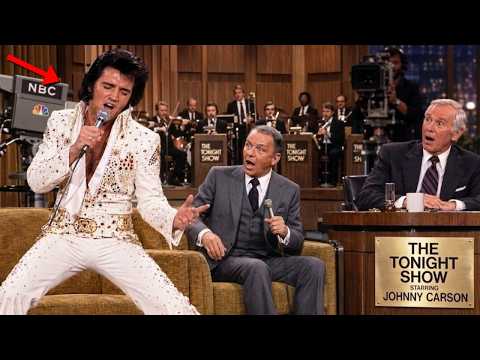
Frank Sinatra was smiling when he handed Elvis Presley the microphone, but it was not a friendly smile. Twenty million people were watching Johnny Carson’s live broadcast when Frank leaned back against the guest couch, crossed one leg, and delivered a challenge the producers had never approved.
“You call yourself the king?” Frank said. “Then sing Bohemian Rhapsody right now without rehearsing.” The audience erupted in laughter. Elvis did not. Johnny Carson’s smile vanished.
Behind the cameras, the floor director ripped off his headset and stared toward the control booth. A producer began slicing one hand across his throat, signaling Johnny to end the exchange before it became a disaster. Johnny ignored him. He looked at Elvis instead.
The king sat motionless beneath the studio lights, dressed in a white jeweled jacket that seemed suddenly too bright for the tension surrounding him. His hands rested upon his knees. His face revealed nothing.
Frank extended the microphone farther. “Well?”
Elvis lifted his eyes. “Do I get a band?”
Frank laughed. “No band, no backing singers, no rehearsal, just you.” The audience laughed again. Several people turned toward Elvis with expressions that made the challenge feel less like entertainment and more like an execution.
They knew what Frank knew. Bohemian Rhapsody was not an ordinary song. It moved through fragile confession, opera, thunderous rock, and haunting silence. Its famous harmonies had been built through layer upon layer of voices inside a recording studio. Even Queen could not recreate every recorded detail with only one man and one microphone.
Frank had selected something impossible. If Elvis refused, people would say the king had been frightened by another singer’s masterpiece. If he accepted and failed, the humiliation would follow him forever.
Johnny leaned across his desk. “Elvis, you do not have to prove anything tonight.” Frank’s smile widened. Elvis noticed. The audience noticed, too.
For one long moment, Elvis looked toward the nearest camera. Beyond its glass eye waited millions of viewers, some loyal, some curious, and others hoping to watch a legend finally fall.
He slowly stood. “I’m not doing it to prove anything.” The laughter weakened. Elvis removed his jeweled jacket and placed it across the couch. Beneath it, he wore a simple black shirt. Without the glitter, he appeared less like an untouchable icon and more like a tired man who had been cornered beneath unforgiving lights.
He turned toward the audience. “I’ll do it because sometimes a song deserves to be heard differently.” Nobody laughed.
Frank leaned forward. “That sounds like an excuse before the first note.”
Elvis looked directly at him. “No. It sounds like a promise that I won’t imitate Freddie Mercury.” The studio went silent.
Elvis walked toward an old black grand piano at the edge of the stage. It had been used earlier by the house band and was never intended for a solo performance. Sheet music remained scattered across its stand. Elvis removed every page.
The orchestra leader approached. “What key?” Elvis sat down. “The one that feels honest.” The musician hesitated, then returned to the shadows.
Johnny left his desk and quietly came closer. “We can take a commercial,” he whispered. “You can think.”
“If I think too long, fear gets a vote.”
Johnny studied him. “Do you know the arrangement?”
“No.”
“Do you know all the changes?”
“Not the way Queen performs them.”
Johnny lowered his voice. “Then what are you going to do?”
Elvis looked at the empty music stand. “Tell the truth and hope it knows the melody.”
The lighting crew darkened the studio until one white spotlight surrounded the piano. The polished black surface reflected Elvis’s face, dividing it into light and shadow. Frank remained upon the couch. His confidence had not disappeared, but the humor had. He had expected Elvis to refuse, laugh, or ask the band for help. He had not expected him to become serious.
Elvis placed his fingers upon the keys, then stopped. A memory had returned. He saw a small church in Mississippi, wooden benches and sunlight crossing worn hymn books. He remembered standing beside his mother, listening as ordinary people sang about sorrow without hiding it. Their voices had not been perfect, but every note carried something no studio could manufacture. He remembered his mother telling him that a song was not something you conquered. It was something you entered.
Elvis closed his eyes. “This song sounds different to me,” he said.
Johnny sat upon the edge of his desk. “How?”
Elvis opened his eyes and looked into the main camera. “Some songs are about performance. This one sounds like a man standing before the whole world while feeling completely alone.” The words struck the room harder than anyone expected.
Behind the fame, wealth, and screaming crowds, Elvis understood loneliness. He knew what it meant to be surrounded by thousands while almost nobody could hear the frightened man beneath the legend. Frank’s expression shifted. For the first time, he seemed to understand that his joke had opened a door Elvis usually kept locked.
Elvis lowered his hands. The first chord emerged slowly. It was darker than anyone expected. There was no attempt to reproduce Queen’s famous opening. Elvis played it like a gospel hymn drifting through an empty southern church after midnight. The audience stopped breathing.
His voice entered almost as a whisper. It carried no imitation of Freddie Mercury’s brilliance. It carried Elvis’s own exhaustion, regret, and hunger for redemption. Each phrase sounded like a confession he had never possessed the courage to make in his own words. Johnny leaned forward. Frank stopped smiling completely.
Elvis sang of judgment as though he had lived beneath it. He sang of loss as though every empty hotel room, every departing friend, and every memory of his mother had gathered beside the piano. One woman in the front row lowered her camera. A stagehand stopped moving. Even the producer who had demanded a commercial removed his headset and listened.
The melody climbed. Elvis’s voice became stronger, but he refused to make it theatrical. He allowed the pauses to remain uncomfortable. He let the room hear his breathing between phrases and the slight tremor in his left hand.
Frank looked toward Johnny. “This wasn’t supposed to happen,” he whispered.
Johnny never looked away from Elvis. “No,” he replied. “That’s why it matters.”
Elvis approached the first major transition. Without layered voices, guitars, or an orchestra, the structure became dangerous. One wrong choice could collapse the entire performance. His fingers moved toward the next chord.
A violent crack exploded from inside the piano. Several keys dropped beneath his hand. The instrument went silent. Elvis stopped singing. The audience gasped.
A technician rushed forward, opened the side panel, and immediately shook his head. Part of the piano’s action had broken. Repairing it would take far longer than the live broadcast had remaining.
Frank slowly stood. The challenge was over. Elvis had been given the perfect excuse to stop. Johnny raised his hand to cut to a commercial.
But Elvis rose from the piano bench. He turned toward the audience and looked at hundreds of frightened, uncertain faces. Then he stepped away from the broken instrument. “No piano,” he said.
Frank stared at him. “No band, no backing singers. What do you have left?”
Elvis took the microphone from the stand. He looked directly at Frank. “Everyone.”
Then he walked toward the audience. But before he could reach them, every light in the studio suddenly went out. The red broadcast signal remained glowing above the camera. Twenty million people were still watching.
And somewhere inside the darkness, a man shouted, “Elvis, don’t sing the next part.”
The warning came from somewhere inside the darkness. A woman screamed. Johnny Carson rose from behind his desk, unable to see anything except the red broadcast light glowing above the main camera. The building had lost its stage power, but the network feed was still alive. Twenty million viewers watched a nearly black screen.
Elvis stood among the first row of seats holding the microphone. A thin emergency light revealed one side of his face.
“Who said that?” Johnny demanded.
A man stepped from beside the control booth. He was the network supervisor, Arthur Reynolds, the person with authority to terminate the broadcast. He carried a flashlight and was followed by two technicians.
“This performance ends now,” Arthur said.
Johnny’s voice hardened. “The audience deserves an explanation.”
“The piano is broken. The lighting system has failed. We have no approved arrangement and no clearance for this performance. If Elvis continues and humiliates himself, the network will be blamed.”
Elvis looked toward him. “You’re protecting the network?”
“I’m protecting everyone.”
“No,” Elvis said. “You’re protecting yourself from a moment you cannot control.”
Arthur ordered the control room to cut the signal. Nothing happened. The broadcast director’s voice emerged through the intercom. “The switch is not responding.” A nervous murmur moved through the studio. The failure had trapped them live.
Arthur approached Elvis and reached for the microphone. Elvis stepped back.
“You accepted a challenge,” Arthur whispered. “The instrument failed. Walk away while people can still call it bad luck.”
Frank Sinatra remained near the couch, barely visible in the darkness. He said nothing.
Elvis looked toward the audience. Hundreds of faces waited beneath the weak emergency lamps. Some appeared worried for him. Others still expected the impossible challenge to end in humiliation. Elvis could have returned to his chair. Nobody would have blamed him.
Instead, he lifted the microphone. “The piano stopped,” he said. “The song didn’t.”
His unaccompanied voice entered the darkness. No chords beneath it, no percussion to guide the tempo, no backing singers to cover his breathing. Every note stood alone before the nation. The vulnerability was terrifying.
Elvis took several steps into the aisle, singing not toward the cameras but toward ordinary people. Without the piano, he no longer sounded like a performer commanding a stage. He sounded like a man confessing something in the dark because he could not say it beneath the lights. A woman near him began crying. An elderly man removed his hat. Arthur stopped reaching for the microphone.
Emergency lights slowly awakened along the walls. Elvis reached the operatic passage. Frank leaned forward—this was the section designed to expose him. Elvis stopped. Silence returned. Then he pointed toward the left side of the audience. “Can you give that back to me?” Their first attempt was weak. “Again.” This time the harmony filled the room.
He taught the opposite side a different response, divided the rear rows into a low humming section. The orchestra leader added his voice without touching an instrument. Elvis pointed toward Johnny. “Me?” the host asked. “Everyone means everyone.” Nervous laughter passed through the studio, then Johnny left his desk and joined.
A cameraman began singing behind his equipment. Stagehands, technicians, security guards added their voices from the shadows. Arthur remained alone until a young assistant quietly began the harmony beside him. He finally joined. Hundreds of strangers who had entered expecting entertainment became part of the performance.
Across the country, viewers joined from their homes. Families sang around television sets. Nurses hummed beside hospital beds. Voices passed through apartment walls between neighbors who had never spoken. Frank’s challenge had been designed to isolate Elvis. Instead, Elvis had made solitude impossible.
The lights returned one by one until a golden spotlight opened above him and revealed hundreds of people singing around him. They no longer looked like spectators. They looked like a congregation. Everyone joined except Frank. Elvis noticed. He walked toward the couch and extended the microphone.
Frank shook his head. “This is your moment.” “A great song belongs to everyone.” Frank looked toward the audience—the same people who had laughed at Elvis now waited for him to answer his own challenge. “I don’t know the song,” Frank said. “Neither did they.” “I don’t sing like you.” “I didn’t ask you to.”
Frank’s hand began trembling as he reached for the microphone. Then he turned away. “I can’t.” The confession silenced the room more completely than any song. Elvis sat beside him. “You’re just afraid they’ll hear the man instead of the voice.”
Frank removed a folded letter worn soft along its edges. It was from a young soldier, Thomas Reed, recovering in a hospital. He had written that both men’s music helped him endure the nights after losing his closest friend. His final request was simple—he wanted to hear the two legends sing together once. The challenge had not begun with arrogance alone. It had begun with fear.
Frank took the microphone. Elvis returned to the broken piano and pressed one of the few keys that still worked. A single low note sounded beneath the choir. Frank raised the microphone. But before his first note emerged, the studio telephone rang.
Johnny answered. A hospital operator spoke urgently. The soldier who had written the letter was watching the broadcast—and his heart had just stopped.
Frank lowered the microphone. “We’re too late.” “You don’t know that.” “Elvis, his heart stopped.” “Then sing until someone tells us to stop.”
Johnny asked the operator to hold the line. A technician connected the telephone to the studio speakers. Twenty million viewers heard hurried footsteps, medical commands, the distant rhythm of emergency equipment. Elvis played the surviving low notes, building a fragile foundation beneath the silence. Frank’s first note trembled—not the controlled voice audiences expected, but fear, regret, and the weight of a letter he had almost kept hidden.
Their voices did not blend perfectly. Frank’s phrasing was elegant and restrained. Elvis sounded raw, southern, and wounded. Neither attempted to overpower the other. They carried what the other could not. The audience began humming again. Inside the hospital, a nurse turned the television volume higher.
Frank reached the passage he had feared. His voice broke. He lowered the microphone, ashamed, but Elvis continued the harmony beneath him. “Don’t hide now.” Frank closed his eyes and allowed the next note to emerge imperfectly. The audience heard not Frank Sinatra the icon—they heard a frightened man asking a stranger to remain alive.
At the broken piano, Elvis’s own hands began trembling. He saw his mother listening from a small room in Memphis. He remembered promises made before fame became a cage. His voice rose with sudden force. The choir answered. One side carried the high harmony, the opposite side provided the response. Johnny, the cameraman, the stage crew joined until the entire studio became a single breathing body.
The hospital sounds continued beneath the music. Doctors called for medication. A machine released a warning tone. Someone ordered another attempt to restart Thomas’s heart. Frank heard it. His face tightened. But he did not stop singing.
Together, they walked toward the main camera. “You asked to hear us sing together,” Frank said. “So wherever you are right now, this belongs to you.” Elvis placed one hand over Frank’s trembling fingers. They entered the final passage side by side.
Elvis’s voice climbed toward the final great note. Then it failed. He opened his mouth, but no sound emerged. Tears fell onto the microphone. The lyrics had reached the wound he could no longer hide. Frank placed one hand upon his shoulder. “Finish it, King. We’re with you.”
Elvis drew one shaking breath. His voice returned as a whisper. Frank lowered his own volume to meet it. The audience softened until hundreds of voices sounded like a distant prayer. The final note contained everything the performance had taken from them—pride, fear, grief, and the courage to remain exposed. Then the sound faded.
Nobody applauded. Johnny pressed the telephone against his ear. The emergency commands had stopped. The warning tone was gone. “Hello?” No answer. Several seconds passed. Then the operator returned, her voice shaking. “The doctors have finished.”
Before Johnny could reveal what she had said, a producer ran onto the stage carrying a second message that had arrived from London. The envelope bore Queen’s management seal. Inside was a handwritten note from Freddie Mercury. “Do not sing it like me. A song survives because another heart discovers a different truth inside it. If the king is willing to stand there without his crown, let him finish.”
Johnny lifted the receiver again. A faint sound emerged through the speakers. One beat, then another, then another. Thomas’s heart was beating. The audience began to rise, but the doctor spoke first. “He is alive. But there is something he needs to hear before we lose him again. He wants the truth about his brother.”
Frank unfolded the letter and noticed two pages had been stuck together. On the hidden page, Thomas had written about his older brother Daniel, who died in the explosion that wounded him. Daniel had survived the first blast, found Thomas trapped beneath burning wreckage, and carried him toward safety. When another explosion struck, Daniel placed his own body over his younger brother. Thomas lived. Daniel did not.
For months, Thomas had carried one unbearable belief—his brother’s death had purchased a life he no longer wanted. The final lines were addressed to both singers. “My brother loved both of you. He said Elvis sounded like hope fighting to survive, while Frank made loneliness feel understood. Please tell me how to live when the person who saved me cannot.”
Elvis approached the camera, not as the king, but as a man who had also wondered how to continue after losing someone who loved him before the world knew his name. “Thomas, your brother did not give you his life so you would spend yours apologizing for surviving.” Frank moved beside him. “He protected your future. Do not turn that gift into a prison.” A faint sound came through the line. Thomas was crying.
Arthur, who had demanded the performance be stopped, now faced the technicians. “Every camera stays.” Elvis returned to the piano. Frank stood beside him. The audience rebuilt the soft harmony they had learned in darkness. They began the final passage—not as a contest, not as imitation, but as an answer to a wounded young man who believed survival had made him guilty. Frank’s controlled voice carried the loneliness. Elvis’s raw voice carried the hope. Neither surrendered its identity. Neither needed to win.
When they reached the final note, Elvis’s voice weakened. Frank stepped closer and carried the harmony until Elvis found his breath. Then the audience supported Frank when emotion broke his control. For the last few seconds, nobody could tell which voice belonged to a legend and which belonged to an ordinary person. They were simply human.
The note faded. Silence. Johnny listened to the hospital line. The doctor spoke quietly. “He heard every word. His condition is stable.” The studio rose. Applause exploded through the room. But Elvis remained seated, his face in both hands. Frank placed one arm around his shoulders and stood beside him until he was ready to rise.
When Elvis finally looked up, Frank stepped toward the audience. “I owe him an apology.” “I challenged this man because I wanted to watch the king fail. I believed if he could not reproduce another artist’s masterpiece, I could expose the limits of his crown. But he did something harder. He removed it.” Frank admitted that pride had disguised itself as humor—he had demanded vulnerability from another man while protecting his own behind a smile. Then he extended his hand. Elvis stared at it for a moment. The audience waited. He smiled and pulled Frank into an embrace.
Elvis walked toward the main camera holding Freddie’s message. “Freddie, this song can never belong to my voice. Tonight, I only borrowed its truth.” Then he addressed Thomas. “And Daniel’s courage belongs to you now. Not as a debt—as a direction.”
Months later, Thomas left the hospital. Frank visited first, bringing the original letter he had kept inside his jacket. Elvis arrived later without photographers. The three men sat together in the hospital garden. Thomas asked whether his brother would be proud of him. Elvis answered carefully. “He did not save the life you were. He saved every person you still have time to become.”
Thomas used that time. He created a support program for wounded veterans and families grieving those who never returned. He never claimed music had healed everything. He simply played the recording from that broadcast for people who believed nobody understood their loneliness. Sometimes hope did not arrive as an answer. Sometimes it arrived as another voice refusing to leave you alone in the dark.
Years later, Johnny Carson was asked which performance had affected him most. He did not speak about perfect notes or record ratings. He remembered the broken piano. He remembered camera operators singing while they filmed. He remembered Frank Sinatra trembling before the microphone and Elvis Presley losing his voice because the truth had become too heavy to carry alone. Most of all, he remembered twenty million people becoming silent at the same time.
That night did not enter television history because Elvis proved he could sing like Freddie Mercury. He did not. He never tried. It became unforgettable because Frank’s mockery created a challenge, Elvis’s courage transformed it, and a dying soldier gave it meaning. A studio full of strangers became a choir. Two rivals became brothers. And a song famous for loneliness became proof that nobody had to survive alone.
Elvis Presley had been asked to defend his crown. Instead, he removed it, sat before a broken piano, and allowed the entire world to hear the frightened man beneath the king. That was why Frank stopped smiling. That was why Johnny forgot to end the broadcast. And that was why, when the final note disappeared, twenty million viewers did not hear Elvis defeating Freddie Mercury’s masterpiece. They heard one artist honoring another by remaining completely, courageously, himself.
So now I ask you: when the spotlight finds you and the piano breaks beneath your hands, will you walk away—or will you lift your voice in the dark and trust that someone out there is still listening? Tell me in the comments below.
Report this article
Select a reason for reporting: