In 1918, a group of professional lobster fishermen working off Port Stephens, on the New South Wales coast north of Sydney, reported an encounter with an unusually large, pale shark. The men described a white creature they estimated at between 115 and 300 feet long, and their reactions were strong enough that some refused to return to work for days.
The account was documented by David George Stead, a prominent Australian naturalist who served as the first fisheries commissioner for the New South Wales government. Stead was a respected figure in Australian marine science, and his decision to record the fishermen’s reports gave the story a level of credibility it might otherwise have lacked.
The men involved were not casual fishermen. Port Stephens was an active center for the lobster industry, staffed largely by families of Italian and Greek immigrants who had settled along the coast since the 1890s. They used open, Mediterranean-style boats suited for reef work, and their catch supplied a significant portion of fresh seafood to Sydney’s growing markets. These were experienced professionals whose livelihoods depended on regular, reliable knowledge of the same stretch of coastline.
Multiple crews working separately along different parts of the coast reportedly gave matching descriptions of the creature: a ghostly white animal of enormous size. Independent accounts with no clear way to coordinate a shared story added to the difficulty of dismissing the reports outright.
The size estimates were the most difficult detail to reconcile. For comparison, confirmed great white sharks reach about 20 feet in length, and whale sharks, the largest living fish, reach about 40 feet. Even the low end of the Port Stephens estimates was roughly three times larger than any fish known to science, and the upper estimate was comparable to the length of a football field.
Modern paleontology has also narrowed what is known about megalodon, the prehistoric shark often linked to such reports. A widely cited 2022 study led by paleobiologist Jack Cooper at Swansea University used a three-dimensional scan of an unusually complete vertebral column to estimate the animal’s length at roughly 50 to 65 feet. That estimate is more conservative than older figures and is still considerably smaller than anything reported at Port Stephens.
The color described in the 1918 accounts also presents a puzzle. Great white sharks have countershaded coloring, gray on top and lighter below, which provides camouflage from both above and below. A fully white shark would lack that advantage, though marine biologists note that leucism, a genetic condition causing partial loss of pigmentation, has been documented in sharks on rare occasions. Photographic evidence of leucistic tiger and oceanic whitetip sharks emerged off Hawaii in 2019 and the Bahamas in 2016 respectively, confirming the condition exists in wild populations.
The behavioral details in the reports were also unusual. The creature allegedly remained near boats and equipment rather than briefly investigating and moving on, which differs from typical great white behavior near vessels. Whether those details reflect real animal behavior or the effects of fear on memory over many retellings is impossible to verify.
Megalodon, formally known as Otodus megalodon, has a fossil record spanning from about 23 million to 3.6 million years ago. Teeth have been found on every continent except Antarctica, indicating the species occupied most ocean basins during its time. Single teeth measuring over seven inches have been recovered, with the largest confirmed specimen held in the Calvert Marine Museum in Maryland.
Australia has a notably rich megalodon fossil record. The Beaumaris fossil site in Victoria has produced some of the most significant southern hemisphere specimens, including a 2019 discovery of fossilized teeth from a juvenile megalodon that researchers believe represents a nursery site. That evidence suggests Australian coastal waters were once breeding grounds for the species.
The accepted scientific consensus places megalodon’s extinction at roughly 3.6 million years ago. A 2019 study in PLOS ONE led by paleobiologist Robert Boessenecker linked the extinction to Pliocene climate cooling, the loss of warm shallow seas that served as nursery habitats, and increased competition with great white sharks and killer whales for the same marine mammal prey.
The ocean has, however, produced documented surprises. The coelacanth, a fish thought extinct for 66 million years, was caught alive off South Africa in 1938. The giant squid, long considered a sailor’s legend, was filmed in its natural habitat for the first time in 2004 by Japanese researchers. The megamouth shark, now a known but rare species, was entirely unknown to science until 1976, when one became entangled in a U.S. Navy research vessel’s anchor off Hawaii.
Modern encounters with large sharks along the Australian coast continue to attract attention. In 2024, a fisherman near the same stretch of coast described meeting a great white of considerable size. Off Port Lincoln in South Australia, great whites have been repeatedly filmed patrolling tuna farm cages, confirming that exceptionally large individuals of known species remain active in these waters.
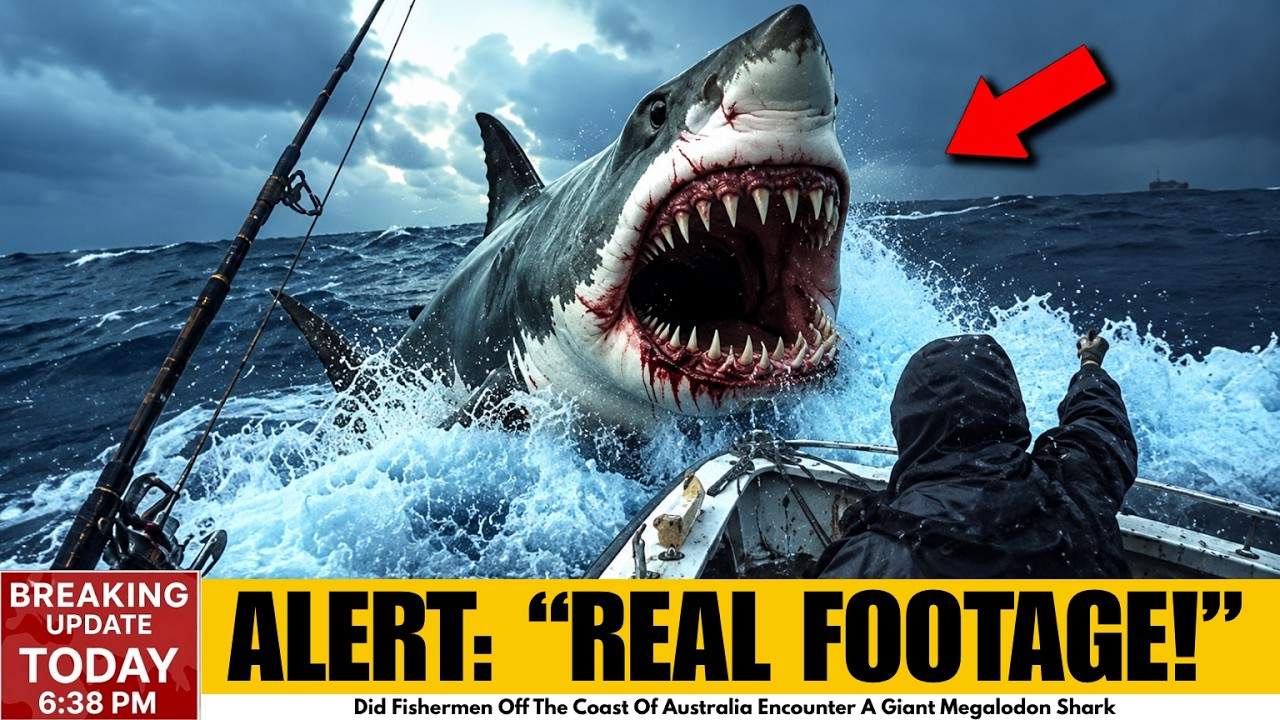
Digital media has also complicated the picture. In May 2021, footage of a basking shark in the Atlantic spread widely online, often mislabeled as megalodon footage. In 2023, researchers tracking viral giant shark videos determined that several were AI-generated or digitally composited, with forensic analysis identifying manipulated shadows and source images. Such incidents do not disprove the 1918 report, which predates digital manipulation by nearly a century, but they do mean modern visual evidence requires more scrutiny.
Marine biologists estimate that up to 80 percent of ocean species remain undiscovered. In 2020, researchers aboard the Schmidt Ocean Institute vessel Falkor recorded a siphonophore roughly 150 feet long off Australia’s west coast, making it the longest animal ever documented. That same survey program has since classified dozens of new species along the Australian continental slope.
Skeptical analysis of the Port Stephens case raises several points. A strong storm had passed through the region shortly before the 1918 incident. Fishermen dealing with storm-damaged equipment, and working within vulnerable immigrant communities with no formal insurance system, may have found it easier to attribute their losses to a supernatural sea creature rather than admit to ordinary storm damage that creditors might question.
There are also biological objections. A population of sharks exceeding 50 feet would require consuming multiple tons of prey daily, an activity that would leave detectable traces in the marine food web, particularly among heavily tracked whale populations. Sharks continuously lose teeth throughout their lives, and megalodon teeth fossilize readily due to their density. If a living population existed near human activity, fresh, unfossilized teeth would periodically wash ashore. None have been found.
The psychological literature on eyewitness testimony also documents how initial fear can retroactively amplify memory through repeated retelling. That phenomenon differs from lying; it reflects how memory reconstructs events rather than simply replaying them.
Environmental DNA sampling, which has advanced considerably in recent years, allows researchers to detect genetic traces left by marine animals in seawater. Large-scale eDNA surveys across Australian coastal waters, including biodiversity monitoring programs led by CSIRO, have not produced genetic signatures consistent with any surviving megalodon lineage. The technique has limitations involving depth, degradation rates, and coverage gaps, but it represents a more rigorous standard of negative evidence than was previously available.
Australia also hosts documented examples of very large known shark species. Deep Blue, one of the largest great whites ever filmed, was estimated at over 20 feet when photographed off Guadalupe Island in 2013. Great whites grow throughout their lives and can live past 70 years, so exceptionally old individuals reaching sizes above population averages are biologically plausible without invoking prehistoric species.
The Port Stephens story occupies a particular space in Australian coastal lore. It is not isolated within a broader pattern of unusual marine encounters reported along the Australian coast, particularly near the continental shelf edge where shallow waters give way to deep ocean conditions. The region remains a documented habitat for large sharks, and the enduring public interest in possible undiscovered ocean giants has contributed to funding and attention for deep-sea and shark research.
What happened off Port Stephens in 1918 remains unresolved. The consistency of independent witness accounts, the credibility of the naturalist who recorded them, and the strength of the fishing community’s reaction prevent the story from being simply dismissed. At the same time, the biological arguments against a surviving megalodon population remain significant. The ocean has repeatedly demonstrated that it holds more than science has yet cataloged, and the case sits in the unresolved space between what has been ruled out and what cannot be confirmed.






