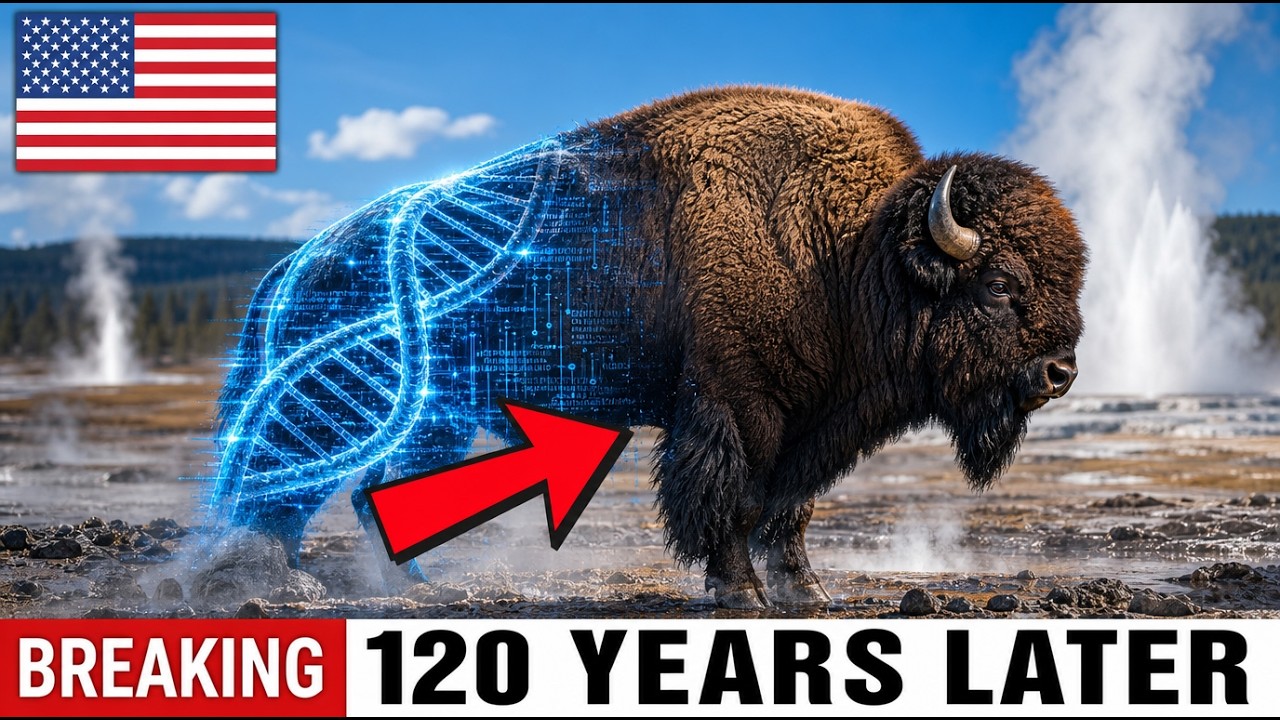
In 2022, a team of geneticists at Texas A&M University completed a study that changed how scientists understand the genetic history of the American bison. The researchers sequenced the genomes of bison from major historical lineages and compared them against the genomes of domestic cattle, searching for traces of cattle DNA. They expected to confirm that certain herds with documented histories of crossbreeding carried cattle ancestry. Instead, they found cattle DNA in every bison genome they analyzed, including herds long believed to be free of any cattle influence.
The Yellowstone National Park herd, widely regarded as the most genetically pure wild bison population in existence, was among them. One animal tested at 0.24 percent cattle ancestry. Across all bison with cattle lineage, the levels ranged from roughly 0.56 to 1.8 percent. These amounts are small enough that they escaped detection for over a century, but they changed the understanding of how the species survived its near-extinction.
The story of how cattle DNA entered the bison genome begins in the late 19th century, when the species nearly disappeared. An estimated 30 to 60 million bison once roamed North America, shaping the prairie ecosystem and sustaining Plains Indian nations. Over a few decades, commercial hide hunting, sport shooting from trains, and government policies that intentionally destroyed herds to weaken Plains tribes reduced the population drastically. By the late 1880s, one survey counted only 541 wild bison remaining in the United States. Every bison alive today, roughly 500,000 animals, descends from that small remnant.
Yellowstone held one of the last wild groups. By 1902, poachers had reduced the park’s indigenous herd to about 23 animals. At that size, the population faced a serious risk of collapse from inbreeding, so park managers decided to bring in outside animals. They purchased 18 females from a Montana herd owned by ranchers Michel Pablo and Charles Allard and three bulls from a Texas herd owned by Charles Goodnight. These animals were shipped to Yellowstone and bred with the surviving indigenous bison.
The private herds that supplied those animals had a hidden history. During the beef shortages that followed the mass slaughter of bison, ranchers had experimented with crossing domestic cattle and bison, hoping to create a hardier animal with more meat. They called the result “cattalo.” The experiment largely failed and was abandoned, but the crossbred animals and their descendants remained within the private herds. When Yellowstone acquired bison from those herds in 1902, cattle genetics came with them.
The geneticist who led the study, James Derr, had spent more than twenty years studying bison DNA. He described the findings as disappointing but not surprising in retrospect. The ranchers who saved the bison from extinction were the same people who had experimented with cattle crossbreeding. The rescue and the mixing of genes were part of the same historical moment.
The discovery had immediate consequences for the field of bison conservation, which had long organized itself around the idea of genetic purity. Herds were ranked based on how clean their genomes were assumed to be, and some populations were isolated from others to protect that ideal. The finding that even the purest herd carried cattle DNA meant that the standard itself was based on an incomplete picture.
Some scientists argued that the focus on purity was misplaced. Oliver Ryder, a geneticist at the San Diego Zoo Wildlife Alliance, cautioned against judging animals by purity alone, noting that real species develop in messy, complicated ways. Brian Davis, a collaborator on the study, pointed out that hybridization is a normal part of evolution and appears throughout the history of many species.
The practical implications of the study were clearer. If the ideal of pure bison genetics was never fully real, then the walls that kept herds isolated from one another could be lowered. Combining herds from different regions could increase genetic diversity, which matters for a species that passed through an extreme population bottleneck.
That shift was already visible on the ground. In 2024, federal and Montana officials agreed to shorten the quarantine period for bull bison leaving Yellowstone from about eighteen months to roughly three hundred days, allowing more animals to be transferred to tribal nations. In early 2026, the largest single transfer of bison on record sent 213 animals to the Fort Peck Reservation in Montana, where the Assiniboine and Sioux tribes manage herds across tens of thousands of acres. The InterTribal Buffalo Council coordinates transfers across more than sixty member tribes. Since 2020, conservation partnerships have returned more than 2,300 bison to tribal nations. Yellowstone also updated its own management target, allowing the park’s herd to range between roughly 3,500 and 6,000 animals instead of holding to a long-standing cap of 3,000.
Inside Yellowstone, the two ancestral lines that researchers had tracked separately for more than a century, the indigenous survivors and the Montana newcomers, have now merged into a single herd.
The story of the bison’s survival is not a story of uncontaminated purity. It is a story of a species reduced to a few hundred animals and rebuilt through the efforts of ranchers, tribal families, and government programs, with all the genetic complexity that such a rescue necessarily involved. The trace of cattle DNA in the Yellowstone herd is a lasting record of that rescue. The 23 indigenous survivors, the 21 outside animals, and the private herds that supplied them all left their mark in the genome, and that genome still carries the evidence of how the species made it through its narrowest moment.






