In the summer of 1980, a cargo plane landed on a gravel airstrip in Canada’s Northwest Territories, near the Liard River Valley. On board were 28 wood bison, the largest land animals in the Western Hemisphere. The species had been absent from this part of the country for more than a century. The animals were released onto ground their kind had not occupied since before the late 1800s.
The immediate goal was modest: keep the animals alive. A founding group of 28 is a slim foundation for rebuilding a subspecies, and a single hard winter or an outbreak of disease could have ended the effort. That did not happen. The animals survived and bred readily. What researchers did not anticipate was where the herd would go once it was free. It moved beyond the release site, crossed a major river that biologists had considered a natural boundary, and established itself across a much larger area than planned.
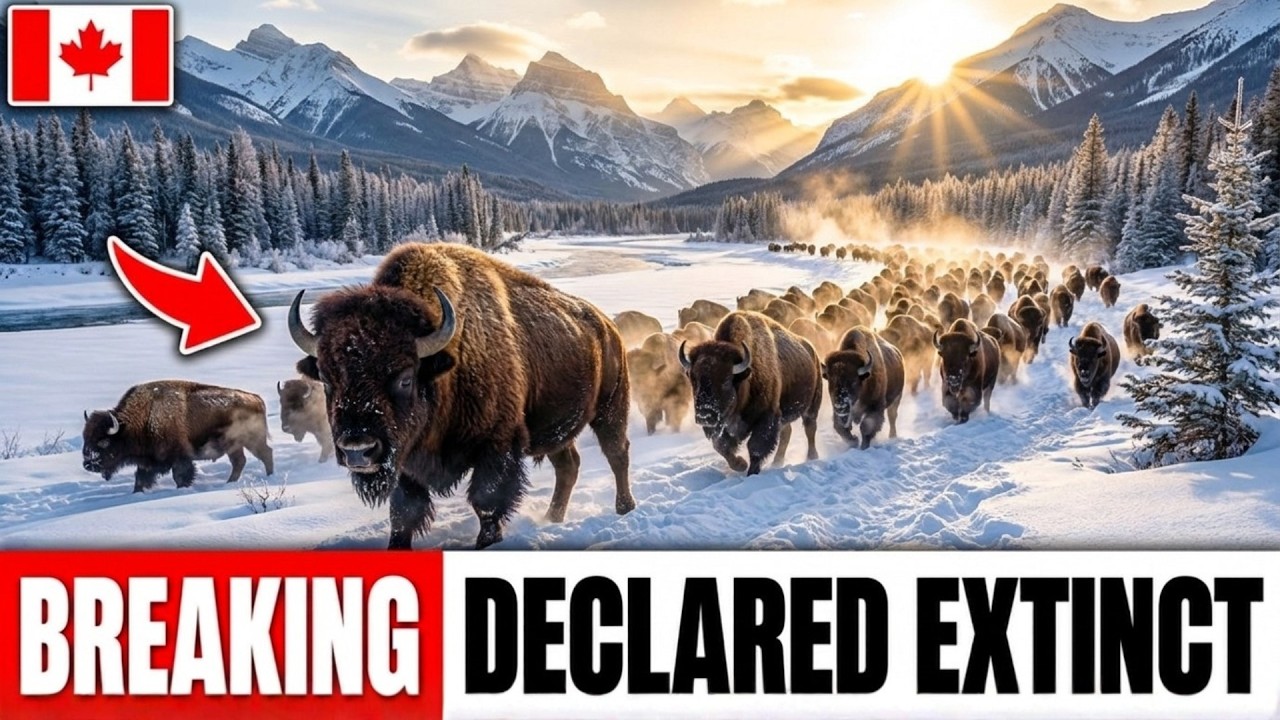
This is the story of that recovery, beginning with the near-erasure of the wood bison in the 19th century, their accidental rediscovery in 1957, and the four decades of data that followed their reintroduction.
The wood bison is larger than its better-known relative, the plains bison. A mature bull can weigh more than 2,000 pounds and stand nearly six feet at the shoulder. It has a taller, more squared hump than the plains bison and is built for cold climates. In winter, it uses its head to sweep snow from frozen ground to reach forage.
The animal’s ecological role goes beyond grazing. By cropping dominant grasses, bison allow smaller flowering plants to grow, increasing plant diversity in grazed areas. Their roaming patterns create a patchwork of tall and short vegetation that supports a wider range of plants, insects, and birds. Their wallows, shallow depressions formed when they roll in dirt, catch rainwater and snowmelt, creating temporary ponds in dry landscapes. Some wallows remain visible for decades. Their dung and urine move nutrients across large areas. Cows also pass knowledge of seasonal routes and calving grounds from mother to daughter across generations.
When the animal is removed from an ecosystem, those processes stop. In Canada, that removal was deliberate. Before the commercial hide trade reached the north, the wood bison population stood at roughly 168,000, according to Parks Canada. Through the 1800s, hunting crews with repeating rifles harvested the animals on an industrial scale, clearing valleys in single seasons. By the early 1900s, only a few hundred wood bison remained.
The Canadian government then moved to protect the survivors, but the rescue effort nearly completed the animal’s demise. In 1922, Wood Buffalo National Park was created, a protected area larger than Switzerland. Between 1925 and 1928, however, the government shipped about 6,700 plains bison from an overcrowded park to the south into the same protected ground, over the objections of scientists. The two subspecies interbred, blurring the pure wood bison line. The newcomers also carried bovine tuberculosis and brucellosis, diseases the resident population had never faced. Infection and hybridization spread through the park for decades. By mid-century, wildlife authorities concluded that the pure wood bison was effectively extinct as a distinct animal.
In 1957, a patrol plane flying over the remote northeast corner of the park spotted a herd of roughly 200 bison along the Nyarling River. These animals looked different from the hybrid herds, with higher, more squared humps. Testing showed they were free of disease and close to pure wood bison. A pocket of the original animal had survived in isolation.
Scientists debated the exact purity of the herd for years, but the consensus was to protect it. Canada had a donor population, and the task became keeping it alive long enough to use it.
The salvage effort produced a narrow genetic bottleneck. In 1963, 18 of the pure animals were captured and moved north across the Mackenzie River, seeding a herd near Fort Providence that would eventually grow past 2,000. In 1965, roughly two dozen more were moved to Elk Island National Park in Alberta, a fully fenced park where they could be kept free of disease and separated from plains bison. That herd became the source for nearly all wood bison alive today, numbering in the thousands across the Northwest Territories, Yukon, British Columbia, Alberta, and Manitoba. Elk Island has since seeded herds across the continent, including one in Alaska in 2015 and another in Siberia.
By 1980, Elk Island could spare some founders. The national plan called for at least three separate free-ranging populations across the historic range to prevent any single disaster from erasing the subspecies again. In June of that year, 28 animals were flown to the Liard River Valley near Nahanni Butte. The site offered open sedge meadows, mineral licks, and braided river flats with abundant forage. But 28 animals in a large wilderness was a thin margin. The releases opened the crates and waited.
Within the first year, biologists documented the ecological effects. The bison grazed meadows down to open ground, formed new wallows that filled with meltwater, and trampled willow thickets along the floodplain. It was the first sustained wood bison grazing in the area in roughly a century, and the effects appeared quickly.
The herd still faced risks. Anthrax occurs in northern soils and can kill bison in waves. Wolves took calves in deep-snow winters. Vehicles killed animals along the Liard Highway. Weather disrupted calving in some years. The hybrid herds around Wood Buffalo National Park still carry tuberculosis and brucellosis, and the clean Nahanni animals were protected only by the distance between them.
Despite these threats, the herd grew. Additional animals were brought in: 12 more in 1989 and 59 in 1998 near Fort Liard, bringing the founding stock to just under 100. Separate herds were also seeded in the Yukon and northeastern British Columbia. The Nahanni herd passed 200 animals by 2000, reached 403 in 2004, and 431 in 2011. A 2017 count estimated roughly 960 bison across about 10,000 square kilometers, a range larger than Yellowstone National Park. Canada’s wildlife authority later downgraded the wood bison from endangered to threatened.
The most striking development involved movement. The animals were released in the lower Liard Valley, but their descendants began holding ground in areas that were never release sites. To reach some of those areas, they had to cross the Liard River, a wide, cold, fast waterway that biologists had treated as a natural barrier.
On July 16, 2002, two researchers watched a group of 18 bison swim across a stretch of the Liard nearly 1.7 kilometers wide, in a current running 14 to 16 kilometers per hour. The animals took at least 27 minutes to reach the far bank. This was not a one-time event. The Nahanni bison now crossed the Liard routinely, calves included, despite the risk of drowning. On the far side, a permanent population established itself in northeastern British Columbia, and the animals pushed on toward the Yukon. A single founder line from the 1980 release now holds territory across three jurisdictions.
The explanation for this movement appears to be food. As the founder herd grew, competition for limited forage pushed animals outward. The best food for these bison is riverine, the sedges and willows on gravel bars and islands along the Liard. To the bison, the river was not a barrier but a corridor of forage. The animals were responding to the landscape on its own terms.
The ecological effects of the return have been substantial. For over a century, the meadows had slowly closed toward shrub and forest as the area adjusted to the absence of large grazers. Old wallows had silted in, and the nutrient cycle had slowed. Along the Liard corridor, that process has reversed. Meadows are being held open again, wallows are filling with water, and insects and amphibians that depend on those temporary ponds are returning.
Research from elsewhere supports the scale of the effect. A 2022 study published in the journal PNAS, based on more than 30 years of data from the Konza Prairie in Kansas, found that returning bison to the grassland roughly doubled the number of native plant species. The study’s lead author, Zak Ratajczak, noted that bison were removed from more than 99 percent of the Great Plains before proper records were kept, meaning most grasslands today may carry a fraction of their original plant diversity.
For the Denesuline people, whose home country includes Nahanni Butte and Fort Liard, the wood bison held cultural significance beyond its biology. The animal was present in the language, in place names, and in stories passed down through generations. For many years, the name pointed at an absence, a creature elders could describe but younger generations had never seen on their own land. After more than a century, the animal has returned to that landscape, and the name has something to point at again.
The broader lesson of the recovery is that the primary human contribution was putting the animal back. After that, the bison ignored the maps drawn for them, crossed a river that had been considered a wall, and restarted an ecological process on their own. The valley was not restored by human design. The animal that knew how to restore it was returned, and then left alone.






