The asteroid that struck near the Yucatan Peninsula 66 million years ago ended the Mesozoic era and eliminated roughly 80 percent of life on Earth. The impact created a crater more than 100 miles wide and triggered a series of natural disasters, including a tsunami that remains the largest known in the planet’s history.
The Chicxulub asteroid, believed to have originated in the outer solar system, was at least six miles across. It crashed into shallow seawater near the peninsula. The collision carved mega ripples into the Earth’s crust in what is now central Louisiana. A 2021 study found that the event also eroded seafloor sediments half a world away, producing waves up to 30,000 times larger than the 2004 Indian Ocean tsunami.
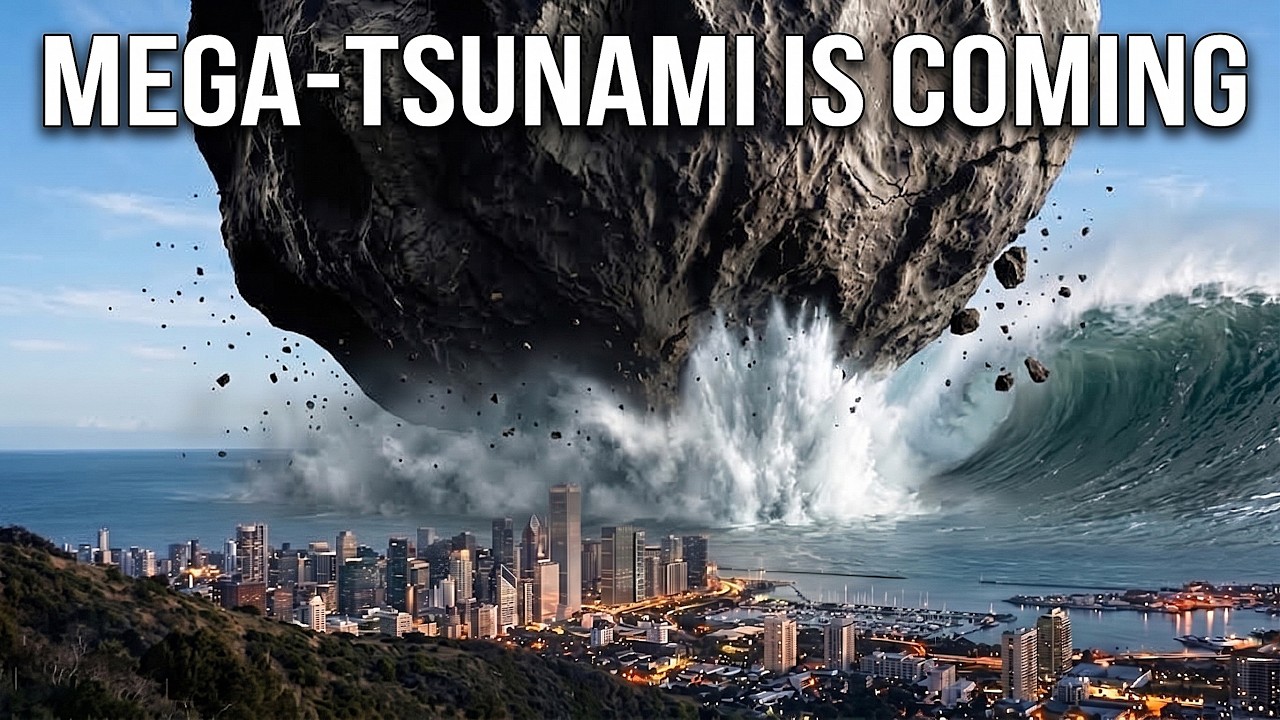
The impact displaced enough water to create a wave almost a mile high. When the ocean rushed back to fill the crater, it ricocheted off the rim, generating more waves. Tsunami waves more than 33 feet tall then traveled around the world at three feet per second, striking coastlines everywhere. Near the impact zone in the Gulf of Mexico, waves exceeded 330 feet in height and moved ten times faster.
Records of historic tsunamis provide some comparison. The 1883 Krakatoa eruption produced a wave as tall as the Statue of Liberty. The 2004 Boxing Day tsunami in Indonesia reached the height of the Arc de Triomphe. The 1958 Lituya Bay event in Alaska, triggered by an earthquake-induced landslide, produced a wave more than half the height of the Burj Khalifa. In 1946, a third of the East Molokai volcano in Hawaii collapsed into the Pacific, generating a tsunami roughly the size of the Shanghai Tower. All of these events were smaller than the one that followed the Chicxulub impact.
The collision also caused earthquakes equivalent to all seismic activity of the past two centuries occurring simultaneously. Less than an hour later, winds of 600 mph flattened surviving structures and scattered debris. The sky darkened as debris reentered the atmosphere, emitting infrared radiation. For the next two years, daylight resembled a cloudy twilight. More than 75 percent of species disappeared. Acid rain fell for months, fires produced toxins that damaged the ozone layer, and temperatures dropped by more than 60 degrees Fahrenheit.
Plants and animals that survived the immediate impact faced these new conditions. Some research suggests the southern hemisphere recovered twice as fast as the northern hemisphere. One theory holds that the season of impact mattered: if it struck during northern spring, northern species were active and exposed, while southern species were preparing for winter and more sheltered. This remains unproven.
Astronomers continue to study asteroids that could pose future risks. One recent discovery, MN45, is roughly the size of eight football fields and completes a full rotation in under two minutes, making it the fastest asteroid found in its size class. Scientists believe it may be a fragment of a larger object shattered by a past collision. Its rapid spin suggests it has unusual internal strength, as most asteroids are loose rubble piles held together by weak gravity. A typical rubble-pile asteroid cannot rotate faster than about 2.2 hours per full spin without breaking apart.
MN45 is not on a path toward Earth. But its discovery raises questions about what else remains undetected. Some simulations suggest a population of city-killer asteroids may be hiding near Venus, obscured by sunlight. Their orbits can shift slowly over time, and a gravity nudge could eventually push one onto an Earth-crossing path.
The asteroid Bennu, a rubble pile about 1,600 feet wide, was studied by NASA’s OSIRIS-REx mission, which returned samples to Earth. The samples contained life-linked elements such as ribose and glucose, along with organic material and ancient stardust. These sugars are building blocks of RNA and DNA, but their presence does not mean Bennu ever hosted life. It does suggest the ingredients for biology were common in the early solar system.
Bennu has a small chance of impacting Earth in the late 2100s, possibly around 2182. An impact would not be extinction-level, but it could disrupt climate patterns and cause regional destruction.
Ceres, the largest object in the main asteroid belt, is a dwarf planet about 600 miles wide. It has no substantial atmosphere, surface temperatures between about negative 28 and negative 225 degrees Fahrenheit, and gravity about 3 percent of Earth’s. NASA’s Dawn spacecraft observed bright patches in a crater in 2015, later identified as sodium carbonate, salty mineral remnants from briny water that may still rise from a reservoir about 25 miles below the surface.
The asteroid Toutatis, shaped like a dumbbell, tumbles chaotically rather than spinning smoothly. Scientists believe it may be two bodies barely touching, and gravitational pulls from Earth and Jupiter repeatedly alter its motion. Its orbit is predictable for the next six centuries, but its path beyond that is uncertain.
Tsunami risk in Europe is a current concern. Only about 10 percent of the world’s tsunamis occur in the Mediterranean, but at least 290 have been recorded in the region since 1600 BCE. The 1755 Lisbon earthquake generated a tsunami that destroyed much of the Portuguese capital. Researchers estimate a major Atlantic tsunami occurs every three to five centuries and could happen again at any time.
Cities including Marseille and Chipiona face a roughly 100 percent chance of being hit by a tsunami in the next 30 years, though the wave will likely be just over three feet high. Even small waves can be dangerous to swimmers and cause flooding that damages harbors and streets. Larger sandbars shifted by underwater currents can disrupt pipelines and internet cables.
UNESCO has developed a Tsunami Ready program to train coastal communities by 2030. The initiative includes evacuation signs, security procedures, and warning plans. Spain has distributed tsunami warning signs along its coastline. The Averroes Fault beneath the Alboran Sea could give residents only 21 minutes to escape. Twelve tsunami warning centers now cover Europe, and systems can issue initial alerts within five minutes of an earthquake, relying on seismic data because seismic waves travel about 100 times faster than tsunamis.
Since 1900, earthquakes have caused over 80 percent of tsunamis. Landslides, volcanic eruptions, and meteorite impacts can also generate them. Meteotsunamis, triggered by weather conditions, are a growing concern in the Mediterranean. In 2006, one struck the harbor of Ciutadella on the Spanish island of Minorca, throwing yachts into each other and causing tens of millions of euros in damage. Meteotsunamis in the Mediterranean are stronger during summer.
Tornadoes remain one of the most unpredictable natural hazards. Most form in the Midwest’s Tornado Alley when warm, moist air from Mexico meets cool, dry air from Canada. Tornadoes can move at speeds exceeding 250 mph and carve paths 50 miles long. They are most common between April and June.
Being inside a tornado is survivable in theory but extremely dangerous. The center of a funnel is colder and less dense than the surrounding air, roughly equivalent to conditions at an altitude of 26,000 feet. Breathing becomes difficult, and debris swirling at hundreds of miles per hour makes injury likely. If a tornado approaches, the safest course is to move to an underground shelter or basement. Emergency supplies should include a battery-operated radio or internet device, non-perishable food, and water. Some people have been picked up by tornadoes and set down unharmed, but this is not a reliable outcome.
The asteroid 2024 YR4, sometimes called Nugget, is about 200 feet across. It was discovered in December 2024 and briefly had a 3 percent chance of impacting Earth, triggering a coordinated international planetary defense response. By March 2025, space agencies ruled out an Earth impact for at least 100 years. However, there is a 4 percent chance it could hit the Moon in December 2032, and the odds may be higher. Its estimated mass ranges widely, making deflection difficult.
The asteroid is currently too far away to study and will not be visible again until June 2028. If it struck the Moon, the impact would create a crater roughly 3,000 feet wide and kick up a massive cloud of regolith. That debris could reach Earth and pose risks to satellites and astronauts. Some researchers have proposed a nuclear mission to break the asteroid apart before it reaches the Moon. Such a mission would need to launch between 2029 and late 2031. Detonation near the surface, known as a height of burst, could destroy the asteroid regardless of its composition, according to NASA studies. Nuclear detonation in space has never been tested for this purpose, and the strategy carries risks, including the possibility of redirecting fragments toward Earth.
NASA’s DART mission, conducted in 2022, demonstrated that crashing a spacecraft into an asteroid can change its trajectory. The spacecraft struck the asteroid Dimorphos, shortening its orbit around its companion Didymos by about 33 minutes, more than three times the expected change. The impact ejected over 2 million pounds of debris and created a tail more than 6,000 miles long. The European Space Agency’s Hera mission, launched in October 2024, will study the aftermath and reach the asteroid pair by October 2026.
NASA also conducts what-if asteroid exercises every two years, simulating potential impact scenarios to prepare scientists and agencies for real threats.
Small asteroids cause damage more often than large ones. On February 15, 2013, an asteroid tens of feet wide exploded in an airburst over Chelyabinsk, Siberia, releasing enormous energy and shattering windows across the city. Over a thousand people were injured, but there were no deaths. An airburst occurs when an object explodes high in the atmosphere without striking the ground.
Astronomers using the James Webb Space Telescope recently discovered 138 new asteroids in the main asteroid belt by analyzing images of the Trappist-1 star system. Six of the newly found asteroids appear to have been pushed into paths that could bring them closer to Earth, likely by nearby planets. These asteroids range from bus-size to stadium-size. The telescope can detect their infrared radiation, allowing scientists to spot the smallest asteroids ever seen in the main belt.
The Vera C. Rubin Observatory in Chile, expected to begin operations in 2025, will photograph the southern sky nightly for at least ten years and could find up to 2.5 million asteroids in six months.
NASA closely monitors the asteroid Bennu, which measures about 1,600 feet across and could potentially drift into Earth’s orbit by September 24, 2182. The chance of impact is roughly 1 in 2,700. If it struck, Bennu would generate 1,200 megatons of energy. Scientists are also studying a region in space called a gravitational keyhole that could set the asteroid on a direct path toward Earth during a flyby in the 22nd century.
The asteroid Apophis, about 1,100 feet across, was once considered one of the most dangerous asteroids detected. Further study confirmed there is no risk of collision for at least a century. It will pass within about 20,000 miles of Earth in April 2029 and will be visible to the naked eye from Europe, West Asia, and Africa. NASA’s OSIRIS-APEX spacecraft, formerly OSIRIS-REx, will reach Apophis in 2029 and study it for 18 months.
The asteroid 16 Psyche, about 173 miles wide, is a metallic object orbiting between Mars and Jupiter. It may be the exposed core of a planetesimal destroyed by a collision billions of years ago. NASA’s Psyche spacecraft launched in October 2023 and will arrive in August 2029. Its estimated value, based on its metal content, is 10 quintillion dollars, but the mission is scientific, not commercial. The probe will analyze Psyche’s composition, gravity field, and possible magnetic field for at least 26 months.
Precious metals on Earth, including gold and platinum, originated in violent cosmic events such as kilonovae, collisions between neutron stars. These metals became part of the cloud that formed the solar system. When Earth formed, most sank toward the core, but collisions with protoplanets, including the Mars-sized Theia believed to have formed the Moon, trapped some in the mantle. Computer models suggest these metals rose closer to the surface through thermal convection over billions of years.
Diamonds have been found in meteorites as nanodiamonds, and researchers believe it may rain diamonds on Neptune and Uranus, where high pressure compresses carbon into crystalline form. Traces of cubic zirconia have been found in lunar rocks.
About 8,200 years ago, an underwater landslide known as the Storegga Slide occurred off the coast of Norway. An area of seafloor roughly the size of Iceland collapsed into the deep ocean, displacing about 840 cubic miles of material. The event generated tsunami waves that struck the Shetland Islands at heights up to 65 feet and surged far inland across mainland Scotland. The wave deposited a layer of marine sand that geologists still find today, sandwiched between ancient peat layers across Scotland, Norway, the Faroe Islands, and Greenland.
The slide also delivered a major blow to Doggerland, the low-lying land that once connected Britain to continental Europe before rising seas swallowed it. Geologists have found evidence that the Storegga region has produced multiple giant slides over the past few hundred thousand years. A modern event of similar scale would threaten coastal cities, harbors, and oil infrastructure, but most researchers agree the slope is more stable today because the unstable glacial sediment has already slid. The UK treats landslide-triggered tsunamis as a low-probability, high-impact event.
In August 2025, a section of a mountain collapsed in Tracy Arm Fjord in Alaska, sending millions of tons of debris into the water. The impact produced a tsunami with a wave height of nearly 1,580 feet, the second largest on record and the largest linked to a landslide. There were no casualties, but cruise ships were scheduled to enter the fjord later that morning. The South Sawyer Glacier had retreated by about 1,640 feet in spring 2025 alone, leaving the surrounding mountain slopes without support. Scientists had almost no warning signs before the collapse.
The 1958 Lituya Bay tsunami in Alaska, triggered by an earthquake that dislodged about 40 million cubic yards of rock, produced a wave reaching 1,720 feet. It remains the largest tsunami wave ever recorded. Five people died. The bay had shown signs of danger for centuries. Explorer Jean François de Galaup La Pérouse noted in 1786 that the forest ended abruptly, as if sliced. His expedition lost 26 men when boats were overwhelmed by currents in the bay.
Japan’s Nankai Trough, a 500-mile underwater fault where the Philippine Sea Plate slides beneath the Eurasian Plate, has produced mega earthquakes every 100 to 200 years over the past 1,400 years. The last one occurred in 1946. Experts estimate an 80 percent probability of another such event, which could generate a tsunami that floods populated areas of Honshu and Shikoku within minutes. About 530,000 people could lose their homes. Japan has equipped buildings with dampers, built coastal shields, and developed an earthquake warning system that detects small tremors and sends alerts to phones within seconds.
Survival preparedness for tsunamis includes maintaining good relationships with neighbors, preparing a backpack with a first aid kit, canned food, flashlights, a battery-powered radio, and bottled water. During an earthquake, experts recommend taking cover under heavy furniture, staying away from windows, and avoiding elevators. During a tsunami, the advice is to move to higher ground, stay as far inland as possible, and not return until authorities confirm it is safe. If no elevation is available, reaching at least the third floor of a reinforced concrete building may help.
Underwater avalanches, also called turbidity currents, are powerful flows of sediment that move across the ocean floor. They occur regularly and can be 100 times larger than land avalanches. About 60,000 years ago, a small landslide in the Agadir Canyon off northwest Africa grew more than 100 times in size as it traveled across the Atlantic seafloor, eroding a 250-mile stretch of the canyon and propelling boulders up to 430 feet up its walls.
In January 2020, a turbidity current rushed more than 680 miles from the Congo River estuary into the deep sea. The flow, driven by flooding and large spring tides, moved at speeds up to 26 feet per second and broke two seabed telecommunication cables, cutting internet speeds across West, Central, and South Africa. It was the longest sediment avalanche ever measured.
Underwater avalanches can be triggered by earthquakes, typhoons, high tides, river floods, and volcanic eruptions. In 1929, an earthquake off Newfoundland triggered a slide that traveled at 42 mph, snapped 11 seabed cables, and generated a tsunami that killed 28 people. Researchers at the University of Liverpool reconstructed a massive slide from more than 300 seafloor samples, showing that even a modest landslide can grow into a flow more than 650 feet tall that spreads over an area larger than the UK.
Seafloor internet cables are essential to global communication. More than 550 active cables stretch 870,000 miles around the planet. In 2006, an earthquake off Taiwan triggered avalanches that cut cables connecting Southeast Asia with the rest of the world. The largest Chinese internet operator lost 90 percent of its traffic to the United States at the peak of the event.
Hurricanes can trigger seismic activity known as stormquakes. Scientists discovered the phenomenon while studying low-frequency earthquakes. Intense storms transfer energy into the ocean, creating waves that interact with the solid earth and produce seismic bursts up to magnitude 3.5. Stormquakes follow seasonal patterns and occur along both coasts of North America.
Hurricane Milton, which struck Florida in October 2024, demonstrated how warm ocean water intensifies storms. It intensified from a tropical storm to a Category 5 hurricane in less than two days, driven by record-high temperatures in the Gulf of Mexico. Estimated losses reached $34 billion. Scientists note that maximum hurricane wind speeds could approach 220 mph by the end of the century as ocean temperatures rise.
Asteroids from one to three feet in size typically explode harmlessly in the atmosphere. Larger objects pose greater risks. The 65-foot asteroid that exploded over Chelyabinsk in 2013 injured 1,615 people. A 300-foot asteroid, like the one that caused the 1908 Tunguska event in Siberia, can flatten forests over a large area. Apophis, at about 1,215 feet, would release energy comparable to the 1883 Krakatoa eruption if it struck.
The Chicxulub impact remains the most consequential asteroid collision in Earth’s history. The asteroid was about 12 miles high when it struck. It released energy equivalent to millions of tons of TNT, created a crater 124 miles wide, and threw up a dust cloud with a mass of 50 trillion tons. Earth was darkened for several days, temperatures dropped dramatically, and most plant and animal species perished. The event marks the boundary between the Mesozoic and Cenozoic eras.
The Moon may have formed after a Mars-sized body called Theia collided with Earth billions of years ago. That collision released enormous energy and produced debris that coalesced into the Moon.
Scientists continue to study asteroids as both scientific resources and potential threats. The OSIRIS-REx mission collected samples from Bennu, and the Japanese Hayabusa 2 mission returned material from the asteroid Ryugu. Analysis of Ryugu samples found silicon carbide grains older than the solar system, indicating the asteroid formed in the outer solar system. Ryugu is one of the darkest bodies in the solar system and is surprisingly dry, possibly because it once passed close to the Sun or because radioactive materials within it removed its water.
Surviving an asteroid impact comparable to Chicxulub would require being far from the impact zone, taking shelter underground, and avoiding coastlines. Tsunamis as tall as skyscrapers would strike coastlines within an hour and reach every coastline on Earth within 15 hours. The impact would send sulfur and water vapor into the atmosphere, causing acid rain and blocking 90 percent of sunlight for at least three years. Temperatures would drop by about 50 degrees Fahrenheit. Tropical islands such as Madagascar and Indonesia would remain relatively habitable, with surviving freshwater ecosystems, but food chains would largely collapse.
Asteroid 2021 RX9, about 120 feet wide, travels at 33,000 mph and crosses Earth’s orbit, but its closest approach is 7.5 Earth-moon distances. Asteroid 2021 NY1, the size of two Statues of Liberty, passes Earth at four Earth-moon distances. Asteroid 2020 VT4, the size of a bus, flew within 230 miles of Earth in daylight, and scientists learned about it only after it had passed.
The atmosphere protects the planet from smaller asteroids, burning most objects under 80 feet in diameter. Larger objects, such as Toutatis, which is 3.3 miles wide, could cause global effects if they struck. Toutatis moves in a chaotic orbit because of gravitational influence from Earth and Jupiter, and its path is predictable only about 50 years in advance.
Scientists have proposed several methods to deflect a dangerous asteroid. One is a kinetic impact, crashing a spacecraft into the object to change its trajectory. Another is a gravitational tractor, in which a spacecraft hovers near the asteroid and uses its own gravity to pull it off course. A third option uses concentrated sunlight to evaporate surface ice, creating a reactive force. Other proposals include wrapping the asteroid in reflective material or attaching rocket engines to control its path. For an asteroid like Ceres, the dwarf planet nearly as wide as Texas, collision with Earth would be catastrophic on a planetary scale, but such an event is not currently under consideration.






