In 2009, explorers confirmed the existence of what is now recognized as the largest natural cave in the world by volume. Located in Vietnam, the cave is known as Hang Son Doong, which translates to “mountain river cave.” It lies within the Phong Nha-Ke Bang National Park, a region of dense forest and limestone mountains that had kept the cave hidden for centuries.
The entrance to Son Doong was first discovered in 1990 by a local man named Khan while he was sheltering from a storm. He noticed a steep opening in a cliff, felt cool air rushing out of it, and heard the sound of a river underground. He did not enter the cave, and the exact location of the entrance was lost for years.
In 2008, Khan rediscovered the entrance while helping British cave explorer Howard Limbert and his team, who were studying the geology of the region. In April 2009, a joint British-Vietnamese expedition entered the cave for the first time. What they found was a system of enormous chambers, underground rivers, and collapsed sections of ceiling that allowed sunlight to reach deep into the earth. The measurements confirmed that Son Doong was larger than any other known natural cave, with passages stretching nearly nine kilometers.
Since that initial survey, scientists and explorers have returned multiple times to study the cave’s geology, biology, and hydrology. One of the most significant questions has involved the cave’s underground river. In a section of the cave known as Doline 1, more than four kilometers from the entrance, the river disappears into a submerged passage. Researchers suspected that this passage might connect Son Doong to a neighboring cave system called Thung, which lies about 600 meters away. If the connection existed, it would add approximately 1.6 million cubic meters to the cave’s volume.
In March 2019, a team of experienced cave divers, including Howard Limbert, Rick Stanton, Jason Mallinson, and Chris Jewell, attempted to explore the submerged passage. The divers reached a depth of about 78 meters, but the passage continued deeper, to roughly 93 meters. At that point, their standard air equipment prevented them from going further safely, and the team turned back. The connection to Thung remains unconfirmed, and the full extent of the underwater passage remains unknown.
Son Doong contains features that distinguish it from most other caves. Large sections of the ceiling have collapsed over time, creating openings known as dolines. These openings allow sunlight, air, and rainwater to enter the cave, making it possible for plant life to thrive hundreds of meters below the surface. In an area called Doline 2, explorers found a functioning jungle, with trees growing toward the openings, ferns covering the ground, and vines wrapping around rocks. The cave’s size and humidity also create conditions that produce fog and cloud-like formations inside the chambers.
The cave supports a documented ecosystem of more than 200 plant species. Researchers have also recorded a range of animal life, including fish, woodlice, millipedes, spiders, and scorpions. Some of these animals have adapted to life in permanent darkness, with reduced or absent eyes and pale or translucent bodies. Scientists continue to study how these species survive in isolation.
The cave also holds geological significance. The limestone in the region is more than 400 million years old, while the cave itself is estimated to have formed between two and three million years ago along a fault line in the Truong Son mountain range. Over time, rainwater and underground rivers slowly dissolved the limestone, carving out the passages seen today. Fossilized coral found near a passage called Fossil Passage indicates that the landscape once looked very different. An underground lake in the cave records water temperatures of roughly 17 to 20 degrees Celsius.
One of the most notable formations inside the cave is a large calcite wall known as the Great Wall of Vietnam. During the 2009 expedition, the team could not climb it without specialized equipment. They returned in 2010 with climbing gear, scaled the wall, and continued another 400 meters to the cave’s exit, completing the main survey of the system.
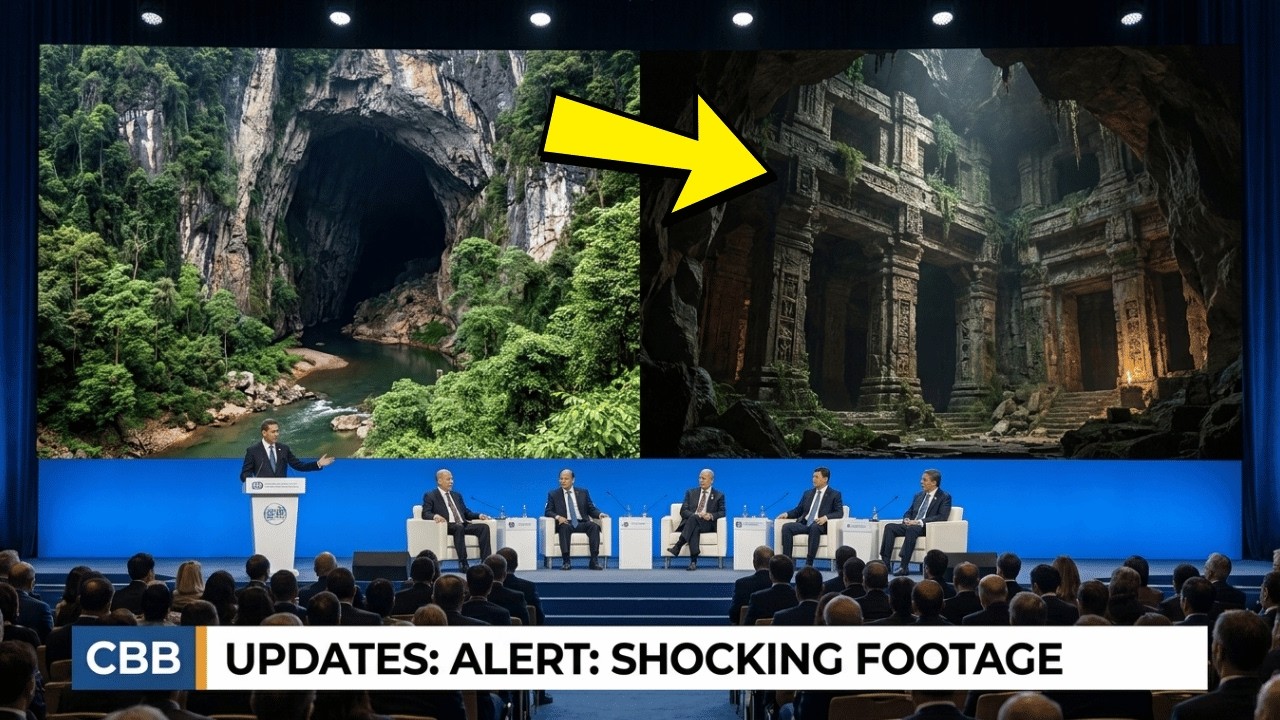
As stories about Son Doong spread, some accounts have included claims of unusual markings, underground signals, and possible connections between distant locations. Some have suggested that certain cave formations resemble ancient writing or that unexplained signals detected underground could be linked to sites thousands of kilometers away. At present, there is no confirmed scientific evidence to support such claims. These ideas remain speculation, and researchers have not found any indication that the cave contains artificial structures or evidence of an unknown civilization.
What is documented is already remarkable. The cave contains a river whose full course is unknown, a functioning ecosystem in darkness, fossils that preserve evidence of past climates, and geological formations that took millions of years to develop. The ongoing study of the cave continues to provide information about how the earth changes over time and how life adapts to extreme environments.
The most significant lesson from Son Doong may be that the planet still holds large systems hidden beneath the surface that remain unexplored. Some passages have not yet been reached because existing equipment and technology are not sufficient for safe exploration. Future expeditions may find new passages, identify new species, or clarify questions that currently remain open. They may also demonstrate that some current theories are incorrect.
The submerged passage where divers turned back remains one of the cave’s unresolved questions. What lies beyond that point has not been seen by humans. It is possible that a connection to another cave system exists, which would make Son Doong even larger than currently measured, but that has not been proven. Until further exploration is possible, the full extent of the cave will remain unknown.






