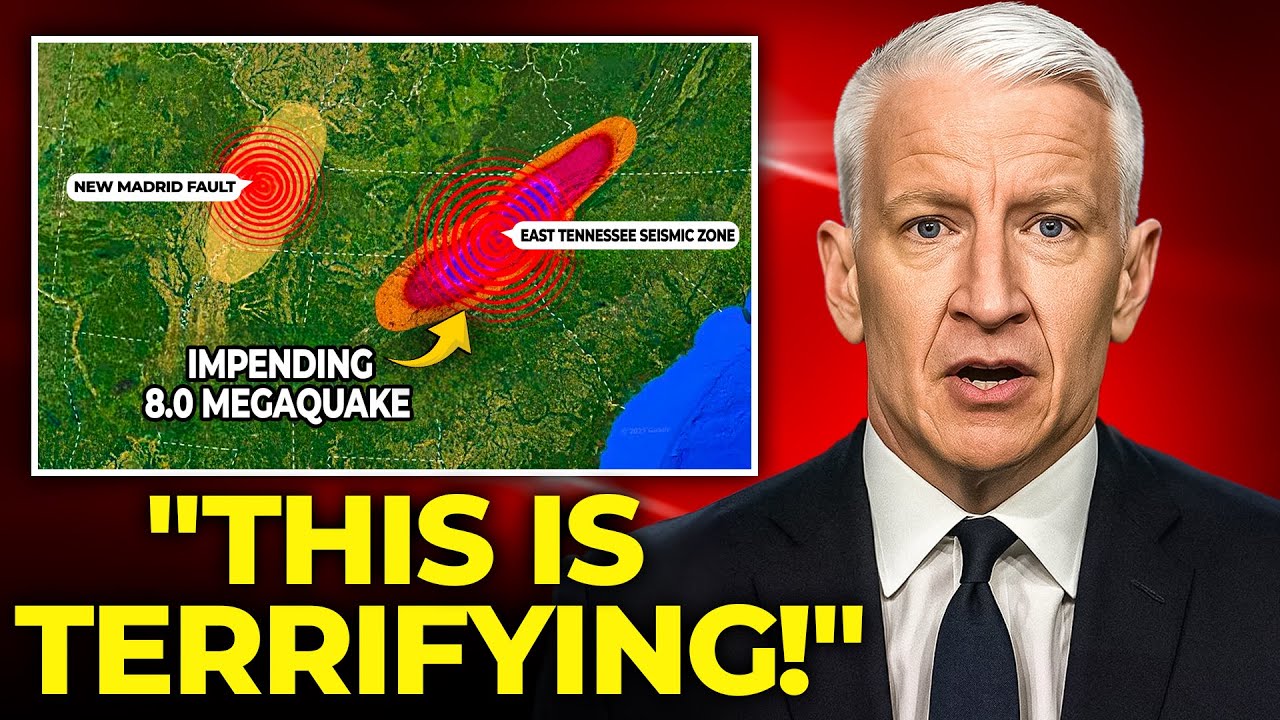
Beneath Tennessee, a fault line stirs with a threat geologists call more terrifying than the legendary New Madrid zone. Scientists have long mapped the region’s seismic history, but new research reveals a hidden danger capable of producing catastrophic ground shaking across the mid-South.

A magnitude 4.1 earthquake centered near Greenback, Tennessee, rattled homes and woke residents in the region this morning. The tremor was felt as far away as Charlotte and Atlanta.

The event drew renewed attention to a seismic zone beneath the Appalachian region that scientists monitor for larger potential earthquakes. The East Tennessee Seismic Zone stretches roughly 300 miles from Alabama through Tennessee into Virginia, with effects reaching into Georgia and Kentucky.
Beneath Tennessee, a fault line stirs with a threat geologists call more terrifying than the legendary New Madrid zone. Scientists have long mapped the region's seismic history, but new research reveals a hidden danger capable of producing catastrophic ground shaking across the mid-South.

Unlike faults along the West Coast, this zone sits in the middle of the continent. The faults are buried deep underground, formed hundreds of millions of years ago during ancient continental collisions. Because the rock in the eastern United States is old and solid, earthquake energy travels farther than it does in California. A quake in Tennessee could be felt hundreds of miles away.

The zone produces frequent small tremors. Thousands have been recorded in the past 20 years, though most are too small to be noticed. Scientists estimate the zone could produce an earthquake as large as magnitude 7.5. The last major quake in the region occurred long ago, and the recorded history contains no event close to that size.

The strongest modern quake in the zone was a magnitude 4.7 near Alcoa, Tennessee, in 1973, which produced more than 30 aftershocks. A magnitude 4.6 quake near Fort Payne, Alabama, in 2003 caused sinkholes, broken water pipes, and chimney collapses. The May 2025 Greenback quake was felt across multiple states, and more than 45,000 people reported feeling it online. No injuries or building collapses were reported.

Evidence indicates at least two prehistoric earthquakes in the zone reached approximately magnitude 6.5. A quake of that size today would cause significant damage across Tennessee, Virginia, Kentucky, North Carolina, and Georgia.

Many buildings in the region were not designed with earthquake safety in mind. Older brick structures, schools, bridges, and homes generally lack reinforcements used in earthquake-prone areas. Power lines, water systems, and roads would likely experience damage in a major event. Dams in the Tennessee Valley could be affected, and landslides could block highways in mountainous areas. Emergency response capabilities would be strained across multiple states simultaneously.

A large earthquake in the zone would likely cause tens of billions of dollars in damage and leave some areas without power, clean water, or functioning hospitals for weeks. The region has not invested in earthquake preparation to the extent that California has, where building codes and public drills are standard. Most residents in the southeast do not regularly consider earthquake risk.

Monitoring and preparation efforts exist. The University of Memphis operates the Center for Earthquake Research and Information, which tracks seismic activity in the zone. Tennessee and other states participate in the Central US Earthquake Consortium, which studies risks and organizes public drills such as the annual ShakeOut. Emergency managers encourage residents to secure heavy furniture, practice drop-cover-hold-on techniques, and keep emergency supplies at home.

The New Madrid fault zone to the west produces larger historical quakes, including the 1811–1812 events that were powerful enough to temporarily alter the flow of the Mississippi River. That zone is currently quieter than the East Tennessee zone, which continues to produce small quakes regularly. The East Tennessee zone sits in a more populated area than the New Madrid zone did two centuries ago.

Earthquake scientists do not predict exactly when a large quake will occur. The pressure in the zone builds slowly over long periods, and the timing of a major release cannot be forecast with precision. The repeated small quakes and prehistoric evidence indicate the region can produce much larger events.


Related Posts

Florida’s ocean floor just collapsed, with sudden oceanic sinkholes emerging off the coast. Massive craters have opened beneath the water, swallowing sandbars and reshaping the seafloor in hours.

In late 2024, a NOAA research vessel mapping the continental shelf near the Florida Straits identified large circular depressions on the seafloor. Some of these sinkholes measured over 300 feet across and descended deeper than a 30-story building. Underwater drone footage showed sediment columns spiraling downward and water currents flowing into the voids. Researchers determined that these feature…

Deep beneath Colorado’s Mesa Verde, scientists have confirmed something startling—a sprawling network of hidden chambers and tunnels carved into the rock, untouched for centuries. For decades, researchers believed the ancient cliff dwellings were the region’s only marvel, but new scans have revealed a far larger subterranean world lurking below the surface.

In the summer of 2023, a survey team used ground-penetrating radar beneath Mesa Verde National Park in Colorado. The equipment detected something unexpected below the surface. The data suggested a network of chambers and passages under part of the mesa. The findings raised questions about the history of a site that has been studied for over a century.Mesa Verde is located in the southwestern corne…

Scientists reopened an underwater cave sealed for 40,000 years and immediately knew something was off. The ancient chamber, hidden beneath the depths, had remained untouched since the Ice Age.

In 2007, cave divers mapping underwater tunnels near Tulum, Mexico, found a large submerged chamber they named Hoyo Negro. The room, about 100 feet deep, contained scattered animal bones and a nearly complete human skeleton. The discovery led to years of research by the Mexican National Institute of Anthropology and History (INAH) and a team of international scientists.The human remains belonged t…

A 12-billion-gallon Florida lake vanished overnight, leaving stunned residents staring at a giant muddy hole. The massive Lake Jackson basin suddenly drained completely as its natural plumbing gave way.

Lake Jackson, a 4,000-acre lake just outside Tallahassee, Florida, drained into underground caves through a sinkhole in its floor over the course of several months. The lake, which once held about 12 billion gallons of water, is now largely exposed mud and sediment. The drain began in late November 2025, after months of drought in the region, and continued into early 2026. By March, vegetation was…

The Oregon coast has just been shut down by federal authorities, but they won’t say why. Divers reportedly surfaced with something from the deep that triggered an immediate, unprecedented closure.

Axial Seamount, an underwater volcano located roughly 300 miles off the Oregon coast, is showing signs that it may erupt before the end of 2025. Scientists have been monitoring the volcano closely since it last erupted in 2015, and recent data indicates the seafloor around it is inflating at a faster rate than it did before its previous eruptions in 1998, 2011, and 2015. The volcano sits along the…

A massive opening just split the seafloor off Florida’s coast, and experts are scrambling to explain what lies beneath. The underwater feature emerged without warning, pulling attention from scientists and officials alike as they mapped its true scale.

In the days following a routine maritime patrol off the coast of Deerfield Beach, Florida, scientists and emergency officials began investigating a series of large sinkholes that formed on the Atlantic seafloor.A Coast Guard vessel conducting a standard safety sweep encountered a depth reading that did not match nautical charts. The instruments measured roughly 40 feet of water where charts indica…

Leave a Reply

Your email address will not be published. Required fields are marked *