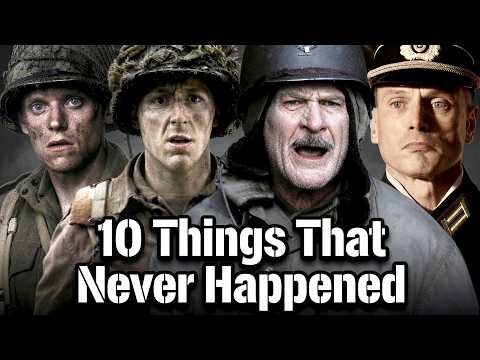
You think you know the story of Easy Company? Think again. HBO’s Band of Brothers is hailed as one of the most accurate war dramas ever made, but scratch the surface and you’ll find moments of pure Hollywood invention—scenes so dramatic, so gut-wrenching, that you’ll swear they must be true. They’re not.
From a co-pilot’s gruesome death that never occurred to a German officer’s pistol that was actually kept, the series took liberties that will leave you questioning everything you thought you knew about the men of Easy Company. What you’re about to read will change the way you see the series forever.
Take the D-Day drop sequence in episode two, “Day of Days.” The show depicts Winters’ C-47 co-pilot getting killed by flak, his face torn apart, forcing a panicked early jump. It’s visceral, chaotic, and sets the tone for the horrors of war. But here’s the truth: no one on Winters’ plane was killed that day. The pilot, Lieutenant William Sammons, was lightly wounded in the foot, and the co-pilot, Lieutenant William Ogle Tree, helped fly the plane back to England safely. The real incident? A few flak hits to the tail. No graphic death, no panic—just the grim reality of war, which was harrowing enough without embellishment.
Then there’s the moment that defined Ronald Speirs as a cold-blooded killer: the execution of German POWs right after Malarkey’s poignant encounter with a German-American prisoner from Oregon. In the series, Speirs calmly offers cigarettes before gunning them down, leaving Malarkey haunted. But that scene never happened—at least not like that. Speirs did admit to shooting prisoners, but there’s zero evidence he encountered that specific group, and Malarkey himself said he believed it happened days later near Carentan. The writers merged events to create a chilling introduction to Speirs, but the truth is messier and less cinematic.
And what about Joe Toye’s brass knuckles punch? In the show, Toye silences a babbling German prisoner with a brutal blow during the Brecourt Manor assault. It’s a moment that cements his tough-guy reputation. But the real puncher was Private Gerald Lorraine, Colonel Sink’s driver, not Toye. Toye, a devout Christian, was known for his compassion, not senseless violence. The writers took a real incident and assigned it to the wrong man, all for dramatic effect.
Perhaps the most egregious distortion involves Albert Blithe. The series portrays him as a coward who overcomes his fear, only to die from a neck wound in 1948. But Blithe didn’t die in 1948—he survived, recovered, and went on to serve in the Korean War. The real Blithe was never so paralyzed by fear that he couldn’t fight; his hysterical blindness was a brief, stress-induced episode, not a weeks-long struggle. Dick Winters himself called the portrayal “unfair.” The writers fabricated an entire arc, including a death that never happened, to create a redemption story that didn’t exist.
Even Dick Winters wasn’t immune to fiction. The poignant Paris flashback in episode five, where Winters sees a boy on a train and remembers a smiling German soldier he shot, never happened. Winters called the scene “stupid” and lamented that he wasn’t consulted. The real German soldier wasn’t a kid—he was a sentry, a man—and Winters never had that moment of paralysis on a train. The writers twisted the truth to heighten the drama, but in doing so, they ignored the real Winters’ own reflections on the war.
And the list goes on: Bill Guarnere never reached Joe Toye to drag him to safety; Colonel Sink never yelled at Winters at Foy; Roy Cobb wasn’t arrested or court-martialed; Easy Company didn’t discover the concentration camp (the 12th Armored Division did); and Winters didn’t let a German officer keep his pistol—he accepted it, and it was a Walther PP, not a Luger. Each of these changes was made for dramatic impact, but they distort the real stories of the men who fought.
So why does it matter? Because Band of Brothers is more than entertainment—it’s a touchstone for how we remember World War II. When Hollywood takes liberties, it shapes our perception of history. The real Easy Company was heroic enough without embellishment. Their courage, their sacrifice, their humanity—that’s the story that deserves to be told.
But the truth is, Band of Brothers is still a masterpiece, and its inaccuracies don’t diminish the bravery of the men it portrays. They simply remind us that war is messy, and memory is imperfect. As Tom Hanks told Winters, “We will be hailed as geniuses if we get this 12% right.” Maybe that’s the real lesson: even with the fabrications, the series brought attention to the real heroes, and for that, we can be grateful.
But let’s dig deeper into the moments the showrunners invented wholesale—scenes that never even had a kernel of truth. Consider the now-iconic speech Ronald Speirs delivers to Albert Blithe in episode three, telling him that the only way to function as a soldier is to accept that he’s already dead. That entire monologue was fabricated by the screenwriters. It never happened, and it wasn’t based on anything Speirs or anyone else ever said to Blithe. Yet it became one of the most quoted moments of the series—proof of how a well-crafted fictional scene can eclipse the real history it claims to depict.
Then there’s the matter of Easy Company and the concentration camp. The ninth episode, “Why We Fight,” shows the men stumbling upon the horrors of Kaufering IV, their faces etched with shock and rage. It’s a powerful, necessary depiction of the Holocaust’s brutality. But Easy Company didn’t discover the camp—the 12th Armored Division did, a full day earlier. By the time Easy Company arrived, liberation efforts were already underway. The show’s version isn’t a lie about the camp’s existence or the atrocities committed there, but it does reassign credit for the discovery, giving the men of Easy Company a narrative weight they didn’t actually carry.
And what about Joseph Liebgott, the German-speaking interpreter who delivers the heartbreaking order for survivors to stop eating? The scene is fictional, but more surprising is the revelation that Liebgott wasn’t Jewish at all. He was a German Roman Catholic. His fellow soldiers assumed he was Jewish because of his name, and he never corrected them. Stephen Ambrose, working from secondhand accounts, carried that error into his book, and the series perpetuated it. It’s a small detail, but it speaks to how easily misinformation becomes accepted history.
The final episode’s most memorable moment—Winters letting a German colonel keep his Luger—is perhaps the most ironic fabrication of all. In the series, it’s a gesture of respect, a quiet acknowledgment of shared humanity between enemies. In reality, Winters accepted the pistol—a Walther PP, not a Luger—from a German major he’d spent hours talking with the day before. They’d discussed tactics, discovered they’d fought each other at Bastogne, and formed a strange, fleeting bond. The major offered the weapon as a token of friendship and surrender. Refusing it would have been an insult. Winters kept that pistol for the rest of his life. The series turned a genuine moment of connection into a fictional act of mercy.
So why do these fabrications matter? Because Band of Brothers isn’t just a TV show—it’s how millions of people learned about Easy Company. When the series invents a death, reassigns a punch, or rewrites a surrender, it overwrites the real memories of the men who were there. The truth, as Winters himself knew, was compelling enough without embellishment.
Tom Hanks reportedly told Winters they’d be lucky to get 17% of the story right. That may have been a joke, but it underscores a hard reality: Hollywood and history are uneasy bedfellows. The men of Easy Company deserve to be remembered for what they actually did—not for the dramatized versions of themselves that look better on screen. And yet, the series remains a gateway to their story, flaws and all.
But here’s what the showrunners never put on screen: the quiet, unglamorous truths that make the real men even more fascinating than their fictional counterparts. Take Roy Cobb, painted as a bitter drunk who gets hauled off in a jeep by military police. The real Cobb received the Good Conduct Medal just two months after his supposed arrest—and re-enlisted in the Army in 1946. No court-martial, no dishonorable discharge. The show needed an antagonist, so it invented one from whole cloth.
Then there’s the matter of the race to Berchtesgaden. The final episodes imply Easy Company reached Hitler’s mountain retreat first, a triumphant capstone to their journey. But that credit belongs to the 7th Infantry Regiment of the 3rd Infantry Division. Easy Company wasn’t even close. It’s a small theft of glory, but a theft nonetheless—one that erases the men who actually got there.
And what about Buck Compton? The series shows him crumbling at Bastogne, paralyzed by shell shock, evacuated with a broken spirit. Compton later fired back at that depiction himself. He wasn’t experiencing shell shock—he was furious. Furious that Lieutenant Norman Dike was never around when the men needed him, furious that good soldiers were dying while command faltered. The show turned righteous anger into psychological collapse, a tidy arc that fit the narrative but betrayed the man.
Even the small, human moments were rewritten. George Luz never got slapped by a German farm girl—that rejection happened to Corporal Lavon Reese, a soldier the series barely mentions. The writers borrowed a real humiliation and gave it to a more prominent character, because Luz was already a fan favorite and the scene played better with him.
So what does all this mean for how we watch Band of Brothers? It means we have to hold two truths at once. The series is a staggering achievement—beautifully acted, meticulously produced, emotionally devastating. It brought the story of Easy Company to millions who might never have picked up Ambrose’s book. But it is not a documentary, and it never claimed to be.
Dick Winters understood this better than anyone. When he complained to Tom Hanks about the lack of accuracy, Hanks didn’t apologize or promise to do better. He laughed and said they’d shoot for 17% and call it a victory. Winters, to his credit, accepted that. He knew the series wasn’t meant to be a history lesson—it was meant to honor the men, even if it did so imperfectly.
And perhaps that’s the real takeaway. The men of Easy Company were ordinary people thrust into extraordinary circumstances. They were scared, brave, petty, generous, broken, and whole—often all at once. The series captured that spirit, even when it got the facts wrong. The truth is messy and contradictory, and no two-hour episode can contain it.
But if you want to truly honor their memory, you have to go beyond the screen. Read the memoirs. Watch the interviews. Listen to the recordings of the men themselves, in their own words, unfiltered by Hollywood. Because the real story—the one without the dramatic music and the perfectly timed close-ups—is somehow even more remarkable.
It’s the story of Joe Toye, a devout Christian and amateur boxer who never threw that punch but who charged into enemy fire anyway. It’s the story of Albert Blithe, who didn’t die in 1948 but lived to fight another war, carrying the scars of combat with him until the end. It’s the story of Bill Guarnere, who didn’t quite reach his friend that day in the snow, but who tried—and paid a terrible price for trying.
These are the men behind the myth. They deserve to be remembered not as characters in a story, but as human beings who did something extraordinary. And that’s a truth no screenplay can improve upon.
So the next time you watch Band of Brothers—and you will—remember that every tearful moment, every heroic stand, was filtered through a writer’s room. That doesn’t make the series a lie; it makes it a lens. A powerful, beautiful lens that brings us closer to a generation we can never truly know.
But the men themselves? They lived the messy, unscripted version. No dramatic music. No perfect timing. Just courage, fear, and the quiet dignity of doing their duty. That’s the story worth carrying forward.
So here’s the question: knowing what you now know, will you watch the series differently—or does the fiction still honor the truth? Let us know in the comments below.
Report this article
Select a reason for reporting:






