They were the faces that defined an era, the names that drew millions to their screens every week. But behind the charm and the talent, some of television’s biggest stars were convinced the spotlight belonged to them alone—and they weren’t afraid to let everyone know it.
From explosive firings to public tantrums and contract battles that held entire networks hostage, these were the egos that nearly brought down the very shows that made them famous. Some television stars were certain the show belonged to them, and they said so out loud.
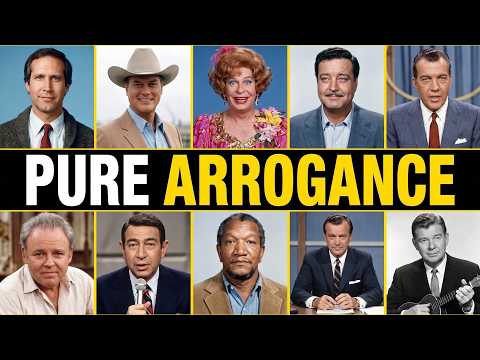
In the golden age of television, when a single hit could turn an unknown into a national icon overnight, the line between confidence and arrogance blurred. For some, that confidence became a weapon—one they wielded against co-stars, writers, and the executives who dared to challenge their vision.
Take Arthur Godfrey, the most valuable man CBS had in the early 1950s. He called his regular performers “the Little Godfreys,” and he meant it literally. When Julius La Rosa, a young singer Godfrey had plucked from obscurity, hired an agent, Godfrey considered it a personal betrayal. On October 19, 1953, Godfrey kept La Rosa waiting backstage until the final minutes of the broadcast, then told the audience that was “Julie’s swan song with us.” La Rosa found out he was fired at the same moment the country did.
Godfrey’s explanation? The young man had “lost his humility.” Within days, he had fired his bandleader and more than 20 other cast and crew members—some for nothing worse than being seen talking to Ed Sullivan. He even buzzed an airport control tower in his private plane because he didn’t get the runway he wanted, earning a six-month suspension of his pilot’s license.
The pattern repeats across the decades. Vince Edwards, the brooding star of Ben Casey, demanded a raise from $1,750 to $7,500 an episode, 25% ownership of the series, and a $300,000 loan to start his own production company—all in his second year on television. Columnists called him “sullen,” “irascible,” and “explosive,” and they were describing the man, not the character.
Milton Berle, television’s first superstar, interrupted rehearsals, rewrote material on the floor, and treated the writing staff as a service department. Carl Reiner said Berle was known as “a real tyrant who made demands that simply couldn’t be met because he didn’t understand that the thing he was working in was a collaboration.”
And then there was Jackie Gleason, “The Great One,” who refused to rehearse, claiming a photographic memory, and let his stand-in walk the scenes while his co-stars sweated through cold sweats before live broadcasts. Audrey Meadows said her first day on The Honeymooners was “the most difficult day of her life.”
These were not isolated incidents. They were the cost of genius—or at least, the cost of believing in your own genius a little too much. And for some, that belief came with a price that would follow them long after the cameras stopped rolling.
What happened when the audiences stopped adoring them? When the networks stopped tolerating them? The stories that follow reveal just how far some stars would go to protect their egos—and what it ultimately cost them.
Jack Paar took over Tonight in 1957 and turned a late-night novelty into a national habit by being the most emotionally transparent man on American television—a gift right up until it wasn’t. On February 10, 1960, NBC’s censors cut a joke from the taped program without telling him. It was a mild story about an English woman asking a Swiss resort about a water closet, and the owner mistaking the letters for “Wayside Chapel.”
The following night, Paar came out, told the audience the network had cut him without a word, said he was leaving the Tonight Show, and walked off the set in the middle of his own broadcast. He stayed gone for nearly a month. When he returned on March 7, he stood until the applause died and opened with: “As I was saying before I was interrupted.”
Howard Cosell didn’t need anyone to make his case for him—he did the work himself. Asked about his reputation, he said he’d been called arrogant, pompous, obnoxious, vain, cruel, verbose, and a showoff. “And that, of course, I was all of those things.” He said versions of that line for 20 years while audiences called him “Humble Howard” and collected the sarcasm like a trophy.
Then came the book his colleagues never forgave. I Never Played the Game arrived in September 1985, and Cosell used it to settle accounts with Frank Gifford, Don Meredith, and Roone Arledge—the men who had shared his booth for the best years of his career. The punchline arrived almost immediately: ABC replaced him on the 1985 World Series with Tim McCarver, a former ballplayer, which was precisely the thing the book had been about.
Redd Foxx had spent 25 years being underpaid by an industry that wouldn’t book him on television at all. When Sanford and Son became the second-highest-rated program in the country, Tandem Productions started him at $6,000 an episode. Partway through the third season in 1974, he simply stopped turning up.
The public explanation was nervous exhaustion and calcification between the fifth and sixth vertebrae. The private explanation was that he wanted more money and a piece of the show itself. Six episodes went out without him. NBC and Tandem sued him and his co-star Demond Wilson for $10 million. Foxx came back at $25,000 an episode with 25% of the producers’ net profits attached—briefly making him the highest-paid actor working in the medium.
Then in 1977, he walked out again, this time for good, to take an hour-long variety show at ABC. NBC responded by cancelling Sanford and Son outright rather than continue it without him. Demond Wilson said afterwards that he learned Foxx was leaving from a newscaster in a hallway at NBC—a fairly exact measure of how much consultation went on between the two leads.
Carol O’Connor’s fight was different. Archie Bunker was the most talked-about character in America by 1974, and the actor playing him had concluded that this made All in the Family in some meaningful sense his. In July of that year, with the fifth season about to start shooting, O’Connor didn’t report. He said salary was not in question—though he did want back money—and that what he wanted was different working conditions. What that meant specifically was script control and a writing credit, along with $25,000 an episode.
Norman Lear obtained a court order barring him from taking any other acting work until the thing was settled. Then Lear did something that told everybody exactly how hard he intended to push back: he ordered two episodes written around Archie’s absence—”Where’s Archie” and “Archie Is Missing”—in which Edith frets about a husband who has vanished on the way to a convention in Buffalo, filmed at a point when no one involved knew whether the man was returning at all.
O’Connor came back. He got the raise, but he never got the script control and he never got the writing credit. By the time the show had become Archie Bunker’s Place, he was on $200,000 an episode—one of the highest-paid performers on American television. There is a genuine complication, though: in the same stretch of his career, O’Connor refused to come in and shoot while 18 maintenance workers at CBS were picketing the lot, and would not cross their line until they had crossed it themselves—which cost him money and had nothing whatever to do with his own billing.
And then there was Larry Hagman, whose holdout became the stuff of network legend. On March 21, 1980, Dallas ended its third season with J.R. Ewing taking two bullets in his own office. Over that summer, the question of who had fired them became the largest thing in popular culture on the planet, with bookmakers taking money on it and the phrase printed on t-shirts in countries that didn’t even air the show.
Hagman was being paid $25,000 an episode at the time—less than CBS was charging advertisers for a single 30-second commercial inside the program. His own summary was that everyone was making a windfall from J.R. except him. So he declined to report for work. Production on the 1980-81 season started in June without its central character.
CBS quietly prepared to recast the part, working out a story in which J.R. would emerge from hospital after facial reconstructive surgery—a neat trick given that he’d been shot in the stomach. Hagman was in England and unreachable while the most valuable cliffhanger in television history sat unresolved.
He came back on roughly $100,000 per episode with a share of J.R. Ewing merchandise attached. The CBS executive Kim LeMasters described the corner they’d been backed into with complete candor years later: “They were caught and he knew it. What were you going to do, replace Larry Hagman?”
The episode that finally answered the question—”Who Done It?”—went out on November 21, 1980, and was watched by something on the order of 83 million people in the United States alone. It remained the most-watched entertainment broadcast in American history for years afterwards. Producers studied what Hagman had done to CBS and built around it. Dick Wolf later designed Law and Order on the principle that no single performer should ever again be load-bearing enough to hold a network hostage the way one Texan in a Stetson had in the summer of 1980.
Ed Sullivan was a newspaper gossip columnist who ended up standing on a stage every Sunday night for 23 years, and he ran that stage the way a columnist runs a column—which is to say, he decided who existed. On November 20, 1955, Bo Diddley agreed during dress rehearsal to sing “16 Tons,” then walked out and played his own record instead. By Diddley’s account, Sullivan came off the stage and told him he was “the first black boy that ever double-crossed me on the show.” Diddley never appeared again.
In January 1958, Sullivan decided the song Buddy Holly had chosen was too wild and ordered a different one. Holly, who had already told people back home in Texas which song he’d be playing, refused. On the broadcast, Sullivan mispronounced his name in the introduction, and Holly’s amplifier was barely audible under the vocal. Drummer Jerry Allison said the lighting and sound were handled in a way that made them look awful.
In October 1964, Sullivan held two fingers up off-camera to tell Jackie Mason how much time he had left. The studio audience noticed, Mason lost the room, and the hand gesture Mason made trying to get it back was read by Sullivan as obscene. That was the end of Jackie Mason on that stage. Mason always said he hadn’t known what the gesture meant and hadn’t made it anyway—and that his earning power was cut right in half after that.
In September 1967, the Doors were told to change a line about getting much higher, nodded agreeably at the producer, and then sang the song as written. The producer, Bob Precht, informed them that Mr. Sullivan had wanted them for six more shows and they would never work the program again.
Sullivan described himself to biographer Gerald Nachman as “a pop-off who flares up and then goes round apologizing.” And the honest counterweight is a large one, because he put black performers on network television at moments when sponsors were calling to complain—and by his biographer’s account, he had to be physically restrained from going after a Ford dealer in Cleveland who objected to him putting an arm around Bill Robinson, whose funeral he later paid for.
Pernell Roberts was the best-trained actor on the Ponderosa, and he could not stop telling journalists so. Bonanza started in 1959, and within a few seasons he was giving interviews his employers must have read with their heads in their hands. He asked in 1963 whether it wasn’t a bit silly for three adult males to have to ask father’s permission for everything they did. He called the whole arrangement adolescent and described his own part as “an impotent role in which wherever he turned there was the father image.”
He told the Associated Press in 1964 that he’d been promised the four characters would be carefully defined and the scripts carefully prepared, and that none of it ever happened. He accused NBC of “perpetuating banality and contributing to the dehumanization of the industry.”
In 1965, he produced the sentence that has followed him ever since: he felt he was an aristocrat in his field of endeavor, and that his being part of Bonanza was like “Isaac Stern sitting in with Lawrence Welk.” He served out his six-year contract, refused to renew, and Adam was written out with the explanation that he’d moved away.
Asked by the Chicago Tribune whether he regretted the timing, his answer was a flat no—he was only sorry he hadn’t managed to get out of the contract sooner. And the part of his complaining that was simply correct: he also went after the show and the network for its all-white crews and guest casts, and for putting white actors in non-white roles. On that, he was right—years before the industry caught up with him.
Which of these stars do you think had the most justified ego—and which one was simply impossible? Let us know in the comments below.






