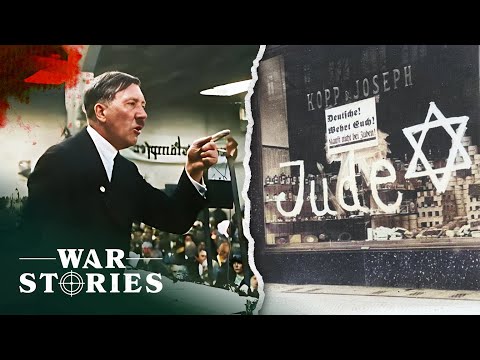
January 1933. Adolf Hitler seizes power in Germany. He arrived not as a tyrant, but as a man of peace—a leader who barely mentioned the Jews. Now, the mask begins to slip. With the chancellorship in his grasp, he can finally pursue his true agenda: ridding Germany of its old enemies. The Jew is the enemy within, and Hitler, the great leader, is now pointing the finger.
But not all Germans are cheering. Many are disturbed by the mistreatment of Jews. So Hitler must find a way to control their minds, to mold them to his way of thinking. This is the story of how Hitler and the Nazis subdued an entire people to their will and trained them to participate in the most evil regime in history.
One month after taking office, a nervous Adolf Hitler appears on the radio waves. It is his first-ever radio address to the German people. Everyone in Germany is reeling from the Great Depression. Stuttering at first, he describes the dire situation. “The misery of our people is horrible to behold,” he says. Millions are unemployed and starving. Germany faces the harshest crisis in its history. About a third of the workforce is jobless, with all the attendant malnutrition, family strife, and working conditions.
There is a clear need for some kind of radical, comprehensive solution to unemployment. Hitler won power by promising to make the economy his priority. The Nazi slogan was “Bread and Work”—basic things Germans had grown used to lacking. They promised to restore them. “The task before us is the hardest that German statesmen have faced in human memory,” he declares, closing with a plea for four years to achieve his goals. He asks for their strength, their time, their patience.
But what many Germans don’t realize is that the economy is not what truly concerns Hitler. He has long-term ambitions, omitted from his speech. Ideological obsessions dating back to his experiences in World War I and the 1920s, expressed in his writings in “Mein Kampf.” First and foremost, he wants to rid Germany of the Jews. He built the party on explicit anti-Semitism. He sees them as a malevolent world force with no national loyalty, blaming them for Germany’s crisis. “This is the great Jewish conspiracy to control the world,” he believes. “We Germans are suffering from it. It’s an international movement, but we in Germany, because of our harsh post-war conditions, are the victims. So our way forward is to get rid of the Jews.”
Within weeks of taking power, instead of addressing unemployment, Hitler targets the Jews. A national boycott of Jewish-owned shops and businesses, with Brownshirts enforcing the blockade. But it doesn’t go well. The reaction of the majority of Germans is not as expected. They continue to shop at Jewish-owned stores. The German people simply aren’t interested in the kind of anti-Semitism Hitler espouses. A report from an American diplomat in Leipzig summarizes the boycott’s impact, describing it as unpopular with the working classes and the educated middle classes. The blockade is called off after just one day.
The clear lesson for Hitler is that if he wants to win Germans to his way of thinking, he must first win their trust and do something about the economy. As a result, he doesn’t mention the Jews again for four more years. Not because he has become lenient on the Jewish question, but because he knows that politically one can gain more through a softer approach than through aggression. He remains staunchly anti-Semitic but is publicly careful not to make it a centerpiece of his program. It is for public consumption—essentially a softer approach in appearance.
Along with his propaganda expert, Joseph Goebbels, Hitler devises a new plan to win the hearts and minds of his people. They unveil a national battle for work. Funded by a billion-Reichsmark economic revival program, he plans road construction, building works, and training for unemployed youth, training them in socially desirable ways. A massive, high-profile construction campaign begins. Goebbels ensures propaganda cameras capture the Führer leading from the front. Hitler appears prominently at construction sites, turning the soil. The centerpiece is the Autobahn—the backbone of their propaganda campaign. The idea is to connect Germany with 6,000 kilometers of new, gleaming roads.
The Autobahn is a symbol of growth. It is a symbol of thinking bigger. It is a symbol of opening up to the outside. We are going somewhere and doing so physically through our road system. The promise is that ordinary Germans can travel freely and explore their nation. Germans were intensely enthusiastic, as you might say they still are today, about the idea of driving on the highway, exploring their homeland. It looked like a vision for the future. It felt like a brave new world. Crucially, these projects require huge numbers of workers. Many of these constructions required unimaginable numbers of labor. So they were actually large-scale job creation schemes. Let’s ask young people who were unemployed and inactive and harsh to be the pioneers who build the highways, build the Autobahn. And by doing so, they will contribute something very positive and valuable to Germany’s growth, in addition to earning good money for themselves.
Next, Hitler reforms the inefficient German labor market with another policy. His response is the new German Labor Front, “Deutsche Arbeitsfront.” On the surface, the Labor Front is a new form of trade union. They will work together. Wage rates, income, and profits will be collectively discussed and settlements reached that benefit everyone. It looks on the surface like labor reform, but it is actually a smoke screen allowing Hitler to attack a new target: the trade unions. Before coming to power, he always saw them as communists, an enemy he hated almost as much as the Jews. He also believes they pose a threat to the nation’s status quo, placing too much power in the hands of workers. So he abolishes the trade unions. Their leaders are arrested, their funds stolen. All other unions are banned. Employment or work becomes impossible without a membership card. It is control of the workforce from above. This was the Nazis’ determination not to allow workers to be a disruptive element in society.
A year later, Hitler’s system is going according to plan. He is seen as a man of work, selflessly dedicated to getting the nation working again. He presents a modern, exciting vision for the future. And he succeeds in leading Germany out of crisis. Unemployment is plummeting, dropping from 6 million to 4 million. But the economic program is only phase one. The next step is to bring the Nazi message into every aspect of people’s lives. Hitler realizes that if he wants to implement his own agenda, he must first capture their hearts and minds.
Hitler’s belief in achieving this is unshakable. He had great willpower. He told a friend: “You will see. We will do the impossible. We will work wonders. We will achieve miracles.” His faith in what his Nazi party can achieve is no less firm. Only the Nazi party possesses the drive, goal, understanding, and self-belief to turn this into reality. So he begins to lay out a major, bold new policy. Its name is “Volksgemeinschaft,” the people’s community. A social engineering project of epic dimensions. Its goal is simple: to make everyone believe in Nazism and accept its values.
“Volksgemeinschaft” is the concept of the distinguished people in the distinguished nation. A very powerful idea that Germany was special, and that the “Volk” (the people) defined that special quality. So the term “Volk” was used to describe the German people at their best. Discover the past with exclusive military history documentaries and free podcasts presented by world-renowned historians, all on History Hit. Watch on your smart TV or on the go with your mobile device. Download the app now to watch everything, from the thrilling story of “Band of Brothers” to Operation Barbarossa and D-Day. Immerse yourself in the dramatic stories of this remarkable era by signing up via the link in the description.
Hitler’s message is that only when the German people come together and advance as one block will the community achieve great things and find its way out of crisis. The national community that finds its divinely ordained destiny was one of Hitler’s favorite phrases. It appears in all his speeches. He repeats it endlessly, as do other top speakers like Goebbels. That emotional sense of unity, sharing a community spirit, and being united in the exciting spirit of a new era, as well as sharing sacrifices and standing together in solidarity in difficult times, is part of the community spirit that the Nazis were very effective at mobilizing and celebrating.
At the head of this community stands the “Führer,” dedicating himself tirelessly to the needs of the German people. The concept of “Volksgemeinschaft” is designed to be modern, exciting, and enjoyable. A celebration of Germany’s greatness. New national days like “Day of Solidarity” and the Führer’s birthday create a sense of an inspired national community. They bring people together in celebration. One crucial aspect of the “Volksgemeinschaft” idea is that it carries the Nazi message into all areas of German life, even to German dinner tables. For example, there was “One-Pot Sunday.” The idea was that people would not eat meat on Sundays. Traditionally, people had a roast on Sunday, but instead they donated the money saved to a public project or welfare system to help the poor, and then gatherings were held where people ate a unified soup without meat together. Sunday dinner was no longer a private family affair but part of a wider community effort for the German cause. The idea that families were not just individual units but part of a larger community, and that individuals derive their value not from their individuality but from their collective membership.
To help promote “Volksgemeinschaft,” the Nazi Party penetrates all levels of society. National Socialism seeps into all aspects of daily life. Whether in voluntary organizations or professional life, people come into contact with representatives of National Socialism. Nazism is now present at every stage of a German’s life. Young people are particularly targeted to adopt this vision. What Nazism tried to do was to become the political wing of the German people as a whole. And if you’re going to do that, you won’t necessarily convince the older generation. But what you can do is start to absorb the younger generation into your movement. So if everything you do is through the party or for it, you’ll become a good little Nazi. So the best way to do that is to not have a scout movement but a Hitler Youth movement. With rival youth organizations like the Scouts, clubs, and various Catholic and Protestant religious groups abolished in the process. They are all merged into the “Hitler Youth” for boys and young men, and the “League of German Girls” for young women.
The uniform is an essential element of feeling a collective identity. The uniform is a great way to bring people together as a group and give them that sense of belonging to a special community. These new Nazi organizations are fun. And for the first time, young people can explore their homeland and taste adventure. Even weddings are politicized Nazi-style. Newlyweds receive a copy of “Mein Kampf” on their wedding day. The party’s influence extends even to the workplace. A massive labor movement, “Strength Through Joy,” is launched to offer workers benefits like trips and holidays. “Strength Through Joy” is one of the most successful Nazi organizations in terms of propaganda, providing recreational programs for workers, helping them relax and enjoy life while indoctrinating them with the fascist spirit. They are allowed to go on holidays at 50% off the market price. Cruise ships are also built. Moreover, modern, state-of-the-art canteens are built in every factory. Even small bands tour these factories. The propaganda message is clear: the Nazi Party will take care of you and offer you a world of promises.
Germans believe this dream of new and exciting opportunities. But what they may not realize is that all of this is part of Hitler’s secret agenda. Because there is another side to the “people’s community.” Hitler’s vision clearly distinguishes between those who are inside the community and thus of pure German blood, and those who are outside it, like the Jews. It was also powerful because it drew a very clear line between those who belonged to the national community and those who did not. So it made you feel valued, and it had a scapegoat to easily blame for problems when they were not part of the national community. And that’s why Jews could not be part of the “Volk.” It was exclusive because it was “Aryan.” It was based on principles and linked to a glorious past and a glorious future.
“Volksgemeinschaft” is the first stage in a slow process of controlling the minds of Germans and making them view Jews as an underclass. Over time, Hitler and his inner circle will use this to make Germans complicit in horrific crimes. But for now, they must remain patient.
After a year in power, things look good for Adolf Hitler. He is turning the economy around, creating a new and exciting social model for Germany, and opening the country up with the Autobahn. Above all, he is getting Germans back to work. Unemployment drops by 33%. So this is something he can boast about to his supporters and say: “Look, I have achieved part of my program. Unemployment is falling.” The official narrative is that unemployment fell because of major projects like the highways. In reality, there is another force at work behind the scenes. Many of the new jobs are due to something else. Hitler is secretly preparing for war. Starting in 1933, the Nazi regime spends vast sums of money on weapons. 35 billion Reichsmarks. It dwarfs all other forms of public spending, including all job creation projects. And it fits another part of Hitler’s true agenda. In his mind, war with Russia is not just inevitable but necessary. Since the days of “Mein Kampf,” Hitler’s firm belief has been that communism poses a threat to the world. He sees it as part of an international Jewish conspiracy. And he believes that armed confrontation with Russia is inevitable. Hitler’s ambition, or his expectations if not his ambition, is that at some point there will be a war. The Soviet Union will have to be confronted militarily at some point. Our first duty is to rearm to make the nation strong by military means.
Rearmament will also allow him to achieve another ambition he set years ago. The idea of “Lebensraum,” or living space, which he believes is necessary for the growth of the German nation. “Lebensraum” is the idea of living space where Germany suffers from very high population density. There are too many people occupying too small a space, thus constraining Germany’s economic development, especially in industry but mostly in agriculture. For Hitler, territorial space will solve the nation’s economic problems and help feed its people. He believes that the land he needs can be taken from those he sees as inferior. From Poland onwards, Europe was Slavic, and the East was Slavic too. So we have the right to control it. So the extent of “Lebensraum,” the living space that Germans need, will be mainly in the East. As a superior people, they can seize land occupied by those inferior to them.
The problem facing Hitler is that any talk of waging war to gain land is horrifying to most Germans. He was elected as a man of peace who promised not to fight any wars. Memories of the horrors of World War I are still alive in people’s minds. 2.4 million of their countrymen were killed. Hundreds of thousands were wounded. This puts Hitler in a dilemma. How to convince Germans to rearm. He comes up with a justification. It’s not about preparing for war. It’s about restoring German pride. So this is a great program. It’s not suffering, German citizens. It’s progress toward our destined greatness, restoring Germany’s greatness.
Hitler says rearmament is the antidote to the humiliation of the Treaty of Versailles. The Treaty of Versailles, signed by the Allies in 1919, made Germany pay for World War I and restricted the size of its armed forces. Germany was required under the Versailles settlement to limit its weapons production and reduce its army to just 100,000 soldiers. But he calculated correctly, as it later turned out, that if he pushed hard enough, there would be no reaction. In March 1935, Hitler imposes conscription. This is a complete challenge to the Treaty of Versailles. The army swells from the permitted 100,000 to half a million men. He is allowed to get away with it, and this gives him more and more confidence. So rearmament is a great way for Hitler to push the boundaries openly. And he continues to reassure people that he doesn’t want war. He is rearming to preserve peace. In a speech on March 16, 1935, he made this promise clear. The government renews its determination before the German people and before the whole world that it will never exceed the limits of preserving German honor and the freedom of the Reich; in particular, it will never make the German national weapon an instrument of war aggression, but an instrument exclusively for defense and thus for the preservation of peace.
However, rearmament has unexpected consequences. It costs a fortune and diverts resources from the German population toward the military. Wages are low, and Germans are forced to work longer hours and harder than ever. All this dims the shine of the carefully constructed dream of a national community that meets everyone’s aspirations. Hardship in a sense can be enriching or noble; this is the Nazi orientation. Don’t view hardship as an enemy. But of course, after a certain point, if you’re asking people to sacrifice, there must be some reward at the end of the line.
Hitler tasks his propaganda minister Joseph Goebbels with monitoring public opinion. He does this by sending secret agents to eavesdrop on conversations and prepare reports. It is the only effective opinion polling available in a totalitarian state. What he learns is alarming. The periods of deprivation they are suffering are beginning to take their toll. These things are unpopular. They cause a lot of grumbling in shop queues and raise significant concern for the Nazi regime. Despite this massive effort to win hearts and minds, it is clear that popular support is fragile. Goebbels and Hitler must find another way to rally people behind the Nazis.
So they devise a plan to exploit opposition and unite Germans against a common enemy. They will blame economic hardship on the Jews. The idea of a scapegoat, an identifiable internal enemy, distracts from internal economic problems and the still-persistent unemployment. And if they are to blame for the crisis in the first place, then this is simply justice. This is not revenge. This is justice. The Jews got what they deserved.
Nuremberg, 1935. The annual Nazi Party rally, a massive propaganda spectacle held every year. Nuremberg is important. It had been the site since the 1920s onwards for the annual Nazi Party rallies. But as the rally events unfold, behind the scenes, there is a last-minute rewrite of the main rally speech. Hitler is desperate to show the party that he has something big to offer. Originally, it was supposed to be about foreign policy, but it is canceled and a new policy is drafted. Instead, this new policy is a package of anti-Semitic laws. The Nuremberg Laws are drawn up as the first major attempt to transform Germany into a racial state, which was Hitler’s ambition, and they clearly attack Jews within.
The Law for the Protection of German Blood and Honor prohibits marriage between Germans and Jews. Germans are forbidden to marry Jews and to have any sexual relations with Jews. If Germans were already married to Jews, they were encouraged and allowed to divorce Jews without any problem at all. And so Nazi racial theories were being translated into horrific reality. The Reich Citizenship Law strips Jews of their citizenship and makes them mere subjects, unlike the rest of the population. They become legal outcasts. However, this leads to unexpected complications. Germans couldn’t really define who was a Jew and who wasn’t, despite having spent years and years and years discussing this question. So new legislation was drafted to resolve this confusion and define precisely who was German and who was Jewish in the eyes of the law. It stipulated that anyone with three Jewish grandparents was by definition a Jew, and thus not entitled to full citizenship, employment rights, legal rights, or education. Being fully Jewish has dire consequences, but even Germans with only one or two Jewish grandparents, known as “Mischlinge” or “hybrids,” also fell under the law. It is the first milestone showing the impossibility of being both Jewish and German at the same time.
Faced with this sudden loss of rights, some “Mischlinge” defended themselves, while other Germans showed their support for them. Various organizations emerged after the Nuremberg racial laws were issued, mainly to defend those Jews who were “barely” Jewish, so to speak. The Association of “Mischlinge,” an organization for non-Aryan Christians, was founded. At one point, it reached 80,000 members. So there was an attempt to provide protection for Jews. It is really the first attempt in Nazi Germany by a non-Jewish organization to present itself as a protector in some way. At this stage, the Nazis tolerate this opposition. In the end, they will gradually dismantle it because Hitler’s laws are accepted by the majority of Germans. They are beginning to believe that Jews are to blame and that the purity of the German people comes before the rights of Jews.
Seven months after the Nuremberg racial laws, Hitler is making progress, but he has not yet fully captured the hearts and minds of the German population. Behind the scenes, Hitler plans a new propaganda coup to divert attention from economic difficulties at home. He plans to appeal to German national pride once again. Hitler decides to remilitarize the Rhineland, an area in western Germany that was demilitarized after World War I. The Rhineland had been a hot-button issue for Germans since 1918. It was German land occupied by the French, and after the occupation, they declared it should remain demilitarized. At first, his generals did not agree. Some of his generals warned him that it was extremely dangerous. “Mein Führer, the French will respond, and the British may join them in response.” He was furious at this and said: “I expect National Socialist troops to be in a state of attack, not defense.” He overrides them and takes a great gamble. In March 1936, he sends German troops into the Rhineland, violating the terms of the Treaty of Versailles once again. It works. The Rhineland is occupied. It happens within a few days. The French protest, but they show no resistance. The danger evaporates. It is a highly successful stroke. It makes him a hero in the eyes of his people.
Then Hitler finally reveals his true agenda: preparation for war. He declares: “The German economy must be ready for war within four years.” It begins with an open program of major projects, including permanent defensive fortifications and military showcase buildings. He also starts a program of domestic manufacturing of essential war materials. This includes rubber, oil, and textiles. The idea is that Germany will no longer need to import these vital supplies. Germany was still dependent on massive quantities of imports. The best example is oil. Germany imported 65% of its total oil needs. So he really wanted to find ways to produce synthetic oil and synthetic rubber so he could finance rearmament without having to buy massive amounts of foreign oil. Hermann Göring, Hitler’s most prominent deputy, is tasked with managing what became known as the Four-Year Plan. Göring was brought in to implement this plan, one of the few programs Hitler himself launched. As part of the plan, the Nazis not only supported synthetic raw materials for war but also for the German people. They created low-quality consumer products and foodstuffs for Germans. But inside German homes, these poor substitutes for imported goods led to more complaints and grumbling. Yet the propaganda image on the surface reflected an abundance of consumer goods. Not least the car. Hitler gives his people a new, shiny goal to look forward to. He promotes the idea of the “Volkswagen,” or people’s car. The “Strength Through Joy” car produced by a Nazi organization. Its advertisements were everywhere, and people had beautiful, brightly colored savings boxes with pictures of happy families driving through the picturesque German countryside in these new cars. It was highly inspiring and optimistic. The idea that you could own a car and choose to go wherever you want on your own decision. We take that for granted, but for Germans in the 1930s, owning a car was a major ambition. Hitler even drew the concept of the “Volkswagen” himself and commissioned car designer Ferdinand Porsche to turn it into reality.
Hitler is now in power for 3 years. Germany looks like a country on the path to progress. It is flexing its muscles on the international stage. It has become bolder and has rearmed itself. The Nazis offer people new consumer goods and a new, attractive lifestyle. But behind the scenes, the country is on the brink of an economic crisis. Recovery and rearmament required massive quantities of imports. The nation was always short of foreign currency to pay for these imported goods. The problem of paying for imports with a shortage of foreign exchange never left the Third Reich. It is a recurring nightmare. At one point, foreign currency reserves fell to critical levels, barely enough for a week’s imports. The reality of the economic situation began to cast a heavy shadow over the people. Food became expensive, and shortages of clothing and household goods appeared. Few could hope to afford the people’s car that had been promoted, or the other temptations trumpeted by the Nazi propaganda machine. By 1937, there was real fear that German workers were beginning to feel resentful due to the relative decline in their wages. They did not get what was expected, and they did not get what they were promised.
Yet one thing saved Hitler and his party. World events came to their aid. In 1937, international trade began to recover. The global economy recovered over the next twelve months. It is a global phenomenon. The economy improved in Europe, and Germany, along with other countries, began to feel the benefits of this recovery in terms of employment. That was the luck that favored Hitler and the Nazis. For Hitler’s inner circle, it was a great relief. They had passed the danger point. From the brink of collapse, it began to look as if the plan was working. Germany’s coffers began to fill again. The Third Reich could once again afford to feed its population. Most importantly, unemployment dropped to nearly zero. This allowed Hitler to appear as an economic genius. Economic recovery is linked to political strength or the idea of the leader. It is the Führer who accomplished this. Without the Führer, this recovery would not have happened. He is now that towering leader, that figure one can be proud of. The man who led Germany out of crisis.
After restoring his credibility, Hitler now believes he can take his racial policy to a new stage of persecution against his old enemy, the Jews. In 1937, Hitler mentions the Jews for the first time in 4 years. He tries out the line he will later use to justify the Holocaust: that Jews are the cause of their own misfortune. He publicly attacks Jews as the cause of Germany’s difficulties and strongly hints that Jews will face retribution for attempting to destroy the efforts of the new German movement, the new Nazi movement to improve Germany, to develop Germany, and to elevate Germany. But the Jews are conspiring to destroy that. The Jew is the enemy within, and Hitler, the great leader, is now pointing the finger.
In 1938, two main state bodies become involved in racial legislation. Now the Secret Police and the Gestapo are unleashed against the Jews. Jews are subjected to verbal abuse. They made it clear that they were anti-Semitic and that they sought to harm them. So there is a state of intimidation in the air. They made it clear that they were targeted people. That is the Gestapo technique of intimidation. So the security service is actually doing intelligence work. And the Gestapo does the work of intimidation and spreading panic. Faced with this pressure, more than 250,000 German Jews leave the country. Their property and wealth are often confiscated and used to fund the Nazi Party budget. But half of Germany’s Jews stay. To exert more pressure, persecution goes a step further. Jewish businesses are “Aryanized.” The decree on the registration of Jewish property excludes Jews further from economic life. They are forbidden to own businesses. They are forced to sell them to “Aryan” Germans at bargain prices.
Then Goebbels plans a new course of action that takes all this even further. His idea is to establish a national day of violence against Jews. It will become known as “Kristallnacht” in the Reich. He even has the perfect justification. The shooting of a German diplomat, Ernst vom Rath, provided a welcome pretext for the Nazi state to unleash a wave of anti-Semitic violence in German cities. It was premeditated. All they wanted was a pretext. And the assassination was the pretext. There is a flood of violence. Nazis attack Jewish property and businesses. Homes are looted. Synagogues are smashed. The term “Kristallnacht” comes from the sound and sight of shattering glass. Mobs incited by the SS destroyed German shops and smashed glass fronts and windows and attacked, brutalized, and beat Jews. The Night of Broken Glass was the natural outcome of a political party and regime that preached violent anti-Semitism. 1,000 synagogues are burned. 7,000 businesses are destroyed. 91 Jews are killed. 30,000 are sent to concentration camps. Finally, Goebbels’ propaganda promotes the idea that the Jews brought it all on themselves. The Jews are blamed for Kristallnacht, and it is said that the people rose up in their anger against the Jews and attacked them. That is how Goebbels framed it in his propaganda. It was a popular movement, a mass movement. We know, of course, that it happened the other way around.
By the end of 1938, from the Nazis’ point of view, their policies have been successful. Hitler has won the hearts and minds of the people and made them adopt his way of thinking. For the first time, Germans realize the true meaning of Hitler’s anti-Semitism, and they begin to embrace it. Perhaps the most alarming feature of that November night is the voluntary participation of many ordinary civilians in the violence. It was a public demonstration of the brutality and hatred the Nazis harbored for the Jewish population. And a horrifying warning of worse to come. Finally, Hitler has gained control of the German people exactly as he wanted. So there is a sense that this is a new dawn, a new era offering exciting opportunities for many people happy to go along with the violence that accompanies it all. Germany has been rearmed. Hitler’s enemies, like the Jews, can be persecuted with minimal resistance. And now he is ready for war.
By 1939, the transformation is complete. The boy who once played in the streets of Braunau now commands the loyalty of millions. “The German people have found their Führer,” Goebbels writes in his diary, “and the Führer has found his people.” The machinery of propaganda, the promise of prosperity, and the careful cultivation of hatred have done their work. Ordinary citizens—teachers, shopkeepers, factory workers—now look away as their Jewish neighbors are beaten in the streets. Some even join in.
Hitler stands at the podium in the Reichstag, his voice rising with practiced fury. “If international finance Jewry should succeed in plunging the nations once more into a world war,” he thunders, “the result will not be the Bolshevization of the earth, but the annihilation of the Jewish race in Europe.” The audience erupts. They believe him. They cheer.
The path to the abyss is no longer a secret. It is a promise, spoken aloud, embraced by a nation that has traded its soul for bread and circuses. The world watches, uncertain and afraid. And somewhere in the crowd, a young soldier named Franz listens, his heart swelling with pride—unaware that the man he adores will soon send him to die in the snows of Stalingrad.
What would you have done, standing in that crowd, when everyone around you was cheering?






