In the popular imagination of World War II, the spotlight rarely falls on Australia. Hollywood gives us the American industrial giant, the Soviet steamroller, and the British bulldog—but the story of a small nation of fewer than seven million people who stood at the gates of hell and refused to let the Axis pass is often relegated to a footnote. This is not just a historical oversight; it is a profound misunderstanding of how the tide of the global conflict was actually turned.
From the scorching deserts of North Africa to the fetid jungles of Papua New Guinea, Australian soldiers delivered a series of strategic firsts that stunned the world. They were the first to halt the Nazi Blitzkrieg on land at Tobruk, and the first to shatter the myth of Japanese invincibility in the mud of Milne Bay. These were not minor skirmishes—they were pivotal hinges upon which the fate of the war swung.
In April 1941, the world watched in terror as General Erwin Rommel’s Afrika Korps seemed unstoppable. The Desert Fox had crushed Poland, France, and the Low Countries with lightning war, and now he set his sights on the strategic port of Tobruk. He expected a quick victory. Instead, he found a wall of Australian grit.
The defense fell to the Australian 9th Division under Major General Leslie Morshead, a man who refused to be intimidated by German tanks. “Let the Panzers pass through the initial lines,” he instructed his men. “We’ll deal with them with anti-tank guns and the 25-pounders, while the infantry stays concealed and slaughters the following German infantry.” It was the bushman’s approach to war—stoic, aggressive, and unpredictable.
Under cover of darkness, Australian patrols slipped into no-man’s land, harassing outposts, stealing equipment, and capturing prisoners. They turned the hunter into the hunted. Rommel, frustrated, complained his elite troops were being held back by “savages.” German propaganda branded the defenders “rats of Tobruk,” but the Australians embraced the title with fierce pride. They crafted unofficial medals from scrap metal and called themselves the Rats. They weren’t trapped—they were holding the door shut on the Third Reich.
For 242 days, the Rats endured blistering heat, sandstorms, thirst, and constant Stuka attacks. They became the first Allied force to successfully stand their ground against a sustained Blitzkrieg offensive on land. By the time they were relieved, they had shattered the myth of German invincibility and given the British Empire its first glimmer of hope.
But Tobruk was only the beginning. By August 1942, the Japanese Imperial Army was viewed as an unstoppable phantom of the jungle. They had never been defeated in a major land engagement. When their elite Special Naval Landing Forces stormed the beaches of Milne Bay, they expected another swift victory.
What they found was a meticulously prepared trap. Under Major General Cyril Clowes, nearly 9,000 Australians—veterans and raw militia alike—stood their ground in a sodden, swampy rainforest where mud swallowed boots and rain fell in torrents. The Japanese launched their trademark night attacks, screaming through the darkness, but the Australians held. They mowed down the attackers with Bren guns and 25-pounders while RAAF Kittyhawks strafed at treetop level.
For the first time, the Japanese were outmaneuvered in the mud. By early September, the elite Japanese Marines were forced to retreat—something they had never done before. Field Marshal Sir William Slim later noted, “It was Australian soldiers who first broke the spell of the invincibility of the Japanese Army.”
The victory at Milne Bay was a seismic event. It proved the Japanese were not supermen and provided the blueprint for the rest of the Pacific War. But the war was about to reach Australia’s own shores.
On the morning of February 19th, 1942, the illusion of geographic isolation was shattered forever. The war didn’t just arrive—it screamed out of the tropical sky in a terrifying display of aerial might. This was the bombing of Darwin, the largest single attack ever mounted by a foreign power on Australian soil.
The strike force was led by Commander Mitsuo Fuchida, the same man who had led the attack on Pearl Harbor just ten weeks earlier. Four aircraft carriers and nearly 200 planes aimed to destroy Darwin’s port facilities. At 9:58 a.m., residents looked up to see a dark cloud of bombers and Zeros. They had no radar, no effective air defense, and almost no warning.
The devastation was instantaneous. The harbor became a cauldron of fire. The USS Peary was hit and sunk, taking 88 sailors to the bottom. Japanese Zeros strafed the streets and the airfield. By the time a second wave finished its work, the town was a smoking ruin. The official death toll was 243, though many believe it was much higher.
For the Australian public, Darwin was a profound psychological trauma—the nation’s Pearl Harbor. Rumors of invasion spread like wildfire, and the Brisbane Line controversy suggested abandoning the north to defend the south. But the government’s reaction was the opposite: the attack galvanized the nation. Darwin was not an isolated incident—it was the first of at least 97 air raids against northern Australia. The country shifted to a total war footing, and the vast empty north was rapidly militarized.
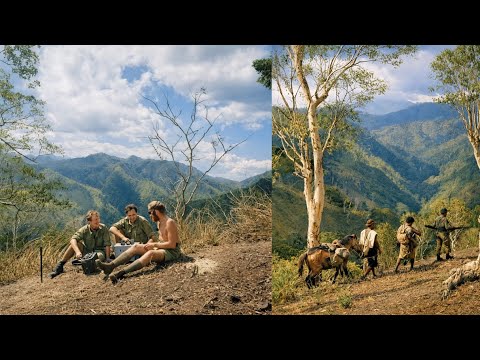
If Milne Bay broke the spell of Japanese invincibility, the Kokoda Track became the crucible of the Australian soul. Stretching 96 km across some of the most treacherous terrain on Earth, this narrow ribbon of mud crested the jagged spine of the Owen Stanley Range—the only overland route to Port Moresby. If captured, the Japanese would have a direct springboard to invade northern Australia.
The defense fell to the “chocolate soldiers,” young militia men derided as troops who would melt under fire. Facing them were 10,000 battle-hardened veterans of the South Seas Detachment. The environment was as lethal as the enemy: razor-sharp ridges, waist-deep swamps, and malaria. At Isurava, outnumbered and outgunned, they fought a fighting withdrawal, turning every ridge into a fortress.
They relied on the Fuzzy Wuzzy Angels, local Papuan carriers who performed miraculous feats of endurance, carrying supplies up and wounded men down with legendary tenderness. “They moved with a rhythmic, steady pace to ensure the wounded felt as little pain as possible,” one digger recalled. When a soldier was too weak to walk, his mates carried his pack. When he was too discouraged to continue, they hauled him to his feet.
By the time the 7th Division veterans arrived, the Japanese momentum was shattered. Exhausted and starving, they were ordered to retreat—the first time a Japanese land advance in the Pacific was reversed through sheer doggedness. Kokoda was a victory won not by superior technology, but by the extraordinary endurance of ordinary men. They didn’t just save Port Moresby—they saved Australia.
What do you think was the most pivotal moment of Australia’s war? Share your thoughts below.






