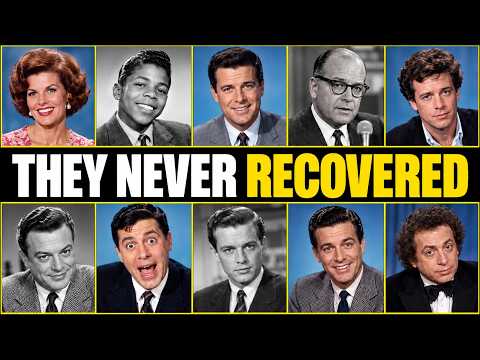
In the golden age of live television, there was no delete button. No second take. No safety net. Every mistake, every misstep, every moment of unchecked ego was broadcast directly into millions of living rooms—and for a handful of stars, it was the last thing America ever saw them do.
What follows is not a collection of minor gaffes. These are the moments when a career ended in real time, with the whole country watching.
Arthur Godfrey was the most powerful man on CBS, a red-headed ukulele-strumming giant who sold everything from tea to cigarettes with a lazy drawl. He called his performers “the little Godfreys,” and he meant the possessive part sincerely. On October 19, 1953, he introduced a young tenor named Julius LaRosa, let him sing, and then told the audience it was the kid’s swan song. Nobody had told LaRosa. He learned he was fired at the same second the country did.
Godfrey explained that the young man had “lost his humility.” Within days, he fired his own bandleader for the crime of owning the label LaRosa recorded for. Comedians built routines around the phrase. The audience that had treated him like a relative quietly stopped tuning in.
But Godfrey’s story had one more turn—and it was darker than anyone expected.
In 1959, Godfrey was diagnosed with lung cancer and had a lung removed. The man who had spent a decade selling Chesterfields in that friendly drawl spent the rest of his life campaigning against cigarettes. He tried television again, but a daytime series went nowhere, and guest spots grew thinner. He lived long enough to watch Carson and Sullivan occupy the position he had held first, and to be introduced to younger audiences as a man who used to be enormous.
Godfrey died in 1983 at 79, decades removed from the medium he once practically owned. Almost none of that early live output was recorded, so the man who taught American business how to sell on camera left behind mostly the memory of the 90 seconds in which he wrecked himself.
Jerry Lester built late night television, then walked out over a blonde named Dagmar. NBC kept her, canceled his show, and never brought him back. He died in 1995, a footnote to Johnny Carson’s job.
Jackie Mason lost 22 years after a gesture Ed Sullivan misread. A judge cleared him, but the industry didn’t care. He was 55 before Broadway gave him back what Sullivan took.
Hal March, the face of the quiz show boom, knew nothing of the rigging. It didn’t matter. He died at 49, remembered for a contest he didn’t fix.
Charles Van Doren admitted the answers were given to him. NBC fired him the same day. He never appeared on American television again—not once in 60 years.
Jerry Lewis’s 13-week live variety show was the most expensive humiliation of its time. He insisted on live, on two hours, on no safety net. It ended him as a television performer.
Alan Freed named rock and roll, refused to sign a dishonest payola statement, and died at 43, broke and blacklisted.
Charles Rocket said one word on live TV and ended the version of his career that was about to happen. He worked steadily afterward, but never again as the next big comedy star.
Dave Garroway invented the morning show, then shot himself in 1982. Today still runs every morning, and almost nothing from his nine years was kept.
Jack Barry was blacklisted for 13 years after the quiz show scandal. He rebuilt in 1972, but his name is still attached to the fraud more than to any of his honest hits.
Frankie Lymon danced with a white girl on live TV in 1957. The South erupted, the show was canceled, and his career ended. He was dead of an overdose at 25.
Anita Bryant won her 1977 campaign, then lost everything. A pie to the face, a national boycott, and by 40 she was unemployable in entertainment. The commercials still air. Almost nobody under 60 knows her name.
Twelve stars. Twelve live moments. One unforgiving medium. Which of these downfalls do you think was the most tragic—and which was entirely self-inflicted?






