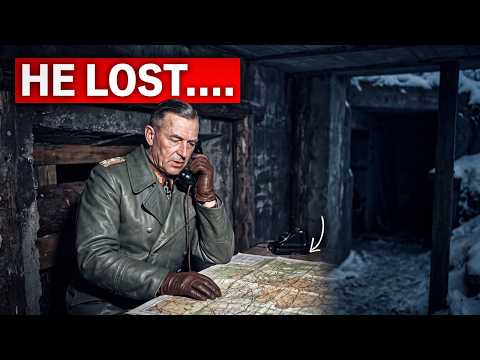
On Christmas Eve 1944, General Hasso von Manteuffel, commander of the Fifth Panzer Army, made a call that would haunt him for the rest of his life. His panzers had smashed through the American line, captured thousands, and driven deeper into Allied territory than any German force since 1940. His lead division was just 5 kilometers from the Meuse River—the ultimate objective. Yet he called Hitler’s headquarters and recommended halting the offensive. His reason was not a lack of men or tanks. It was time. “The time his Fifth Army had lost at a small Belgian crossroads town called St. Vith.” That word—time—is the key to everything that follows.
Manteuffel was no ordinary general. A Prussian aristocrat, a decorated panzer commander from North Africa to the Eastern Front, he had personally persuaded Hitler to alter the tactical plan. But he was beaten not by an American army that stood and fought, but by one that moved—that fell back, village by village, ridge by ridge, in a series of fighting retreats so deliberate, so stubborn, and so costly in hours that by the time his panzers rolled through each abandoned position, the clock had already killed his plan. The Americans lost nearly every position they held, and in losing those positions, they won the battle. Manteuffel later called it “the war of the small men”—the company commanders, sergeants, and junior officers who held crossroads, blew bridges, and fought rear guard actions across the frozen hills, upsetting the entire German timetable.
Across the Fifth Panzer Army’s front, German after-action reports recorded the same phenomenon with bewilderment. A position would be taken, often at significant cost, and the Germans would move forward expecting open road. Instead, they found the road cratered, the next bridge demolished, and the same Americans—sometimes reinforced by stragglers from shattered units—dug in at the next defensible point, firing again. The Americans were not holding ground. They were selling it at a price measured in hours, and every hour cost the German offensive something it could never buy back.
The German plan was built on a timetable. St. Vith was supposed to fall by December 17th. Bastogne by the end of the first or second day. The Meuse within four days. Every objective had a deadline, and every deadline was a link in a chain. If one link held too long, the entire chain stretched—and what stretched was not just the schedule but the fuel supply, the ammunition reserve, and the narrow window of bad weather that kept Allied aircraft on the ground. The German plan needed speed the way a human body needs oxygen, and the Americans had found the one weapon that could suffocate it: retreat conducted the right way. It was not a sign of defeat. It was a form of attack, and the German doctrine of rapid armored exploitation had no answer for it.
But to understand why the Americans could fight this way, and why the Germans could not stop it, you need to understand the man whose army ran into it—and the plan he had staked everything on. Hasso von Manteuffel was born in 1897 in Potsdam, the garrison city of the Prussian military aristocracy. His granduncle was a field marshal. The army was not a career choice; it was an inheritance. He served in World War I as a cavalryman, was wounded by shrapnel, and between the wars became an instructor at the Panzer Troop School in Berlin. Standing just 5 feet 2 inches, wiry and slight, he was called “the little general” by his men—but his enemies learned that his size had no relationship to his capacity for violence. On the Eastern Front, he earned the Knight’s Cross, and by autumn 1944 he was one of only 27 men in the entire German military to hold the Knight’s Cross with oak leaves, swords, and diamonds. Hitler admired him—unusual for a man who despised most of his generals—and promoted him directly from division to army command.
Before the offensive, Manteuffel tried to change the plan. He and Field Marshal Walter Model believed Hitler’s grand objective—driving all the way to Antwerp—was beyond Germany’s strength. They proposed a smaller operation, a pinching attack against the American salient at Aachen. Hitler rejected it outright. He wanted a war-changing blow, and he was willing to gamble Germany’s last strategic reserve to get it. Manteuffel accepted the decision because in the German system, the Führer’s word was final. But he fought for every tactical detail he could win. In a personal meeting with Hitler, he argued for infantry to infiltrate American positions in darkness before the artillery barrage, for searchlights bounced off low clouds to create “artificial moonlight,” and for a short, sharp bombardment instead of a massive preparation. Hitler agreed to all three—a rare concession. But even Manteuffel’s tactical skill could not fix the fundamental problem: the offensive needed to move fast, and he had laid out three conditions for success. The first was surprise. The second was bad weather to ground the Allied air forces. The third was rapid, undelayed progress through and beyond St. Vith. The first two were met on the morning of December 16th. The third was not.
And the reason it was not met leads to a man whose name Manteuffel did not yet know—a man standing in a classroom at the United States Army’s Armor School years earlier, learning principles that would one day stop a Panzer army in its tracks. Remember his name: Brigadier General Bruce C. Clarke. He will return.
Before Clarke enters the story, you need to understand what the Americans were doing that the Germans could not stop—and why they could do it. Because the fighting retreat that wrecked Manteuffel’s timetable was not an accident. It was a specific, trainable, repeatable form of warfare that the United States Army had built into its doctrine before the first American soldier ever set foot in the Ardennes. The concept had a name. The Army called it delay. In its field manuals, the American Army described delay as a defensive operation in which a force trades space for time. The word trades is important. A trade implies a transaction. Something is given and something is received. What the delaying force gives is ground. What it receives is hours. And those hours, accumulated across dozens of positions, hundreds of crossroads, and thousands of small decisions made by sergeants and lieutenants in the freezing dark, add up to something no Panzer division can fight. They add up to a schedule that no longer works.
The American Army trained for this at every level. A rifle company learned how to occupy a position, engage the enemy long enough to force him to deploy from march column into assault formation, and then withdraw to the next position before the assault could close. An engineer platoon learned how to blow a bridge at the last possible second. An artillery battery learned how to register fire on a road junction, deliver a concentration that stopped movement for 10 or 15 minutes, and then shift to the next junction. None of these actions, taken alone, would stop an armored division. But taken together, repeated across a front of 20 or 30 miles, executed by hundreds of small units acting on their own initiative because the chain of command above them had been shattered, they created cumulative friction that was devastating to any plan built on speed.
The German army understood delay in theory, but German doctrine treated it as a temporary necessity—a brief pause before the counterattack restored the line. The idea of deliberately giving ground, of planning to lose position after position as part of a coherent strategy, ran against every instinct the Wehrmacht had drilled into its officers. German training emphasized holding ground. A German officer who gave up a position without orders risked court-martial. The concept of Auftragstaktik—mission-type tactics—gave German officers freedom in how they achieved an objective, but the objective itself was almost always to hold or to take, not to retreat, not to trade, not to lose on purpose. And so, when the Fifth Panzer Army’s divisions rolled forward on December 16th and began encountering Americans who fought hard, fell back, fought again, and kept falling back in a pattern that never quite became a rout and never quite became a stand, the German commanders had no template for what they were seeing. They were watching an army that had been trained to lose ground in a way that made losing ground a weapon.
And the first Americans to use that weapon against Manteuffel were the men of the 28th Infantry Division—the Bloody Bucket. Major General Norman Cota’s division was, on December 16th, one of the most battered in the American army. It had been nearly destroyed in the Hürtgen Forest in November and had been sent to the Ardennes to rest and absorb replacements. Its three infantry regiments were spread across a front of roughly 25 miles along the Our River and the ridgeline the Americans called Skyline Drive. On a quiet front, 25 miles was manageable. On December 16th, it was a death sentence. The German 47th Panzer Corps, commanded by General Heinrich von Lüttwitz, struck the 28th Division with 27,000 men and over 200 armored vehicles. The corps included the 2nd Panzer Division, the 26th Volksgrenadier Division, and the Panzer Lehr Division—three of the most capable formations in the German army. Their objective was to cross the Our River, break through the 28th Division, seize the road junction at Bastogne, and race for the Meuse. Lüttwitz expected to reach the Meuse in six days. He would never reach it at all.
Standing directly in the path of the 47th Panzer Corps was Colonel Hurley Fuller’s 110th Infantry Regiment. Fuller had roughly 5,000 men defending a string of village strongpoints along Skyline Drive, including the towns of Marnach, Hosingen, and Clervaux. Against him came the full weight of the 2nd Panzer Division, pushing for the bridges at Dasburg and the road to Bastogne beyond. What Fuller’s regiment did over the next three days is one of the great delaying actions in American military history. The village strongpoints did not hold permanently. They were never meant to. Marnach was overrun on the 16th and 17th. Hosingen held until the 18th. Clervaux, where Fuller had his command post in the town castle, became a miniature siege. Fuller’s men fought room by room through the town while German tanks pushed through the streets. Fuller himself escaped through a window of his overrun command post and down a ladder in the darkness before being captured on December 18th. But here is what mattered. Every hour that Fuller’s men held a village was an hour that German tanks were not rolling toward Bastogne, and the hours accumulated in a way the German planners had not anticipated.
The heavy bridges needed to carry 60-ton tanks across the Our River at Dasburg and Gemünd took far longer to build than the German engineers had planned. Construction that was supposed to be finished by noon dragged on until nightfall. The problem was not German incompetence. The problem was that American engineers had prepared demolitions on the existing bridges and blown them precisely on schedule. American artillery had registered the crossing sites and dropped shells on the German bridge builders at intervals throughout the day, forcing them to take cover, restart, and take cover again. And the narrow forest roads leading to the river—roads that could handle a single column of vehicles in one direction—became choked with German armor, infantry, and supply convoys all trying to reach the same crossing points at the same time. Traffic backed up for miles. Vehicles that should have been at the front by noon were still sitting on forest roads at midnight.
Fuller’s 110th Infantry was not the only regiment of the 28th Division that cost Manteuffel time. To the north, Colonel Gustin Nelson’s 112th Infantry held positions along the Our River and denied the Germans the bridges at Ürdingen for two critical days. The 112th fought with its back to the river, counterattacked repeatedly to retake lost positions, and withdrew only when ordered to by division headquarters. To the south, the 109th Infantry, commanded by Lieutenant Colonel James Rudder—the same officer who had led the Ranger assault on Pointe du Hoc on D-Day—conducted a series of delaying ambushes that traded one ridgeline after another for hours the Germans could not spare. Three regiments, three different sectors, the same result. Ground lost, time stolen. The first day’s plan had been built on the assumption of minimal delay at the river crossings. The actual delay was double what the plan allowed, and every additional hour of delay at the Our meant one fewer hour of daylight for the Panzers to exploit on the roads beyond.
By December 19th, the 28th Division had effectively ceased to exist as a fighting force. Of the 110th Infantry’s roughly 5,000 men, only 532 were still fit for duty. Colonel Fuller was a prisoner. The division’s line was gone. But General Lüttwitz was three days behind schedule, and those three days changed everything. Because the road to Bastogne, which Lüttwitz’s Panzers were supposed to have cleared by the end of the second day, was now being blocked by something that had not been there 72 hours earlier. The 101st Airborne Division, rushed forward from its rest camp in France, had reached Bastogne on the night of December 18th. The race was lost, and the men who lost it for the Germans were not only the infantrymen of the Bloody Bucket. They included another set of small units whose delaying actions in front of Bastogne have been largely forgotten in the shadow of the siege that followed.
On December 18th, as the 101st Airborne was racing toward Bastogne in open trucks, Colonel William Roberts of Combat Command B, 10th Armored Division, arrived in Bastogne ahead of them. Roberts had three small task forces, each built around a company of tanks and a company of armored infantry. He sent them east on three separate roads to delay the German advance long enough for the paratroopers to arrive and dig in. Team Desobry, commanded by Major William Desobry, was sent to the village of Noville, five miles northeast of Bastogne. Team Cherry, under Lieutenant Colonel Henry Cherry, went to Longvilly on the eastern road. Team O’Hara, under Lieutenant Colonel James O’Hara, covered the southeastern approach at Wardin. None of these teams was large enough to stop a Panzer division. That was not their job. Their job was to slow one down, and they did.
At Noville, Team Desobry ran head-on into the 2nd Panzer Division on the morning of December 19th. In the fog and confusion of a meeting engagement, Desobry’s tanks and infantry fought the German advance to a standstill for an entire day, knocking out numerous German tanks and forcing the 2nd Panzer to deploy its full strength against what amounted to a company-sized roadblock. Desobry himself was severely wounded later that day when an artillery shell struck his command post during a conference with officers of the 506th Parachute Infantry—the same blast that killed Lieutenant Colonel James LaPrade. His team held Noville until the afternoon of December 20th, when the survivors, now reinforced by a battalion of the 506th Parachute Infantry, withdrew into the Bastogne perimeter. Team Cherry at Longvilly was overwhelmed and largely destroyed, but its resistance added hours. Team O’Hara at Wardin held its position and fell back into the perimeter. Further south, roadblocks set by the 9th Armored Division’s CCR—Task Force Rose at Lullange and Task Force Harper at Allerborn—absorbed the shock of the German advance and were destroyed. But destroyed is not the same as useless. Every roadblock that the Germans had to stop for, deploy against, and eliminate was a roadblock that consumed minutes and hours that the German timetable did not contain.
By December 22nd, Bastogne was surrounded. General Lüttwitz sent a surrender ultimatum to the acting commander of the 101st Airborne, Brigadier General Anthony McAuliffe. McAuliffe’s reply became the most famous single word in the history of the Battle of the Bulge. He said, “Nuts.” Bastogne would never fall. And it would never fall because the small units that fought and died in front of it—the teams and the task forces and the roadblocks—had bought the hours that made its defense possible. General Troy Middleton, the corps commander responsible for the Ardennes sector, said after the war that the 110th Infantry of the 28th Division did a splendid job. It put up very stiff resistance for three days. Had this regiment not put up the fight it did, the Germans would have been in Bastogne long before the 101st Airborne reached that town. That sentence, spoken by a man who had watched the 28th Division dissolve, is the clearest summary of what Manteuffel’s army ran into. An American regiment that was destroyed and won anyway.
But Skyline Drive was only the southern arm of Manteuffel’s advance. Forty miles to the north, the road through St. Vith was supposed to deliver the knockout blow. And it was there, at that small crossroads town in the Belgian hills, that the fighting retreat reached its purest and most devastating form. This is where Brigadier General Bruce Clarke enters the story. And this is where the German timetable died.
Clarke’s mobile defense at St. Vith held for four days beyond the German timetable, and when he finally withdrew across the Salm River on December 23rd, he left behind a German army that had lost its most precious commodity: time. Manteuffel’s telephone call on Christmas Eve was an admission that the war of the small men had worked. “The Americans denied me the one thing the plan could not survive without,” he later said. “They denied me time.”
After the war, Manteuffel told Bruce Clarke at a reunion that the mobile defense had made him believe he faced a corps instead of a thin force of units. That illusion—created by retreating and striking back from unexpected directions—multiplied Clarke’s strength. “By retiring a kilometer or so a day, I was winning,” Clarke explained. “And the Germans, by being prevented from advancing many kilometers a day, were losing.”
The Battle of the Bulge was won not by holding ground, but by trading it for hours. The small men—the sergeants, lieutenants, and engineers—understood that retreat could be a weapon. They sold ground at a price the German army could not afford, and in doing so, they saved the world.
If this story reached you, a like helps it find others who care about this history. And if someone in your family served in the Battle of the Bulge, tell me about them in the comments—because these were the small men whose hours saved the world. How will you remember their sacrifice?






