On a foggy February morning in 1951, Alfried Krupp, heir to the Krupp steel and armaments empire, walked out of Landsberg Prison after serving just six years of a twelve-year sentence for using slave labor and plundering occupied economies. Reporters asked about the future. “I hope it will never be necessary to produce arms again,” he said. Within years, he was running a profitable industrial company again, his fortune restored.
How did convicted war criminals walk free so soon after World War II? The answer lies in a shifting political landscape, where Cold War fears and German pressure converged to empty the prisons.
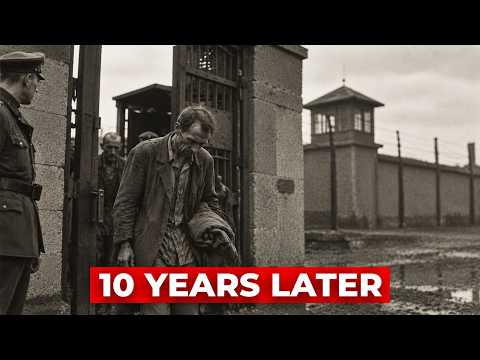
At the end of September 1956, Karl Dönitz, the man Hitler had named as his successor, left Spandau Prison in West Berlin after serving every day of his ten-year sentence. But others were less patient. A field marshal sentenced to death was already living at home. An industrialist convicted over slave labor was back in charge of his fortune. And SS men who had commanded killing squads had been free for years.
The first big door opened on January 31, 1951, at Landsberg Prison in Bavaria. That day, American High Commissioner John McCloy announced his decisions on 89 convicted war criminals. He upheld only five of 15 death sentences, cut the sentences of 79 men, and, counting time served and good behavior, 32 of them could walk out almost at once.
Landsberg already had a dark history. In 1924, Adolf Hitler spent 264 days there after his failed coup, dictating Mein Kampf. After the war, the US Army turned it into War Criminal Prison No. 1, where 252 condemned war criminals were hanged. By January 1951, the same building started letting convicted men go.
One of those freed was Alfred Krupp. In 1948, an American tribunal had convicted him of using slave labor and plundering occupied countries, sentencing him to 12 years and confiscation of all property. McCloy reduced the sentence to time served and gave Krupp his property back. On a foggy February morning in 1951, after six years in prison, Krupp walked out to a champagne breakfast. When reporters asked about the future, he said he hoped it would never be necessary to produce arms again.
But the money came back fast. In March 1953, Krupp took over management of the company again. According to Time magazine, he received $2.6 million from Allied sales of Krupp properties and borrowed more than $17 million from commercial banks. By 1954, the firm was profitable again, and by 1955, around $40 million had been poured into rebuilding its plants. A man convicted over forced labor in 1948 was running a profitable industrial company six years later.
The Allies did attach one condition: under a 1953 agreement, Krupp was supposed to sell off his coal and steel operations by 1959. They were never sold. In 1960, they were merged with another company instead.
McCloy had been under heavy pressure. For months, Chancellor Konrad Adenauer had been pressing him to clear the death sentences and show clemency to men convicted at the later Nuremberg trials. So had West German political parties, organizations of former Wehrmacht soldiers, and the German Evangelical Church. Requests piled up on the Chancellor’s desk, and he passed the pressure straight onto the Americans.
Among the files McCloy reviewed that winter were the men from the Einsatzgruppen trial, the commanders of SS units that had shot civilians behind the Eastern Front. Their story is the hardest one, and we’ll get to it. The reason all that pressure suddenly started working lay on the other side of the world.
In June 1950, war broke out in Korea, and Washington started to look at Europe very differently. If a communist army could cross a border in Asia, a Soviet one could cross a border in Europe, and the Western allies had nothing like enough troops on the ground to stop it. The obvious untapped source of trained soldiers on the continent was sitting in West Germany. Five years after the Wehrmacht surrendered, the Americans began to talk seriously about German soldiers again.
In October 1950, a group of former Wehrmacht generals and admirals met in secret at Himmerod Abbey, a Cistercian monastery in the Eifel Hills, invited by Adenauer’s government. Their task was to sketch out what a new West German force might look like inside a Western defense alliance. Over five days, they produced a 40-page document now known as the Himmerod Memorandum. Most of it dealt with divisions, command structures, and equipment. But it also set conditions. All German soldiers convicted as war criminals were to be released. The so-called defamation of the German soldier, including the men of the Waffen SS, had to stop. And steps had to be taken to change public opinion about German soldiers, both at home and abroad.
The men who had helped design Germany’s new army were setting the West its price before a single recruit had signed up. That price was paid in pieces. In January 1951, the same month McCloy announced his decisions at Landsberg, General Dwight Eisenhower joined other American officers in a public declaration that there was a real difference between the German soldier and Hitler and his criminal group. Eisenhower had led the armies that defeated the Wehrmacht. Now he was drawing the very line the Himmerod generals had asked for, separating the regular army from the war crimes.
The deal worked on its own terms. Five years later, in 1955, West Germany joined NATO. On November 12, 1955, the first soldiers of a new West German army, the Bundeswehr, were sworn in. Among them were Adolf Heusinger and Hans Speidel, two men who had been generals in the Wehrmacht. Ten years after Germany’s surrender, its former generals were back in uniform, this time on the Western side. But in 1951, that army still existed only on paper, and the pressure on the prisons was only getting started.
From there, the pressure moved from paper to people. Every remaining prisoner in Allied custody became a political issue in West Germany. Veterans associations, churches, and politicians kept pushing for their release, and the Western powers who now needed German goodwill and German soldiers had less and less appetite to resist.
The clearest sign of how far things had moved came in the cases of the two most famous field marshals the Allies were holding. The first was Albert Kesselring, who had commanded German forces in Italy. After the war, he was tried and convicted of ordering the murder of 335 Italian civilians in the Ardeatine massacre and of inciting his troops to kill civilians in reprisals against the Italian resistance. He was sentenced to death. The death sentence was commuted to life imprisonment. Then a political and media campaign for his release got underway, and in 1952, Kesselring walked free officially on grounds of health.
He did not disappear quietly. In 1953, he published his memoirs under the title A Soldier to the Last Day. He accepted the honorary presidency of three veterans organizations: the Association of Luftwaffe Veterans, the Veterans Association of the Africa Corps, and most controversially the right-wing Stahlhelm. A man who had been sentenced to death over the killing of civilians became the figurehead of German veterans groups within a few years. And for someone released because of his health, he lived on for about eight more years, until July 1960.
In Italy, his release landed very differently. After Kesselring reportedly said the Italians ought to build him a monument, the jurist Piero Calamandrei answered him on December 4, 1952, with a poem written as an inscription in stone. Its opening speaks to Kesselring directly. “You will have it, comrade Kesselring, the monument you demand from us Italians.” That inscription was later set on memorial plaques in towns across Italy.
The second was Erich von Manstein, one of the most famous German commanders of the war. In 1949, a military court in Hamburg tried him for war crimes. It convicted him on nine of seventeen charges, including the mistreatment of prisoners of war and failing to protect civilians, and sentenced him to eighteen years. The sentence was cut to twelve. Then, on May 7, 1953, after fewer than four years behind bars, he was released. The official reason was a recurrence of eye problems, but his release had also been pushed by a remarkable group of supporters, among them Winston Churchill, Konrad Adenauer, and the British military historian Basil Liddell Hart.
Once he was out, Manstein went straight back to the business of soldiering. In the mid-1950s, he served as a military adviser to the West German government while it rebuilt its armed forces. In 1955, he published his memoir, Lost Victories. It was sharply critical of Hitler’s leadership, but it dealt almost entirely with military questions and left the political and moral side of the war largely untouched.
There was one part of his life that release could not touch. Manstein’s son, Gero, a lieutenant, had been killed in battle on October 29, 1942. Manstein later described it as the worst thing that happened to him personally during the war. He came home in 1953 to a family that had already been missing a son for more than ten years. His wife, Jutta, whom he had married in 1920, lived to see him free and died in 1966.
Because the Americans were about to free a man their own court had sentenced to death for the killing of American prisoners. On December 17, 1944, in the opening days of the Battle of the Bulge, 84 American prisoners of war were killed at the Baugnez crossroads, near the Belgian town of Malmedy. The men who did it belonged to a Waffen-SS battle group led by Joachim Peiper.
The Americans did not forget Malmedy. From May to July 1946, an American military court at Dachau tried 74 Waffen-SS officers and soldiers in what became known as the Malmedy massacre trial. On July 16, 1946, it sentenced 43 of them to death by hanging, Peiper among them. Then the case began to come apart.
Several defendants, Peiper among them, complained that they had been mistreated. Their defense counsel, Colonel Everett, accused the American prosecutors of keeping the prisoners in dark solitary confinement on near-starvation rations, and of beatings and other torture to get confessions. In March 1949, the United States Senate set up a subcommittee to investigate, and Senator Joseph McCarthy pushed the case aggressively. The subcommittee rejected the most serious torture charges, but it accepted that there had been enough irregularities in the process to justify reducing the sentences.
Not one of the 43 death sentences from the Malmedy trial was ever carried out. Peiper’s was commuted to life imprisonment. In 1954, life was cut to 35 years. And on December 22, 1956, more than eleven years after the war ended, the American authorities released him on parole. The man convicted over the deaths of 84 American prisoners was set free by the country those prisoners had served. He was the last of the Malmedy defendants to leave prison.
Within a month, Peiper had a job. On January 17, 1957, he started work at Porsche. When controversy over his war record caught up with him, he was let go. His next position, a training job at Volkswagen, was arranged by HIAG, the lobbying organization of former Waffen SS men. These were the same men whose so-called defamation the Himmerod generals had insisted must end.
HIAG had been founded in Bonn in 1951, campaigning openly for the release of imprisoned war criminals, war pensions, and the legal rehabilitation of the Waffen SS. By the late 1950s, it had around 20,000 members. Peiper later moved to France, to the village of Traves. On July 14, 1976, he died there when his house was set on fire.
The next group to walk free had been convicted over killing on a scale far beyond Malmedy. The Einsatzgruppen were the SS mobile killing units that followed the German army into the Soviet Union in 1941, organizing the shooting of more than half a million people in the first nine months alone. After the war, an American tribunal at Nuremberg handed down 14 death sentences. Only four of those men were ever executed.
Otto Ohlendorf and three others were hanged at Landsberg on June 7, 1951. The other ten death sentences were commuted that same year. Then the prison terms began to shrink. Heinz Jost walked out in December 1951. Franz Six was released in October 1952. Erwin Schulz followed in January 1954. By 1958, every man from the Einsatzgruppen trial was free.
Set those dates next to another group of German men from the same war. Ordinary soldiers taken prisoner by the Soviet Union, many of them conscripts, were still in Soviet camps in the early 1950s. The last of them only began reaching the reception camp at Friedland in October 1955. By then, Heinz Jost had been a free man for almost four years. A conscript captured at Stalingrad could spend more than a decade in a Soviet labor camp while officers convicted over mass shootings were back in civilian life before him.
By the mid-1950s, most of the prisons the Western allies had filled were emptying fast. But one prison in Berlin worked very differently. Spandau held exactly seven men, the defendants sentenced to prison terms by the main International Tribunal at Nuremberg: Hess, Dönitz, Raeder, Funk, Neurath, Speer, and Schirach. It was run by all four occupying powers together, each taking turns guarding it one month at a time.
The rules inside were severe. At first, a prisoner could send out one page of letters a month. Talking between prisoners was forbidden. Newspapers were banned. Through the night, guards flashed lights into the cells every fifteen minutes. And yet, even here, two of the three life sentences did not run their course. Neurath was released in November 1954 because of ill health. Raeder followed in September 1955. Funk was let out in May 1957, again on health grounds.
For some, the ill health was real. Neurath died in August 1956, less than two years after he walked out. Funk lived three years after his release, Raeder five. Of the seven, only four served their sentences in full. Speer and Schirach stayed for their twenty years and left in 1966.
Speer used those years in ways the rules never intended. Prisoners were forbidden to write memoirs, but from 1948 a sympathetic Dutch orderly helped smuggle his writings out. By the end, they amounted to 20,000 pages, and he had finished drafting his memoirs as early as November 1953, more than twelve years before he was free. To fill the long daily walks in the prison garden, Speer set himself an imaginary journey around the world. By the time his sentence ended, he had covered more than 30,000 kilometers and finished his walk, in his mind, near Guadalajara, in Mexico.
Rudolf Hess, sentenced to life, never left at all. The fourth was the man standing at the gate at the start of this story. Karl Dönitz had commanded Germany’s U-boats, then the entire navy, and at the very end, Hitler named him as his successor. At Nuremberg, he was sentenced to ten years. He served all of them. Unlike Neurath, Raeder, and Funk, he was never let out early on health grounds.
At the end of September 1956, he left Spandau a free man. He came home to his wife, Ingeborg, whom he had married forty years earlier. They had raised three children together. Both of their sons had been dead for more than twelve years. Peter had been a watch officer on the submarine U-954 when it was sunk in the North Atlantic with all hands in May 1943. Klaus was killed a year later, on his twenty-fourth birthday, when his E-boat was destroyed during a raid off the English coast.
So the man Hitler had chosen to succeed him went home to a quiet village near Hamburg without either of his sons. In 1958, he published a memoir called Ten Years and Twenty Days, the twenty days being his brief time as Hitler’s successor. He claimed to have known nothing of the Holocaust. In November 1960, he stood at the funeral of Erich Raeder, the man who had commanded the Navy before him. Two years later, Ingeborg died. Dönitz himself lived until Christmas Eve, 1980.
Alfried Krupp’s homecoming had its own fractures, even with his fortune restored. He married again in 1952 and was divorced by 1957. He disinherited his only son, Arndt. Several of the men who walked out of these prisons in the 1950s came home to families the war had already broken.
In May 1958, the US Army released the last four prisoners from Landsberg and handed the building back to the Bavarian authorities, who still run it as a prison today. Three of those last four were SS officers from the Einsatzgruppen trial, who had once been sentenced to death. The prison where Hitler had written Mein Kampf no longer held a single war criminal.
What remained was Spandau. After Speer and Schirach walked out in 1966, a prison run by four nations held a single inmate. Rudolf Hess, the man who had helped Hitler write Mein Kampf at Landsberg more than forty years earlier, was guarded there month after month by the armies of the United States, Britain, France, and the Soviet Union for another twenty-one years, until his death in August 1987.
Then the authorities pulled the prison down. In August 1987, Spandau was demolished and its materials were ground up and scattered or buried so that nothing of it could ever become a shrine. The verdicts handed down after the war were never overturned. What vanished quietly and mostly within ten years were the sentences.
So here is the question that lingers over all of it: if the Cold War demanded allies more than it demanded justice, was letting these men walk free a necessary bargain, or a betrayal of the people they were convicted of killing? What would you have done in McCloy’s position in that winter of 1951?






