The camera shook violently as the first men fell. On the morning of June 6, 1944, Sergeant Richard Taylor of the US Signal Corps pressed his eye to the viewfinder and captured what no one else could: the only motion picture footage of the first assault wave on Omaha Beach. The film is raw, shaky, and utterly unfiltered—American soldiers crouching behind shingle, dashing across open sand, and then, suddenly, two men cut down by machine gun fire. Taylor, already wounded in the arm, kept filming. He had landed with the assault troops on the eastern end of Omaha, right into the teeth of German defenses at Fox Green. What he recorded that day would become the most famous—and most debated—footage of D-Day.
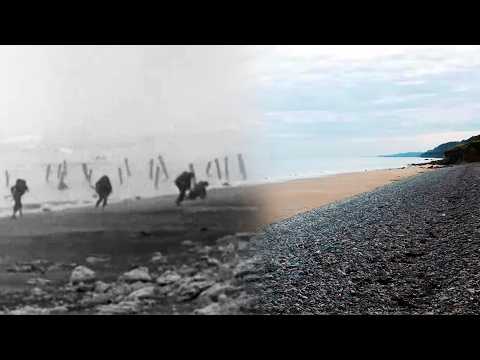
But the film raises haunting questions. Where exactly was Taylor standing? What was happening around him in those chaotic seconds? And how did the men in that footage manage to fight their way off D-Day’s deadliest beach? This is the story of that footage—and the men who made it possible.
Omaha Beach was a killing ground unlike any other. Fifty- to hundred-foot bluffs bookended by sheer cliffs ran the entire four-mile stretch, offering the Germans an imposing defensive position. They had built a series of interlocking strongpoints—Widerstandsneste, or resistance nests—each bristling with anti-tank guns, machine guns, barbed wire, and minefields, manned by up to fifty men. Nine of the fifteen WNs on Omaha clustered around the four main draws, the natural valleys that offered the only exits from the beach. But at the eastern end, near exit F1, a fisherman’s path led to a small hamlet called Cabourg. Above it sat WN60, a crescent-shaped network of trenches and guns, commanded by twenty-nine-year-old Gefreiter Alfred Eberhardt. Two Belgian 75-mm field guns, two concrete mortar tobruks, and a panzerturm with a French tank turret made WN60 a fortress. Any assault here would be funneled through a narrow break in the cliffs, in full view of the guns.
That’s why F1 was never supposed to be directly assaulted. But as the old adage goes, no plan survives first contact with the enemy. The Americans had divided Omaha into sectors, with the eastern half—Easy Red, Fox Green, and Fox Red—assigned to the battle-tested US 1st Infantry Division, the Big Red One. Leading the assault were men of the 3rd Battalion, 16th Infantry Regiment, and more specifically, Company L. Captain John Armellino, a twenty-three-year-old New Jersey native, commanded the 187 men of Company L. With him was Lieutenant Jimmy Monteith, a Virginia native whose leadership qualities had been noted early. Their objective: WN61, the strongpoint guarding the eastern half of the Colleville draw, complete with a powerful westward-facing Pak 88 anti-tank gun.
Early on June 6, tens of thousands of men watched as an immense naval bombardment roared overhead. But much of that ordnance came to nothing—the dug-in German positions stood up well, and many aircraft missed their targets. Smoke and dust obscured the coastline, and the approaching landing craft had few identifying markers. For Company L, chaos descended immediately. On the run-in, number four section’s LCA capsized in the harsh swell, drowning eight men before they even reached the beach. By the time the five remaining boats touched down, it was already 7:00 a.m., thirty minutes behind schedule. Lieutenant Klenk’s boat was the first to land, but the strong current had pushed them off course—700 yards east of their intended landing point, directly under the guns of WN60. Moments later, artillery fire struck the boat. Men were killed outright, and survivors clamored over the dead and wounded to get out. Nineteen men were lost in the chaos.
The other four LCAs ground to a halt, dropping their ramps onto Fox Green. There was little cover—just a band of mine posts and open sand. The waterlogged attackers, weighed down with kit and ammunition, trudged forward across 200 yards of open beach under heavy machine gun fire. Private John Sweeney remembered: “All of a sudden, I got hit by machine gun fire coming from the left front. I was turned completely around. The bazooka I was carrying was full of holes and the life belt I was wearing was taken right off me.” Staff Sergeant Vincent McKinney, the last to leave his sinking LCA, recalled: “I didn’t see a soul. I thought how eerie this was. I could see little puffs coming out of the sand where they were shooting at me.”
Despite the hellish race, some men reached the relative safety of the cliffs. Among them were Captain Armellino and Lieutenants Klenk, Cutler, and Monteith. But by 7:30, the mixed units under the cliffs were still pinned down, and the tide was rising. New troops were being disgorged onto beaches in front of unsuppressed machine guns. Command and control was strained. Armellino knew something had to be done. Bursting out of cover and sprinting across to establish contact with two Sherman tanks, he was gravely wounded by a mortar shell fragment that struck his right thigh, severing an artery. Command fell to Lieutenant Cutler, with Monteith and Klenk in support. After a quick discussion, it was decided that only one spot offered any hope: the entrance to the F-1 draw. Access was a small break in the cliffs, but only 100 yards from the nearest guns of WN60. It was a perilous prospect.
Gathering his two machine guns, Cutler ordered his sections to prepare to move. At the same time, Jimmy Monteith set out in Armellino’s footsteps, racing across the open sand to the two Shermans. Hammering on the turret of the lead tank, he managed to establish contact and pointed out the key targets in WN60 covering the F-1 draw. Moments later, the tanks began to move, taking up a position to add heavy covering fire. Racing back, Monteith, Cutler, and the survivors began to climb. About that same moment, offshore, Richard Taylor and the third wave were approaching Fox sector. His film footage starts in an LCA, showing Royal Navy crew and First Division troops, then switches to the beach itself. The time was likely between 8:00 and 9:00, the tide already reaching the second band of obstacles. The final shot shows assaulting troops trudging toward the cliff. Moments later, two men will be cut down by machine gun fire. Taylor was already wounded in the arm before these shots were taken—the scene of a man holding his bandaged hand is believed to be Taylor himself, filmed by his commander, Lieutenant Martin Grossfeld.
The next roll was taken hours later, around 10:30 a.m., as the tide had significantly moved in. This section is accompanied by famous photos of bandaged men huddling along the protective cliff—various units of the Third Battalion and stragglers of Company E, 29th Division. One photo, taken around 11:20 a.m., shows troops disembarking from an LCI, and the back of the two Sherman tanks with their wading snorkels clearly identifiable. Taylor’s iconic film is the only surviving footage taken on the beach during the assault waves, ironically on a lesser-known sector of Bloody Omaha.
But what actually happened on the ground? Surviving records suggest the advance took the fisherman’s track, skirting the base of WN60 before attacking from the flank and rear. There was no headlong charge into the German lines. Rather, it was an extremely slow, frightening, mentally and physically exhausting advance, with men moving in rough diamond formation from cover to cover below the ever-watchful Germans. Monteith, in the lead, stopped and studied the area every chance he could, at one point running back to the beach to further direct the two tanks onto the stubborn defenses. It’s often cited that Monteith had tanks follow him up the F-1 draw, but this was impossible—the ground was too steep and too loose for 30-ton tanks. He probably directed them right up onto the shingle as close as they could get and then to fire 75-mm rounds directly at WN60. From this spot, they knocked out the two 75-mm guns that had been lobbing shells along the packed beach all morning.
Yard by yard, under constant harassing fire, the advance continued. By mid-morning, after a nerve-racking climb, the summit of the bluffs was in sight. A low-level reconnaissance shot from May 19, 1944, shows the German-built track leading to WN60 and the line of the fisherman’s path. Crucially, the route appears to lie in defilade from the guns of WN60, supporting the suggestion that the advance followed this valley and outflanked the strongpoint to the west. It was during this movement that a patrol led by PFC Joseph Liebowitz found itself in a grenade-tossing duel with German defenders in WN60’s western trench. Lieutenant Klenk ordered some of his men to fix bayonets and clear it out. As they moved in, fifteen defenders of Company 3, exhausted and outnumbered, surrendered. Around the same time, the survivors of L Company under Lieutenant Cutler forced their own way toward the summit in a brutal yard-by-yard advance, with seventeen-year-old Private Joe Artensio reportedly silencing a German machine gun with a well-placed grenade at just a few yards’ range.
This is the point where one might say, “And finally, WN60 was captured and Draw F-1 was open.” But it doesn’t work like that. The truth is the fight was a drawn-out and confusing affair, more akin to a series of individual skirmishes than a coherent battle. Establishing timings are tricky, to say the least. That said, by late morning, the tide had literally and metaphorically turned as the leading men of the 16th passed well beyond WN60 and on toward the hamlets of Cabourg and Le Grand Hamel. Testament to the importance of WN60 came a short time later in the form of determined German counterattacks to drive the Americans back into the sea and reclaim their lost stretch of the Atlantic Wall. But to no avail. The same determination the GIs had shown in climbing the bluffs that morning kept them there that afternoon.
But not without cost. In the thick of that final fight, as he had been all day, was Jimmy Monteith. His Medal of Honor citation recalls: “Supervising the defense of his newly won position against repeated vicious counterattacks, he continued to ignore his own personal safety, repeatedly crossing the two or three hundred yards of open terrain under heavy fire to strengthen links in his defensive chain. When the enemy succeeded in completely surrounding First Lieutenant Monteith and his unit while leading the fight out of the situation, he was killed by enemy fire.” His courage, gallantry, and intrepid leadership are worthy of emulation. It was actions just like that, performed by men known and unknown, which ultimately meant that when night fell on the eastern end of Omaha Beach at the end of the longest day, WN60 and this small patch of ground remained in Allied hands.
Today, Jimmy Monteith lies buried in the immaculately kept Normandy American Cemetery, just a stone’s throw from WN60 and overlooking Omaha Beach. Not many miles away, another cemetery holds 21,000 German servicemen, including Alfred Eberhard, who commanded WN60 that day and who, along with thousands of others from all sides, fell in the brutal combat in the weeks to come. But the story of that morning—of Taylor’s shaking camera, of Armellino’s desperate sprint, of Monteith’s relentless courage—is one that still echoes across the sand and surf of Omaha Beach.
Taylor’s film survives as more than a record—it is a witness. Seventy-nine years later, the grain and shake of those frames still carry the sound of machine gun fire and the weight of men who never made it past the shingle.
WN60 is quiet now. The trenches have softened, the guns are gone, and the fisherman’s path is overgrown. But the bluffs remain, and so does the question the footage demands of us.
What would you have done, pinned against that cliff with the tide rising and the guns above? Would you have climbed?






