For decades, Hollywood sold the world a seductive lie: that a cigarette dangling from the lips of a movie star was the ultimate symbol of cool. It was glamorous, rebellious, and irresistible. But behind the silver screen’s shimmering haze, a deadly reality was unfolding. The very habit that made legends look invincible was quietly destroying them, one puff at a time. These are the stories of the stars who lit up the screen—and paid for it with their lives.
Clark Gable, the undisputed King of Hollywood, seemed untouchable. He flew combat missions in World War II and embodied the rugged American hero. But off-screen, he was fighting a war he couldn’t win. For over thirty years, Gable smoked three packs of unfiltered cigarettes a day, a habit that would ultimately claim his life.
His charm and charisma masked the damage accumulating inside his body. By 1960, after decades of relentless smoking, his health was failing. Then came the final blow: a fourth heart attack. He died at just 59, leaving behind a legacy and a warning he never intended to give.
Equally tragic is the story of Yul Brynner. With his shaved head and commanding presence, he was the picture of strength. But Brynner was hiding a shocking secret: he smoked five packs of cigarettes a day. Five packs. Even by Hollywood’s permissive standards, that was extreme.
When he was diagnosed with lung cancer, the man who had projected invincibility was forced into a battle he couldn’t control. But what he did next made his story unforgettable. Knowing he was dying, he recorded a public service announcement, looking directly into the camera with haunting sincerity: “Now that I’m gone, don’t smoke. Whatever you do, just don’t smoke.”
John Wayne, the ultimate American tough guy, was rarely seen without a cigarette. He endorsed Camels and embodied a masculinity that seemed to defy mortality. At his worst, he smoked seven packs of unfiltered cigarettes a day. Seven. It was a staggering number that even his legendary toughness couldn’t overcome.
In 1964, doctors discovered severe damage to his lungs and removed most of his left lung. The man who had conquered countless on-screen villains was now facing an enemy he couldn’t outdraw. He survived another 15 years, but the damage was done. He died at 72, a shadow of the giant he had once been.
Then there’s Humphrey Bogart, the epitome of cool. His trademark cigarette was originally a prop to give his hands something to do during long dialogue scenes. But it became his identity. Off-screen, he smoked two packs a day and drank heavily. When he finally sought help in 1956, the diagnosis was esophageal cancer. He was gone just a year later, at 57.
The irony is devastating: the man who made smoking look glamorous became one of its most famous victims. The cigarette that built his image helped write his final chapter.
And the list goes on. Errol Flynn, the swashbuckling rogue, died of a heart attack at 50—doctors said his body resembled that of a man in his mid-70s. Spencer Tracy battled alcohol and cigarettes for years before succumbing to heart disease. Rod Serling, the genius behind The Twilight Zone, smoked four packs a day and died at 50 after bypass surgery. Walt Disney, the man who built the happiest place on earth, hid his heavy smoking from the public—but couldn’t hide from lung cancer, which took him at 65.
These stars lit up our screens and captured our imaginations. But their stories are a stark reminder that the glamour was just an illusion. The smoke has cleared, and the cost is undeniable.
But the story doesn’t end with those legends. Some of Hollywood’s most beloved icons carried the same habit into the modern era, long after the surgeon general’s warnings made the danger impossible to ignore. Their stories prove that fame, fortune, and even the brightest talent offer no protection from the consequences of a cigarette.
Take Lucille Ball, America’s favorite comedian. To millions, she was a whirlwind of energy, a woman who could turn the simplest situation into television gold. But behind the laughter was a habit she could never quite shake. Like many stars of her generation, Lucy began smoking when cigarettes were everywhere—movie sets, studios, restaurants, even airplanes. It seemed impossible to escape.
Over the years, friends and colleagues noticed her persistent coughing. But in those days, such symptoms were dismissed as normal. After all, if everyone around you smoked, how dangerous could it really be? That illusion wouldn’t last forever. As the years passed, Ball developed serious health issues, and decades of smoking were believed to have contributed significantly to her declining condition.
What makes her story especially powerful is the contrast. She brought joy and optimism to millions of homes. Yet she shared the same vulnerability as so many stars of her era. Fame couldn’t protect her. Success couldn’t protect her.
Then there was Jackie Gleason, the comedy genius behind Ralph Kramden. His larger-than-life personality was matched only by his larger-than-life appetites. Gleason’s weight reportedly fluctuated between 230 and 330 pounds, and he was known to chain-smoke up to five packs a day. Food, whiskey, and cigarettes—it was a lifestyle built entirely around excess.
Friends joked that he treated scotch like most people treated water. For years, his fame and charisma seemed to overshadow the warning signs. Audiences saw a comedy genius; few saw the toll his lifestyle was taking behind the scenes. In 1987, Gleason died from colon cancer at 71. The body, it turned out, could only take so much.
And then there’s the story that might surprise you most: Walt Disney. When people think of Disney, they picture imagination, childhood memories, and the happiest place on earth. What they usually don’t picture is a chain smoker. Yet behind the wholesome image that defined an entertainment empire was a habit Disney struggled with for decades.
Many photographs from his early years show him with a cigarette in hand—though his public relations team frequently had them airbrushed out to protect his family-friendly image. While Hollywood stars openly embraced smoking as part of their persona, Disney understood that his audience was different. He wasn’t selling rebellion or glamour. He was selling dreams.
So the cigarettes quietly disappeared from public view, even as the habit continued behind the scenes. For years, the workload was relentless. Disney poured himself into animation, television, and the creation of Disneyland. But constant stress combined with decades of smoking eventually took a serious toll.
In 1966, doctors discovered lung cancer. Within weeks, Disney underwent surgery to remove part of his lung. Sadly, it wasn’t enough. Just a short time later, he passed away at 65. The man who gave generations an escape into magical worlds couldn’t escape the consequences of a habit quietly damaging his own body.
Frank Sinatra and Dean Martin, the kings of cool, were rarely seen without a cigarette in hand. For decades, smoking was woven into their public image—as essential as the microphone or the martini glass. To fans, it looked sophisticated. To advertisers, it looked marketable. To doctors, not so much.
Sinatra built his career around one of the greatest voices in entertainment history, yet he spent years exposing that voice to cigarette smoke. As he aged, he faced numerous respiratory and cardiovascular issues. Martin, meanwhile, hid behind a carefree grin while his body paid the price for decades of late nights, alcohol, and smoke. The carefree entertainer who seemed immune to life’s problems was facing the same reality as countless smokers before him.
But perhaps no story captures the full tragedy of Hollywood’s smoking culture like that of Sammy Davis Jr. He wasn’t just a smoker—smoking was part of his act. One of his signature moves was taking a drag from a cigarette mid-song, then exhaling the smoke as he delivered the next note. To audiences, it looked smooth, stylish, effortless.
The problem was that his vocal cords disagreed. Years before the damage became obvious, Nat King Cole tried to warn him. He explained that constantly singing while inhaling hot cigarette smoke was slowly destroying the very instrument that made Sammy famous. But like many smokers, Sammy believed the consequences were somewhere far off in the future. They weren’t.
By the 1980s, he began experiencing serious vocal problems. His manager arranged for him to see a throat specialist, and the diagnosis confirmed exactly what Nat King Cole had predicted years earlier. The combination of smoking and singing had inflamed his vocal cords, creating nodules that threatened his voice. It was a cruel irony—the habit that looked so cool on stage was quietly attacking the gift that made him a star.
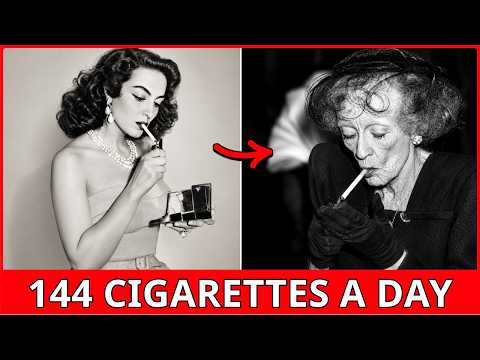
And then there’s the case of Betty Davis, who defied the odds in ways that still baffle medical experts. Unlike many stars who smoked simply because it looked glamorous, Davis insisted on smoking on screen for a different reason: realism. If her character smoked, she wanted audiences to believe it.
But offscreen, she was reportedly smoking up to four packs a day, often claiming she couldn’t go more than ten minutes without lighting one. Friends, interviewers, and even her dentist witnessed the addiction firsthand. She was known to smoke in waiting rooms and sometimes even while sitting in the dentist’s chair.
Yet what makes her story so remarkable is what happened next. Despite decades of heavy smoking, Davis lived to the age of 81, far longer than many of her contemporaries. While smoking undoubtedly took a toll on her appearance and health, she avoided many of the smoking-related diseases that claimed the lives of others on this list. Even more astonishing, reports suggest she continued smoking nearly 100 cigarettes a day late into her life.
Her longevity remains one of Hollywood’s great medical mysteries—a reminder that while the dangers of smoking are undeniable, the human body sometimes responds in ways we can’t fully explain. But for every Betty Davis, there were dozens of stars whose luck ran out far too soon.
The pattern is impossible to ignore. From Clark Gable’s three packs to John Wayne’s seven, from Yul Brynner’s haunting warning to Humphrey Bogart’s fatal diagnosis, the stories share a devastating common thread. These were people with access to the best doctors, the finest healthcare, and every resource imaginable. And yet, the habit was stronger.
What makes their stories so compelling isn’t just the tragedy—it’s the illusion. On screen, they were invincible. They survived wars, defeated villains, and conquered impossible odds. Off-screen, they were as vulnerable as anyone else. The cigarette that made them look cool was the one thing they couldn’t defeat.
And the story doesn’t end with them. Their images—Bogart’s smoldering gaze, Sinatra’s effortless style, Dean Martin’s carefree grin—continued to sell the same seductive lie to generations of fans who copied the habit without knowing the cost.
Today, the smoke has cleared from Hollywood’s golden age, but the lesson lingers. Cigarettes no longer grace magazine covers or glide across the silver screen with the same careless glamour. Yet the ghosts of Gable, Bogart, and Wayne remain—a quiet chorus warning us from the past.
Their talent was immense. Their charm was undeniable. But none of it could stop a habit that had quietly become their most dangerous co-star. Fame gave them everything except immunity.
So the next time an old movie plays and a legend lights up with that familiar, effortless cool, remember what the camera never showed: the cough, the diagnosis, the final, devastating scene.
Which of these stories stayed with you the longest—and does it make you see that iconic on-screen cigarette differently now?






