On May 5th, 1886, a single Norway pine log wedged between two rock outcrops at Devil’s Elbow on the St. Croix River. Within hours, hundreds of thousands of logs piled against it, and within weeks, the jam stretched for over two miles, threatening to bankrupt the entire region. This is the story of the largest log jam in recorded history and the desperate men who fought to break it.
The jam was a disaster waiting to happen. The winter cut had been enormous—over 400 million board feet of timber sent to the riverbanks. When the ice went out, all of it hit the river at once, and the St. Croix, even in flood, couldn’t handle the volume. At Devil’s Elbow, where the channel narrowed to less than 150 feet, the river choked. Within 24 hours, the jam was beyond the capacity of a small crew. Within a week, it was a geological feature.
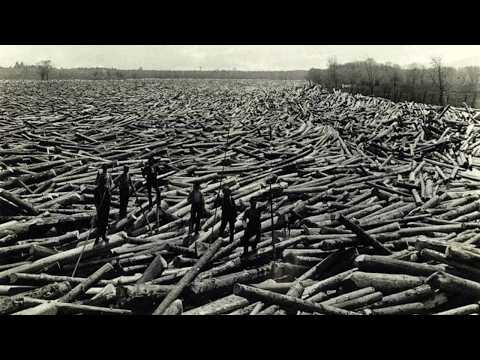
The Squa Boom Company mobilized immediately. They sent out a call for men, offering double wages and a bonus for the most dangerous work. Over 200 men assembled at the jam site, working 12-hour shifts around the clock. The work was a nightmare. The jam was not static; it was a mass under tension, with logs shifting constantly. If you fell through the logs, you went into the cold, fast water and drowned, trapped beneath tons of wood.
The traditional methods—prying and chopping key logs—were too slow. So the company made a decision that was both brilliant and insane: they would use dynamite. Explosives had been used before, but never on this scale, with men working directly on the logs. The plan was to drill holes into key logs, pack them with dynamite, and blow them apart. The drilling was done by hand, a single hole taking an hour. The blasts were spectacular and terrifying, sometimes triggering cascades, other times doing nothing visible.
The danger was constant. Fuses were unpredictable. A blaster named Michael Hanrahan was caught by a premature explosion, thrown into the river with a shattered leg and severe burns. Another man, Joseph Leoo, was crushed when a section of the jam released unexpectedly. Men were injured and killed, but the work continued day after day, week after week.
By mid-June, the strategy shifted. Teams with crosscut saws attacked the jam from the sides, cutting through logs at the edges to reduce the mass bit by bit. It was slow, brutal work. Sawyers faced the unique danger of logs rolling as tension shifted. One Sawyer, Lars Anderson, was pulled into the jam when a log he was cutting rolled and took the saw with it. His body was found three days later, two miles downstream.
The costs were climbing. The Boom Company had spent over $30,000, equivalent to nearly a million dollars today, and the jam was still there. Stillwater, the sawmill capital, was on the edge of financial collapse. Thousands of mill workers were unemployed, and the town’s economy was based on lumber. If the lumber didn’t flow, the money didn’t flow.
Finally, on June 24th, after 50 days, a massive blast near the base of the jam shattered a cluster of key logs. The explosion was heard in Stillwater, 15 miles away. The jam broke. Not all at once, but it broke. A section near the center let go, triggering a cascade. Timber started flowing downstream. Men ran for the banks. Three were carried downstream on the logs; two made it to shore, but the third, Patrick Quinn, fell through and was never seen again.
The breakup continued for three days, with logs moving downstream in waves. The mills fired up their boilers, and Stillwater began to breathe again. But a core section remained at Devil’s Elbow, still blocking the channel. The crews went back to work, and the final section was broken in mid-July, 57 days after the jam had first formed.
When it was over, the Boom Company tallied the costs: over $40,000 spent, six men confirmed dead, dozens injured, and an estimated 10 to 15 million board feet of timber lost. But the drive was saved. The logs reached the mills, the contracts were fulfilled, and the industry survived. The 1886 jam was a turning point, proving that the system was fragile and that pushing too many logs through too fast was a gamble.
The men who broke the jam became legends in the logging camps. But most of them didn’t see it that way. It was a job—a dangerous, exhausting job that paid well and nearly killed them. When it was over, they took their pay and moved on. Some went back to the logging camps, some found work in the mills, and a few left the industry entirely. The physical evidence of the jam is mostly gone. Devil’s Elbow is still there, a bend in the river that looks unremarkable today. There’s no marker, no monument to the jam or the men who broke it.
But in the local historical societies, in the archives, there are records—company ledgers, newspaper articles, and a few grainy photographs showing the mass of logs and the tiny figures of men standing on them, dwarfed by the timber. These fragments are all that remain. The legacy of the 1886 jam is written into the history of industrial logging in America. It was the largest log jam ever documented, a disaster that could have destroyed an entire regional economy, but didn’t because men were willing to do work that defied common sense.
The use of dynamite to break the jam became standard practice, exported to logging regions across the country. But the human cost was never fully accounted for. Six men died, but how many were injured? How many came away with hearing damage, respiratory problems, or psychological trauma? The records don’t say. The men didn’t talk about it. You did the work. You survived or you didn’t, and you moved on. That was the ethos of the logging camps.
Walk along the St. Croix today and it’s a quiet river. Clean water, forests on both banks, kayakers and fishermen. It’s hard to imagine it choked with logs, a two-mile-long wall of timber stretching upstream, men crawling over the surface like ants, the sound of saws and explosions echoing off the valley walls. But it happened in the spring and summer of 1886. The St. Croix was not a river. It was a battlefield. And the men who fought there, who broke the largest log jam in history, left no monuments except the lumber that built a region and the knowledge that it could be done.
But the story does not end with the jam. What happened in the years after Devil’s Elbow shaped the entire future of American logging, and the lessons learned there were written in blood and dynamite. The Boom Company, chastened by the near-collapse of its finances, poured money into preventing another catastrophe. They blasted the rock outcrops at Devil’s Elbow itself, widening the channel and removing the very obstacle that had started it all. They built additional holding booms upstream to regulate the flow of timber, releasing logs in controlled batches rather than all at once.
The river drivers got better tools and better training. The peeve and can hook were refined, and the men who rode the logs became a specialized breed, respected and feared in equal measure. The techniques developed at Devil’s Elbow—drilling, blasting, side-cutting with crosscut saws—were exported to Maine, to Michigan, to the Pacific Northwest. Every major logging river in America adopted them.
Yet the men themselves were largely forgotten. The ballad of Patrick Quinn was sung in the camps for a generation, but as the old loggers died off, so did the songs. By the early 1900s, the great log drives were ending anyway. The railroads had arrived, and timber could be moved by rail far more reliably than by river. The white pine forests of the St. Croix Valley were cut over, the land stripped and sold to farmers and speculators. The river that had once carried millions of logs was left to heal in silence.
But there is one more chapter to this story, and it is perhaps the strangest of all. In the summer of 1886, while the crews were still fighting the residual jam at Devil’s Elbow, a young reporter from the Stillwater Gazette climbed onto the logs with a notebook and a pencil. His name was Elias Ward, and he spent three days living among the jam breakers, sleeping in their tents, eating their beans, and recording everything he saw.
Ward’s account, published in a series of articles that August, is the most detailed first-hand record of the jam that survives. He described the sound of the dynamite—a deep, concussive boom that he felt in his chest before he heard it—and the way the men would freeze when a charge was lit, counting the seconds under their breath. He described the smell of the camp, a mixture of pine sap, sweat, and black powder. And he described the faces of the men, weathered and hollow-eyed, men who had seen things on that jam that they would never speak of again.
One passage stands out. Ward asked a blaster named Thomas Corcoran why he did the work. Corcoran, a veteran of the Civil War who had survived Antietam and Gettysburg, looked at the reporter for a long moment. “I’ve seen men die in worse ways,” he said. “At least here, the timber doesn’t shoot back.” Then he laughed, and went back to drilling his hole.
Ward’s articles were read across Minnesota and Wisconsin, and for a brief moment, the men of Devil’s Elbow were famous. But fame faded quickly. The reporter himself died of typhoid fever two years later, at the age of twenty-nine, and his notebooks were lost. The newspaper clippings survived only in a single bound volume in the Stillwater library, where they sat largely unread for over a century.
And yet the story refused to die entirely. In the 1930s, during the Great Depression, a WPA writer named Margaret Loomis was assigned to collect oral histories from elderly loggers. She tracked down three surviving veterans of the 1886 jam, all of them in their seventies or eighties, living in small towns along the river. Their memories of the jam were vivid, almost hallucinatory—the wall of timber, the explosions, the men who fell through the logs and vanished.
One of them, a man named Ole Halvorsen, had been a sawyer at Devil’s Elbow. He told Loomis that he still dreamed about the jam, fifty years later. In the dream, he was standing on the logs, and the logs were moving, and he could not find his way to shore. “I wake up and I’m in my bed,” he said, “and I have to remind myself that I’m not on the river anymore.”
Loomis’s interviews were typed up and filed away, and for decades they gathered dust in a state archive. But they survived, and they are the reason we know the names of the men who died—not just Patrick Quinn and Lars Anderson and Joseph Leoo, but the others whose deaths were never recorded in the company ledgers. There was a man known only as “the Swede,” who fell through the logs in early June and whose body was never recovered. There was a young boy, perhaps fourteen or fifteen, who was crushed by a rolling log and buried on the riverbank without a marker.
The jam, it turned out, had claimed more lives than the official count admitted. The Boom Company had downplayed the death toll to avoid bad publicity, and the newspapers had reported only what they were told. The true number of dead may never be known.
By the time the last of the old loggers died in the 1950s, the St. Croix Valley had changed beyond recognition. The great white pine forests were gone, replaced by second-growth hardwood and farmland. The sawmills in Stillwater had closed, one by one, and the town had reinvented itself as a tourist destination. The river that had once been a battlefield was now a place for pleasure boats and summer cabins.
But the river remembered. In the 1990s, a local historian named Dale Krogstad began searching the riverbed near Devil’s Elbow with a metal detector and a dredge. He was looking for artifacts from the jam—tools, chains, perhaps even the remains of the dynamite charges. What he found instead was a section of riverbottom still littered with sunken logs, the timber perfectly preserved in the cold, oxygen-poor water. Some of those logs were Norway pine, over a century old, their grain as tight and straight as the day they were cut.
Krogstad pulled up a dozen of them and had them milled into lumber. The wood was beautiful—dense, fragrant, a deep amber color. He built a small cabin out of it, on a bluff overlooking the river. And in the cabin, he hung a framed photograph of the 1886 jam, the one grainy image that shows the wall of timber and the tiny figures of men standing on it. Visitors to the cabin often ask about the photograph, and Krogstad tells them the story—the jam, the dynamite, the men who died. Most of them have never heard it before. They listen, and they shake their heads, and they say something like, “I can’t imagine.”
But someone did imagine it. Someone lived it. And the river, quiet now, still carries the memory of that summer, when the St. Croix was not a river but a wall of timber, and the men who broke it were ordinary men doing extraordinary work, and the cost was measured in lives that no monument records.
Today, the only monument is the lumber itself—the beams and floorboards of barns and farmhouses across the Midwest, still holding straight after 140 years. Every white pine plank cut from a log that came through Devil’s Elbow is a headstone nobody recognizes.
And the river keeps its own archive. Sunken logs still rest in the cold water, preserved like artifacts in a museum no one visits. Occasionally a diver or a dredger brings one up, and for a moment the jam exists again—the smell of pine sap, the sound of the dynamite, the men counting seconds under their breath.
So here is the question worth asking: if a disaster this large can vanish from public memory in a single century, what else are we forgetting right now?
What story from your own town’s past deserves to be dug out of the archives before it disappears for good? Tell us in the comments—we read every one.






