The snow had barely settled over the ruins of Stalingrad when the first columns began to form. It was February 2, 1943, and the Sixth German Army had just surrendered—but for the 91,000 men who laid down their arms, the nightmare was only beginning. They had survived the hell of urban warfare, the relentless Soviet counteroffensive, and the bone-crushing cold. Now they would face something far worse: the long march east.
As the defeated soldiers stumbled out of cellars and bunkers, many already on the verge of death from starvation and frostbite, Soviet guards herded them into long, ragged lines. They were stripped of their belongings, their warm clothing, their last scraps of food. Then they were told to march.
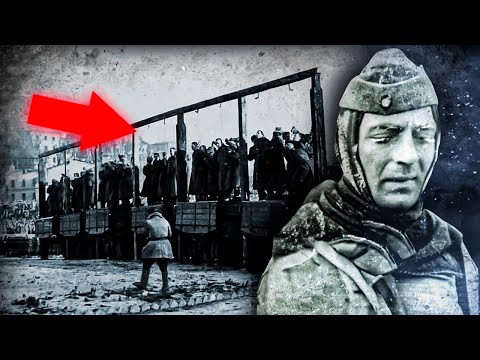
The destination was unknown—some whispered of camps in Siberia, others of labor sites near the Volga. But the immediate reality was the march itself: hundreds of kilometers through subzero temperatures, with no shelter, no medical care, and barely any food. “Those who could not continue were simply shot in the darkness of the night,” one survivor later recalled. The frozen corpses of their comrades lined the route, a grim warning to those who faltered.
Back in Berlin, Hitler had already condemned these men. Just days before the surrender, he had promoted General Friedrich Paulus to Field Marshal, expecting him to take his own life rather than be captured. Paulus refused. In retaliation, the Gestapo arrested his wife and children, sending them to an Alpine prison. The men who had fought for the Führer were now abandoned by him, left to face an uncertain fate in the hands of the enemy.
For the Soviets, the victory at Stalingrad was a turning point—but the prisoners were a logistical burden and a resource to be exploited. The camps that awaited them, hastily organized in the ruins of schools, monasteries, and factories, were woefully unprepared. In Beketovka, a former school with holes in the walls and no doors or windows, prisoners slept huddled on the frozen ground, their bodies pressed together for warmth. Temperatures dropped below minus thirty degrees Celsius. Disease ran rampant: typhus, dysentery, diphtheria. The dead were piled like cordwood, stripped of their clothing by guards or fellow prisoners.
Yet even as the death toll mounted, the survivors held onto a flicker of hope—that the war might end, that they might return home. But for most, that hope would prove as illusory as the promises of the Nazi regime. The march east was only the first step into a decade of suffering.
Among the prisoners who stumbled through the snow that February was a young lieutenant from Munich, Hans Weber, who had celebrated his twenty-second birthday just two days before the surrender. He had been a clerk in the Sixth Army’s supply corps—a job that had kept him behind a desk until the final weeks of the encirclement, when every man was needed at the front. Now, like thousands of others, he was just another starving body in a column that stretched for kilometers across the frozen steppe.
The guards who escorted them were a mix of Red Army soldiers and NKVD troops, many of them veterans of the brutal street fighting that had destroyed the city. Their faces were hard, their eyes cold—not with hatred, but with a kind of exhausted indifference. They had seen too much to feel anything for the ragged Germans who shuffled past them. Some spat. Others simply watched, rifles slung over their shoulders, as the prisoners stumbled forward.
Hans quickly learned the rules of survival. Never fall behind. Never show weakness. Never let go of your mess kit—it was the only thing between you and starvation. The bread ration, when it came, was a few grams of black loam baked with sawdust. Men fought over crumbs. Some killed for them. Hans saw a soldier beaten to death with a rifle butt for stealing a dead comrade’s boots.
The first camp they reached was little more than a clearing in the snow, surrounded by barbed wire and watchtowers. There were no barracks—only holes dug into the frozen earth, covered with branches and scraps of canvas. Hans crawled into one of these holes with three other men, their bodies pressed together for warmth. In the morning, one of them was dead. He had frozen solid during the night, his eyes still open, staring at nothing.
It was here that Hans first heard the name Beketovka—the camp that would become synonymous with suffering for the Stalingrad prisoners. A former school on the outskirts of the city, it had been damaged during the fighting, its walls pocked with shrapnel holes, its windows and doors long since burned for firewood. Thousands of men were crammed into its classrooms and corridors, sleeping on the bare floor in rows so tight that no one could turn over without touching a neighbor.
Dysentery swept through the camp within days. The latrines were overflowing, the water supply contaminated. Men who had survived the battle now died in their own filth, too weak to move. The guards did nothing. They stood at the gates, watching, counting the bodies as they were dragged out each morning.
Hans caught typhus in the third week. He remembered little of that time—only the fever dreams, the faces of his mother and sister floating before him, the sensation of being carried by someone else’s hands. When he finally regained consciousness, he was in a different camp, further east, and the man who had carried him was dead. He never learned his name.
By spring, the columns had thinned. Of the 91,000 men captured at Stalingrad, only a fraction remained alive to see the thaw. The snow melted to reveal the bodies of those who had fallen during the march—hundreds of them, frozen into the ground, their limbs twisted at unnatural angles. The Soviet authorities ordered them buried in mass graves, unmarked, unrecorded. Their families in Germany would never know where they were laid to rest.
For those who survived, the labor camps awaited. Hans was sent to a mine in the Urals, where he worked twelve-hour shifts in darkness, hauling coal with his bare hands. The work was brutal, the food barely enough to keep a man alive. But Hans discovered that the guards, for all their hardness, were not uniformly cruel. One of them, an older man with a limp, sometimes slipped him an extra piece of bread. “You are a soldier,” the guard said once, in broken German. “I was a soldier too. We do what we must.”
It was a small kindness, but it was enough to keep Hans going. He began to believe that he might survive—that one day, he might see Germany again.
But survival in the camps was not a matter of hope alone. It was a daily arithmetic of calories, warmth, and luck. Hans learned to eat his bread slowly, to chew every crumb until it dissolved, to trick his stomach into believing it was full. He learned to sleep with his back against the wall, because the wall was warmer than the open air, and because it kept him from being trampled by men who thrashed in their sleep.
Most of all, he learned to watch the guards. Not all of them were the same. Some were brutal, yes—men who beat prisoners for sport or shot those who strayed too close to the wire. But others were merely tired, worn down by years of war, and they turned a blind eye to the small economies of survival: the extra potato slipped into a pocket, the hour of rest stolen behind a shed.
Hans found work in the camp kitchen, a job that meant warmth and the chance to scrape the bottom of the soup cauldron. It was there that he met a man named Yakov, a Soviet prisoner himself—a former soldier who had been captured by the Germans in 1941 and now served as a trustee. Yakov spoke a little German, and in the long evenings, as the wind howled outside, he told Hans about his village, his wife, his daughter. “We are all prisoners now,” Yakov said one night, staring into the stove. “You for Hitler, me for Stalin. Both of us for nothing.”
It was Yakov who warned Hans about the interrogations. “They will come for you,” he said. “They will ask you to sign papers, to speak on the radio, to join their committees. If you refuse, they will send you to the mines. If you accept, your own people will call you a traitor.” Hans thought of Seidlitz-Kurtzbach, the general who had broadcast anti-Nazi propaganda from Moscow, and shuddered. He had no love for Hitler—not anymore—but the thought of speaking against his own country, of becoming a tool for the Soviets, filled him with a cold dread that had nothing to do with the temperature.
When the interrogators finally came, they were surprisingly patient. They offered him cigarettes, asked about his family, his education, his political views. Hans said little. He spoke of his mother, his sister, the small apartment in Munich where he had grown up. He did not mention the war, or Hitler, or the things he had seen. “You are a clerk,” the interrogator said at last, stubbing out his cigarette. “Not a fanatic. You could be useful to us.” Hans shook his head. “I am a soldier,” he said, the words tasting like ash. “I just want to go home.”
They sent him back to the mine. It was a punishment, but a mild one—a sign that they had not given up on him, that they might try again. Hans did not know whether to be relieved or afraid.
As the months passed, the camp began to change. American aid packages arrived, and with them came a trickle of real food: canned meat, dried milk, chocolate. The prisoners who had survived the first winter—the ones who had not died of typhus or been shot for stealing bread—found themselves slowly, cautiously, regaining their strength. Hans gained weight. His hands, which had been raw and bleeding from the coal, began to heal.
But the war was still far from over. In the summer of 1943, news reached the camp of the German defeat at Kursk—the greatest tank battle in history. The guards passed the news along with a kind of grim satisfaction, and Hans saw in their faces something he had not seen before: the first flicker of belief that the tide had truly turned.
That night, Yakov sat beside him in the kitchen, a stolen cigarette burning between his fingers. “The Red Army is coming,” he said. “They will take back everything.” He paused, looking at Hans with an expression that was almost kind. “And you? What will you do when the war is over?”
Hans thought of Munich, of the ruins of his family’s apartment, of the sister he did not know was alive or dead. “I will go home,” he said. “If there is a home left to go to.”
Yakov nodded slowly. “There is always a home,” he said. “Even if it is only a memory.”
But for Hans, and for thousands like him, home was still a distant dream—a place beyond the barbed wire and the watchtowers, beyond the endless columns and the frozen graves. The war still had years to run, and the worst of the suffering was yet to come.
Hans survived the mine, the camps, and the long years of silence. In the autumn of 1955, he stepped off a train in Friedland, a gaunt man of thirty-four with a battered mess kit still in his bag. He had been captured at twenty-two; he returned to a Germany that barely remembered him.
His mother had died in 1947. His sister had married and moved west. “You look like a stranger,” she whispered when they met, and he could not argue.
He found work as a bookkeeper, married a widow, and rarely spoke of Stalingrad. But on winter nights, he would sometimes sit by the window and watch the snow, remembering the columns, the frozen dead, the guard who gave him bread. Of the 91,000 men who surrendered, only about 5,000 came home. Hans was one of them—and he never understood why.
Was survival a gift, a punishment, or merely luck—and what do we owe the dead who never returned?






