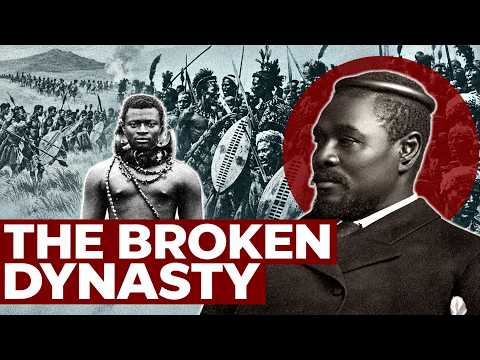
Imagine a kingdom so powerful it handed the British Empire its worst military defeat in living memory. An army of warriors with shields and spears against rifles, artillery, and Gatling guns—and somehow, they won. Now imagine being the child of that kingdom’s king, watching everything your father built carved apart by the very empire your people once humiliated on the battlefield. This is the story of what happened after Britain destroyed the Zulu Kingdom—and what became of King Cetshwayo’s children. It’s a saga of exile, betrayal, manipulation, and survival against impossible odds: a royal family torn apart, scattered across oceans, imprisoned on remote islands, put on show trials, and stripped of everything, only to endure through a century of colonial oppression and emerge still standing.
Let me take you back to the late 1870s, to a stretch of southern Africa the British Empire had its eyes on. Britain had already swallowed enormous portions of the continent, driven by diamonds, labor, and a grand vision of a unified British federation. But one major obstacle stood in the way: the Zulu Kingdom. This was no fragile tribal arrangement—it was a formidable military state forged by the legendary King Shaka, who transformed a small clan into a dominant regional power through revolutionary tactics and ruthless discipline. By the 1870s, under King Cetshwayo, the kingdom was still intact, still proud, and still capable of defending itself.
Cetshwayo was a remarkable figure—over six feet tall, broad-shouldered, carrying himself with unmistakable royalty. He understood the British threat and tried repeatedly to maintain peaceful relations with colonial authorities in Natal. He wasn’t seeking war. But the British, specifically Sir Bartle Frere, the high commissioner for South Africa, had other plans. Frere was obsessed with a South African confederation under British control and saw the Zulu military system as an existential threat. In December 1878, he issued an ultimatum designed to be impossible to accept: dismantle the Zulu military, surrender warriors accused of crossing into British territory, pay a massive fine in cattle, and accept Christian missionaries and a permanent British resident. Cetshwayo was given 30 days. He didn’t bother responding—the ultimatum wasn’t a negotiation; it was a declaration of war dressed up in diplomatic language.
In January 1879, the British invaded. Lord Chelmsford split his forces into three columns and marched into Zululand with around 17,000 troops. He was supremely confident—so confident that he made catastrophic tactical errors. On January 22, 1879, at a place called Isandlwana, the Zulu army of over 20,000 warriors launched a surprise attack on the central British column. Chelmsford had split his forces again, leaving the camp poorly fortified and undermanned. The Zulu warriors swept over the British positions like a wave breaking over rocks. Over 1,300 British and allied troops were killed. It was the worst defeat the British had ever suffered at the hands of an indigenous African force, and the news sent shockwaves through London.
But empires don’t accept humiliation—they double down. Reinforcements were rushed to southern Africa. Chelmsford was given a second chance. Over the next several months, the British systematically ground down the Zulu resistance. On July 4, 1879, at Ulundi, Cetshwayo’s royal capital, Chelmsford drew up his 5,000-strong army in a massive hollow square. Around 20,000 Zulu warriors attacked in their traditional formation, wave after wave hurling themselves at the British lines. But this time, the British were ready. Gatling guns, artillery, and disciplined rifle fire cut the Zulu charges to pieces. Around 6,000 Zulu warriors were killed. The British lost just 10 men. After the battle, the British burned Ulundi to the ground. King Cetshwayo became a fugitive, moving from hiding place to hiding place, hoping perhaps the British might still negotiate. But on August 28, 1879, he was captured. The man who had once commanded one of the most powerful armies in Africa was now a prisoner, and his kingdom lay in ruins.
Now, here’s where the story takes a turn most people don’t expect. The British didn’t just defeat the Zulu Kingdom—they dismembered it. A British administrator named Sir Garnet Wolseley was sent to impose a new political order. His solution was brutally simple: divide the kingdom into 13 separate chieftainships, each under a chief handpicked by the British. Some were traditional Zulu leaders, but others were rivals and enemies of the royal house—men with no legitimate claim to authority but who could be relied upon to serve British interests. The most dangerous of these appointed chiefs was Zibhebhu kaMaphitha, a powerful and ambitious leader of the Mandlakazi faction. The British deliberately placed his territory in the northern heartland of Zulu royalist support, knowing full well that his presence would suppress the Usutu faction loyal to Cetshwayo. It was a calculated act of political sabotage, and it worked exactly as intended. Within months, the chieftainships were at each other’s throats. The unity that had defined the Zulu Kingdom for decades was shattered.
Meanwhile, Cetshwayo was shipped off to Cape Town, where he was held in captivity. But the deposed king was no fool. Even in exile, he continued to lobby for his restoration. He wrote letters, made appeals, and played the diplomatic game with a patience and sophistication that surprised many of his British captors. And then something remarkable happened. The situation in Zululand deteriorated so badly—with factions fighting each other and the whole region sliding toward chaos—that the British government began to reconsider its approach. In 1882, Cetshwayo was brought to England. He arrived at Southampton in early August, and the British public was fascinated. Crowds gathered to catch a glimpse of the famous Zulu king. Newspapers ran breathless accounts of his movements, his appearance, his dignified bearing. He stayed at 18 Melbury Road in London’s Holland Park, a spot later commemorated with a blue plaque by English Heritage. He met with government officials, including Prime Minister William Ewart Gladstone. And on August 14, he was granted an audience with Queen Victoria herself at Osborne House on the Isle of Wight.
Victoria was impressed. She described Cetshwayo in her journal as “a very fine man.” She told him she recognized him as a great warrior who had fought against the British, but that she rejoiced they were now friends. She called him a brave enemy. She presented him with a silver loving cup and commissioned a portrait of him. It was a moment of genuine, if somewhat patronizing, respect between two monarchs from vastly different worlds. Cetshwayo later sent Victoria a basket woven from South African grass as a gesture of reciprocity.
But behind the pageantry, the political reality was far less generous. The British agreed to restore Cetshwayo, but only to a fraction of his former territory. Zululand was effectively partitioned a second time. Cetshwayo would rule a diminished central portion, while Zibhebhu retained his northern chieftainship, and a British-controlled reserve was carved out in the south. It was restoration in name only. The king was being sent back to a kingdom deliberately set up to fail.
Cetshwayo returned to Zululand in January 1883. He was welcomed by his Usutu supporters, but the joy of his return was short-lived because Zibhebhu and his Mandlakazi faction had no intention of accepting the restored king’s authority. The civil war that the British partition had ignited was about to explode.
On July 22, 1883, Zibhebhu launched a devastating surprise attack on Cetshwayo’s rebuilt royal homestead at Ondini near Ulundi. The assault was swift and brutal. Cetshwayo’s senior military commanders, including the legendary General Ntshingwayo Khoza—the man who had led the Zulu forces at Isandlwana—were hunted down and killed. Hundreds of Usutu loyalists were slaughtered. Cetshwayo himself was wounded in the attack, but he managed to escape with his 15-year-old son, Dinuzulu, into the dense forest. It was the final blow. Broken in body and spirit, Cetshwayo was eventually persuaded to move to Eshowe, where he was placed under the protection of the British resident commissioner, Sir Melmoth Osborn. But there was no recovering from what had happened.
On February 8, 1884, King Cetshwayo died. He was around 58 years old. The official cause was given as a heart attack, but many Zulu believed then—and many historians consider it plausible now—that he was poisoned. The circumstances of his death remain one of the enduring mysteries of Zulu history. His body was taken to the Nkandla forest for burial, returned to the earth of the land he had fought so hard to defend.
And now, with the last great independent Zulu king in the ground, the question that hangs over everything is this: What happened to his children? What became of the royal bloodline?
Cetshwayo had three sons. The first was Masezana, born to a daughter of Sekethwayo. The second was Mkhobeni, born to a daughter of Madela. And the third and youngest was the one who would matter most—a boy originally named Mahalana, born to a daughter of Msweli. According to Zulu oral tradition, Cetshwayo had a dream in which the spirit of the great King Dingane appeared and told him that he would be given only one son destined to rule, because if there were many, they would fight among themselves for the throne. That son would be light in complexion, and he should be named Dinuzulu. Soon after this dream, the first two sons, Masezana and Mkhobeni, fell ill and died. Whether this was coincidence or something darker, the tradition doesn’t say, but the result was that Dinuzulu, the child of the prophecy, became the sole surviving heir. Before Cetshwayo died, he gave explicit instructions to his half-brother Dabulamanzi—the famous Zulu commander who had led the attack on Rorke’s Drift during the Anglo-Zulu War. He told Dabulamanzi to raise Dinuzulu, to protect him, to prepare him for the day when he would take the throne. It was a sacred charge passed from a dying king to a trusted warrior, and Dabulamanzi accepted it.
On May 20, 1884, just three months after Cetshwayo’s death, Dinuzulu was proclaimed king of the Zulu nation. He was around 15 or 16 years old—a teenager thrust into a role that would have tested the wisest and most experienced of leaders. And the situation he inherited was nothing short of catastrophic. His kingdom was fractured. His father’s enemies were still powerful and active. The British were watching every move. And Zibhebhu was still out there, still dangerous, still determined to destroy the royal house.
Dinuzulu’s first instinct was to appeal to the British for help. He sent messages, made diplomatic overtures, asked the colonial authorities to intervene against Zibhebhu and restore order. But the British ignored him completely. They had no interest in strengthening the Zulu monarchy. If anything, the continued instability served their purposes perfectly. And so, with no help coming from the British, Dinuzulu made a fateful decision that would define the rest of his life. He turned to the Boers.
Specifically, he offered rewards of land to Boer farmers from the districts of Utrecht and Vryheid if they would come and fight alongside his Usutu forces against Zibhebhu. It was a desperate gamble, and he knew it would come at a terrible cost, but he was out of options. In 1884, a group of Boer volunteers led by a young officer named Louis Botha—who would later become the first prime minister of the Union of South Africa—formed what they called “Dinuzulu’s Volunteers.” After several clashes, they defeated Zibhebhu at the Battle of Ghost Mountain on June 5, 1884, in the Lebombo Mountains. The victory was decisive. Zibhebhu was routed and his power was broken, at least for a time. But the price Dinuzulu paid was staggering. In return for their military support, the Boers demanded land—a lot of land. They received 800 farms comprising over 1,350,000 morgen, more than 4,000 square miles. They used this land to carve out what they called the New Republic, an independent Boer state right in the heart of what had been Zululand. It was as if a desperate young man had sold a vital organ to pay off a debt. The kingdom was saved from Zibhebhu, but a massive chunk of it now belonged to the Boers. And the British, watching from the sidelines, used this Boer land grab as justification to annex even more Zulu territory.
In 1887, Britain formally annexed Zululand, incorporating it into their colonial administration. For Dinuzulu, this was an unbearable provocation. His people had fought the British, survived a civil war, and defeated their enemies, only to see their land swallowed piece by piece by colonial powers. In 1888, the young king led a rebellion against the British annexation, but the uprising was quickly suppressed and Dinuzulu was captured.
Now, here’s where the story becomes truly haunting. Because the British didn’t just imprison Dinuzulu—they exiled him to St. Helena. Yes, the very same remote island in the South Atlantic where Napoleon Bonaparte had been sent to die. The same barren rock thousands of miles from anywhere, surrounded by nothing but endless ocean. It was a deliberate act of symbolism. The British were sending a message not just to Dinuzulu, but to every colonized people under their control: This is what happens to kings who resist.
Dinuzulu arrived on St. Helena in 1890 and would remain there for seven years. He was allowed to bring an entourage of about 20 people, including two of his wives, his uncles, a doctor, and translators. The conditions of his exile were austere but not entirely cruel. He was moved between several residences on the island—from Rosemary Hall to Maldivia and finally to Francis Plain House. Despite the isolation, Dinuzulu was resourceful and adaptable. He engaged with the local community. He learned to read and write. He even learned to play the piano and the organ. Can you picture that for a moment? A Zulu king, grandson of warriors who had shattered a British army, sitting at a piano on a wind-blasted island in the middle of the Atlantic Ocean, teaching himself to play European music. There’s something profoundly melancholic about that image—and yet also something deeply resilient.
And it was during this exile on St. Helena that something remarkable happened. Dinuzulu’s son Solomon was born. The future king of the Zulu nation came into this world not in the rolling green hills of Zululand, not in a royal kraal surrounded by warriors and cattle, but on a tiny island prison—the child of an exiled monarch. It’s one of those details that almost feels too poignant to be true, but it is.
In 1897, when Zululand was formally incorporated into the colony of Natal, the British finally allowed Dinuzulu to return. But they didn’t restore him as king. Instead, they installed him as an induna—a kind of administrative chieftain—a title that carried none of the sovereign authority of the kingship. It was a calculated humiliation. They let him come home, but they stripped him of any real power. He was king in the eyes of his people, but a glorified headman in the eyes of the colonial state.
For a few years, Dinuzulu existed in this strange twilight position. He was respected by the Zulu people, who still regarded him as their rightful king. But the colonial government of Natal watched him with suspicion, always wary that his mere presence might inspire resistance. And in 1906, their fears seemed to be realized when a major uprising erupted across Natal. It was called the Bambatha Rebellion, named after a minor chief named Bambatha, who had led an armed revolt against the imposition of a deeply unpopular poll tax on the African population.
The poll tax was a blunt instrument of colonial exploitation. Every African man in Natal was required to pay a tax of one pound per year, regardless of his economic circumstances. For many families living at subsistence level, this was a crushing burden. The tax was designed not just to raise revenue, but to force African men into the wage labor economy, particularly in the diamond and gold mines. It was the kind of structural violence that empires excel at—the kind that looks administrative on paper but feels like slow strangulation in practice.
When Bambatha refused to pay the tax and took up arms, it sparked a broader insurgency across parts of Natal and Zululand. The colonial authorities responded with savage force. Over 3,000 Africans were killed in the suppression of the rebellion, many of them summarily executed. Bambatha himself was hunted down and killed, and his head was reportedly cut off and displayed as a warning. And then the colonial government turned its attention to Dinuzulu. They accused him of orchestrating the rebellion from behind the scenes, of giving Bambatha orders and encouragement. The evidence was thin at best. Bambatha had sought refuge at Dinuzulu’s homestead before the rebellion, but Dinuzulu consistently denied any involvement. Nevertheless, the Natal government was determined to make an example of him.
On December 9, 1907, Dinuzulu surrendered to the authorities without incident. What followed was one of the most dramatic political trials in South African history. Beginning on November 10, 1908, in the town hall of Greytown, Natal, Dinuzulu faced 23 charges, including high treason, public violence, sedition, and rebellion. The trial was a spectacle watched closely by the press and the public. Dinuzulu’s defense was led by William Philip Schreiner, a former prime minister of the Cape Colony, who mounted a vigorous legal challenge to the government’s case. The trial dragged on for months. When judgment was finally handed down on March 3, 1909, it was something of an embarrassment for the Natal government. Dinuzulu was acquitted on the vast majority of the charges, but he was found guilty on a handful of lesser counts, including the crucial charge of harboring rebels. He was sentenced to four years’ imprisonment.
But then history intervened in an unexpected way. In 1910, the Union of South Africa was formed, merging the four British colonies in southern Africa into a single dominion. The first prime minister of the new union was none other than General Louis Botha—the very same man who had led the Boer volunteers fighting alongside Dinuzulu against Zibhebhu all those years ago. Botha ordered Dinuzulu’s release from prison, but there was a condition. Dinuzulu was permanently exiled from Zululand and Natal. The fallen king was sent to a remote farm called Uitkyk near Middelburg in the Transvaal province. It was a lonely, desolate place. His only companion was Mankulumana, his faithful old adviser. He was given 16 oxen, three milk cows, a cart, and a plow. The British granted him an allowance of £500 a year. And there, on that isolated farm, the man who had once been proclaimed king of the Zulu nation lived out his final years.
On October 18, 1913, Dinuzulu died. He was around 44 or 45 years old. A life of constant struggle, exile, imprisonment, and betrayal had taken its toll. He was buried at the royal house of KwaNobamba, and the question of succession immediately plunged the royal family into crisis.
You see, Dinuzulu had several sons, and the question of who would succeed him was far from straightforward. Two contenders stood out. The first was David Nyana kaDinuzulu, the elder of the two. The second was Solomon kaDinuzulu, the boy who had been born on St. Helena during Dinuzulu’s exile. While Dinuzulu’s body lay unburied in the intense summer heat, a faction of Zulu leaders met behind closed doors and appointed David as the heir. But this decision was immediately contested. Prince Mnya kaNdabuko and Prince Mkabeni kaDabulamanzi, among others, opposed the appointment because it had been made without consulting all the leading men of the nation. And then a letter surfaced. Harriette Colenso, a remarkable woman and the daughter of the first bishop of Natal, who had long championed the cause of the Zulu royal family, informed the adviser Mankulumana of a letter she had received from Prince Solomon, in which Dinuzulu had appointed Solomon as his rightful heir. This revelation changed everything. Prince Solomon was recognized as king of the Zulu nation.
But Solomon’s kingship was a shadow of what it had once meant. The South African government refused to recognize him as king. They referred to him merely as the chief of the Usutu area. It was a deliberate diminishment, part of a broader colonial strategy to undermine African sovereignty and reduce royal authority to little more than a ceremonial figurehead. But the Zulu people knew who he was. To them, he was their king, regardless of what any colonial bureaucrat might say.
Solomon kaDinuzulu, born in exile on a prison island, was the first westernized king of the Zulu nation. He had been educated during his father’s captivity on St. Helena. And when he returned to South Africa as a young man, he brought with him an understanding of both the Zulu and European worlds that few of his predecessors had possessed. He was a man caught between two realities, trying to preserve the traditions of his people while navigating the treacherous waters of white minority rule.
In the 1920s, Solomon took a significant political step. Working in conjunction with the African National Congress, he became a co-founder of the original Inkatha movement, known as Inkatha kaZulu. This was a cultural and political organization designed to unite the Zulu people and resist the erosion of their identity under colonial and then union government policies. The movement was formed largely in response to Prime Minister Jan Smuts’s Native Affairs Bill of 1920, which sought to further restrict African political participation and land ownership. Solomon also understood the importance of alliances. He worked to heal the divisions that had plagued the Zulu royal family since the civil war of the 1880s. He brought together the Usutu, the Mandlakazi, and other factions under a single national identity. He built bridges across racial lines. He was by all accounts a unifier and a peacemaker in a time when those qualities were desperately needed.
But Solomon’s reign was not without its troubles. There were succession disputes, political pressures from the Union government, and the ever-present challenge of maintaining royal authority in a system designed to crush it. One particularly tragic episode involved the death of his eldest son and appointed heir, Prince Hezron. In 1925, the Prince of Wales visited South Africa and met Solomon. During their conversation, Solomon pointed to Hezron as his heir. This designation was supposed to be kept secret, as Zulu custom prohibits open discussion of succession while the reigning king is still alive. But word somehow leaked within the royal household. And it is believed that one of Solomon’s other wives poisoned young Hezron. The boy died before he was even old enough to herd cattle.
Solomon himself died on March 4, 1933, at the age of 41 or 42, at a place called Cami in the Eastern Cape. He was followed by another succession dispute—this time between his sons Cyprian Bhekuzulu and Zachariah. The dispute dragged on for years, with Solomon’s brother Arthur Mshiyeni kaDinuzulu serving as regent during the uncertainty. Finally, in 1944, Cyprian was chosen, and in 1948, he was officially installed as king.
Now, here’s something that connects this entire saga to the modern world. Remember Solomon’s sister, Princess Magogo? She was born after Dinuzulu’s return from St. Helena, and she grew up to become one of the most celebrated musicians in Zulu culture. Famous for her performances of traditional Zulu songs, she married into the powerful Buthelezi clan, and her son was none other than Mangosuthu Buthelezi, the founder of the Inkatha Freedom Party, who would become one of the most influential and controversial political figures in 20th-century South African history. Buthelezi served as the traditional prime minister of the Zulu royal family from 1954 all the way until his death in 2023 at the age of 95. Through his mother’s bloodline, he was a direct descendant of King Cetshwayo’s lineage, and the royal line continued.
Cyprian Bhekuzulu reigned until his death in 1968, succeeded by his son Goodwill Zwelithini kaBhekuzulu, who became the longest-reigning Zulu monarch in modern history, serving from 1968 until his death in 2021. Goodwill Zwelithini presided over the Zulu monarchy through some of the most turbulent decades in South African history—the apartheid era, the violent political conflicts of the 1980s and 90s, the transition to democracy, and the challenges of the post-apartheid period. He was succeeded by his son Misuzulu kaZwelithini, who is the current reigning Zulu king as of today.
So trace that line from Cetshwayo, the warrior king who humiliated the British at Isandlwana, to Dinuzulu, the exile on St. Helena, to Solomon, the modernizer born on a prison island, to Cyprian, to Goodwill Zwelithini, to Misuzulu. That is six generations of an unbroken royal line stretching from the height of Zulu military power in the 1870s to the present day. And every single one of those generations faced extraordinary challenges—colonial oppression, exile, political manipulation, imprisonment, succession crises, and the relentless pressure of a world that had no interest in seeing an African monarchy survive. And yet survive it did.
That’s the part of this story that doesn’t get told often enough. Because when we talk about the Anglo-Zulu War, we usually focus on the battles. We talk about Isandlwana and Rorke’s Drift and Ulundi. We talk about Cetshwayo’s capture, and then the story just sort of ends—as if the Zulu people ceased to exist after 1879. But they didn’t. They endured. They adapted. They fought in different ways—through diplomacy, through legal battles, through cultural preservation, through sheer stubborn persistence.
Think about what Dinuzulu went through. Exiled to St. Helena at the age of about 22, he spent seven years on that island. He came back only to be dragged into another colonial trap during the Bambatha Rebellion. He was put on trial for treason, convicted, imprisoned again, and then exiled once more to a lonely farm where he died in his mid-40s. And yet, he never stopped being the king of the Zulu people in their eyes. His authority was spiritual and cultural, rooted in something far deeper than colonial law could ever acknowledge or destroy.
And think about Solomon—born literally in captivity—who somehow transformed himself into a political leader capable of uniting a fractured nation and founding a movement that would echo through South African politics for the rest of the century. Or think about Princess Magogo, who kept the ancient songs alive, who became a living repository of Zulu cultural memory, and whose son would shape the political destiny of millions.
The British thought they had solved the Zulu problem in 1879. They thought by burning Ulundi, capturing the king, and carving the kingdom into 13 manageable pieces, they could erase the Zulu nation from the map of history. But what they failed to understand—what empires always fail to understand—is that a nation is not just territory. It’s not just an army. It’s a people, a culture, a memory, and a bloodline that refuses to be extinguished.
Today, the Zulu monarchy still exists. The current king, Misuzulu kaZwelithini, is a direct descendant of Cetshwayo. The Zulu people remain the largest ethnic group in South Africa, numbering around 12 million. The province of KwaZulu-Natal, which encompasses much of the old Zulu kingdom, is named in their honor. And the legacy of Cetshwayo, of Dinuzulu, of Solomon, and all the kings who followed is woven into the fabric of South African identity in ways that no colonial administrator could ever have predicted or prevented.
But let’s not romanticize this story too much, because there are real and uncomfortable truths buried in it as well. The British strategy of divide and conquer worked devastatingly well. The Zulu civil war of the 1880s was not an accident—it was engineered. The appointment of Zibhebhu, the deliberate partition of Zulu territory, the refusal to help Dinuzulu against his enemies—these were all calculated moves designed to keep the Zulu nation weak and fractured. And the human cost was enormous. Thousands of Zulu people died in the civil wars that followed the British conquest. Communities were torn apart. Families were scattered. Land was stolen. A way of life that had endured for generations was fundamentally altered.
And the Boer intervention, which Dinuzulu sought out of desperation, ended up costing the Zulu people dearly. The land that was given to the Boer volunteers in exchange for their military support was never returned. The New Republic that the Boers established on that stolen land was eventually absorbed into the Transvaal and then into the Union of South Africa. It was a pattern that would repeat itself throughout African history—colonized peoples forced to make impossible choices, trading one form of exploitation for another, paying for survival with the very land that sustained them.
And then there’s the broader question of what the colonial experience did to African political structures across the entire continent. The Zulu Kingdom was just one of many African states that were dismantled by European empires in the late 19th century. The pattern was always the same: military conquest, the removal of indigenous leadership, the imposition of colonial administrative structures, and the systematic undermining of African political authority. What happened to Cetshwayo’s children was not unique. It was the template, the playbook, the standard operating procedure of empire.
But what makes the Zulu case particularly striking is the resilience of the royal line. Despite everything—despite exile and imprisonment and manipulation and death—the bloodline survived. Dinuzulu kept it alive through sheer force of will. Solomon nurtured it into something new. And subsequent generations carried it forward into the modern era.
Today, the Zulu monarchy is recognized in the South African Constitution. The king has no formal political power, but the institution retains enormous cultural and symbolic significance. Millions of Zulu people still look to the royal house as a source of identity, pride, and continuity with the past. In a country still grappling with the legacies of colonialism and apartheid, the survival of the Zulu monarchy is a quiet but powerful statement about the endurance of African sovereignty.
So the next time someone tells you the story of the Anglo-Zulu War and they stop at the Battle of Ulundi or Cetshwayo’s capture or the burning of the royal kraal, remember that the story didn’t end there. It continued through six generations of kings and queens, through exile on remote islands and lonely farms in the Transvaal, through show trials and rebellions and cultural revival. It continued in the songs that Princess Magogo sang and the political movements that her descendants led. It continued in the faces of 12 million Zulu people who still carry the memory of who they are and where they came from. And it continues today, because the bloodline of Cetshwayo—the last great king of an independent Zulu nation—is still alive. The crown may have changed. The world may have changed. But the line endures. And that, perhaps more than any battle or any treaty, is the real story of the Zulu Kingdom.
That is the story the textbooks leave out: not a defeat, but a long, stubborn survival. The crown was broken, scattered, and humiliated—yet it was never extinguished.
From Cetshwayo’s last stand to Misuzulu’s coronation, the bloodline outlasted the empire that tried to erase it. Six generations, one unbroken thread.
And that raises a question worth sitting with: if a royal house can survive conquest, exile, and a century of erasure, what does that say about the resilience buried in all of us?
What part of this story hit you hardest—the dream of Dinuzulu, the piano on St. Helena, or the letter that changed a succession? Tell me in the comments.






