Douglas Bader’s story sounds almost impossible. A man who lost both legs in a flying accident, forced out of the Royal Air Force, told his flying career was over—only to return at the outbreak of World War II and become one of Britain’s most famous fighter aces. During the Battle of Britain, Bader emerged not just as a lethal pilot, but as a force of personality. Loved by some, loathed by others, admired by the public, feared by the enemy—his story is as much about character as combat.
From reckless youth to catastrophic crash, through the skies over Britain and France, into captivity at Colditz, and finally into a controversial post-war life, this is the story of a man who refused to accept limits.
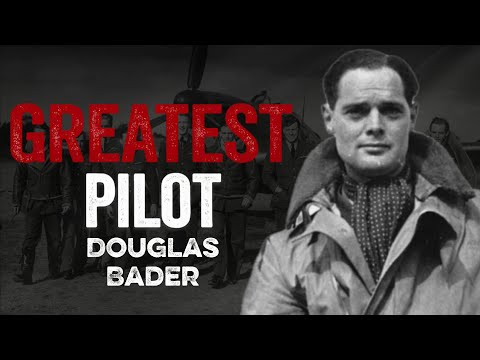
Douglas Robert Stewart Bader was born on February 21, 1910, in St. John’s Wood, London. His father, Major Frederick Roberts Bader, served with the Royal Engineers in World War I and was badly wounded in France—wounds that ultimately killed him in 1922, leaving Douglas fatherless at twelve. His early childhood was unsettled, split between relatives on the Isle of Man and time in India. When the family returned to England, stability remained elusive. His mother remarried, and Douglas grew up in a rectory near Doncaster under a mild stepfather who never truly controlled him. Without strong discipline, Bader became wild and reckless—traits that would never leave him.
Sent to boarding school, first to Temple Grove and later to St. Edward’s School in Oxford, Bader found outlets for his aggression. Sport became central to his identity: rugby, boxing, cricket—anything involving physical dominance or competition appealed to him. He was fearless, stubborn, and intensely competitive, regularly taking on larger opponents and refusing to back down. Teachers found him difficult, but some recognized the force of personality behind the trouble. Aviation first touched his life as a teenager during a visit to RAF Cranwell, yet even then flying was secondary to sport. Only later, encouraged by mentors and driven to test himself, did he pursue the RAF as a career.
In 1928, Bader entered RAF Cranwell as an officer cadet. From the start, he stood out. He was a gifted pilot with sharp instincts and excellent aircraft handling, but also impatient and openly rebellious of rules he considered unnecessary. He reveled in speed and risk, and aerobatics quickly became his passion. Commissioned as a pilot officer in 1930, he joined No. 23 Squadron, flying Bristol Bulldogs and Gloster Gamecocks. His flying was dazzling, but his discipline was appalling. He repeatedly ignored regulations forbidding low-level aerobatics, convinced that skill alone was enough to keep him safe.
That confidence proved fatal on December 14, 1931. While attempting aerobatics at low altitude at Woodley Airfield, Bader clipped a wingtip and crashed. The impact was catastrophic. Both legs were shattered beyond saving, and surgeons amputated one above the knee and the other below. For days he hovered near death, heavily dependent on morphine. Most men would have accepted the end of any flying ambitions. Bader did not.
Even lying in his hospital bed, he refused to see himself as finished. Recovery was slow and agonizing. Learning to walk again on artificial legs demanded relentless effort, but Bader attacked rehabilitation with the same ferocity he applied to everything else. He drove cars, danced, played golf, and eventually persuaded the RAF to let him fly again. In 1932, he proved he could still handle an aircraft, passing flight tests successfully. Despite this, the RAF invalidated him out, citing regulations that did not account for a double amputee pilot. Bitterly disappointed, Bader left the service in 1933 and joined Shell, marrying Thelma Edwards later that year. Outwardly, he resumed civilian life, but privately, he never gave up on returning to the cockpit.
As Europe drifted toward war, Bader repeatedly petitioned the Air Ministry. When war finally came in September 1939, his persistence paid off. Britain could no longer afford to waste experienced pilots. After refresher training, Bader flew solo again in November 1939—eight years after losing his legs. Almost immediately, he returned to old habits, flying aggressively and pushing limits, but this time with an enemy to fight.
Posted to No. 19 Squadron at Duxford, Bader flew the Spitfire and quickly adapted to modern air combat. His lack of lower legs proved unexpectedly advantageous. High-G turns that caused other pilots to gray out did not affect him as severely, allowing him to stay conscious longer in violent maneuvers. During the Battle of France and the Dunkirk evacuation, he scored his first victories, shooting down German fighters and bombers over the Channel. His confidence grew rapidly, and so did his reputation.
In June 1940, Bader was given command of No. 242 Squadron, a demoralized unit largely composed of Canadian pilots who had suffered heavy losses. Many resented their new commander. Bader won them over not with sympathy, but with results. He cut through bureaucracy, demanded excellence, and led from the front. Within weeks, the squadron was transformed.
As the Battle of Britain began in July 1940, Fighter Command faced its greatest test. The Luftwaffe sought to destroy British air defenses ahead of a planned invasion. Radar stations, airfields, and cities came under sustained attack. Bader and his pilots flew multiple sorties a day, often scrambling with little warning into mass formations of enemy bombers escorted by fighters. Combat was brutal and exhausting.
Bader thrived in this environment. He attacked aggressively, often closing to point-blank range before firing. He destroyed Dornier Do 17s, Heinkel He 111s, Junkers Ju 88s, and Messerschmitt fighters, sometimes pressing attacks until ammunition ran out. On more than one occasion, he considered ramming enemy aircraft. His leadership earned him the Distinguished Service Order and the Distinguished Flying Cross. By September 1940, he was one of Fighter Command’s most famous leaders.
He also became one of its most controversial. Bader was a vocal supporter of the big wing tactic advocated by Air Vice-Marshal Mallory. The idea was to assemble large formations of fighters to strike German bomber streams in force. Critics, including Air Vice-Marshal Park, argued that this took too long and risked missing incoming raids.
The debate became deeply personal. Bader was never one to soften his opinions. While the big wing’s effectiveness remains disputed, it cemented Bader’s reputation as a bold and uncompromising commander.
After the Battle of Britain, Bader continued offensive operations over occupied Europe as a wing commander, leading fighter sweeps and bomber escorts over France. He encountered elite Luftwaffe units and aces such as Adolf Galland. Despite mounting fatigue among his pilots, Bader pushed for more sorties, driven by his own relentless energy and desire to lead from the front.
On August 9, 1941, everything changed. Flying a Spitfire over northern France, Bader became separated from his wing and engaged enemy fighters alone. During the fight, his aircraft was destroyed. Whether he collided with a Messerschmitt, was shot down by a German pilot, or fell victim to friendly fire remains unresolved. What is certain is that Bader bailed out at extreme speed, losing one of his artificial legs in the process, and parachuted into occupied France.
Captured by German forces, Bader was treated with unusual respect. Luftwaffe officers, including Galland, admired him as a fellow fighter pilot. Galland even arranged for the RAF to drop Bader a replacement leg by parachute—an extraordinary act of wartime chivalry. Bader accepted the courtesy, then promptly attempted to escape.
Over the next three years, Bader became a constant headache for his captors. He attempted to escape repeatedly, organized resistance, taunted guards, and refused to cooperate. His behavior earned him a transfer to Colditz Castle, the infamous escape-proof camp for incorrigible prisoners. Even there, he continued plotting escapes and provoking German authorities. At one point, the Gestapo considered him so dangerous that they discussed removing his artificial legs permanently.
Bader remained at Colditz until April 1945, when the castle was liberated by American forces. The moment he walked through those gates a free man, he was already thinking about the sky again. He was not a man who looked backward.
After the war, Bader briefly returned to the RAF, leading a massive victory flypast over London and holding senior instructional posts. The sight of him roaring overhead in formation, prosthetic legs and all, became one of the defining images of victory. Yet peacetime service never suited him. He struggled to adapt to the slow rhythms of bureaucracy and retired in 1946 with the rank of group captain.
He returned to Shell, embarking on a successful international business career that allowed him to keep flying and remain involved in aviation. In the decades that followed, Bader became a national icon. His story was immortalized in the book and film Reach for the Sky. Though he privately disliked how the film softened his personality—turning his sharp edges into something more palatable—he became a tireless campaigner for disabled people, proving through his own life that physical disability did not mean diminished ambition. For this work, he was knighted in 1976.
Yet Bader remained a deeply divisive figure. Blunt, outspoken, and politically controversial, he expressed views that alienated many. Admirers saw a fearless leader who never compromised. Critics saw arrogance, intolerance, and an inability to change. Both perspectives were valid. Douglas Bader was not a comfortable hero, but he was an honest one.
He died on September 5, 1982, after suffering a heart attack, aged 72. At his funeral, among the mourners was Adolf Galland, his former enemy and lifelong friend—a symbol of the respect forged between pilots who had once tried to kill each other.
Today, Douglas Bader’s legacy endures not just in the victories scored or medals won, but in the example of a man who refused to accept limitation. He remains one of the most extraordinary, complex, and unforgettable figures of the Second World War. He left a story about defiance and the refusal to accept defeat—a story that continues to challenge, inspire, and provoke debate decades after the engines fell silent.
Even now, decades after his death, Bader’s name still sparks argument. Historians debate the big wing, veterans remember his ruthless drive, and disability advocates point to him as proof that limits are often just other people’s expectations. He was never easy to love—but impossible to ignore.
His greatest victory was not in the air. It was the refusal, again and again, to let a crash, a regulation, or a cage define him. “I never accepted that I was finished,” he once said. That stubbornness cost him friends and made enemies—but it also rebuilt squadrons and inspired a nation.
Douglas Bader was not a comfortable hero, but he was an honest one. And perhaps that is the truest kind of legacy: a life that still makes us argue, still makes us wonder what we would do with our own limits.
So here’s the question: if you lost everything that made you feel whole, would you find a way back to the sky—or would you let the ground keep you? Tell us in the comments below.






