At 11 p.m. on July 15, 1779, Brigadier General Anthony Wayne sat in a cramped farmhouse near the Hudson River, writing what he believed would be his final letter. Outside, 1,200 of the Continental Army’s finest soldiers stood in disciplined silence, their bayonets fixed, waiting for an order they knew nothing about. Wayne had told them nothing—not yet.
The letter was to his closest friend, Sharp Delany. “By morning I will either be breakfasting in the enemy’s fort or in the other world,” he wrote. He asked Delany to care for his children. Then he sealed the letter, rose, and stepped out to lead the most audacious attack of the American Revolution.
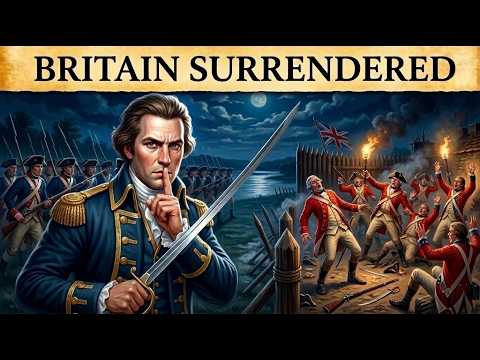
What no one knew that night—not Wayne’s officers, not his men, not even George Washington waiting miles away—was that this attack had been building inside Anthony Wayne for two years. Every detail, from the empty muskets to the silent bayonet approach, was inspired by the worst night of his life: the night that nearly destroyed his career, his reputation, and his mind.
This is the story of how a general humiliated by the British returned to beat them at their own game—in the dark, on a cliff’s edge, with guns that fired not a single shot.
Ten years before that letter, Anthony Wayne was no soldier. He was a surveyor from Chester County, Pennsylvania, measuring land and studying mathematics at the College of Philadelphia. His grandfather had fought alongside William of Orange at the Battle of the Boyne before emigrating; his father, Isaac, had served as an officer in the French and Indian War. Military service ran in the Wayne blood, but young Anthony seemed destined for a quieter life.
In 1765, he sailed to Nova Scotia at age twenty to survey 100,000 acres for a land company. He returned home the next year, married Penrose, opened a tannery, and settled in Westboro as a colonial businessman. But the American Revolution changed everything.
When fighting broke out in 1775, Wayne threw himself into the cause with a fervor that stunned those who knew him as a surveyor and businessman. He helped form a Pennsylvania militia unit and was elected to the state assembly. By early 1776, he had been promoted to colonel and given command of the 4th Pennsylvania Battalion. He led troops through the failed invasion of Quebec, hacking his way through the frozen Canadian wilderness in a campaign that would have broken lesser men. He fought at Three Rivers, where the Americans suffered crushing defeats. He helped hold Fort Ticonderoga when the northern front seemed on the verge of collapse.
He was aggressive, bold, sometimes reckless—in ways that terrified his subordinates as much as the enemy. By 1777, Wayne had been promoted to brigadier general and given command of the Pennsylvania Line, one of the strongest units in Washington’s army. He was thirty-two years old, ambitious, and hungry for a battle that would make his name. He was about to get one—but not the kind he wanted.
September 1777 was a disaster for the Continental Army. Washington’s forces had been defeated at Brandywine, and the British under General William Howe were marching toward Philadelphia, the capital of the Revolution. Washington withdrew across the Schuylkill River to reorganize, but he left Wayne’s Pennsylvania division behind with orders to harass the British rear and try to capture their supply wagons.
Wayne assumed the British didn’t know where he was. He was wrong. Local Loyalists reported his position, and Howe knew exactly where Wayne’s men were camped—just four miles from the British lines near the Paoli Tavern in present-day Malvern, Pennsylvania.
On the night of September 20, Major General Charles Grey led a British strike force directly toward Wayne’s camp. Grey had earned a nickname before the attack even began. He ordered all his men to remove the flints from their muskets so no one would accidentally fire and reveal their approach. The attack would be carried out entirely with bayonets. They called him “No-Flint Grey.”
A local blacksmith, forced to serve as a guide, led the British column through the woods until they reached Wayne’s position directly. The British attacked the camp in three waves. The 2nd Light Infantry led the assault, followed by the 44th Foot and the 42nd Highlanders. A small group of the 16th Light Dragoons accompanied the infantry, swords drawn.
Wayne’s men were completely surprised. Soldiers who had been asleep minutes before scrambled in the dark, trying to load weapons they could barely see, as British bayonets cut through the camp. Some men fled through a gap in the fence at the edge of the camp, while others fell dead before they could stand. The British mixed with the fleeing Americans, and the chaotic fight spread to the White Horse Tavern on the road.
A force of Maryland militia under General William Smallwood approached from the west to help, but the inexperienced troops scattered in chaos when they ran into the rear of the British attack. The fight was short, savage, and one-sided: more than 200 Americans were killed, wounded, or captured, while the British suffered fewer than 20 casualties.
Wayne himself barely escaped, his men scattered, demoralized, and furious. American propaganda soon labeled the attack the Paoli Massacre, claiming the British had shown no mercy to soldiers trying to surrender. The charge wasn’t entirely accurate—the British captured 71 men—but it stuck. Wayne’s troops adopted a battle cry that would follow them for the rest of the war: “Remember Paoli!”
The personal consequences for Wayne were nearly as severe as the tactical ones. He was charged with negligence for allowing the surprise attack. A board of officers cleared him, but Wayne wasn’t satisfied. He demanded a full court-martial to clear his name completely. The court-martial acquitted him with what they called the highest honor, declaring he had done everything expected of an active, brave, and vigilant officer. The acquittal saved his career, but the humiliation never left him.
Wayne had watched British soldiers use the bayonet as a silent weapon of terror against his men, and the memory of that night burned in his mind like a coal. He carried it through the bitter winter at Valley Forge, where his men shivered without proper shelter and he wrote to friends of the snowdrifts that prevented Greenwood from burning. He held his men together through conditions that shattered other units.
Wayne continued through the inconclusive Battle of Monmouth in the summer of 1778, where General Charles Lee abandoned his troops and was surrounded by superior British numbers until Washington himself sent reinforcements. Wayne held, reorganized his men, and kept fighting. A legend later arose that Wayne personally stood over the body of a British officer, Lieutenant Colonel Henry Monckton, who fell in the battle during its worst phase.
But something else happened during those months that proved more important than any single battle. At Valley Forge, a Prussian military drillmaster named Baron Friedrich von Steuben arrived and began transforming Washington’s army from a collection of militias into something resembling a professional European fighting force. Steuben taught the Continental soldiers how to maneuver in formation, how to load and fire with disciplined speed, and—most importantly—how to use the bayonet. Before Steuben, American soldiers had mostly treated the bayonet as a cooking tool, a convenient skewer for roasting meat over a campfire. Steuben taught them to handle it as a weapon.
Wayne listened with intense interest. For a time after Monmouth, the situation seemed stable. The British withdrew to New York City, and Washington set up winter quarters near Middlebrook, New Jersey. The war in the northern theater reached a stalemate. Small skirmishes broke out, but nothing decisive happened. The British turned their attention south, sending forces to capture Savannah, Georgia, and begin operations in the Carolinas.
That calm didn’t last. In late May 1779, British General Sir Henry Clinton sailed up the Hudson River with about 6,000 troops. His target was King’s Ferry, a vital crossing point on the Hudson linking the eastern and western halves of Washington’s supply lines. The ferry was protected by two small American forts, one at Stony Point on the west bank and the other at Verplanck’s Point on the east bank.
The small American garrison at Stony Point, perhaps 40 men, caught one look at Clinton’s fleet and fled. They set fire to the unfinished wooden fort as they withdrew. The British occupied both positions without a fight, hauled cannons up the steep slopes of Stony Point, and began fortifying the rocky peninsula jutting into the Hudson as a clenched fist, rising nearly 150 feet above the water.
Lieutenant Colonel Henry Johnson of the 17th Foot was appointed commander of the Stony Point garrison, about 500 soldiers including infantry and artillery crews, distributed across 15 gun positions along the heights. Clinton was setting a trap. He wanted to draw Washington out of his stronghold at West Point, just 12 miles upriver, and fight in the open where British regulars could destroy him.
Washington recognized the danger and refused to fall into the trap, but he couldn’t ignore Stony Point either. The position threatened West Point and blocked a vital river crossing. Washington needed a solution bold enough to make a difference, yet calculated enough to avoid disaster. So he began gathering intelligence.
First, he sent Captain Allen McLane of Delaware to scout the British defenses. McLane was one of the war’s most skilled spies, and he entered the fort disguised as a local woman visiting her sons, who were supposedly Loyalists serving in the British garrison. Once inside, McLane discovered the fortifications were still incomplete and vulnerable to penetration. He drew a map of what he could and reported back.
Then Washington climbed Buckberg Mountain overlooking Stony Point and studied the British position through a telescope. He used information from local merchants to learn the size of the garrison, the types of passwords the soldiers used, and the locations of the guards on the south side of the peninsula, which couldn’t be seen from the mountain.
What he saw was both encouraging and terrifying. The British defenses weren’t walls in the traditional sense. There was no stone, no masonry. The fortifications consisted of earthen gun positions called “redans” and rows of “abatis”—cut trees with sharpened branches pointing outward like wooden spears, fixed in earthen embankments. The terrain itself was the real defense. The rocky peninsula could only be approached from the west through a narrow defile, and on either side of that defile lay deep tidal marshes flooded at high tide. The position seemed nearly impossible to take by direct assault.
Yet Washington decided to take it. And he chose Anthony Wayne to lead the attack.
This wasn’t a random choice. Washington had watched Wayne for years and trusted his tactical instinct enough to give him a rare privilege in the Continental Army: permission to modify the plan as he saw fit. Wayne had the right qualities for this kind of operation. He was aggressive, fearless, and he had a personal score to settle.
The plan Washington and Wayne built together rested on one radical idea: the attack would be carried out almost entirely with bayonets. The soldiers would carry muskets, but they would be unloaded. Not a single round in the chamber. This wasn’t just symbolism—it was practical. A loaded musket might fire accidentally if a soldier stumbled on the rocky slopes in the dark, and a single unexpected shot could alert the entire British garrison. Silence was everything.
This was also, without question, the same tactic used against Wayne at Paoli two years earlier. The British had removed their flints and attacked with bayonets in the dark. Now Wayne would use their method against them. If Wayne recognized the irony, he didn’t record it. But his men understood. They remembered Paoli.
On the morning of July 15, the core of the light infantry gathered at Sandy Beach, north of Fort Montgomery. These weren’t ordinary Continental soldiers. The light infantry was an elite seasonal unit selected from the best companies in Washington’s army—handpicked veterans who had fought for two, three, or even four years. They had trained under Wayne for weeks, and they had been honed by Baron von Steuben’s training reforms at Valley Forge. The first copies of Steuben’s military manual had reached the highlands just in time for the light infantry to use in their final preparations.
At noon, they began a 15-mile march over Dunderberg Mountain and through narrow passes south toward Stony Point. For eight hours, the column struggled along rocky trails barely wide enough for two men abreast. Wayne ordered any civilians encountered along the route to be detained immediately and held until after the battle to prevent word reaching the British. The approach to the farms was silent, and anyone found on the road was arrested without explanation.
The men still didn’t know their target. Wayne kept the destination secret until the last moment, and the tension of marching toward an unknown battle in the gathering dusk added to the soldiers’ suffering with every mile. By 8 p.m. that evening, the entire force had assembled at Springsteel Farm, less than two miles from the British outer defense line. Only then were the soldiers told what they were about to do.
Their reaction was a mix of determination and fear. They would attack a fortified position on a cliff top in the dark without being able to fire a shot. Some officers exchanged glances. Wayne read his daily orders aloud, and the men absorbed the reality of what was being asked of them.
Wayne divided his 1,200 men into three columns. The main column, about 700 soldiers including the 1st and 3rd Light Infantry regiments, would attack from the south, advancing along the riverbank below the fort. Wayne would lead this column himself. A second column of 300 men under Colonel Richard Butler would attack from the north, while a smaller force of about 150 North Carolina soldiers under Major Hardy Murfree would launch a diversionary attack in the center across the bridge, where the British expected any attack to come.
The two flanking columns were to attack in complete silence using only bayonets. Murfree’s men in the center were the only soldiers authorized to fire. Their gunfire would signal the flanking columns to begin their advance, and the noise would draw British attention and reinforcements toward the center, away from the real attack.
Each flanking column was led by a group of 20 volunteers called the “Forlorn Hope.” The name wasn’t metaphorical—it was a military term borrowed from the Dutch, and its meaning was perfectly clear. These were the men who would go first, armed with axes and their unloaded muskets, their job to hack through the sharpened barriers so the columns behind them could pass. To volunteer for the Forlorn Hope was to volunteer to be the first to die.
Wayne offered cash rewards to motivate them: $500 for the first soldier to successfully enter the British fortifications, $400 for the second, $300 for the third, and so on down to $100 for the fifth. The money was to be paid regardless of whether the soldier survived. To recognize each other in the dark, each man pinned a square piece of white paper to the front of his hat. The prearranged recognition signal, to be shouted once they entered the fort, was a simple phrase that would echo across the Hudson before sunrise.
The men received a ration of rum. Some, like Wayne, wrote their wills and final letters. Then they formed ranks with bayonets fixed, and the Forlorn Hope moved to the front. At 11:30 that night, the word came. They marched.
The weather favored them. Clouds blocked the moonlight, and strong winds forced the British warships anchored in Haverstraw Bay to retreat downriver, removing a layer of naval defense that could have been devastating. The darkness was nearly total.
Wayne’s southern column reached the marshy flats below the fort and discovered the water was deeper than expected. The men waded through mud and tidal water that reached their waists, and in some places their chests, holding their useless muskets above their heads. It took 30 agonizing minutes to cross the flooded ground and reach the first line of abatis.
At midnight, Murfree’s diversionary force opened fire from the bridge. The crack of muskets shattered the silence, and British guards immediately began firing back toward the center of their defenses. Lieutenant Colonel Henry Johnson, the British garrison commander, did exactly what Wayne had expected. He rushed six companies of the 17th Foot toward the bridge to repel what he believed was the main attack.
While Johnson looked in the wrong direction, Wayne’s men surged up the southern slope. The Forlorn Hope attacked the sharpened fortifications with axes, cutting and tearing at the obstacles, as British soldiers finally spotted dark shapes moving on the flanks and began firing at the mass of men pushing up through the rocks. The bright flashes of muskets lit the darkness. Musket balls whined through the air.
Wayne was near the front of the southern column when a British musket ball struck him in the head. He fell to the ground, bleeding and dazed. The ball had grazed his scalp instead of penetrating his skull, but the wound was ugly and disorienting. Any other commander might have been carried to the rear. Wayne refused. From the ground, covered in blood and half-blind, he shouted the order that would make his name: “Carry me into the fort! If the wound is fatal, I will die at the head of the column!”
His men carried him forward. Colonel Christian Febiger took operational command of Wayne’s column, while Butler’s northern force, coming from the opposite direction, breached their section of the abatis. Both columns broke through the British inner defenses at almost the same moment. The British cannons, positioned at the top to defend against this kind of attack, couldn’t be angled low enough to fire on the soldiers climbing the slopes directly below them. The guns were useless.
Inside the fortifications, the fighting was savage and close. Bayonet against bayonet in near-total darkness, friend and foe distinguished only by the white paper squares on their hats. Lieutenant Colonel François de Fleury, a French engineer serving with the Americans, reached the upper British fortifications first. He seized the British flag flying over the position and tore it down. Behind him came Lieutenant George Knox, then Sergeants Baker, Spencer, and Dunlop, pouring through the gap as the prearranged cry rose: “The fort’s our own! The fort’s our own!”
Johnson realized too late that his garrison was being overrun from two directions while his best troops were pinned at the bridge, fighting a diversionary battle. In the chaos, British soldiers fired on each other. Within 25 minutes of the first shots, it was over. Johnson surrendered to Febiger. The entire garrison fell into captivity.
The final tally was brutal: 15 Americans killed and 83 wounded. The British lost 20 killed, 74 wounded, and 472 captured. Wayne’s core force had stormed a fortified position on a cliff in total darkness with empty muskets and taken it in less than half an hour.
What happened next reveals as much about Wayne and his men as the battle itself. At Paoli, American propaganda had accused the British of massacring soldiers trying to surrender. Whether those charges were fully justified or not, Wayne’s men had every right to want revenge. They had been shouting “Remember Paoli!” for two years. But there was no massacre at Stony Point. Wayne’s soldiers spared every British soldier who surrendered, treated the wounded, and took prisoners instead of taking vengeance. British Commodore George Collier later wrote that the Americans showed a generosity and mercy unprecedented during the rebellion. Even King George III himself was reportedly moved by the mercy shown to his captured soldiers.
Before dawn, Wayne sent a message to George Washington that still echoes today: “The fort and garrison under Colonel Johnson are ours. Our officers and men behaved like men determined to be free.”
Washington rode to Stony Point the next day to inspect the captured position and congratulate the troops. But he also made a careful strategic calculation. The fort was too isolated to hold against British naval forces that could sail upriver at any time. He ordered the fortifications destroyed and the captured artillery, ammunition, and supplies removed. Two days after the battle, the Americans abandoned Stony Point, and the British reoccupied it within a week.
Strategically, the battle changed little on the map. The British rebuilt the fortifications with a different design, this time under the supervision of Captain Patrick Ferguson. They controlled both sides of King’s Ferry until October, then withdrew to New York on their own schedule. The war wasn’t decided at Stony Point—no territory was liberated, no British army was destroyed. The loss of the 17th Foot and the grenadier companies of the 71st as effective combat units did affect Clinton, but it wasn’t a knockout blow.
But that wasn’t the real objective. The real victory was psychological. The Continental Army had proven it could match the British at their most terrifying tactic—the disciplined nighttime bayonet assault—and even surpass them. Stony Point validated everything Washington and Steuben had built since Valley Forge. The exhausted, frozen, starving army that had barely survived the winter of 1778 was gone. In its place stood a professional fighting force capable of planning and executing one of the most technically complex operations of eighteenth-century warfare.
General Charles Lee, no friend of Washington, described the attack as not only the most brilliant during the entire war on either side, but one of the most brilliant he had ever seen in history. Congress awarded Wayne a gold medal—one of only 11 granted during the American Revolution. De Fleury and Major John Stewart received silver medals. Lieutenants Gibbons and Knox were promoted to brevet rank. Wayne’s light infantry became a legend in the army.
As for Wayne himself, the nickname he earned at Stony Point stayed with him for life. They called him “Mad Anthony”—not because he was insane, but because the attack seemed so recklessly bold that only a madman would attempt it. Yet it worked.
Wayne kept fighting. He served through the rest of the Revolution, helped suppress a mutiny in the Pennsylvania Line, fought in Virginia, and was present during the siege of Yorktown when Cornwallis surrendered in 1781. After the war, he negotiated treaties with the Creek and Cherokee nations in Georgia and received a plantation in recognition of his efforts. In 1794, President Washington called on him again to deal with British-backed resistance in the Northwest Territory. Wayne won the Battle of Fallen Timbers near present-day Toledo, Ohio, and secured the Treaty of Greenville, which opened much of modern Ohio and Indiana to American settlement.
He died on December 15, 1796, at age 51 at a frontier post in Erie, Pennsylvania, after serving his country for more than 20 years since first putting on a uniform. He was buried there initially, and his remains were later moved to his family plot at St. David’s Church in Radnor, Pennsylvania, near the Chester County land where he grew up.
Today, there are more places named for Anthony Wayne in the United States than almost any other figure of the Revolution. Counties, towns, schools, a university in Detroit, a fort in Indiana. Twenty-one townships in Ohio alone bear his name. But the moment that earned him all of it was 30 minutes of darkness on a rocky cliff above the Hudson River, where a man broken by the bayonet picked up the same weapon and used it to reclaim everything he had lost.
Stony Point is a state historic site in Rockland County, New York today. The cliffs still stand. The river still runs below them. And every July, reenactors gather to commemorate what happened on that peninsula, when 1,200 men crossed a marsh in the dark, climbed a fortress with empty weapons, and changed the meaning of American soldiering.
Wayne’s letter to Delany was never needed. By sunrise, he was not in the other world but standing inside the captured fort, his head bandaged, his name immortal. The British bayonet that had shattered his men at Paoli had been turned against them, and the student had become the master.
“The fort and garrison are ours,” he had written to Washington, and with those words, the Continental Army proved it could match the British in the dark, with cold steel and silent discipline.
Stony Point was abandoned within days, but the psychological blow echoed through the war. Wayne’s light infantry became a legend, and “Mad Anthony” a name that would never fade. He fought on until Yorktown, then served his young nation in peace and war, dying at fifty-one with his boots on.
Today, twenty-one townships in Ohio alone bear his name, but the true monument is the cliff above the Hudson, where every July, reenactors gather to remember the night a broken man reclaimed his honor with the weapon that had broken him.
What do you think was the most decisive moment of the American Revolution—was it a battle like Stony Point, or something else entirely? Share your thoughts below.






