Most people think they know the story of the 2008 financial crisis. They’ll tell you it was about greedy bankers making risky bets with other people’s money, or reckless homeowners borrowing more than they could afford, or Wall Street being Wall Street. And yeah, those things are all part of the picture. But here’s the thing: the version most people have in their heads—the version that’s been told and retold in documentaries and textbooks and political speeches—it’s not wrong exactly, but it’s dangerously incomplete. It misses the architecture. It skips over the decisions made in quiet rooms years before anyone had heard the word subprime. Decisions that deliberately dismantled every guardrail that stood between the American financial system and total catastrophe.
Because the 2008 crash didn’t happen the way a natural disaster happens, randomly and without warning. It was engineered piece by piece, law by law, handshake by handshake, by the very people who were supposed to be protecting the system. And the most unsettling part—the part that historians rarely emphasize—is that someone saw it coming. Someone tried to stop it. And she was silenced.
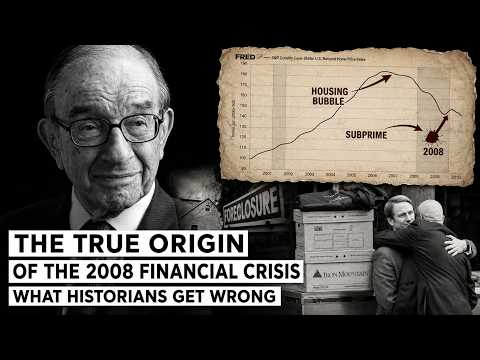
So today, we’re going to take a different kind of look at the worst financial crisis since the Great Depression. We’re going to go deeper than the usual narrative, past the headlines and the courtroom theatrics and the images of bankers carrying cardboard boxes out of Lehman Brothers. We’re going to trace the roots of this disaster back to where they really began: in the halls of Congress, in the boardrooms of the Federal Reserve, in the lobbying campaigns that most people have never heard of. And what you’ll find is a story that’s far more disturbing than the one you’ve been told.
Let’s start where most accounts of this crisis begin: in the American housing market. Because in fairness, the housing bubble is genuinely where the fuse was lit. But we need to understand what made that fuse possible in the first place.
For generations, home ownership was the foundation of the American dream. Federal policy had been backing the mortgage market since at least the 1930s, when the government first stepped in to support lending after the devastation of the Great Depression. The logic was straightforward. If ordinary Americans could own homes, they’d have stability. They’d buy appliances, cars, furniture. They’d invest in their neighborhoods. The economy would grow and everyone would benefit. After the Second World War, the GI Bill sweetened the deal even further, offering veterans cheap home loans. Suburbs exploded outward from every major city. New houses, new driveways, new lives. And for decades it worked remarkably well.
But somewhere along the way, the machinery that supported home ownership mutated into something unrecognizable. The system that had been designed to help middle-class families build stable lives was gradually hijacked and turned into a profit engine for Wall Street. And this transformation didn’t happen overnight. It happened through a series of deliberate policy choices that stretches back further than most people realize.
Now here’s where we need to challenge the popular narrative, because the standard version of events goes something like this: reckless bankers made bad loans. They packaged those loans into complicated securities. Nobody understood the risks. And then the whole thing blew up. That’s the short version. And it’s the version that politicians on both sides of the aisle have found convenient to repeat, because it gives them clear villains—the bankers—and clear victims—the homeowners—and it conveniently leaves out the most important characters in the story: the politicians and regulators who deliberately created the conditions for disaster.
Let’s go back to 1999. Bill Clinton is in the White House. The economy is roaring. The dot-com bubble hasn’t burst yet. Unemployment is low. Markets are surging. And in Washington there’s this prevailing wisdom—almost a religion, really—that markets are self-correcting. That the less government interferes with the financial system, the better off everyone will be. This ideology isn’t new. It’s been building since the Reagan era. But by the late ’90s it has reached a kind of fever pitch.
And it’s in this environment that one of the most consequential pieces of legislation in modern American history gets passed. On November 12th, 1999, President Clinton signs the Gramm-Leach-Bliley Act into law. Now this might sound like just another piece of boring legislation with a forgettable name. But this law effectively dismantled the Glass-Steagall Act, a Depression-era firewall that had kept commercial banks, investment banks, and insurance companies separated for nearly seven decades.
Now, here’s where the conventional narrative gets it wrong, and this is crucial. A lot of people will tell you that the repeal of Glass-Steagall caused the 2008 crisis. Politicians have campaigned on this claim, entire movements have been built around it, and it’s become one of those things that people repeat so often that it’s accepted as fact. But the reality is far more complicated. Former Federal Reserve Chairman Ben Bernanke himself has called Glass-Steagall’s repeal irrelevant to the crisis, and he has a point. Think about it. The institutions that actually collapsed in 2008—Bear Stearns, Lehman Brothers—these were stand-alone investment banks. They weren’t combined commercial-investment hybrids created by the repeal of Glass-Steagall. Wachovia and Washington Mutual, the commercial banks that failed, went down because they made terrible real estate loans, something that Glass-Steagall wouldn’t have prevented. And AIG, the insurance giant that required a $182 billion bailout, wasn’t a bank at all.
So, does that mean the repeal didn’t matter? Absolutely not. But not for the reasons most people think. The real damage of the Gramm-Leach-Bliley Act wasn’t the specific mergers it allowed. It was the signal it sent. It was a declaration broadcast to every trading floor and boardroom in America that the era of financial regulation was over, that the government wasn’t just stepping back—it was getting out of the way entirely. And more importantly, the repeal unleashed an acquisition spree that created financial institutions so enormous, so interconnected that when one of them stumbled, the entire system shook. These weren’t just banks anymore; they were sprawling conglomerates, too big to fail and too complex to manage. By 2007, some of these institutions were leveraged more than 33 to 1, meaning that a mere 3% decline in their asset values would effectively wipe them out.
But here’s the thing: the Gramm-Leach-Bliley Act was just one piece of a much larger deregulatory puzzle. And the next piece—arguably the most destructive of all—has received far less attention in the popular telling of this story.
Thirteen months after Glass-Steagall was repealed, in the final days of December 2000, Congress passed another bill. This one was 262 pages long, buried inside an 11,000-page spending package, rushed through a lame-duck session with almost no debate, and certainly no time for anyone to actually read the thing. It was called the Commodity Futures Modernization Act, and it is, in many ways, the real smoking gun of the 2008 crisis.
What this law did was deceptively simple. It ensured that over-the-counter derivatives—these exotic financial instruments that very few people understood—would remain completely, utterly, deliberately unregulated. No oversight, no transparency, no capital requirements, no accountability. The Commodity Futures Trading Commission, the federal agency that was supposed to be watching this market, was explicitly banned from doing its job. The law didn’t just leave derivatives unregulated; it made regulating them illegal.
Now, to understand why this matters so much, you need to understand what derivatives are and how they came to eat the financial system alive. A derivative is essentially a bet. It’s a contract whose value is derived from something else—an interest rate, a commodity price, a bond, a basket of mortgages. They can be used to manage risk, which is their legitimate purpose. A farmer can use derivatives to lock in the price of his wheat harvest, for example. An airline can hedge against rising fuel costs. That’s perfectly reasonable. But derivatives can also be used to speculate, to make enormous, highly leveraged bets on the future direction of virtually anything. And when they’re unregulated, when there’s no one keeping track of who owes what to whom, when there are no requirements to set aside capital to cover potential losses, the market doesn’t just grow—it metastasizes.
By the eve of the crisis, the notional value of the global derivatives market had swollen to approximately $600 trillion. Just pause on that number for a moment. $600 trillion. That’s roughly 10 times the entire GDP of the planet. Now, notional value isn’t the same as actual money at risk, but it gives you a sense of the sheer scale of speculation that was happening in a market with essentially zero oversight.
The most consequential of these derivatives were credit default swaps—instruments that function like insurance policies on bonds and loans. You could buy a credit default swap to protect yourself if a particular bond defaulted. The seller of the swap would collect regular premiums and, in exchange, they promised to pay you the full value of the bond if things went south. Simple enough in theory. But here’s the critical detail that turns this from a risk management tool into a weapon of financial destruction: unlike actual insurance, you didn’t need to own the underlying asset to buy a credit default swap on it. This would be like your neighbor taking out a fire insurance policy on your house. They have no stake in the house. They have no responsibility for maintaining it. In fact, they have every incentive to see it burn. And that’s precisely what happened in the derivatives market. Speculators who had no exposure to the underlying mortgages were placing massive bets that those mortgages would fail. And the more bets they placed, the more money they’d make when the housing market collapsed.
Now, the company at the very center of this disaster was AIG, the American International Group, which was at the time the largest insurance company in the world. Through its financial products division, based not in New York but in London—beyond the easy reach of American regulators—AIG had sold roughly $500 billion worth of credit default swaps. They were essentially insuring the entire mortgage market, collecting billions in premiums while assuming they’d never actually have to pay out. And why did they believe this? Because the assets they were insuring—collateralized debt obligations built from pools of mortgages—carried AAA ratings from the major credit rating agencies. AAA, the same rating given to the United States government. Between 2002 and 2007, Moody’s alone stamped its AAA approval on nearly 45,000 mortgage-related securities. In 2006 alone, Moody’s was approving 30 of these securities every single working day. But these ratings were, to put it politely, a fantasy. The rating agencies were being paid by the very banks whose products they were evaluating. It was like having a restaurant critic who gets paid by the restaurants he reviews. The incentive to give everything five stars was overwhelming, and that’s exactly what they did.
So, you have this extraordinary situation. Banks are making riskier and riskier mortgages because they know they can immediately sell them off. The mortgages get bundled into securities and rated AAA. Those securities are then insured by credit default swaps sold by AIG, which doesn’t set aside nearly enough capital to cover its bets. And the entire structure—this towering, interconnected house of cards—is operating in a market that Congress has deliberately placed beyond the reach of any regulator.
But here’s what makes the story truly tragic. It didn’t have to happen this way. Because there was someone who saw the danger, who understood exactly where this was headed, and who tried to stop it. And her name was Brooksley Born.
Born was appointed chair of the Commodity Futures Trading Commission in 1996. She was a brilliant lawyer, the first woman to be president of the Stanford Law Review, a partner at one of Washington’s most prestigious law firms, and an expert in derivatives. When she arrived at the CFTC and began examining the over-the-counter derivatives market, she was alarmed by what she found. A market that had exploded from roughly $4.5 trillion to $28 trillion in just four years, with essentially no one watching.
In the spring of 1998, Born issued what’s called a concept release—a set of questions asking whether the derivatives market should be subject to some basic regulation. Not new laws, not restrictions, just questions. What happened next is one of the most shameful episodes in modern American regulatory history.
Within hours, Federal Reserve Chairman Alan Greenspan, Treasury Secretary Robert Rubin, and SEC Chairman Arthur Levitt issued a joint statement expressing their grave concerns. Three of the most powerful financial regulators in the world ganging up on a fourth—not because she’d done something reckless, but because she’d had the audacity to ask whether maybe, just maybe, someone should be keeping an eye on a market growing at an exponential rate.
Larry Summers, then Rubin’s deputy at Treasury, was even more aggressive. According to multiple accounts, Summers called Born directly to berate her. One of Born’s top aides, Michael Greenberger, described the scene. Born hung up the phone, the blood drained from her face. Summers had told her she was going to cause the worst financial crisis since the end of the Second World War. His message was simple and blunt: “Stop right away. No more.”
Think about the irony of that for a moment. The man warning that regulation would cause a financial crisis was unwittingly describing the crisis that the absence of regulation would actually produce just a decade later.
Born released her concept paper anyway. Within weeks, Greenspan, Rubin, and Levitt jointly urged Congress to impose a moratorium on the CFTC regulating over-the-counter derivatives. And Congress, ever responsive to Wall Street lobbying, obliged.
Then, five months later, something happened that should have vindicated Born completely. A hedge fund called Long-Term Capital Management, which had made massive, highly leveraged bets using the very derivatives Born had been warning about, collapsed spectacularly. The Federal Reserve had to orchestrate a $3.6 billion bailout involving 14 of Wall Street’s biggest banks to prevent a cascade of defaults that could have destabilized the entire financial system. It was a dress rehearsal for 2008, a clear and unmistakable warning.
And the response from Washington? Nothing. No new regulations, no investigation into the derivatives market. In fact, the opposite happened. In 2000, the year after Born left the CFTC, Congress passed the Commodity Futures Modernization Act, which didn’t just maintain the status quo of non-regulation—it actively stripped the CFTC and the SEC of any authority to regulate over-the-counter derivatives going forward. The bill was sponsored by Senator Phil Gramm, the same man behind the Gramm-Leach-Bliley Act, and was signed by President Clinton in his final days in office. The derivatives genie was now not just out of the bottle—the bottle had been smashed and the pieces scattered.
Now, let’s trace how all of these policy failures converge to create the actual crisis. Because the mechanics of the collapse are just as important as the political decisions that enabled it.
By the early 2000s, the American housing market was entering one of the most extraordinary periods of speculation in economic history. Home prices were rising at rates that defied all historical precedent. Between 1997 and 2006, the price of a typical American house increased by 124%. In some markets, prices were doubling in just a few years. This wasn’t happening naturally. It was being actively engineered by a financial system that had discovered it could make enormous profits by turning mortgages into securities and selling them to investors around the world.
Here’s how the machine worked. A family walks into a bank and applies for a mortgage. In the old days, the bank would carefully evaluate the borrower because the bank was going to be stuck with that loan for 30 years. If the borrower defaulted, the bank lost money. So, the bank had every incentive to make sure the borrower could actually afford the payments. But by the early 2000s, that incentive structure had been completely inverted.
The bank no longer intended to hold the mortgage. Instead, it would sell the mortgage almost immediately to an investment bank, which would pull it together with thousands of other mortgages into a mortgage-backed security. The security would then be sliced into tranches, rated by the credit agencies, and sold to investors. And here’s the key. Once the bank sold the mortgage, it no longer cared whether the borrower could pay. The risk had been transferred. The bank collected its fees and moved on to the next loan. This created a perverse incentive to make as many loans as possible, regardless of quality. And that’s exactly what happened.
Lending standards collapsed. By 2006, nearly a quarter of all mortgages being originated in the United States were subprime—meaning they were made to borrowers with poor credit histories, insufficient income documentation, or both. Some lenders were issuing what were called NINJA loans—No Income, No Job, No Assets. Others offered adjustable-rate mortgages with seductively low introductory rates that reset to levels the borrower couldn’t possibly afford. The lenders didn’t care because they weren’t keeping the loans. The investment banks didn’t care because they were making billions in fees from packaging and selling the securities. The rating agencies didn’t care because they were being paid by the banks to rubber-stamp everything AAA. And the regulators—well, the regulators had been told to stand down.
Now, here’s where the story gets even more twisted, and this is an element that most popular accounts of the crisis completely overlook. It wasn’t just that bad mortgages were being made and securitized. The financial system had created a mechanism to amplify the damage exponentially, and that mechanism was the synthetic collateralized debt obligation.
A regular CDO was a pool of actual mortgages. A synthetic CDO contained no mortgages at all. Instead, it was made entirely of credit default swaps—bets on whether pools of mortgages would default. This meant that for every dollar of actual mortgage risk in the system, Wall Street could create unlimited additional dollars of exposure through synthetic instruments. Between 2004 and 2007, Goldman Sachs alone packaged and sold $73 billion in synthetic CDOs that referenced more than 3,400 mortgage securities, with 610 of those securities appearing at least twice.
So, the losses from actual mortgage defaults—which were enormous in themselves—were multiplied many times over by these synthetic bets. When the housing market turned, the damage wasn’t proportional to the actual bad loans. It was proportional to the entire web of derivatives that had been woven around those loans. And because none of this was happening on any regulated exchange, nobody—not the banks, not the regulators, not the Treasury—nobody knew the full extent of the exposure.
This is the critical piece that most historical accounts understate. The crisis of 2008 wasn’t really a housing crisis. Housing was the trigger, but the bullet was derivatives. Without the unregulated derivatives market, the housing downturn would have been painful—certainly. Banks would have lost money, homeowners would have defaulted, but it would have been a manageable recession, not a near-collapse of the global financial system. It was the derivatives—the credit default swaps, the synthetic CDOs, the entire shadow banking apparatus that had been deliberately shielded from regulation—that transformed a serious real estate correction into the worst economic catastrophe in 70 years.
By mid-2007, the cracks were becoming impossible to ignore. Two Bear Stearns hedge funds that had invested heavily in subprime mortgage securities collapsed. In August, BNP Paribas, the French banking giant, froze three investment funds because it said it could no longer accurately value their holdings of American mortgage-backed securities. The credit markets began to seize up.
And yet, incredibly, the prevailing wisdom in Washington was that the problem was containable. In March of 2007, Federal Reserve Chairman Ben Bernanke testified before Congress that “the impact on the broader economy and financial markets of the problems in the subprime market seems likely to be contained.” Contained. That word would become the most infamous misjudgment since “peace in our time.”
By September 2008, the system was in full-blown cardiac arrest. Lehman Brothers, which had been in existence since 1844, collapsed under the weight of $39 billion in toxic real estate assets. It was the largest bankruptcy in American history, with over $600 billion in assets. The government decided to let Lehman fail—a decision that sent shockwaves through every financial market on Earth.
The next day, AIG’s credit rating was downgraded. Immediately, collateral calls on its credit default swap portfolio surged to $32 billion, and its shortfall hit $12.4 billion—an almost incomprehensible change from $8.6 billion just days earlier. AIG couldn’t pay. The Federal Reserve stepped in with an $85 billion emergency loan, eventually ballooning to $182 billion. This wasn’t a bailout of AIG per se. It was a bailout of every bank and institution that had bought credit default swaps from AIG. If AIG went down, they’d all go down. Goldman Sachs alone had approximately $20 billion in transactions with AIG.
The dominoes were falling. Merrill Lynch, one of the most storied names in American finance, was absorbed by Bank of America in a forced merger. Washington Mutual, the largest savings institution in the country, was seized by regulators and sold to J.P. Morgan Chase in the largest bank failure in American history. Wachovia, the fourth-largest bank in the nation, teetered on the edge before being acquired by Wells Fargo.
Within weeks, the Dow Jones Industrial Average had plunged nearly 40%. Global stock markets lost approximately $17 trillion in value. 8.7 million Americans lost their jobs. Nearly 10 million lost their homes. Household net worth in the United States declined by $13 trillion in the first year of the crisis alone. It would take the better part of a decade for most Americans to recover what they’d lost, and some never would.
Now, here’s where we need to talk about what historians consistently get wrong about this crisis—or at least what they consistently under-emphasize. The dominant narrative frames the crisis as a failure of markets. Greedy bankers took excessive risks, and the system crashed. And that’s true, as far as it goes. But it treats the crisis as though it were primarily a private sector failure—as though the government was an innocent bystander that simply failed to act in time.
The reality is almost the exact opposite. The government wasn’t a bystander. It was an active participant in creating the conditions for catastrophe. Every guardrail that could have prevented or mitigated the crisis was deliberately dismantled by government policy. Glass-Steagall was repealed by an act of Congress. The derivatives market was explicitly deregulated by an act of Congress. The one person who tried to sound the alarm was systematically silenced by the most powerful economic officials in the government. The SEC under Chairman Christopher Cox reduced oversight of the major investment banks through a program called the Consolidated Supervised Entities program, which essentially allowed Bear Stearns, Lehman Brothers, Goldman Sachs, Morgan Stanley, and Merrill Lynch to regulate themselves. The Federal Reserve under Greenspan kept interest rates extraordinarily low for years after the dot-com bust, flooding the system with cheap money that had to go somewhere—and it went into real estate.
This wasn’t a failure of regulation in the sense of regulators being asleep at the switch. This was a deliberate, ideological, systematic dismantling of the regulatory framework. And the people who dismantled it weren’t shadowy conspirators. They were the most respected, most honored, most celebrated figures in American economic life. Greenspan was treated as an oracle, a near-deity of monetary policy. Rubin was considered the wisest financial mind in government. Summers would go on to be a Harvard president and a top economic advisor to President Obama. These were the architects of the disaster, and most of them faced no consequences whatsoever.
In fact—and this is perhaps the most disturbing element of the entire story—many of the people who created the conditions for the crisis were subsequently put in charge of cleaning it up. Larry Summers became the director of the National Economic Council under President Obama. Timothy Geithner, who as president of the New York Federal Reserve had overseen Wall Street in the years leading up to the crash, was made Treasury Secretary. The same foxes who’d helped demolish the henhouse were now put in charge of rebuilding it.
Meanwhile, on the other side of the ledger, accountability was virtually nonexistent. The Financial Crisis Inquiry Commission, established by Congress to investigate the causes of the crisis, issued three separate reports split along partisan lines, each blaming different causes depending on political ideology. The majority blamed deregulation and Wall Street greed. A Republican minority blamed the credit bubble and government housing policies. A second Republican dissent focused narrowly on the housing bubble itself. There was no consensus, no unified diagnosis, and crucially, no criminal accountability. Of the major Wall Street executives who presided over the crisis, essentially none went to prison for their role in the catastrophe.
The banks paid large fines, certainly. By 2014, the 60 largest financial institutions had settled more than 200 securities fraud suits and over 40 predatory lending suits, paying nearly $80 billion in total penalties. But $80 billion is a rounding error for institutions that had profited by trillions during the bubble years. And it came out of shareholders’ pockets, not the executives’ personal fortunes. The message was clear: you can gamble with the global economy, crash it, get bailed out by taxpayers, and walk away with your bonus intact.
There’s another dimension to this story that’s often overlooked, and that’s the global nature of the crisis. This wasn’t just an American event. The housing bubble and the derivatives market had created a web of financial contagion that stretched across the entire planet. European banks had gorged themselves on American mortgage-backed securities, and when those securities went bad, the crisis leapt across the Atlantic with devastating speed. Iceland’s entire banking system collapsed. Ireland was forced to guarantee every bank deposit in the country to prevent a total run. Greece, already fiscally fragile, was pushed into a debt crisis that would reshape European politics for a generation. Spain’s housing bubble, inflated by many of the same dynamics that had driven the American one, burst spectacularly. Unemployment in some European countries exceeded 25%.
The global dimensions of the crisis reveal something important about what historians get wrong. This wasn’t primarily a story about American homeowners who borrowed too much—though that happened. It wasn’t primarily a story about greedy bankers—though they were certainly greedy. At its core, this was a story about the deliberate construction of a global financial system that was designed to be opaque, unregulated, and fantastically profitable for a tiny number of insiders—and about what happens when that system encounters reality.
The 2008 crisis also reveals a deeper structural truth about the relationship between government and finance that most accounts barely touch. The revolving door between Wall Street and Washington wasn’t just a symptom of corruption. It was the mechanism by which the financial industry captured the regulatory apparatus and turned it to its own purposes. Robert Rubin left his position as co-chairman of Goldman Sachs to become Treasury Secretary. After leaving Treasury, he joined Citigroup, where he was paid over $126 million over the next decade, while the bank loaded up on precisely the kind of toxic assets that the deregulation he’d championed had enabled. Citigroup would eventually require $45 billion in taxpayer bailout funds. Henry Paulson left his position as CEO of Goldman Sachs to become Treasury Secretary under George W. Bush, and it was from that position that he oversaw the bailout of AIG—which conveniently ensured that Goldman Sachs, AIG’s largest counterparty, was paid 100 cents on the dollar for its credit default swap contracts. There was no haircut, no negotiation, no shared sacrifice. Goldman got every penny.
These aren’t conspiracy theories. These are documented facts. And yet they’re consistently underplayed in mainstream accounts of the crisis, which tend to focus on the mechanics of mortgage-backed securities and CDOs while treating the political economy as background noise. But the political economy wasn’t background noise. It was the main event.
So, what are the real lessons of 2008? Not the sanitized, textbook lessons about the importance of financial regulation—though that’s certainly true. The deeper lessons.
First, the crisis revealed that the ideology of self-regulating markets—the belief that sophisticated financial professionals can be trusted to police themselves—was catastrophically wrong. Not just modestly mistaken, but fundamentally, philosophically, disastrously wrong. The people running these institutions didn’t understand the risks they were taking. Bear Stearns didn’t understand its exposure. Lehman Brothers didn’t understand its exposure. AIG certainly didn’t understand its exposure. The head of AIG Financial Products, Joseph Cassano, repeatedly assured investors that the company’s credit default swap portfolio was perfectly safe, even as it was hemorrhaging tens of billions of dollars.
Second, the crisis exposed the danger of financial complexity as a deliberate strategy. The instruments at the center of the crisis—the CDOs, the CDO-squareds, the synthetic CDOs, the credit default swaps—these weren’t complex by accident. They were complex by design. Complexity served two purposes. It allowed the banks to extract enormous fees from investors who couldn’t fully understand what they were buying, and it made the system so opaque that even regulators couldn’t see where the risks were accumulating. When the Financial Crisis Inquiry Commission asked regulators and bank executives to explain these products, many of them couldn’t.
Third, and most disturbingly, the crisis demonstrated that the financial system has the ability to capture the political process and use it to serve its own interests, even when those interests directly contradict the public good. The lobbying campaign that destroyed Brooksley Born’s attempt to regulate derivatives wasn’t just about protecting profits. It was about ensuring that the most dangerous market in the world remained invisible, unaccountable, and enormously profitable for the people running it.
Now, some might argue that the Dodd-Frank Wall Street Reform Act, passed in 2010, addressed these problems, and it did—to a degree. Dodd-Frank required derivatives to be traded on regulated exchanges. It established the Consumer Financial Protection Bureau. It created mechanisms for winding down failing financial institutions without taxpayer bailouts. These were genuine improvements. But Dodd-Frank was compromised from the start, weakened by industry lobbying before it was even signed into law. And in the years since its passage, significant portions of it have been rolled back. The same arguments that were used to deregulate the system in the 1990s—that regulation stifles innovation, that it puts American firms at a competitive disadvantage, that sophisticated markets don’t need government oversight—those arguments are being made again today by many of the same people, using the same language, backed by the same money.
The economist Hyman Minsky, who spent his career studying financial instability, had a concept that’s become known as the Minsky moment. He argued that stability itself is destabilizing. When times are good for long enough, people begin to believe that the good times will continue forever. They take on more risk. They increase their leverage. They dismiss warnings. And eventually, inevitably, the system reaches a tipping point, and what seemed like a robust economy reveals itself to be built on sand.
The period before the 2008 crisis was, in many ways, the ultimate Minsky moment. The Great Moderation, as economists called the period from the mid-1980s onward, had convinced almost everyone—bankers, regulators, politicians, economists—that severe financial crises were a thing of the past. That modern risk management tools had tamed the boom-and-bust cycle. That the adults were in charge and everything was under control. Greenspan himself had spoken of a new era of financial stability enabled by derivatives that spread risk more efficiently across the system. He called derivatives one of the greatest innovations in recent financial history. He said they helped businesses and banks manage their risks more effectively than ever before. He testified before Congress that government regulation was unnecessary because Wall Street professionals could police themselves.
He was wrong about everything. And the cost of his error was borne not by him, not by the bankers, not by the politicians who had championed deregulation, but by millions of ordinary people who lost their homes, their jobs, their savings, and their futures.
Brooksley Born, the woman who tried to prevent it all, received the John F. Kennedy Profile in Courage Award in 2009. Arthur Levitt, the former SEC chairman who had joined Greenspan and Rubin in opposing her, eventually admitted publicly that silencing Born was clearly a mistake. He said he wished he’d known her better, that she was one of the most capable, dedicated, intelligent, and committed public servants he’d ever encountered. Cold comfort, perhaps, for the millions who paid the price for not listening to her.
That brings us to the question that still matters today. If the conventional story of the 2008 crisis—the story of greedy bankers and reckless borrowers—is incomplete, what does the complete story tell us about where we stand now?
It tells us that the forces that created the crisis haven’t disappeared. They’ve adapted. The same ideology of market fundamentalism, the same revolving door between Wall Street and Washington, the same lobbying apparatus, the same arguments about the dangers of over-regulation—they’re all still here, still operating, still shaping policy.
And it tells us something else, something more fundamental. It tells us that financial crises aren’t natural disasters. They’re not earthquakes or hurricanes, random acts of nature that no one can predict or prevent. They’re man-made. They’re the product of choices—deliberate, calculated choices made by people with names and addresses and motivations that can be understood. The 2008 crisis was not inevitable. It was engineered by decades of deregulation, enabled by the capture of government by financial interests, and amplified by instruments of speculation that were deliberately hidden from view.
Understanding that—truly understanding it—is the first step toward making sure it doesn’t happen again. But given the short memory of markets, and the even shorter memory of politicians, you’ll forgive me if I’m not optimistic.
If you found this deep dive valuable, please do subscribe to the channel. It helps more than you know. And I would love to hear your thoughts in the comments. How do you think the story of 2008 has been told versus what actually happened? Let me know. Thanks so much for watching. I’ll see you in the next one.