The jungle was silent—too silent. Then, the crack of a single rifle shot shattered the stillness, and within seconds, the air erupted with the deafening roar of M16s and the frantic shouts of men who knew they were being hunted. It was the summer of 1965, and the first major US combat troops had just landed in Vietnam, brimming with confidence and overwhelming firepower. They were about to learn a brutal lesson: in this war, there were no front lines, no safe zones, and no easy victories.
The arrival of 50,000 American soldiers marked a turning point in a conflict that would come to define a generation. Their mission: to find and destroy the Viet Cong guerrillas who seemed to melt into the dense jungle. But from the very first patrol, it was clear that the enemy had no intention of fighting fair.
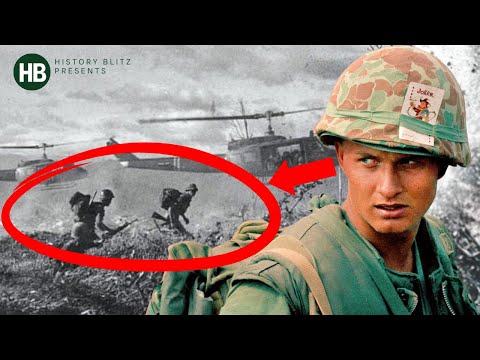
“You couldn’t see them,” one veteran recalled. “They were ghosts. By the time you heard a shot, your buddy was already down.” The Viet Cong, battle-hardened and intimately familiar with the terrain, used hit-and-run tactics that turned the jungle into a deadly maze. Every trail could be booby-trapped; every village could hide an ambush.
The US strategy, known as Search and Destroy, was simple in theory: locate the enemy, call in massive firepower, and withdraw. But in practice, it was a nightmare. “We were told to count bodies,” another soldier said. “But how do you count an enemy that vanishes into the shadows?” The body count became the metric of success, a grim numbers game that often included civilians and inflated figures.
As the months wore on, the toll mounted. American troops, trained for conventional warfare, found themselves fighting a shadow war in sweltering heat and torrential rain. The helicopters that were supposed to give them an edge often became targets themselves. “We’d fly in, guns blazing, only to find empty tunnels and angry villagers,” a platoon leader remembered. The Viet Cong’s network of tunnels stretched for miles, allowing them to appear and disappear at will.
Back home, the public grew restless. The Johnson administration, desperate to show progress, leaned on statistics. But the numbers lied. “If it’s dead and Vietnamese, it’s VC,” became a dark joke among the ranks. The reality was far more complex—and far more tragic.
By 1967, the Search and Destroy missions had inflicted heavy casualties on both sides, but the Viet Cong only grew stronger, replenished by a steady stream of reinforcements and supplies from the North. The US military, despite its technological might, was stuck in a quagmire.
And then came the turning point—a battle that would shock the world and expose the flaws in America’s strategy. But that’s a story for another time.
The battles of 1966 and 1967 were fought not just in the jungles but in the rice paddies and rubber plantations that stretched toward the Cambodian border. Operation Cedar Falls, launched in January 1967, was one of the largest Search and Destroy missions of the war. Nearly 30,000 American and South Vietnamese troops descended on the Iron Triangle, a Viet Cong stronghold just north of Saigon.
“We were told this was the heart of the insurgency,” a sergeant from the 1st Infantry Division recalled. “We found tunnels, weapons, rice caches—but the enemy was already gone.” The Viet Cong had learned to read the signs of an impending operation: the roar of helicopters, the rumble of tanks, the sudden silence of the local population. They vanished into the jungle or melted into villages, leaving behind only booby traps and the bitter resentment of civilians who had been uprooted from their homes.
The destruction of villages like Ben Suc, where thousands of residents were forcibly relocated, became a symbol of the strategy’s moral cost. “We burned their homes and called it progress,” another veteran said. “How were we supposed to win their hearts after that?”
Meanwhile, the body count continued to climb. In the first six months of 1967, US commanders reported nearly 50,000 enemy killed—a figure that, if accurate, would have wiped out the Viet Cong several times over. The discrepancy was obvious to anyone paying attention. “We counted the same bodies three times,” a military intelligence officer admitted. “It was a game, and everyone knew it.”
The Viet Cong, despite staggering losses, adapted. They avoided large engagements, relying instead on small-unit ambushes and sabotage. Their supply lines, the Ho Chi Minh Trail, remained a lifeline that American bombing could not sever. “We’d hit them, and they’d disappear,” a helicopter pilot said. “Then a month later, they’d be back with new weapons and new recruits.”
For the American soldiers, the psychological toll was immense. The jungle was an enemy that never slept. Patrols were stalked by the constant threat of sniper fire, punji stakes, and tripwires. “You started to see VC in every shadow,” one Marine recalled. “And then you started shooting at shadows.”
By the fall of 1967, the US military had won nearly every major battle it fought. Yet the war was no closer to being won. The Viet Cong, though weakened, remained a potent force. The South Vietnamese government, riddled with corruption, struggled to win popular support. And in Washington, the political ground was shifting.
Protests against the war were growing. The Pentagon, once confident in its metrics, began to question the body count. General William Westmoreland, the commander of US forces in Vietnam, insisted that the enemy was on the verge of collapse. “We’re winning,” he told Congress in November 1967. “The end is in sight.”
He was wrong. The Viet Cong and the North Vietnamese Army were preparing a massive offensive—one that would strike at the heart of South Vietnam’s cities and change the war forever. The Tet Offensive was coming.
The warning signs were there for anyone willing to read them. In the final weeks of 1967, US intelligence intercepted a surge of radio traffic along the Ho Chi Minh Trail—hundreds of trucks moving south under cover of darkness, their engines muffled against the roar of American bombers. “We knew something big was coming,” a signals analyst later said. “But the generals didn’t want to hear it. They were too invested in the numbers.”
Westmoreland’s confidence, broadcast to Congress and echoed through the Pentagon, had become a trap. To admit that the enemy was massing for a major strike would be to admit that the body count had been a lie. So the warnings were quietly filed away, and the Search and Destroy missions continued, grinding through the same villages and the same jungles, chasing an enemy that always seemed one step ahead.
The soldiers on the ground felt the shift before their commanders did. Patrols grew quieter, more cautious. “The jungle went dead,” one platoon sergeant remembered. “No birds, no insects—just this feeling that a thousand eyes were watching you.” The Viet Cong were pulling back from their usual hit-and-run raids, conserving their strength for something larger.
In the Central Highlands, near the remote Special Forces outpost at Dak To, the first signs of the coming storm broke through. In early November 1967, North Vietnamese regulars launched a ferocious assault on Hill 875, a strategic position overlooking the surrounding valleys. The fighting was savage—hand-to-hand at times, with American paratroopers pinned down for days under relentless mortar fire.
“We called in airstrikes on our own position,” a surviving paratrooper recalled. “That’s how close they were.” The hill was eventually taken, but at a cost of nearly 300 American lives. It was a victory in the traditional sense—ground gained, enemy killed—but it felt hollow. The North Vietnamese had simply withdrawn, their forces intact, their intentions still unclear.
Similar battles erupted across the country: at Loc Ninh, at Con Thien, at Khe Sanh, where US Marines found themselves besieged in a remote valley near the DMZ. The fighting was brutal and seemingly endless, a grinding war of attrition that neither side could win. “We were winning every battle,” a Marine officer said, “and losing the war.”
And then, in the last days of January 1968, the truth could no longer be hidden. The Tet Offensive was about to begin—a coordinated assault on more than 100 cities and towns across South Vietnam, including the US Embassy in Saigon itself. The war was about to come home to the American public in a way no body count ever could.
The Tet Offensive erupted in the early hours of January 31, 1968. “They hit everywhere at once,” a Marine at Khe Sanh recalled. “Saigon, Hue, Da Nang—it was like the whole country exploded.” Viet Cong fighters, many disguised as civilians, stormed the US Embassy, government buildings, and military bases. For weeks, the fighting raged street to street.
Militarily, the offensive was a disaster for the communists. Tens of thousands of Viet Cong were killed, and the guerrilla movement never fully recovered. But the psychological blow was devastating. “We thought we were winning,” a US intelligence officer admitted. “Tet proved we’d been lied to.” The images of burning cities and American casualties shattered public confidence.
Westmoreland requested 200,000 more troops. Instead, President Johnson went on television and announced he would not seek reelection. “The war was over for him that night,” an aide later said. “And for a lot of Americans too.” The Search and Destroy era was finished—not because it had failed on the battlefield, but because the country could no longer believe in it.
In the months that followed, US strategy shifted toward Vietnamization—training South Vietnamese forces to take over the fight. American troops began to withdraw, though the war would drag on for five more bloody years. “We won every battle,” one veteran said quietly, “and still lost the war.” The body counts, the burned villages, the tunnels—they had all been for nothing.
The jungle still holds those ghosts. The lessons of Search and Destroy—that technology cannot defeat an insurgency, that numbers can lie, that hearts and minds matter more than body counts—were learned at a terrible cost. “We were fighting the wrong war,” a platoon leader reflected decades later. “And we didn’t figure it out until it was too late.”
What do you think—was the Vietnam War ever winnable, or was the strategy doomed from the very first patrol?






